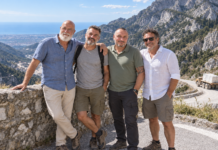

 We were four friends staying at the Sardinian house of one of us in Santa Maria Coghinas, a small town inland from the Gulf of Asinara. It was a practical base rather than the kind of place people display in holiday brochures. We had a kitchen, a table large enough for late dinners, and a friend who knew which roads actually led somewhere.
That last detail mattered. Sardinia can punish anyone who chooses a beach by photograph alone. A bay may look close on a map but require an hour on a rough road. A famous stretch of sand may be full before breakfast, while another one, only a few kilometres away, remains nearly empty because the entrance is poorly marked.
Our host understood this. Each morning he looked at the sky, considered the wind and then decided where we were going. We rarely knew the destination until we were already in the car.
Four Friends and One Local Expert
From Santa Maria Coghinas, we travelled in different directions along the north coast. We went toward Badesi and Li Junchi, where the beach seems to run without interruption beneath a broad sky. On another day we continued north toward Isola Rossa, with its red granite and small harbour. West of the house were Baia delle Mimose and the long coast around the mouth of the Coghinas. To the south, the road led us toward San Pietro a Mare, La Ciaccia and Castelsardo.
These were not expeditions. We carried towels, water, bread, pecorino, tomatoes and whatever fruit was in the house. Nobody wanted to organize a schedule. The only firm rule was that we did not leave rubbish behind.
Our host also had a useful habit: he ignored the first entrance to almost every beach. If a sign pointed clearly toward parking, he usually drove past it.
“That is where everyone goes,” he would say.
He preferred side roads, stretches of dirt and openings between the Mediterranean scrub that did not appear to promise anything. Sometimes this produced nothing more than a locked gate and a difficult three-point turn. More often, it brought us to a quieter section of the same coast.
The Beach Beyond the Track
The beach in this story was west of Santa Maria Coghinas, along the broad sweep of coast between Badesi and Valledoria. I cannot give precise directions, partly because I did not drive and partly because the entrance was little more than a sandy track beside a line of scrub. It was not a secret cove with theatrical cliffs. It was a long, open beach—pale sand, low dunes behind it and a sea that changed colour every few metres.
There were perhaps six other people in sight when we arrived. Two were walking far to the north. A couple had placed their umbrella several hundred metres away. Near the southern end, a man stood beside a small fishing boat pulled up close to the water.
We carried our things away from the entrance and chose a place where the dunes gave us some protection. The morning was warm but not oppressive. The sea was calm enough to make us careless about the wind.
For nearly two hours, very little happened. We swam, ate, argued about where to have dinner and watched the beach become even emptier. The two walkers disappeared. The couple folded their umbrella and left. By early afternoon, apart from the fisherman in the distance, the four of us appeared to have the entire coast to ourselves.
The Wind Changed First
The change did not arrive dramatically. The surface of the sea darkened in patches. Our towels began lifting at the corners. The air, which had been coming gently from behind the dunes, turned and came directly across the water.
Our host noticed it before the rest of us.
“We should begin packing,” he said.
He was not alarmed. It was the tone of someone who had made this mistake before and did not intend to repeat it.
While we gathered our things, we saw the fisherman pushing his boat toward the water. That seemed strange. The wind was strengthening, and the little boat looked too heavy for one person. Then we realized he was not trying to launch it. The stern was already in the water, and each wave was turning the hull sideways. He was trying to pull it farther up the beach before the sea took control of it.
The four of us walked over. No discussion was necessary.
A Boat, a Rope and Five Men
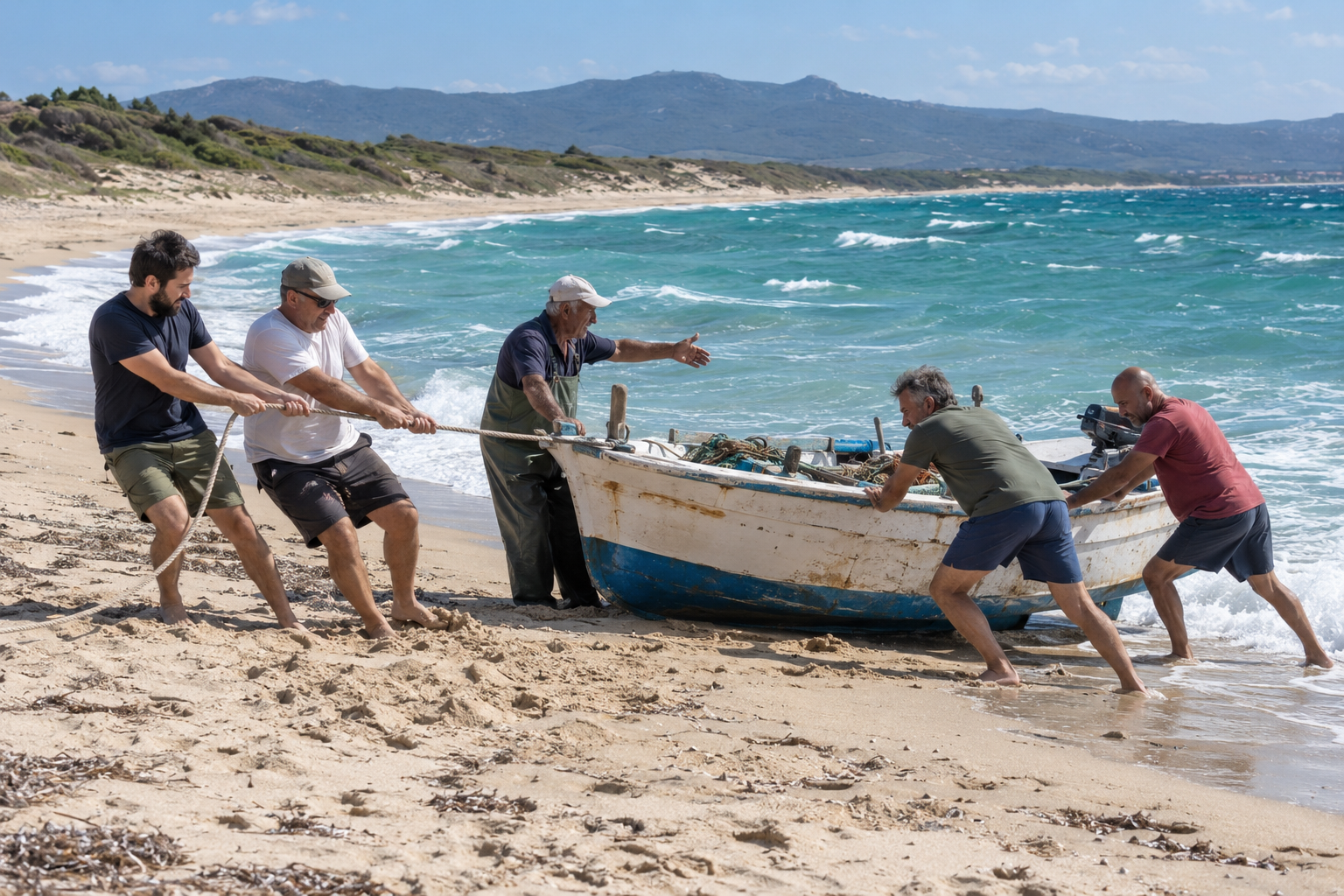
The boat was an old open fishing craft with an outboard motor and a collection of plastic crates inside. A rope ran from the bow to the fisherman’s hands. He had managed to keep the bow facing the beach, but the wet sand gave him no purchase. Every time he gained half a metre, the next wave took it back.
He did not ask for help in a theatrical way. He simply looked at us and said, “Prendete la corda.” Take the rope.
Two of us pulled while the others pushed from the sides. The first attempt failed because we were working at different moments. On the second, we waited for the water to recede and moved together. The boat came forward, stopped and then slid back just enough to make the effort feel pointless.
The fisherman told us to remove the crates. They held line, floats, a fuel container and a few tools. Once the boat was lighter, we tried again. This time we moved it beyond the band of dark, wet sand. We dragged it several more metres until the bow rested close to the dunes.
The entire operation lasted perhaps ten minutes. It felt longer because the wind filled every pause, and because none of us wanted to be the person who lost his grip and sent the boat backward.
When it was secure, the fisherman tied the rope around a heavy piece of driftwood buried deep in the sand. He checked the knot twice. Only then did he explain that the engine had refused to start when the wind turned. He had rowed close enough to jump into the shallows, but he could not manage the final distance alone.
Nothing Was Offered and Nothing Was Expected
He thanked us and asked where we were from. When we said we were staying in Santa Maria Coghinas, he nodded toward our friend.
“Then one of you knows better,” he said.
Our host accepted the criticism without protest.
The fisherman did not invite us home, produce a bottle of homemade wine or reveal some profound secret about Sardinian life. Real encounters rarely conclude so neatly. He gave us the name of a mechanic, although none of us needed one, and warned us that the wind would be worse within an hour. Then he started carrying his equipment toward an old car parked behind the dunes.
We returned to our towels and discovered that one of our empty food bags had travelled halfway down the beach. We collected it, checked the sand carefully for anything else and packed the car.
By the time we left, the water had lost its transparent calm. Short waves were breaking at an angle, and loose sand moved quickly across the surface of the beach. The place no longer looked private or peaceful. It looked exposed.
Why I Remember That Beach
During our stay, we saw more impressive places. Isola Rossa was more immediately picturesque. The coast near Castelsardo offered the stronger view. The long beaches around Badesi were easier to describe afterward because they had names, parking areas and recognizable entrances.
Yet this is the beach I remember most clearly.
It was not because we had it almost to ourselves. Empty beaches are pleasant, but emptiness alone is not an experience. What stayed with me was the speed with which the day changed. One moment, four friends were doing nothing under a Sardinian sky. A few minutes later, we were ankle-deep in water, pulling a stranger’s boat beyond the reach of the waves.
There was no emergency service, no audience and no photograph. None of us thought to take out a phone. We did what was needed, the fisherman secured his boat, and everyone went on with the afternoon.
Back at the house in Santa Maria Coghinas, we washed off the sand and opened the windows to let the wind through. Over dinner, the story was already being corrected by all four of us. One claimed he had done most of the pulling. Another insisted that removing the crates had been his idea. Our host said the important point was that he had warned us about the wind.
That argument lasted longer than the incident itself.
The Value of Staying with Someone Who Knows the Place
Staying in a friend’s house changed the way we saw northern Sardinia. We were not trying to complete a list of famous beaches. We could choose a direction in the morning, stop when the landscape looked interesting and return another day if the weather was wrong.
Santa Maria Coghinas made that possible. The town sits inland, near the river rather than directly on the sea, but the beaches of Badesi, Valledoria and the Castelsardo coast were all within reach. At the end of each day, we returned to a real house rather than another check-in desk.
The arrangement also reminded us that local knowledge is not mainly about finding places nobody else knows. It is about understanding conditions: which road becomes difficult after rain, where parking creates trouble, which beach is protected from a particular wind and when it is time to leave.
Our friend had taken us to a beach with almost nobody on it. More importantly, he recognized the moment when that beach was about to become a different place.
The Story We Took Home
If the fisherman had started his engine ten minutes earlier, nothing would have happened. If the wind had remained light, we would probably remember the day only vaguely. Instead, the trouble with a small boat gave the afternoon a precise shape.
That is often how travel works. The places advertised most aggressively are not always the ones that stay with us. Sometimes the lasting memory comes from an unnamed stretch of coast, a sudden change in weather and a simple instruction from a stranger:
“Take the rope.”
External Sources
SardegnaTurismo: Badesi and the beaches of northern Sardinia
https://www.sardegnaturismo.it/en/places/north-west/badesi
SardegnaTurismo: Isola Rossa
https://www.sardegnaturismo.it/en/explore/isola-rossa
SardegnaTurismo: Castelsardo
https://www.sardegnaturismo.it/en/explore/castelsardo