
 In August, the coast of northern Tuscany can feel exhausted by the heat before the day has properly begun. The shutters are lowered against the sun, parked cars become ovens, and even a short walk acquires the unnecessary seriousness of an expedition.
Campocecina offers a practical escape. From the plain around Carrara, the road climbs rapidly into the Apuan Alps, passing through chestnut woods toward a high terrace where the air is cooler and the coast lies open below. It is close enough for a day trip, but the change in altitude makes it feel much farther away.
My plan was uncomplicated: drive up in the morning, spend some time around Campocecina, have lunch at the Belvedere restaurant, then descend toward Colonnata to buy lardo.
The itinerary sounded almost too orderly to become a story.
What interrupted it was the marble industry itself. On a narrow quarry road, traffic stopped while a massive load was moved through the mountain. For several minutes, nobody could go forward and nobody could turn around. The delay was brief and completely routine for the people working there, but it changed the way I saw the landscape.
The white mountains were no longer scenery. They were a workplace, and we were in the way.
Leaving the August Heat Behind
I left the coastal plain in the morning, before the temperature reached its worst. The sea was still visible in flashes between buildings, and the sky had the pale, hard color that often announces another very hot day.
The road began to climb behind Carrara, through villages where stone houses stood close to bends that were designed long before modern traffic. Gradually, the density of the plain fell away. Apartment blocks gave way to woods, retaining walls and sharper turns. The air coming through the open window became less oppressive.
This part of Tuscany is often misunderstood by visitors who expect the region to proceed in a sequence of vineyards, cypress trees and Renaissance towns. Around Carrara, the geography is more abrupt. The Apuan Alps rise almost directly behind the coastal strip, creating a landscape in which beaches, industrial yards, mountain villages and exposed rock exist within a surprisingly small area.
From below, the pale quarry faces can resemble snowfields. Up close, the illusion disappears. The mountain has been cut into levels, ramps and enormous geometric surfaces. Roads cross slopes that would otherwise appear inaccessible. Machinery sits against walls of marble so large that even industrial vehicles look temporary.
I continued toward Campocecina through Castelpoggio and into thicker woodland. With each kilometer, the August heat became less insistent. By the time I reached the high ground, opening the car door no longer felt like stepping into a furnace.
That alone justified the trip.
Campocecina Above the Coast
Campocecina is not a town in the usual sense. It is an upland area of woods, open meadows, trails and viewpoints in the Apuan Alps above Carrara. At roughly 1,300 meters, it looks across the marble mountains in one direction and toward the coastal plain and Ligurian Sea in the other.
I walked without attempting a long hike. This was a day trip, not a test of endurance, and the appeal lay in being able to move slowly in air that was noticeably cooler than the coast.
The trees provided shade, but the main relief came from altitude. A breeze passed across the exposed areas, carrying none of the accumulated heat of the plain. Families had spread blankets on the grass. A few walkers disappeared toward the trails. Other visitors did what I was doing: stopped at the open viewpoints and tried to reconcile the mountain foreground with the sea beyond it.
From this height, the coastal settlements appeared almost continuous. Carrara, Marina di Carrara and the towns farther south dissolved into a broad band between the mountains and the water. Roads, railway lines, buildings and beaches lost their individual importance.
The quarries had the opposite effect. Distance made their scale more visible. White cuts appeared across the mountainsides, some exposed to the sky and others entering directly into the rock. They did not look natural, but neither did they look easily removable. Centuries of extraction had become part of the geography.
Near Campocecina, the mountain carries another kind of human intervention at the Cava dei Poeti, where lines by writers and public figures have been carved into the stone. The idea is unusual but appropriate. In Carrara, marble is rarely left as geology alone. It is cut, transported, carved, polished, sold, debated and turned into memory.
By lunchtime, the simple pleasure of cooler air had produced a serious appetite.
Lunch at the Belvedere
The Belvedere restaurant has the advantage of a name that does not exaggerate. From the area around it, the land falls away toward the coast, and on a clear day the sea becomes part of the view rather than a distant blue suggestion.
I took a table and allowed lunch to occupy the middle of the day. There was no reason to hurry back into the heat.
Mountain restaurants in this part of Tuscany are not built around the idea of a light interruption. The food belongs to woods, pastures and people who once worked physically demanding days. Pasta, mushrooms, grilled meat, local cheeses and robust sauces make more sense here than the careful little plates associated with fashionable versions of Tuscany.
I ate while looking down toward the coast I had left that morning. From the table, August appeared manageable. The haze over the plain suggested the temperature below, but at Campocecina the room remained comfortable and the air outside continued to move.
Lunch also provided the necessary pause between two very different parts of the day. Campocecina was about height, distance and open views. Colonnata would be narrower, enclosed by steep slopes and closely tied to the daily business of marble.
I paid, returned to the car and began the descent.
The Road Enters the Quarries
Mountain roads around Carrara demand attention even before quarry traffic appears. They are narrow, uneven in places and full of bends that conceal whatever is coming from the opposite direction. Local drivers understand where two vehicles can pass and where one must wait. Visitors often learn this one bend too late.
As I approached the quarry area, the road surface changed. White dust collected along the edges and coated walls, signs and vegetation. The tires passed over small fragments of stone. Industrial roads branched away toward working areas where ordinary cars clearly did not belong.
Then the traffic ahead stopped.
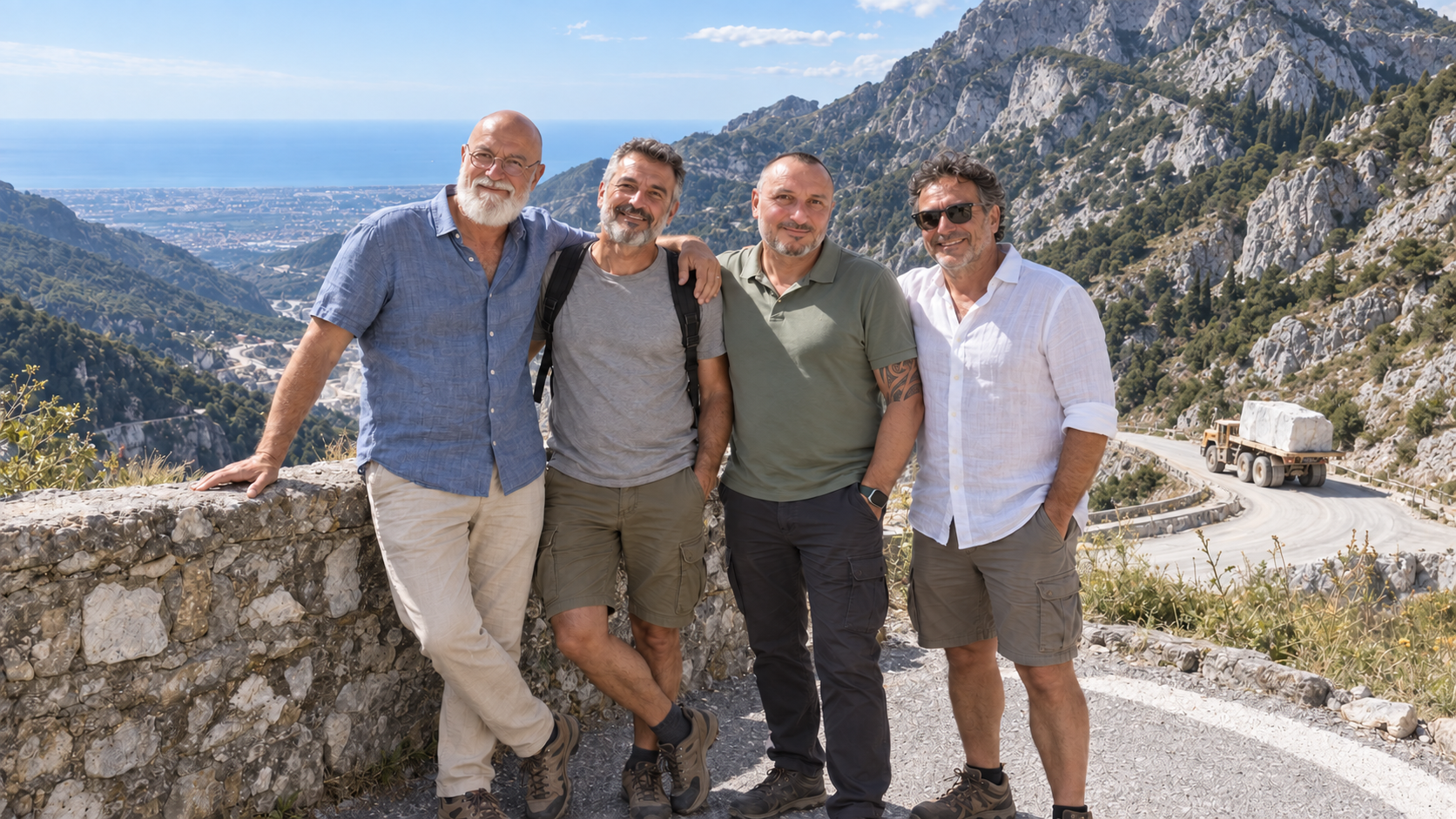
There were only a few vehicles, but the reason was immediately obvious. Farther along the road, workers were managing the movement of a heavy marble load. A quarry truck occupied nearly the full width of the route. Its scale was difficult to judge until a man standing near one of its wheels provided the comparison.
A worker walked toward us and signaled that we would have to wait. Then he looked at the position of the cars and asked the first drivers to reverse toward a wider section of the road.
This was not a suggestion.
One car backed up, then another. Each driver watched mirrors, stone walls and the vehicle behind. There was no room for irritation because there was no alternative. The road belonged, at least for those minutes, to the block coming through.
When my turn came, I reversed slowly into a rough lay-by. The worker raised one hand, moved it slightly to the left, then closed his fist. Stop.
The truck advanced.
When the Mountain Passed Beside Me
The block of marble looked less like cargo than a detached section of the mountain. It sat low on the transporter, rectangular and unfinished, its surface marked by extraction rather than polish. There was nothing elegant about it yet. No sculpture, kitchen counter, hotel lobby or cathedral floor could be seen in its raw mass.
The vehicle moved at walking speed. Its engine filled the narrow space, and white dust lifted beneath the tires. The driver concentrated on the worker ahead, who guided the load around the bend with short, economical gestures.
As it passed my car, the available distance appeared absurdly small. I could see the layered marks on the marble and the heavy securing equipment holding it in place. The block had been separated from the mountain, but moving it only a few kilometers still required machinery, judgment and the temporary control of the road.
Nobody treated the event as remarkable. The workers were performing an ordinary operation. The local drivers waited with the resignation of people familiar with quarry traffic. Only visitors watched as though the mountain itself were being transported.
The interruption lasted perhaps fifteen minutes. Memory has made it longer because every part of it demanded attention.
Once the transporter cleared the bend, the worker lowered his arm and the cars began moving again. There was no announcement and no dramatic conclusion. The road reopened because the work had passed.
I drove on more cautiously.
The experience corrected the visual temptation of the quarries. From a viewpoint, their enormous white walls can appear almost abstract—beautiful surfaces cut into the Alps. On the road, abstraction ends. Marble extraction involves noise, dust, risk, technical skill and vehicles carrying weights that dictate the movement of everyone around them.
The quarries are impressive, but they are not an outdoor museum. They are active industrial sites with a long history of difficult labor and fatal accidents. The beauty of the material has never made the work gentle.
Colonnata at the End of the Road
Colonnata appeared against the mountainside as a compact settlement of stone buildings, narrow passages and small shops. The village is only a short distance from Carrara, but its position among the quarry basins gives it a separate identity.
Marble is everywhere, including underfoot. Yet Colonnata is equally famous for something much softer: lardo.
Lardo di Colonnata IGP is pork back fat seasoned with salt, herbs and spices, then matured in marble basins known as conche. The connection between quarrying and food is not decorative marketing added for visitors. Lardo belonged to the working life of the village. It was inexpensive, calorie-rich food for quarrymen performing severe physical labor.
Today it is sliced very thinly and treated as a specialty, but it still makes most sense on warm bread, when the fat begins to soften and the rosemary, garlic and pepper become more evident.
I walked through the center and stopped at one of the local larderie. Buying lardo in Colonnata is not difficult; choosing among the producers is the more serious question. Packages, jars and vacuum-sealed pieces occupied the counter, along with other cured meats and local products.
I bought enough to take home, with the usual confidence that it would last longer than it eventually did.
Outside, the village remained quiet compared with the industrial roads around it. The quarry faces rose beyond the roofs. A product matured in marble had become the village’s most recognizable food, while the stone surrounding it continued to leave the mountain in enormous blocks.
The two economies were not separate. They had developed from the same terrain and the same working culture.
What Changed During the Day
The trip had begun as an August escape: go higher, find cooler air, eat lunch with a view and return with something good from Colonnata.
All of that happened exactly as planned.
Campocecina provided relief from the heat. The Belvedere provided lunch and a view stretching from the mountains to the coast. Colonnata provided lardo and a reason to walk through a village whose history cannot be separated from marble.
The delay on the quarry road was the only unscheduled part. It did not become an adventure, and it would be dishonest to turn it into one. Nobody was in danger. Nothing failed. The workers knew precisely what they were doing.
Its importance came from scale.
From the coast, the quarries are white marks on distant mountains. From Campocecina, they are immense cuts in a panoramic landscape. But from a car pulled tightly into a lay-by, with a raw block of marble passing a few meters away, they become physical and immediate.
The material is heavy. The roads are narrow. The work controls the mountain.
Later that afternoon, I returned to the August heat near the sea. The temperature had not improved. The shutters were still closed, the pavement still radiated warmth, and the package of lardo had to be moved quickly into the refrigerator.
Yet the distance between the coast and Campocecina no longer seemed small. In a single day, I had moved from sea level to cool mountain air, looked down across the Riviera Apuana, eaten above the woods, waited while part of a mountain traveled past me, and ended in a village where pork fat matures inside marble.
This is what makes the Carrara area difficult to summarize. Industry, landscape, food and ordinary local life are pressed together too closely to be separated into convenient themes.
The mountain did not reveal a secret. It simply made me wait long enough to see what was already happening.
A Practical Note for Campocecina and Colonnata
Campocecina can be reached by car from Carrara, with the final approach following a winding mountain road through wooded terrain. Even in summer, weather and visibility can change quickly at altitude. Bring a light layer, water and shoes suitable for uneven ground, even if you are planning only a short walk.
The area around the Belvedere and nearby trails offers broad views over the Apuan Alps and the coast. Opening days and restaurant hours can vary, so confirm them before making the drive specifically for lunch.
Colonnata lies in a different quarry basin and should not be treated as a quick continuation along an easy panoramic road. Allow time for narrow roads, industrial traffic and possible delays. Active quarry roads and work areas are not places for unsupervised exploration. For a close visit to the quarries, use an authorized guided tour rather than entering restricted areas in a normal car.
In Colonnata, look for Lardo di Colonnata IGP and ask the producer how it should be stored and served. Thin slices on warm, unsalted bread are enough; the lardo does not need an elaborate recipe.
For more ideas in the region, visit Italia Mia’s Travel section. Official visitor information is available from Visit Tuscany’s guide to Colonnata and the Riviera Apuana guide to Campocecina.
External Sources
- Visit Tuscany: Colonnata
- Italia.it: Colonnata and the Carrara Marble Quarries
- Visit Carrara: The Marble Quarries
- Visit Riviera Apuana: Campocecina
- Carrara Marble Tour: The Marble Quarries