
 I spent three nights in Bologna in autumn, staying at a B&B within walking distance of the historic center. I had visited the city before, but only briefly, usually while passing through or with enough time for a meal and a hurried walk around Piazza Maggiore. This time, I wanted to remain long enough for Bologna to become more than its usual list of associations: tortellini, towers, university students and red brick.
Three nights are still not much, but they change the nature of a visit. There is an arrival evening, a full day without luggage, another morning in which the streets begin to look familiar, and a final breakfast when you already know which direction to take after leaving the door.
The B&B was comfortable rather than memorable, which suited me. I did not need the accommodation to tell a story. I needed a quiet room, a decent breakfast and a base from which I could walk without consulting a map every ten minutes.
Bologna supplied the rest.
The event I remember most was not scheduled. There was no ticket, stage or announced program. A group of musicians began playing beneath the porticoes on an ordinary evening, and the architecture did what it had been doing for centuries: it gathered strangers into a shared public space.
For less than an hour, the city stopped functioning as a route between dinner, home and the next appointment. It became a concert hall.
Three Autumn Nights in the Center
I arrived in the afternoon, when the autumn light was already beginning to withdraw from the narrow streets. Bologna’s colors seem particularly suited to that season. The ochre walls, terracotta roofs and faded red façades do not depend on bright sunshine. Under a grey sky, they become deeper rather than duller.
After leaving my bag at the B&B, I walked toward the center without a plan. The porticoes immediately altered the rhythm of the city. They did not feel like decorative arcades added to important buildings. They were the streets: continuous, irregular and inhabited.
Some were broad enough for shops, café tables and groups of people to coexist without difficulty. Others narrowed suddenly, forcing everyone into brief negotiations. Bicycles appeared from behind columns. Students stood in circles that occupied more space than they realized. Residents carried shopping bags through visitors who had stopped to photograph a ceiling.
I reached Via Rizzoli and the Two Towers, then continued to Piazza Maggiore. The square was active but not theatrical. People crossed it on their way elsewhere. Others sat on the raised stone platform in front of the Basilica of San Petronio. Children moved through the open space while adults watched from a distance that suggested experience rather than anxiety.
Nearby, the Quadrilatero was more compressed and commercial. The old market streets were crowded with food shops, displays of cheese and cured meats, fruit, pasta, bottles and menus written for people who had arrived intending to eat. Bologna has every reason to be proud of its food, but the concentration can become almost too efficient. Within a few streets, appetite is organized, displayed and sold from every direction.
I ate well that evening, although not extravagantly. Bologna does not require an elaborate restaurant in order to make dinner convincing. A plate of tagliatelle al ragù, a glass of Sangiovese and a room full of people speaking at normal volume were enough.
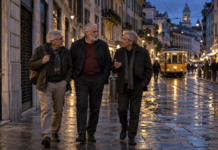
When I returned to the B&B, rain had begun. I walked most of the way under cover.
That was when I understood that the porticoes were not simply Bologna’s visual signature. They changed what residents could do. A wet evening did not empty the streets; it rearranged them.
Bologna in Daylight
The following morning, I returned to Piazza Maggiore before the center became crowded. I walked through the courtyard of the Archiginnasio and looked into the Teatro Anatomico, where carved wooden figures and an ornate ceiling surround the marble table once used for anatomy lessons. The room is beautiful, but not comfortably so. Its decoration cannot erase its purpose.
From there I continued beneath the Pavaglione portico and eventually toward Piazza Santo Stefano. The open space is not a conventional square. It widens gradually from the street, framed by old buildings, until the Basilica of Santo Stefano closes the view.
Inside the complex, the city became quiet. Churches, courtyards and passages followed one another without the clarity of a single grand interior. The place seemed assembled over time rather than conceived in one gesture, which is largely what gives it authority.
Back outside, Bologna resumed immediately: delivery vehicles, bicycles, people looking at menus and residents who had no reason to admire what they passed every day.
I spent much of the afternoon walking. This sounds unambitious until one considers what walking in Bologna includes. A route changes character from one block to the next. There are palaces whose importance is easy to miss, worn columns with graffiti at eye level, dark entrances opening into bright courtyards, bookshops, university departments, expensive boutiques and ordinary household stores.
The city rewards attention more than distance.
Near the university district, the population became younger and the walls more heavily marked. Via Zamboni led toward Piazza Verdi, where the grand institutional presence of the Teatro Comunale met the restless public life of students, bicycles, bars and people sitting wherever sitting was possible.
It was not the polished Bologna of food magazines. It was louder, less orderly and more current.
I continued walking and returned to the center by another route. By evening, I had no desire to study a guidebook. I rested at the B&B, changed clothes and went out to find dinner.
A City Designed for Sound
The air had become cooler, and there was moisture in it without actual rain. Under the porticoes, voices carried farther than expected. Footsteps, bicycle bells, the scrape of chairs and fragments of conversation overlapped, but the columns divided the sound into sections. The city never became silent; it became acoustic.
After dinner, I walked with no destination. I passed Piazza Maggiore, where small groups remained on the steps and along the edges of the square, then continued toward the Two Towers. From there, Via Zamboni drew me back into the university quarter.
I heard the music before I saw the musicians.
At first it was only a double bass line repeating beneath the ordinary noise of the street. Then a clarinet entered with a phrase that was too controlled to be accidental. The sound came from farther along the portico, disappearing whenever a bus or a large group passed and returning more clearly as I approached.
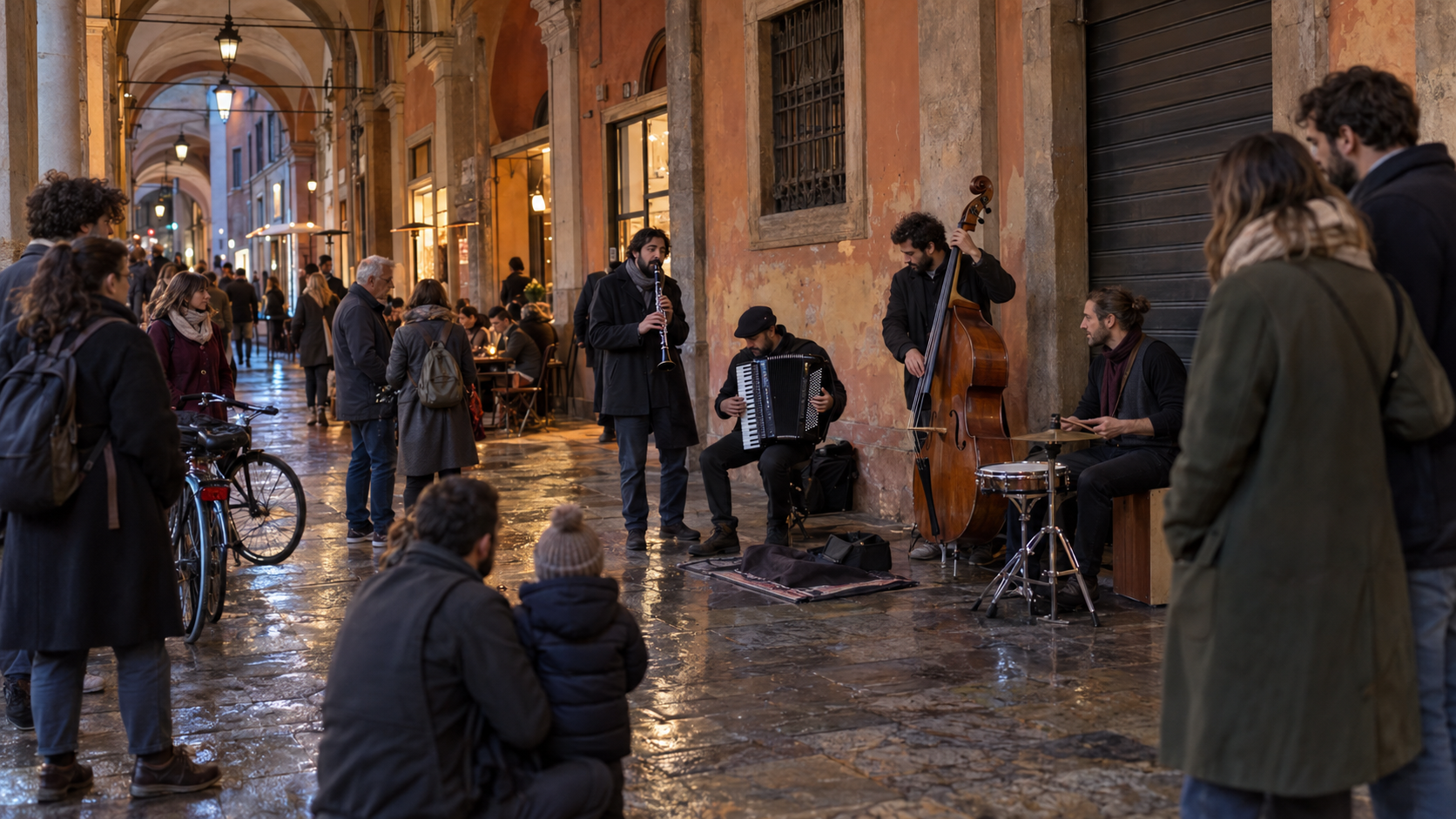
There were four musicians: clarinet, accordion, double bass and a small percussion setup reduced to what could be carried and assembled on the pavement. They had placed themselves in a wider section of the portico where a shop had closed for the evening. The metal shutter behind them served as an imperfect backdrop. An open instrument case lay on the ground.
Nothing suggested an official performance. There was no sign, amplification or introduction. The musicians were dressed for the weather, not for a stage. One still wore a scarf. Another had placed his coat over a folding stool.
They were already in the middle of a piece when I arrived.
The Audience Assembles
At first, the audience consisted mostly of people who had slowed down. That distinction mattered. No one had decided to attend a concert. Pedestrians simply took longer than necessary to pass.
A couple stood near one of the columns. Three students stopped with bicycles and remained astride them. A delivery rider removed his helmet but did not leave his bicycle. Two women carrying shopping bags placed them at their feet. A man with a dog moved to the edge of the group after the dog showed more interest in the open instrument case than in the music.
I stood against the wall, leaving the central passage open.
The musicians finished the piece without ceremony. There was applause, slightly delayed because nobody was sure whether the music had truly ended. The clarinet player nodded, counted quietly, and the group began again.
The second piece had the movement of a folk dance without sounding like a demonstration of folklore. The accordion established the rhythm, the bass kept it grounded, and the clarinet moved above them with more freedom than before. The percussionist worked with brushes, a small drum and a cymbal that he struck sparingly.
People continued to pass through the audience. This would have been disruptive in a theater. Under the portico, it became part of the event. Someone crossed between the musicians and the listeners carrying two pizzas. A bicycle bell sounded at exactly the wrong moment. A child began dancing, stopped when he realized people were watching, then started again facing the musicians instead of the crowd.
The portico made room for all of it.
More listeners arrived from both directions. They formed a shallow semicircle that never completely blocked the walkway. Those in a hurry passed behind us. Those who were uncertain stood at the edges. A few people filmed short sections on their phones, but most put the phones away after recording enough to prove that they had been there.
I noticed how quickly strangers established rules without discussing them. Nobody stood directly in front of a seated listener. Parents kept children from touching the instruments. Coins and notes entered the case between pieces rather than during them. Conversations became quieter near the musicians and returned to normal volume ten meters away.
It was not perfect behavior, but it was collective behavior.
The Porticoes Take Over
The architecture changed the music. Notes traveled down the covered walkway, reflected from stone, brick, plaster and metal shutters, then returned with a short echo. The musicians did not need to play loudly. The portico gathered the sound and sent it toward people who could not yet see its source.
That was how the audience kept growing.
An elderly man stopped beside me and listened for several minutes. He did not speak until the group finished a faster number.
“Better than the traffic,” he said.
It was not an invitation to conversation, and I did not turn it into one. I agreed. He remained for the next piece and then left.
The musicians moved between styles without explanation. There was something recognizably connected to jazz, another piece with Eastern European phrasing, and a slower melody that reduced the portico to a listening room. Whether the compositions were original or borrowed did not matter to me. The point was not recognition.
During the slower piece, the usual hierarchy of the street reversed. The people who had stopped were no longer obstacles to those moving through; they were the reason the place had become interesting. Restaurant workers came to their doorways. Someone leaned from an upper window. The owner of the closed shop was absent, but his shutter had acquired a temporary function as the back wall of a stage.
The musicians were not transforming Bologna into something it was not. They were using what the city already offered.
This was the decisive quality of the evening. In another place, street music can feel placed in front of architecture. In Bologna, the music entered the structure of the porticoes. Columns framed the performers. The ceiling contained the sound. The long covered passage brought in listeners. Shops, residences, university buildings and the street itself supplied the audience.
For a while, it seemed absurd that anyone would build a concert hall differently.
No Grand Finale
The performance ended as informally as it had begun.
The musicians played one final piece, brisk and concise. The audience understood the ending this time and applauded immediately. The clarinet player thanked everyone. The accordionist closed his instrument before the applause had completely stopped. The percussionist began dismantling the cymbal stand.
There was no encore. People approached the open case, added money and moved away. A few spoke to the musicians. Most resumed the interrupted evening.
Within five minutes, the audience had dissolved.
The delivery rider put on his helmet. The students pushed their bicycles toward Piazza Verdi. The child who had danced was carried away by a parent. The old man beside me had already disappeared.
The portico returned to its ordinary uses.
I remained long enough to watch the double bass player secure his instrument in its case. Then I walked back toward Piazza Maggiore. The streets seemed quieter, although they probably were not. My attention had adjusted to a different scale of sound.
In the square, San Petronio stood half-lit above the remaining pedestrians. I crossed without stopping and continued through the streets toward the B&B. Nothing else happened that night, and nothing needed to.
The Third Day
The next morning, Bologna looked entirely practical again. Cafés served breakfast, delivery vans occupied impossible spaces and students moved toward lectures. The porticoes held cigarette smoke, hurried conversations and the smell of coffee.
I returned to some of the same streets in daylight. The place where the musicians had played was unremarkable. The shop shutter was open. Merchandise filled the window. Pedestrians moved through without slowing.
I was pleased by the lack of evidence.
Travel increasingly encourages us to treat every experience as a permanent installation: something marked on a map, reviewed, photographed and available again at a scheduled hour. The previous night had left no such guarantee. The musicians might return regularly or never play in that exact place again. I did not ask.
Instead, I spent the rest of the day looking at Bologna with the knowledge that its public spaces were capable of changing function very quickly. Piazza Santo Stefano could be an architectural composition in the morning and a meeting place by evening. Piazza Maggiore could be a civic monument, a shortcut or an outdoor room. A portico could be a pavement, shelter, market frontage, bicycle route, conversation space or concert hall.
The city did not need to close one function before beginning another.
I ate lunch near the Mercato delle Erbe, where the atmosphere was less ceremonial than in some of the better-known streets around the Quadrilatero. Later I walked without attempting to add another major sight. Three nights had given me enough time to stop converting every hour into a task.
That evening was quieter. I had dinner, took one last walk and returned early to the B&B. The earlier performance remained the natural conclusion of the visit, even though I still had another night in the city.
What I Remember About Bologna
Bologna offers more important monuments than a temporary group of street musicians. It has one of Europe’s oldest universities, medieval towers, major churches, historic markets, museums and a food culture that deserves attention beyond the simplified idea that every meal must be enormous.
Yet monuments do not always determine what survives in memory.
I remember the autumn color of the buildings and the cooler air after dark. I remember the change from the composed center around Piazza Maggiore to the untidier energy of Via Zamboni and Piazza Verdi. I remember eating well without needing to turn every dish into a performance of authenticity.
Most clearly, I remember hearing the double bass before I could see who was playing.
The music did not reveal a secret Bologna. It revealed a public one: a city whose most characteristic architecture belongs partly to everyone moving beneath it. The porticoes protected people from rain and traffic, but they also held them together long enough for an audience to form.
Nobody had been invited. Nobody had reserved a seat. People arrived from work, dinner, university or an evening walk and remained because the sound gave them a reason not to continue immediately.
Then the music stopped, and the city carried on.
That was not a disappointment. It was what made the evening credible.
For less than an hour, Bologna became a concert hall. By the time I returned the next morning, it had become a street again.
A Practical Note for Three Nights in Bologna
Bologna is well suited to a three-night visit because the historic center is compact and much of it can be explored on foot. A central B&B makes it possible to return during the afternoon, rest, and go out again after dark without organizing transport.
The porticoes are not a single attraction but a citywide system of covered public walkways. Twelve representative sections were added to the UNESCO World Heritage List in 2021, while the wider network extends for approximately 62 kilometers. The UNESCO World Heritage Centre explains their architectural and social importance, and Bologna Welcome provides visitor information about the recognized sections.
For a short stay, Piazza Maggiore, the Archiginnasio, the Quadrilatero, Piazza Santo Stefano and the university district around Via Zamboni can all be connected through walks rather than treated as separate excursions. Bologna Welcome’s suggested 48-hour itinerary is a useful starting point, although the city benefits from leaving at least one evening unplanned.
Street performances are temporary by nature. Do not build an itinerary around finding one. Walk after dinner, follow the sound if there is any, and be willing to stop.
External Sources
- UNESCO World Heritage Centre: The Porticoes of Bologna
- Bologna Welcome: UNESCO Porticoes
- Bologna Welcome: Piazza Verdi
- Bologna Welcome: Piazza Santo Stefano
- Bologna Welcome: Visiting Bologna in 48 Hours