
 There were three of us on the flight from Pisa to Catania, traveling with the confidence of men who had rented a car and therefore believed they understood the size of Sicily.
We had five days. On paper, that seemed sufficient. We would collect the car at Catania Airport, drive south to Syracuse, continue through Noto and Marzamemi, cross toward Modica and Ragusa, reach Agrigento, and return to Catania without wasting time.
The plan was efficient, which should have warned us that it had little to do with Sicily.
We landed in the morning, collected a compact rental car and spent longer than expected learning its controls in the airport parking lot. One friend took responsibility for navigation. The other immediately objected to the route selected by the navigation system. I drove while they debated whether a road could be trusted simply because it appeared as a solid line on a screen.
By the end of the first day, we had walked through Ortigia, seen Piazza Duomo after the day-trippers began to leave, and eaten dinner near the market. The following morning, we drove to Noto and then continued toward Marzamemi. We were moving quickly and seeing a great deal. We were also beginning to experience the particular exhaustion that comes from treating towns as appointments.
On the third morning, we left Marzamemi intending to reach Scicli before lunch and Ragusa by late afternoon. We had not gone far when a yellow warning light appeared on the dashboard.
None of us knew what it meant.
A Warning Light Outside Pachino
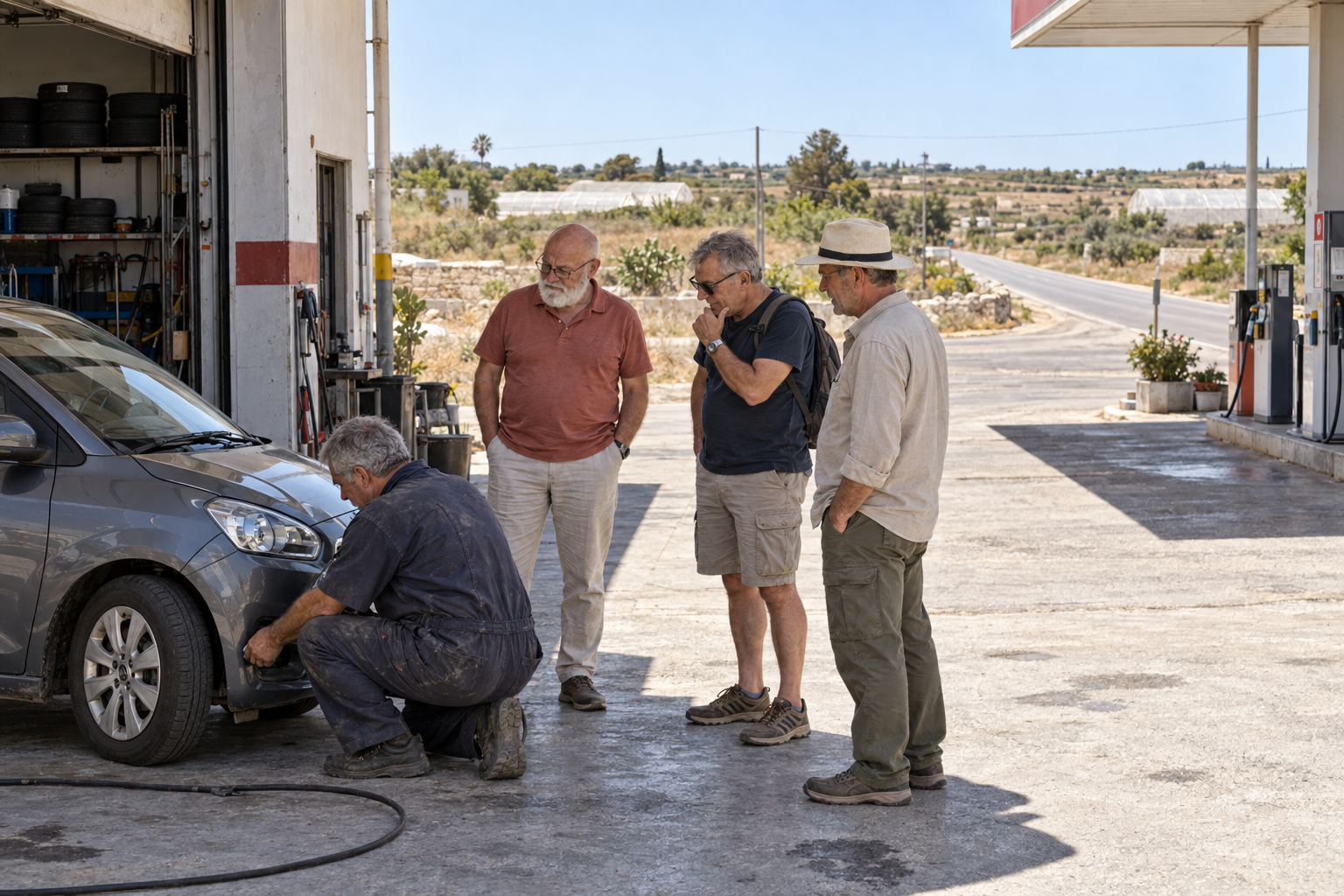
We pulled into a petrol station on the outskirts of Pachino. It had two pumps, a small office and a workshop attached to one side. A faded drinks refrigerator stood near the entrance. There was no picturesque view, no baroque façade and nothing that would have caused us to stop under normal circumstances.
A man in dark work trousers came out of the workshop wiping his hands on a cloth. He was in his late fifties, perhaps early sixties, with short gray hair and the expression of someone accustomed to travelers arriving with problems they could not describe.
I pointed to the dashboard.
“Rental car?” he asked.
It was not difficult to guess.
His name was Davide. He leaned into the car, checked the display and told us that one tire had lost pressure. He examined it, found a small screw and said it could be repaired. The process would take twenty minutes.
One of my friends asked whether there was a café nearby.
Davide looked toward the refrigerator.
“Coffee, yes,” he said. “A café, no.”
He disappeared into the office and returned with four small plastic cups. The coffee came from a machine behind the counter. It was strong, hot and better than it had any reason to be.
We stood outside the workshop while he removed the tire.
Our Route Was the First Problem
Davide asked where we were going. We gave him the complete schedule with the satisfaction of people presenting a well-organized project.
He listened without interruption.
“Today?” he asked when we finished.
We explained that Scicli and Ragusa were today. Agrigento was tomorrow. Catania came after that.
He shook his head, not dramatically, but with professional disappointment.
“You have already paid for the car,” he said. “You do not have to prove that it works.”
The remark irritated me because it was accurate.
He asked what we had actually enjoyed so far. We mentioned Ortigia at night, the streets behind Noto’s cathedral and the fishing boats in Marzamemi before the restaurants became busy. None of us mentioned the monuments we had photographed.
Davide placed the repaired tire back on the car and told us to forget Ragusa for the afternoon. We should follow the coastal road toward Portopalo, stop near Isola delle Correnti and then drive west through Sampieri. Scicli could wait until evening.
Our navigator opened his phone and began searching.
Davide took the phone from his hand, enlarged the map and traced the road with one finger.
“Do not ask the telephone where to stop,” he said. “It has never been there.”
The Address Written on a Receipt
Before we left, Davide asked what we planned to do for lunch. We had not discussed it, which meant we would probably have chosen the first restaurant with convenient parking.
He went inside the office, found an old receipt and wrote a name and a telephone number on the back. The place, he explained, was outside Pachino, along a road bordered by greenhouses and fields. It served lunch to local workers and a few people who knew about it. There was no menu posted outside and no view worth photographing.
“Tell them Davide sent you,” he said.
That sentence can be valuable in Sicily, but it can also produce confusion. We asked whether we needed to telephone first.
Davide had already made the call.
The repair cost less than expected. When I tried to add something for the coffee, he refused. He was not offended; he simply considered the coffee part of waiting for a tire.
We followed his directions and missed the turning twice.
The restaurant occupied a low building behind a row of oleanders. Several white vans and small trucks were parked outside. Inside, the television was showing the news with the sound turned down. There were no decorative fishing nets, ceramic lemons or photographs of famous Sicilian actors. The tables were covered with paper.
A woman near the kitchen asked whether we were the three sent by Davide.
For the first time on the trip, we were expected somewhere.
Lunch was not elaborate. We ate pasta with tomato sauce made from Pachino tomatoes, grilled vegetables, local cheese, bread and slices of watermelon. A plate of fried fish appeared even though we had not ordered it. The workers at the next table discussed fuel prices, irrigation and a football match. Nobody lowered a voice because visitors were present.
This was not a secret Sicily carefully hidden from tourists. It was simply a part of the island that had no reason to advertise itself to us.
The Coast We Nearly Missed
After lunch, we abandoned the schedule.
We drove south toward Portopalo di Capo Passero, then continued to the point where the Ionian and Mediterranean seas meet near Isola delle Correnti. The wind was strong enough to make conversation difficult. The landscape was flatter and more exposed than the Sicily of travel posters. Greenhouses stretched inland, fishing boats rested near the shore and the road passed fields that looked worked rather than arranged.
We stayed longer than planned because there was no longer a plan to violate.
Later, we followed the coast toward Sampieri. The road was slower than the inland route, but the distance stopped feeling like an obstacle. We passed small houses, agricultural land, roadside shrines and beaches that appeared briefly between walls and vegetation. Near Sampieri, we walked along the beach with the old industrial structure of Fornace Penna visible in the distance.
We reached Scicli in the early evening.
The baroque center was still active, but the day’s heat had begun to release its grip. People sat outside along Via Francesco Mormino Penna. Children moved between tables while adults continued conversations that had probably begun long before we arrived. We walked without checking how much time remained before the next destination.
Ragusa disappeared from that day’s itinerary. Nothing happened as a result.
What the Stranger Changed
Davide did not tell us his life story. He did not invite us home or offer a speech about Sicily. We knew that he repaired cars, that he had lived near Pachino for most of his life and that he distrusted navigation systems. He mentioned a daughter in Bologna and complained that she called only when a warning light appeared on her dashboard.
Our conversation lasted perhaps forty minutes.
Yet he changed the character of the trip because he interrupted the way we were using the island. Until that morning, Sicily had been a sequence of places we intended to complete. We photographed a church, found the recommended street, ordered the local dish and moved on before the experience could become inconvenient.
Davide showed us a different structure. A mechanic called a restaurant. A woman in the restaurant knew precisely who had sent us. Roads mattered not only because of where they ended but because of the fields, workshops, beaches and ordinary businesses along them. Places were connected by people as much as by maps.
The encounter also revealed something less flattering about us. We had arrived with only five days and behaved as though Sicily were responsible for fitting inside them. The island was not too large for our trip. Our trip was too crowded for the island.
That evening in Scicli, the three of us had dinner later than planned. We did not discuss the following morning until the plates had been cleared. When we finally opened the map, we removed two stops.
The decision felt less like a sacrifice than a correction.
The Smallest Part of the Journey
We eventually reached Ragusa, Agrigento and Catania. We saw the places we had traveled to see, although fewer of them than expected. I remember the cathedral in Noto, the evening light on the stone in Ragusa Ibla and the scale of the temples outside Agrigento.
But I also remember a petrol station outside Pachino.
It was not the most beautiful location of the trip. I took no photographs there. Davide never posed beside the car, and we did not exchange telephone numbers. When we drove away, he returned to the workshop and we continued along the coast.
That is often how a stranger changes a day. Not by becoming part of your life, but by altering the next few hours so completely that you see the rest of the journey differently.
We had landed in Catania with a rental car, three opinions and a schedule designed to defeat distance.
A screw in a tire and a man with a coffee machine corrected us.