
 There were four of us in the car, all men, all old enough to know that a road trip becomes less democratic with every passing hour. One wanted the windows open. Another objected to the music. The third had appointed himself navigator, although he was usually the last to admit that we had missed a turn. I was driving.
We had left Bari that morning without much of a plan beyond heading south. After the traffic thinned, the road began to run between olive groves, low stone walls and fields dried pale by the sun. We passed Conversano, then continued toward the Valle d’Itria, arguing about whether to stop in Polignano a Mare or leave the coast for another day.
By late afternoon, the four of us had reached the same conclusion independently: we needed coffee, food and an hour without the car.
We turned into Cisternino.
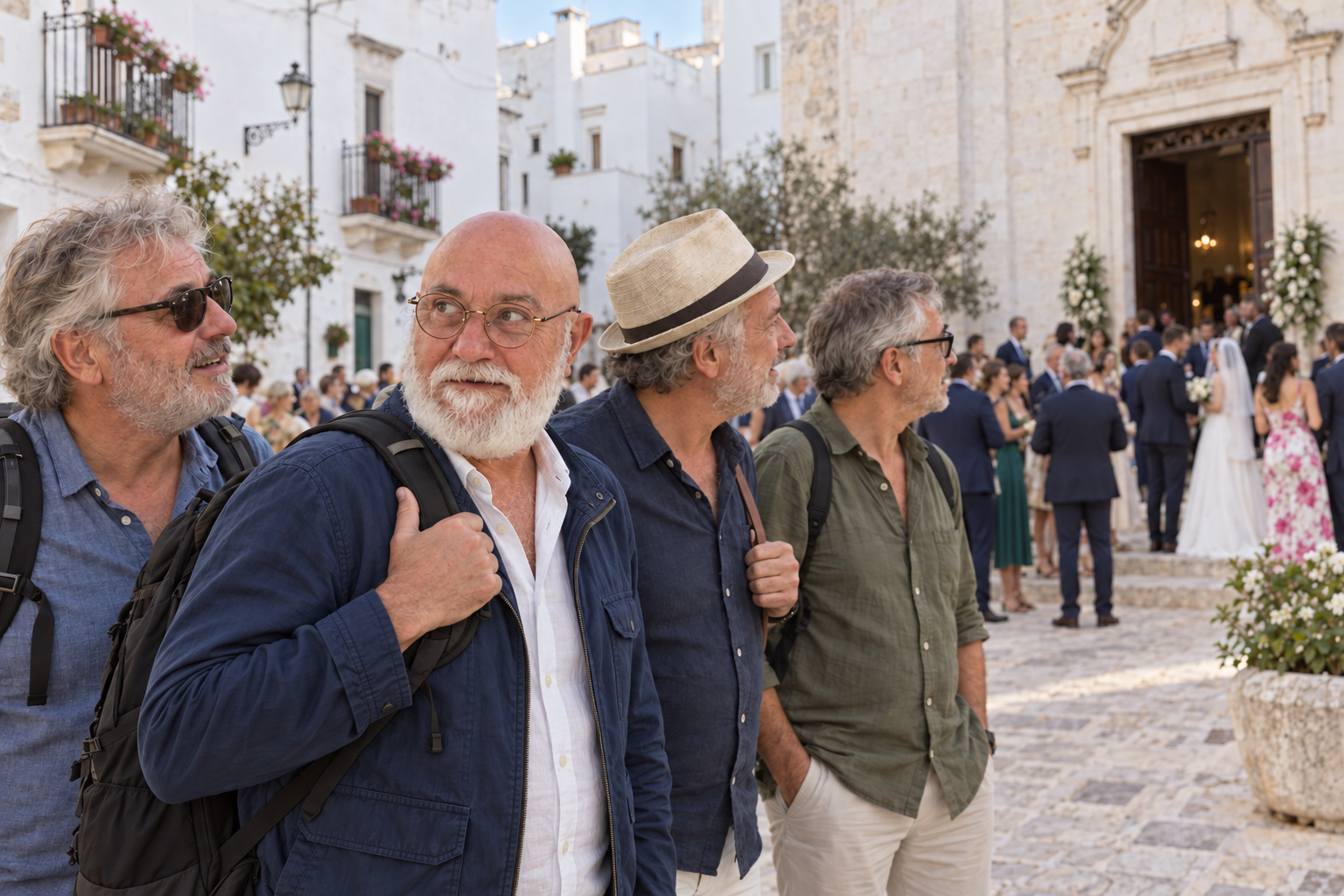
The whitewashed center was busy, but not with tourists following a guide. Cars were parked tightly along every usable stretch of road. Men in dark suits stood outside a church, smoking with the distracted concentration of people waiting for something to begin. Women crossed the square in dresses clearly chosen for an occasion. A boy in a small blue jacket was kicking at the base of a stone column while an older woman tried to keep him clean.
“Wedding,” one of my friends said.
It was not an inspired observation.
We parked outside the historic center and walked in through the narrow streets, past balconies crowded with geraniums and doorways open to the evening air. At Piazza Vittorio Emanuele II, people had begun to gather around the Torre dell’Orologio. There was music somewhere nearby, not yet loud enough to take control of the square.
Our intention was to find a bar, have an aperitivo and continue toward Ostuni before dark. Instead, we stopped to watch.
Four Men Standing in the Wrong Place
There is a particular way to look conspicuous at an Italian wedding. Arrive as four men with no jackets, no ties and no women accompanying you. Stand together at the edge of the square. Look interested but pretend not to be watching.
Within minutes, an older man approached us. He wore a navy suit that was too heavy for the weather and carried a cigarette between two fingers. He asked whom we were with.
“No one,” I said. “We’re just passing through.”
He looked at the others, then back at me.
“Americani?”
I explained that I was Italian and American, and that we were traveling together through Puglia. This answer seemed to require a short investigation. Where did my family come from? Where did I live now? Had the others been to Puglia before? Why had we chosen Cisternino?
The last question was difficult to answer honestly. We had chosen it because we were tired of sitting in the car.
The man introduced himself as Michele. He was an uncle of the groom, although in the next ten minutes two other men also introduced themselves as uncles of the groom. Whether they were brothers, cousins or simply part of the wider category of zio was never made clear.
Michele pointed toward the bar and told us to have a drink.
We thanked him and said that was exactly what we intended to do.
“No,” he replied. “With us.”
That was the invitation. There was no performance of southern hospitality, no speech about strangers becoming family. He had decided that four visitors should not be standing empty-handed while everyone else was drinking. The matter was settled.
The Rules Changed Without Being Explained
The bride and groom appeared to applause, rice and a confusion of mobile phones held above people’s heads. The church bells competed with the music. Children ran through the adults. Someone handed us glasses of prosecco.
We stayed near the edge of the group because we understood the limits of the situation. We had been offered a drink, not adopted. We did not take photographs of the couple. We did not push toward the center. We tried to remain guests of the uncle rather than become a problem for the bride.
Then plates began to arrive.
There were small focacce, pieces of fried dough, olives, cheese and paper cones of vegetables. A woman carrying a tray stopped in front of us. We each took one item. She looked annoyed and moved the tray closer.
“Prendete,” she said. Take more.
One of my friends, who had spent the drive complaining that we would spoil dinner if we ate too early, was soon holding a second plate.
The square filled gradually. The wedding did not seem separate from the town; it occupied it for an hour. Residents came to their doors. People who clearly had no connection to the couple paused to watch. The bar continued serving its regular customers a few meters from the reception. A delivery scooter tried to pass, gave up and reversed into a side street.
This was not the polished Puglia sold in travel photographs. Nothing had been arranged for our benefit. The stone was not glowing on command. The parked cars had not been removed. Plastic crates were stacked beside a shop entrance, and one of the waiters kept shouting at people to move away from the trays.
It was better for that reason. We were seeing an ordinary private event spill into public space, with all the practical disorder that involves.
An Invitation with Conditions
After the aperitivo, many guests began walking toward another part of town. We assumed the encounter was over. We thanked Michele, wished the couple well and started back toward the car.
He stopped us.
“Where are you going?”
“Ostuni.”
“Now?”
He said this as if Ostuni had ceased to exist after sunset.
The reception, he explained, would continue at a masseria outside town. We should come for dinner. At this point, even my friend with the second plate hesitated. Accepting a glass in a public square was one thing. Appearing unannounced at a formal reception was another.
I asked whether the bride and groom knew about this plan.
Michele waved the question away, which was not reassuring.
Then a younger man joined us. He was the groom’s brother. He had heard about the four travelers, apparently because news had already moved through the wedding faster than we had. He confirmed the invitation, but with one condition: we would sit at the table with the unmarried cousins and we would not leave before the dancing.
We agreed.
Back at the car, we examined ourselves. Four men in travel clothes, one of us wearing shoes covered in dust, were about to enter a Puglian wedding reception. There was no time to buy anything appropriate. We did what could be done with clean shirts from our bags and a bottle of local wine purchased from the first shop still open.
The masseria stood beyond town among olive trees and dry-stone walls. Long tables had been set in a courtyard. Strings of lights crossed above them, functional rather than theatrical. The seating plan had already been adjusted. Four handwritten names—our first names only—had been added to one table.
It was the clearest evidence that we were no longer merely watching.
Dinner Among Strangers
Italian weddings are not brief, and Puglian weddings do not improve the chances of an early departure. Courses arrived at a pace that suggested time had been removed from consideration. Antipasti were followed by pasta, then fish, then meat, then fruit, desserts and a cake that seemed to require its own ceremony.
The cousins questioned us between courses. They wanted to know what Americans thought of Italy, whether New York was still worth visiting, why Italian food abroad contained so much garlic, and whether any of us were married. The last question caused more interest than the others.
The conversation moved rapidly between Italian, dialect and English. We understood some of it and pretended to understand more. They made fun of our pronunciation. We made fun of their directions, which had included the phrase “after the olive tree” in a landscape containing several million olive trees.
The bride eventually came to our table. By then, I suspected she had been given several conflicting explanations of who we were. We apologized for arriving without an invitation.
“You have an invitation,” she said, pointing toward Michele. “Unfortunately.”
Michele, standing behind her, looked pleased with himself.
She thanked us for the wine, asked about our trip and moved on to the next table. The exchange lasted perhaps three minutes. It was neither dramatic nor emotional. What mattered was that she knew we were there and did not object.
Leaving Before It Became a Legend
We kept our promise and stayed for the dancing. Two of my friends participated enthusiastically. The third relied on the strategy of holding a drink and looking occupied. I lasted through several songs before returning to the table.
Sometime after midnight, we decided to leave. The evening had already given us more than we could reasonably accept. We found the groom’s brother, thanked the bride and groom again, and said goodbye to the cousins.
Michele was offended that we were leaving so early.
“You said you were going to Ostuni,” he reminded us.
“Tomorrow.”
That satisfied him. He embraced each of us and gave us a container of leftover pastries for the road. The groom’s brother wrote the name of a breakfast bar on a napkin and told us where to park in Ostuni. The directions were excellent until the final instruction, which involved turning near an olive tree.
We drove away through the dark countryside with the windows open. For once, nobody objected to the music. The car smelled of pastries, wine and the dust we had carried in on our shoes.
It would be easy to turn the evening into a story about Puglian generosity and claim that we had become part of a family. We had not. We were four strangers who entered a wedding for a few hours because one man considered it unreasonable to leave us standing in a square, and because the bride and groom were willing to accommodate his decision.
That was enough.
The most memorable encounters while traveling are often described as magical, as if chance alone creates them. In reality, they depend on judgment: knowing when to accept, when not to presume, when to remain at the edge and when an invitation has become genuine.
We had started the day as four men arguing in a car. We ended it driving toward a hotel we had not yet booked, carrying wedding pastries from people whose surname we never learned.
We had never been invited.
Then, quite plainly, we were.