
 Some trips begin with a monument or a landscape. This one began with friends.
I went to Bolsena for two days to spend time with people I knew and to explore a part of northern Lazio that I had passed near without properly seeing. The lake was the obvious attraction, but it was not the only reason the visit worked. Bolsena is small enough to understand on foot, old enough to reward attention and relaxed enough that two days do not have to become an exercise in scheduling.
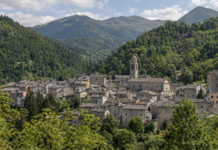
Lake Bolsena immediately establishes the pace. It is broad, open and rarely theatrical. From the shore, the opposite side often seems farther away than expected, and the two islands sit in the water without dominating it. Behind the lakefront, the town rises toward a medieval quarter of dark volcanic stone, narrow lanes and the Rocca Monaldeschi. The transition from water to old town takes only a few minutes, but it feels like moving between two different places.
Visiting friends also changed the character of the trip. I was not arriving simply to collect attractions. There was time to walk without a route, stop for coffee, sit by the lake and let familiar company occupy part of the day. That is often when a place becomes more convincing: not during the planned visit, but in the intervals around it.
A Lake Formed by Volcanoes
Lake Bolsena lies in the caldera of the Vulsini volcanic complex. Its origins explain the dark stone used throughout the area, the rounded contours of the surrounding land and the fertile countryside of northern Lazio. Often described as Europe’s largest volcanic lake, it covers a substantial part of the landscape between Viterbo, Orvieto and the Tuscan border.
The lake has two islands, Bisentina and Martana. Both are privately owned and cannot be treated as ordinary public parks, although seasonal boat excursions may allow visitors to approach or visit Bisentina under controlled arrangements. Martana is more closely associated with the story of Amalasuntha, the sixth-century Ostrogothic queen who was imprisoned and killed on the island.
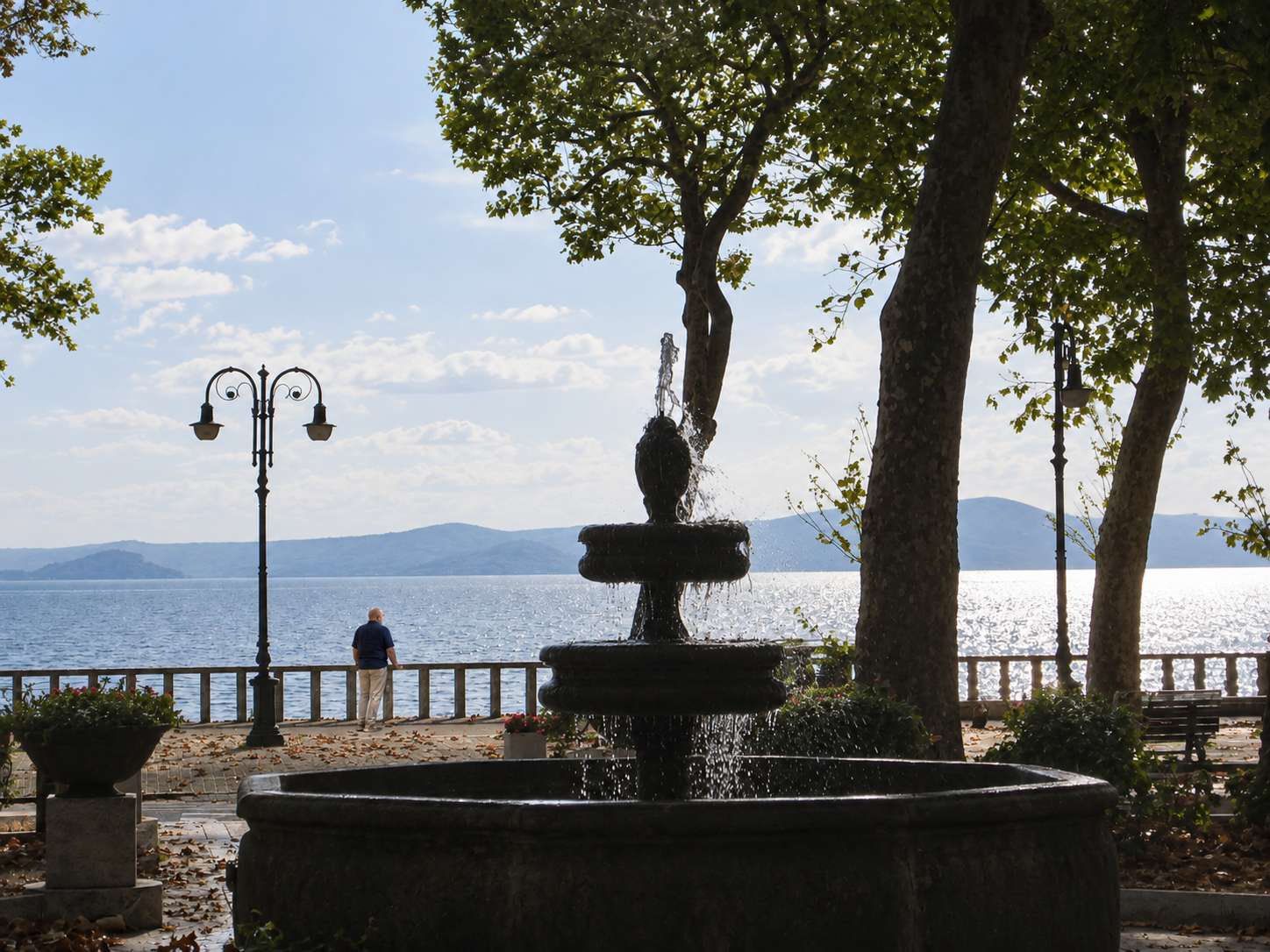
From the promenade in Bolsena, however, history is less immediate than the physical scale of the water. Fishing boats and small pleasure craft sit near the shore. Reeds and trees soften parts of the waterfront, while open stretches reveal a lake that can look blue, silver or almost leaden depending on the weather.
It does not have the steep alpine scenery of Como or Garda. Its character is quieter and more horizontal. That restraint is one of its strengths.
Day One: The Lakefront and the Old Town
We began near the water rather than at the castle. The lungolago is an easy introduction to Bolsena, particularly after a drive. It gives the town space before the old streets begin to climb.
There are beaches and grassy areas along the shore, and in warmer months people swim, rent small boats or sit outside the bars and restaurants. Even without entering the water, the lakefront is worth walking slowly. The view changes as the shore curves, and the town behind it gradually reveals the fortress above the roofs.
Lunch near the lake naturally raises the question of local fish. Depending on the catch and the season, menus may include coregone, also known as lavarello, as well as eel, perch or other freshwater fish. It is better to ask what is genuinely local and available that day than to order by habit. Northern Lazio also contributes olive oil, legumes, cured meats and the robust pasta dishes of Tuscia, so eating here need not depend entirely on fish.
After lunch, we left the flatter lakeside streets and walked toward the upper town. Bolsena rewards this approach because its monuments are not isolated from the houses around them. Doorways, exterior staircases, potted plants and small passages make the climb feel inhabited rather than arranged for tourists.
The medieval Rione Castello gathers around the Rocca Monaldeschi della Cervara. The fortress developed over several centuries, beginning with fortification ordered in the twelfth century and continuing under Orvieto and the Monaldeschi family. Its four towers still give the town a clear silhouette from below.
Inside the Rocca is the Museo Territoriale del Lago di Bolsena. Its collections connect the building to the wider landscape: the geology of the volcanic basin, Etruscan and Roman settlement, medieval life and the freshwater environment of the lake. The aquarium in the lower part of the complex is modest in scale but useful because it presents the lake as an ecosystem rather than simply a view.
The walkable sections of the fortress provide the best overview of Bolsena. From above, the town’s geography becomes simple: the dense medieval quarter beneath the walls, the later streets descending toward the water, and the immense lake beyond them. The view is more informative than any map.
Volsinii Beneath Modern Bolsena
Bolsena’s history did not begin with its medieval castle. The Roman city of Volsinii developed here after Rome conquered the important Etruscan center of Velzna in 264 BC and relocated part of its population. Archaeological remains on the heights above the modern town include streets, houses, public structures and evidence of a prosperous settlement.
The exact relationship between Etruscan Velzna and Roman Volsinii has long generated scholarly discussion, particularly because Orvieto is generally identified with the principal Etruscan city. For a visitor, the important point is that Bolsena belongs to a much older regional history linking Etruscan centers, Roman roads, agriculture and control of the territory between the Tiber and the lake.
The archaeological area at Poggio Moscini is less immediately spectacular than the fortress, but it provides context. Walls, paving and building foundations require some imagination; they also make clear that the commanding position above the lake was valued long before the medieval town took shape.
By late afternoon, we returned to the lower streets and the water. This was one of the advantages of having two days. There was no need to force the basilica, castle, museum, archaeology and surrounding towns into a single circuit. We could sit by the lake, talk and allow the light to change.
Dinner was part of the visit with friends rather than a separate tourist event. That distinction mattered. A place feels different when the table is not merely the final item on an itinerary.
Santa Cristina and the Miracle of Bolsena
The following morning began at the Basilica of Santa Cristina, the monument that connects Bolsena to one of the most influential religious traditions of medieval Europe.
The complex is not one uniform church. Buildings and spaces from different periods have been joined together, including the Romanesque basilica, the Grotto of Saint Christina, early Christian catacombs and the later Chapel of the Miracle. The result is architecturally irregular but historically compelling.
Saint Christina is Bolsena’s patron saint. According to tradition, she was a young Christian martyr persecuted during the Roman period. Her story became inseparable from the town, and the underground spaces associated with her cult preserve some of the complex’s strongest atmosphere.
Bolsena is also connected to the Eucharistic Miracle of 1263. According to Catholic tradition, a priest who doubted the doctrine of the Real Presence was celebrating Mass when the consecrated host bled onto the corporal. The relic is preserved in the Cathedral of Orvieto, while the stones associated with the event remain in Bolsena.
Pope Urban IV established the Feast of Corpus Christi for the universal Church in 1264, and the miracle became closely linked to that decision. Raphael later represented the event in The Mass at Bolsena in the Vatican Palace. Whatever a visitor’s religious beliefs, the episode demonstrates how an event associated with a small lakeside town entered European art, ritual and collective memory.
The basilica is best visited without haste. The grotto, chapels and catacomb areas are not always accessible in exactly the same way, so current opening arrangements should be checked before arrival.
Day Two Around the Lake: Marta and Capodimonte
After seeing Santa Cristina, we used the second day to explore more of the lake. It is possible to drive the entire perimeter, but completing a circuit merely to say it has been done misses the point. We chose a few stops on the southern and western shore and left time to get out of the car.
Marta is a working lakeside town with a long fishing tradition. Its waterfront is more practical than ornamental, with boats, nets and the daily evidence of a community still connected to the water. Above the shore, the old town rises toward the Torre dell’Orologio.
Marta is also known for the Barabbata, or Festa della Madonna del Monte, held each year on May 14. The procession has deep agricultural associations, with local guilds and categories of workers carrying tools, produce and decorated displays. It is a reminder that the economy around the lake has always depended on the land as well as fishing.
Farther along the shore, Capodimonte occupies a promontory projecting into the lake. Its position makes it one of the most visually distinctive towns on the water. The compact historic center gathers around the Farnese fortress, while the lakeside promenade below offers views toward Bisentina and Martana.
We walked, stopped for something to drink and looked back across the water rather than searching for another major attraction. Capodimonte works precisely because its appeal is spatial: the promontory, the castle, the marina and the islands form one scene.
Travelers with more time could continue to Montefiascone for its hilltop views and wine traditions, visit the natural landscapes around Gradoli and Grotte di Castro, or combine Bolsena with Orvieto. Civita di Bagnoregio is also close enough for an excursion, although its visitor numbers and highly managed access create a very different atmosphere from the lake towns.
What Two Days Made Possible
Bolsena could be visited in a few hours. You could walk the lakefront, climb to the Rocca, enter Santa Cristina and leave. The main sights are close enough to make that practical.
Two days produced a different visit. The old town was no longer simply the route to the castle. The lake changed with the time of day. Marta and Capodimonte showed that the water is shared by communities with different relationships to it. Most importantly, seeing friends meant that not every hour needed to justify itself through sightseeing.
That is what I remember most clearly. We were not constantly searching for the next impressive view. We moved between conversation and exploration, between the table and the street, between the lakefront and the volcanic stone of the upper town.
Bolsena does not need to compete with the grand destinations of central Italy. Its strength lies in the way history, water and ordinary life remain close together. The fortress looks over the roofs; the basilica opens onto a lived-in square; within minutes, the streets descend again to the lake.
I went there to visit friends and came away with a clearer sense of the whole area. The friendship gave the trip its reason. Bolsena and the lake gave it its shape.
Practical Advice for Two Days in Bolsena
A car is the most convenient way to reach Bolsena and explore the other lake towns. The historic center includes steep streets and restricted-traffic areas, so confirm parking arrangements with your accommodation rather than driving directly into the old quarter.
For a short stay, choose accommodation either near the center, for easy access to Santa Cristina and the medieval town, or near the waterfront, for evening walks and lake views. The distance between the two is manageable, but the route slopes uphill toward the castle.
Comfortable shoes are essential on the stone lanes. Museum, basilica, catacomb and archaeological-site hours may change by season, and some attractions close during part of the day. Check official information shortly before visiting.
Summer is the liveliest period and the best time for swimming and boat activities, but it also brings more traffic and higher demand for rooms. Late spring and early autumn are particularly good for walking and driving around the lake. In any season, allow for cooler air and sudden changes in weather near the water.
Book Your Bolsena Stay and Experiences
Some links in this section are affiliate links. Italia Mia may earn a commission if you make a booking or purchase through them, at no additional cost to you.
Find Hotels in Bolsena with Trip.com
For a two-day visit, staying within walking distance of both the lakefront and historic center keeps the trip simple. You can compare hotels in Bolsena, guest ratings and current availability on Trip.com. Check the property location carefully if you want a lake view, need private parking or prefer to avoid the uphill walk to the medieval quarter.
Travelers who want to stay directly beside the water can also view Le Naiadi Park Hotel Sul Lago on Trip.com. Prices and availability vary by date, so confirm the room type, cancellation conditions and included services before booking.
Reserve a Nearby Cultural Experience with Weekend in Italy
Weekend in Italy does not currently offer a Bolsena-specific attraction ticket. If you combine the lake with nearby Orvieto, you can view the Assisi and Orvieto day tour through Weekend in Italy. Read the itinerary carefully, since this is a full-day excursion departing from Rome rather than a local tour from Bolsena.
Continue Exploring at Home with Amazon.com
For maps and background reading, you can browse travel guides to Lazio and northern Lazio on Amazon.com, look for books about the Etruscans, or find detailed road maps of central Italy. Check publication dates and map scales before ordering, since local access information can change.
External Links
Visit Bolsena — official tourism website
Rocca Monaldeschi della Cervara