
Part of Unexpected Italy: Stories from My Recent Travels
Four of us went to Padova for two days, a short trip that initially seemed easy to organize. The city is compact, most of its important places are within walking distance, and none of us felt the need to arrive with an exhausting schedule. We had one fixed appointment—the Scrovegni Chapel—and intended to decide everything else as we went.
That reservation turned out to be the right way to approach Padova. Giotto gave the trip its structure, but the city filled in the spaces around it.
Padova is sometimes treated as a secondary stop between Venice, Verona and Bologna. That is misleading. It does not present itself with the theatrical confidence of Venice, and it does not depend on one famous square or monument. Its character is distributed across arcaded streets, medieval market squares, university buildings, churches, cafés and the steady movement of people who actually live there.
With three friends, this made the city particularly enjoyable. Nobody had to agree on a grand plan. We could walk, stop, change direction and meet again at the next piazza without losing half the day.
Day One: Beginning with Giotto
We had booked the Scrovegni Chapel before arriving. This is essential rather than optional: entry is controlled, same-day reservations are not available, and visitors must arrive well before their assigned time.
The formalities create a sense of anticipation. Before entering the chapel, visitors spend time in a climate-controlled room that helps protect the frescoes from sudden changes in temperature and humidity. It is a practical conservation measure, but it also acts as a pause between the ordinary city and the room Giotto transformed.
Nothing fully prepares you for the blue.
The chapel is small enough to understand as a single space, yet every wall competes for attention. Giotto painted the cycle in the early fourteenth century, arranging episodes from the lives of the Virgin and Christ in clear narrative bands. The figures possess weight, sorrow and physical presence. Faces turn toward one another. Hands communicate hesitation, grief and recognition. Architecture frames the scenes without overwhelming them.
The famous Kiss of Judas is not memorable simply because two faces meet at the center. It is the pressure of the crowd, the raised arms and the yellow cloak that closes around Christ. In the Lamentation, grief travels through the bodies of the mourners and even through the angels above them. Across the entrance wall, the Last Judgment changes the scale completely, shifting from intimate human drama to a vision of order, punishment and salvation.
Enrico Scrovegni commissioned the chapel, traditionally associated with his family’s reputation for moneylending and with ideas of devotion, status and redemption. Whatever his motives, the result belongs to more than one patron or one period. Giotto made sacred history feel inhabited by real people.
The allotted visit felt short, but not superficial. In fact, the limit forced us to look carefully. The four of us emerged with different details fixed in our minds. That became the first real pleasure of traveling together: the conversation outside continued the visit. One friend had concentrated on the painted architecture, another on the devils in the Last Judgment, while I kept returning to the faces.
The Eremitani and the Walk into the Center
The chapel stands beside the former monastery complex of the Eremitani, so we continued into the nearby church and museum area rather than rushing toward the best-known piazzas. The Church of the Eremitani carries visible scars from the bombing of 1944, when part of the building and important frescoes were destroyed. The restoration does not pretend that the damage never happened. Fragments, reconstruction and absence coexist.
This gave the morning a second, less expected subject. At the Scrovegni Chapel, extraordinary care preserves a nearly complete medieval vision. A few steps away, the Eremitani shows how vulnerable such work remains.
From there we walked along the arcades toward the center. Padova’s porticoes are not merely picturesque. They determine how the city is used, protecting pedestrians from rain and summer heat and creating a continuous zone between public street and private building. Shops, bars, pharmacies and old doorways occupy the same long sheltered route.
We stopped at Caffè Pedrocchi, the nineteenth-century café near the university. Its reputation could easily make it feel like a monument in which coffee happens to be served, but it still functions as a meeting place. We ordered at an unhurried pace and discussed what to see next. The decision was simple: no taxis, no rigid sequence, just the center on foot.
Piazza delle Erbe, Piazza della Frutta and Palazzo della Ragione
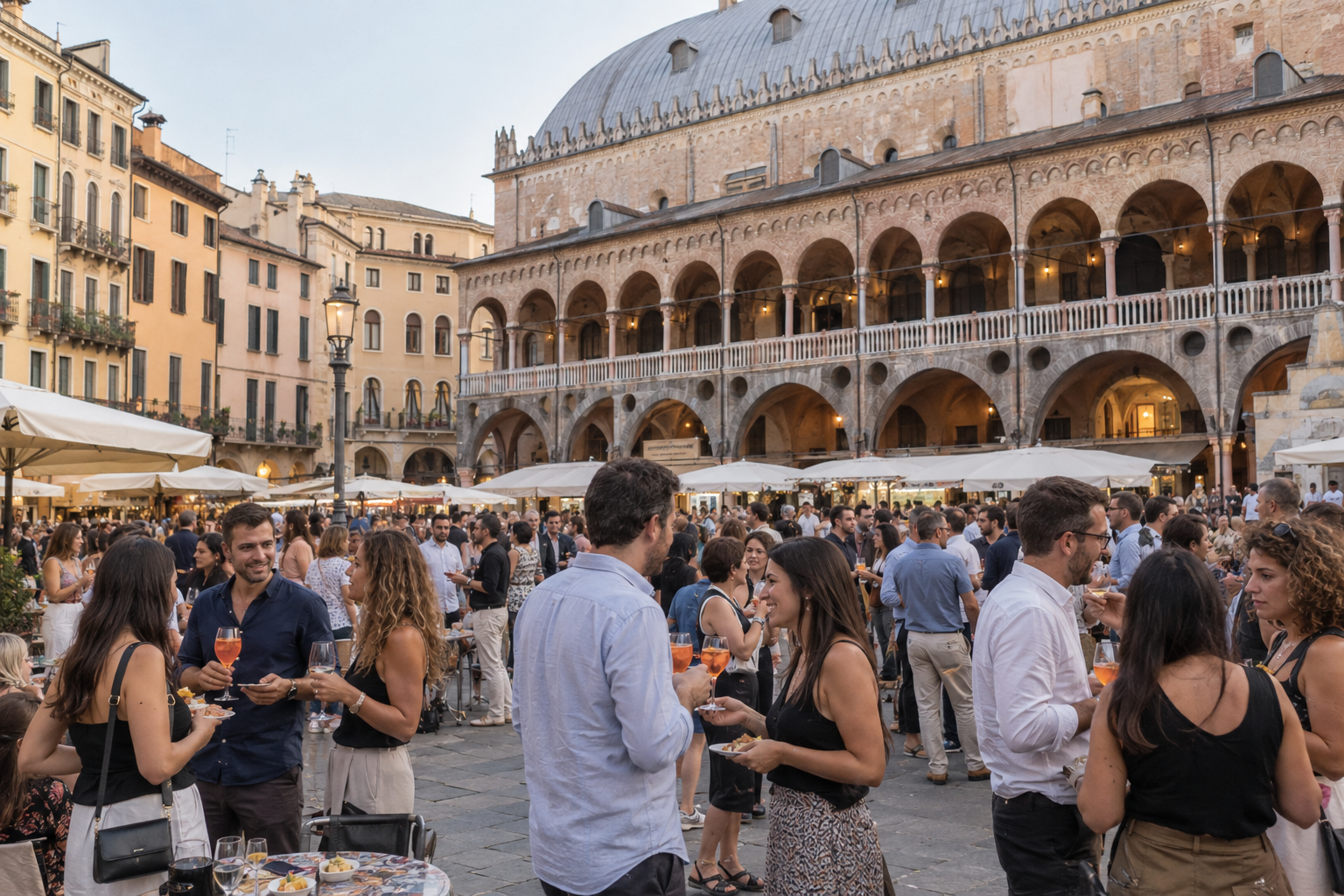
Padova becomes most convincing around Piazza delle Erbe and Piazza della Frutta. These are not ceremonial spaces emptied for photography. Market stalls, bicycles, delivery vehicles, shoppers and people stopping for an aperitivo prevent the architecture from becoming a stage set.
Between the two squares rises the Palazzo della Ragione, known locally as the Salone. The building has served the commercial and civic life of Padova since the Middle Ages. Beneath it, the covered market remains part of the city’s daily routine; above it is the enormous hall with its astrological fresco cycle and great wooden horse.
The relationship between the market below and the hall above says a great deal about Padova. Food, trade, law, civic authority and art were not placed in separate districts. They were stacked together.
We moved from one square to another, passed through Piazza dei Signori and stopped beneath the clock tower. None of these crossings took long, yet we spent most of the afternoon there. One friend wanted to examine a shop window, another disappeared briefly beneath the Palazzo in search of something to eat, and the rest of us waited with glasses in hand. That unscheduled hour is the part I remember most clearly.
Travel among friends is often described through the things everyone does together. In reality, it works when a group is comfortable separating for twenty minutes and reforming without discussion. Padova’s center is perfectly suited to that rhythm.
We ate dinner in the center and walked again afterward. The market activity had subsided, tables occupied the edges of the piazzas, and the medieval buildings seemed less imposing than they had during the day. The city had not become silent; it had simply changed users.
Day Two: The University, the Santo and Prato della Valle
On the second morning we passed through the university quarter. The University of Padova was founded in 1222 and remains inseparable from the identity of the city. Palazzo Bo, its historic seat, is associated with centuries of scholarship and with Galileo Galilei, who taught in Padova from 1592 to 1610.
Even without taking a full guided visit, the university’s presence is obvious. Students occupy the streets and cafés, keeping the center from becoming too polished or too dependent on visitors. Padova feels old, but it does not feel retired.
We then walked toward the Basilica of Saint Anthony, which everyone in Padova simply calls Il Santo. The basilica’s domes and complex mixture of Romanesque, Gothic and Byzantine elements announce it from a distance, but the experience inside is more direct. Pilgrims approach the saint’s tomb, people leave photographs and written requests, and others move quietly through the chapels without behaving like conventional tourists.
Whether or not one arrives for religious reasons, the intensity is unmistakable. This is not a church preserved after its original purpose disappeared. It remains an active destination of faith.
Outside, the equestrian monument to Gattamelata by Donatello stands with a different kind of authority. After the visual density of the basilica, the bronze condottiere appears controlled and self-contained. We spent some time in Piazza del Santo before continuing on foot.
The route led naturally to Prato della Valle. Its scale is difficult to judge in photographs. The elliptical canal, the statues, the bridges and the green Isola Memmia create a public space large enough to absorb crowds without feeling congested. People crossed it on bicycles, sat near the water and used it as part of an ordinary weekend rather than approaching it as a monument.
We walked the circuit slowly. After a day and a half of frescoes, churches and medieval streets, the openness was welcome. The Basilica of Santa Giustina formed the architectural edge of the square, while conversation among the four of us drifted away from what we had seen and toward when we might travel together again.
Nearby, the Botanical Garden of Padova offered a possible final visit. Founded in 1545 and recognized as a UNESCO World Heritage Site, it is the world’s oldest university botanical garden still in its original location. Two days are enough to see Padova well, but not enough to complete every worthwhile visit. We chose not to turn the final hours into a race.
What Surprised Me About Padova
The Scrovegni Chapel was the reason we went, and it deserves to be. It is one of those rare works whose fame does not exaggerate its effect. Yet the surprise was how little the rest of Padova depended on that masterpiece.
The city center has several identities operating at once: pilgrimage city, university city, market city and city of fourteenth-century frescoes. In 2021, eight groups of frescoes were inscribed by UNESCO as Padova Urbs Picta, recognizing a painted heritage that extends well beyond Giotto’s chapel. That wider context matters. The Scrovegni Chapel is not an isolated treasure accidentally left in Padova; it is the most famous part of a much larger artistic environment.
Two days also gave us something a day trip would not have provided. We saw the piazzas change from market spaces to evening meeting places. We had time to return through the same streets instead of treating every corner as a one-time sight. We could disagree about what impressed us without dividing the group or abandoning the plan.
Padova rewards attention more than speed. It does not need to compete with Venice, and it should not be presented merely as an alternative to it. After two days with three friends, the city felt complete on its own terms: serious without being solemn, beautiful without excessive display, and old without being frozen.
Practical Notes for Two Days in Padova
Reserve the Scrovegni Chapel before the trip. Same-day booking is not permitted, and the official site advises visitors—especially groups—to collect tickets well in advance of the assigned entrance.
Keep the center on foot. The Scrovegni Chapel, Caffè Pedrocchi, Palazzo Bo, the principal market squares, the Basilica of Saint Anthony and Prato della Valle form a logical walking route.
Do not overfill the schedule. A first day built around the chapel, the Eremitani and the central piazzas leaves time for the market and evening atmosphere. The second day can include Palazzo Bo, the Santo, Prato della Valle and, if desired, the Botanical Garden.
Allow time for the wider fresco city. The official Padova Urbs Picta itinerary includes eight buildings and complexes with fourteenth-century fresco cycles. Visitors interested in art can easily justify a longer stay.
Book Your Padova Stay and Italy Experiences
Some links in this section are affiliate links. Italia Mia may earn a commission if you make a booking through them, at no additional cost to you.
Find Hotels in Padova with Trip.com
For a two-day visit, staying in or near the historic center makes it easier to reach the Scrovegni Chapel, the market squares, the university quarter and the Basilica of Saint Anthony on foot. Travelers can compare Padova hotels, current rates and availability on Trip.com. Check the precise location before booking, as some properties listed under Padova are outside the most convenient walking area.
Reserve Museum Tickets and Tours with Weekend in Italy
If Padova is part of a longer journey, Weekend in Italy offers advance tickets and guided experiences for many of Italy’s major museums, monuments and historic sites. Availability and inclusions vary, so confirm the attraction, entrance time, meeting point and cancellation terms before purchasing. The Scrovegni Chapel itself should still be reserved through its official booking system unless a specific Padova product is shown.
External Sources
Scrovegni Chapel — official information and reservations
Turismo Padova — ten things not to miss
Padova Urbs Picta — official tourism information
Botanical Garden of Padova — official website