

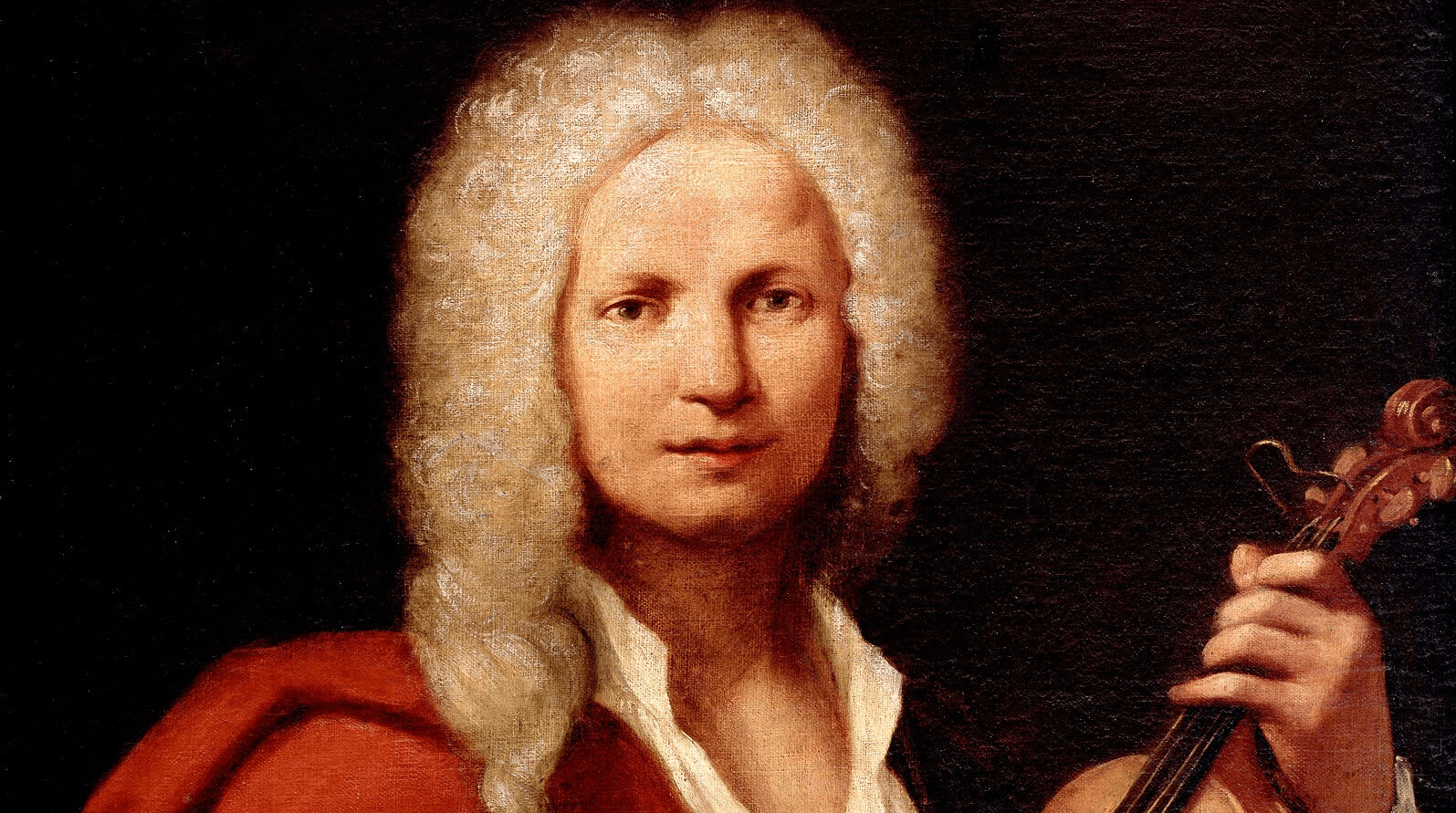
 Antonio Vivaldi transformed the sound of the Baroque era. A virtuoso violinist, innovative composer, Catholic priest and successful opera impresario, he helped establish the solo concerto as one of the most important forms in Western music.
Today, Vivaldi is inseparable from The Four Seasons, yet his surviving catalogue extends far beyond those four concertos. He wrote hundreds of instrumental works, sacred compositions, operas, cantatas and sonatas. His bold rhythms, memorable melodies and dramatic contrasts influenced composers across Europe, most famously Johann Sebastian Bach.
Vivaldi’s life was also filled with contradictions. Known as Il Prete Rosso—the Red Priest—he rarely celebrated Mass after the beginning of his career. He earned considerable sums from publishing, teaching and opera, but died in Vienna under modest circumstances. Celebrated throughout Europe during his lifetime, he was largely forgotten after his death and rediscovered only centuries later.
Early Life in Venice
Antonio Lucio Vivaldi was born in Venice on March 4, 1678, when the city was still the capital of the independent Republic of Venice. He was the son of Camilla Calicchio and Giovanni Battista Vivaldi, a barber who became a professional violinist.
Antonio was baptized immediately after birth because he was believed to be in danger of dying. The exact nature of his lifelong health problems remains uncertain. Vivaldi later referred to a strettezza di petto, or tightness of the chest, which some biographers have interpreted as asthma.
His condition did not prevent him from developing into an exceptionally energetic musician and traveler, although it may have stopped him from playing wind instruments and contributed to his eventual decision to stop celebrating Mass.
Vivaldi’s father joined the orchestra of St. Mark’s Basilica in 1685. He almost certainly gave Antonio his first violin lessons and may have introduced him to Venice’s network of musicians, patrons, publishers and theatrical impresarios.
The young Vivaldi therefore grew up surrounded by one of Europe’s richest musical cultures. Venice supported churches, music schools, public opera houses and printing businesses, while visitors from across Europe carried Venetian music back to their own countries.
For a wider view of this tradition, read ItaliaMia’s guide to Italian classical music through the centuries.
The Red Priest
Vivaldi began preparing for the priesthood when he was fifteen. He received the lower orders gradually and was ordained on March 23, 1703.
His distinctive red hair, apparently inherited from his father, inspired the nickname Il Prete Rosso. The name followed him throughout his career and remains one of the most recognizable epithets in music history.
Vivaldi stopped celebrating Mass regularly not long after his ordination. He claimed that his chest condition sometimes forced him to leave the altar. Critics questioned this explanation, particularly because he remained active as a composer, violinist and traveler.
Whatever the full reason, Vivaldi remained a priest for the rest of his life. There is no evidence that he abandoned the Church or was formally released from his clerical obligations.
The image of Vivaldi as a rebellious or scandalous priest has sometimes overshadowed his serious contribution to sacred music. Works such as the Gloria, Stabat Mater, Magnificat, Nisi Dominus and Juditha triumphans demonstrate his ability to unite religious texts with theatrical color and instrumental brilliance.
Vivaldi and the Ospedale della Pietà
In September 1703, only months after his ordination, Vivaldi became a violin teacher at the Ospedale della Pietà. This Venetian institution cared for abandoned and orphaned children, but it was also one of the city’s most important centers of musical education.
The most talented female residents, known as the figlie di coro, received intensive training as singers and instrumentalists. Their concerts attracted Venetian audiences and international visitors, earning the Pietà a remarkable reputation.
Vivaldi taught violin, directed ensembles, acquired instruments and composed music suited to the abilities of individual performers. His students played not only the violin but also the cello, viola d’amore, oboe, bassoon, flute, recorder, mandolin and other instruments.
This working environment encouraged experimentation. Vivaldi could test new combinations of instruments, write demanding solo passages for gifted performers and explore the contrast between a soloist and a larger ensemble.
His association with the Pietà was not entirely continuous. Its governors regularly voted on the appointment of teachers, and Vivaldi’s position changed several times. Nevertheless, he remained connected to the institution for much of his professional life and composed a substantial amount of music for its musicians.
The Pietà was more than an employer. It functioned as Vivaldi’s musical laboratory.
The Rise of a European Composer
Vivaldi’s first published collection, a set of trio sonatas known as Opus 1, appeared in 1705. A collection of violin sonatas followed in 1709.
His international breakthrough came with L’estro armonico, Opus 3, published in Amsterdam in 1711. The title can be translated approximately as “Harmonic Inspiration.” Its twelve concertos for one, two and four violins circulated widely and helped establish Vivaldi’s reputation beyond Italy.
Publishing in Amsterdam gave Vivaldi access to an international market. Northern European printers possessed efficient distribution networks, and printed editions allowed his music to reach courts, churches and private musicians who had never visited Venice.
The concertos impressed listeners with their rhythmic drive, clear structure, dramatic sequences and brilliant solo writing. Instead of treating the soloist as simply another member of the ensemble, Vivaldi placed the individual performer in vivid dialogue—and sometimes apparent competition—with the orchestra.
Johann Sebastian Bach studied Vivaldi’s concertos closely and transcribed several of them for keyboard instruments. Through Vivaldi, Bach explored large-scale musical organization, recurring orchestral passages and the relationship between solo episodes and structural returns.
Vivaldi’s influence on Bach alone would secure his place in musical history, but his works also shaped composers and performers throughout Germany, France, England and Italy.
How Vivaldi Changed the Concerto
Vivaldi did not invent the concerto, but he played a decisive role in defining its mature Baroque form.
Many of his solo concertos follow a three-movement pattern:
- A fast opening movement
- A slower and more lyrical central movement
- A fast, energetic finale
In the outer movements, Vivaldi frequently used a ritornello structure. A recurring orchestral passage returns between contrasting solo episodes, giving the listener recognizable points of reference while allowing the soloist to venture into new keys, melodies and technical displays.
His concertos are never merely mechanical exercises. The most successful combine formal clarity with color, surprise and theatrical momentum. Rapid scales, repeated notes, arpeggios and dramatic leaps reveal Vivaldi’s intimate knowledge of the violin.
He also expanded the concerto repertory for other instruments. His music gave unusual prominence to the bassoon, cello, oboe, recorder, viola d’amore and mandolin, sometimes combining instruments in imaginative ensembles.
Learn more about the instruments that shaped this tradition in ItaliaMia’s history of musical instruments invented and developed in Italy.
Vivaldi and the Opera House
The modern image of Vivaldi concentrates on instrumental music, but he devoted a major part of his career to opera.
His first known opera, Ottone in villa, was performed in Vicenza in 1713. Vivaldi then became closely involved with Venice’s Teatro Sant’Angelo, working as a composer and impresario.
An impresario needed to assemble singers, musicians, librettists, scenery and financing while satisfying audiences, theater owners and aristocratic patrons. The work demanded business judgment as well as musical ability.
Vivaldi claimed to have composed more than ninety operas, although this figure may have included revisions and productions rather than entirely original scores. Around fifty opera titles have been associated with him, and only a portion survive in complete form.
Important works include Orlando finto pazzo, Ercole sul Termodonte, Farnace, La fida ninfa, Bajazet, Griselda and L’Olimpiade.
His operas demonstrate that the rhythmic excitement of the concertos was connected to theatrical experience. Vivaldi knew how to create anticipation, introduce a character, accompany a dramatic confrontation and build toward a conclusion.
For an introduction to the broader Italian operatic tradition, see the most famous Italian opera composers and their masterpieces.
Mantua and the Creation of The Four Seasons
From approximately 1718 to 1720, Vivaldi worked in Mantua as maestro di cappella da camera at the court of Prince Philip of Hesse-Darmstadt.
The landscapes and changing weather of northern Italy may have contributed to the descriptive imagination behind Vivaldi’s most famous composition, although the precise origins of The Four Seasons remain uncertain.
The four concertos were published in Amsterdam in 1725 as the opening section of Il cimento dell’armonia e dell’inventione, Opus 8. The title suggests a contest between established musical order and creative invention.
Each concerto corresponds to a season and is associated with a descriptive sonnet, possibly written by Vivaldi himself.
Spring
Birds welcome the new season, streams flow gently and a storm interrupts the celebration. A sleeping shepherd is guarded by his barking dog before the final movement introduces a rustic dance.
Summer
The music evokes oppressive heat, insects, uneasy winds and the fear of an approaching storm. The finale unleashes thunder, lightning and hail with extraordinary rhythmic intensity.
Autumn
Villagers celebrate the harvest with dancing and wine. The central movement portrays drunken sleep, while the finale depicts a hunt from its beginning to the death of the pursued animal.
Winter
Shivering figures stamp their feet against the cold, teeth chatter and icy winds attack. The slow movement offers warmth beside a fire before the final movement ventures onto slippery ice.
The concertos are among the earliest and most celebrated examples of program music—instrumental music designed to represent a narrative, scene or extra-musical idea. Their popularity can sometimes make them seem familiar, but attentive listening reveals daring textures, irregular accents and highly imaginative orchestral effects.
Anna Girò and the Rumors Around Vivaldi
While working in Mantua, Vivaldi met the young singer Anna Girò, who became one of his most important professional collaborators. She performed leading roles in several of his operas and traveled with him, usually accompanied by her older half-sister Paolina.
Their close association generated rumors. Vivaldi firmly denied having a romantic relationship with Anna and described both women as trusted members of his household and professional circle.
No reliable evidence proves that Vivaldi and Girò were lovers. Their relationship is better understood as a sustained artistic partnership between a composer-impresario and a singer whose abilities he knew exceptionally well.
The controversy nevertheless harmed Vivaldi. In 1737 Cardinal Tommaso Ruffo prevented him from entering Ferrara to present an opera season, citing his failure to celebrate Mass and his association with Anna Girò. The decision caused Vivaldi significant financial losses.
European Fame and Imperial Patronage
Vivaldi traveled extensively by the standards of his time. His music was performed across Europe, and his patrons included members of aristocratic and royal families.
He visited Rome and reportedly performed for Pope Benedict XIII. He also developed a connection with Emperor Charles VI, who admired his music and honored him with a title and gifts.
Vivaldi’s published collections were dedicated to influential patrons. These dedications were not simply ceremonial: they formed part of a network through which composers secured protection, prestige and future commissions.
By the 1730s, however, musical fashion was changing. Venetian audiences increasingly favored younger composers and newer operatic styles. Vivaldi’s financial position became less secure, and he sold groups of manuscripts at unusually low prices.
Final Journey to Vienna
In 1740, Vivaldi left Venice and traveled to Vienna, probably hoping to find new opportunities under Emperor Charles VI.
His timing was disastrous. The emperor died in October 1740, soon after Vivaldi’s arrival. The political and military crisis that followed disrupted theatrical life and deprived the composer of his most important prospective patron.
Vivaldi died in Vienna on July 28, 1741, at the age of 63. The recorded cause was an “internal inflammation,” a description too vague to allow a modern diagnosis.
He received a modest funeral and was buried in a cemetery belonging to a public hospital. The cemetery was later removed, and the precise location of his grave is no longer identifiable.
Descriptions of Vivaldi dying completely forgotten and destitute can be exaggerated. He had been internationally famous and had earned substantial income during his career. Nevertheless, the surviving funeral records indicate that his final circumstances were far removed from the success he had once enjoyed.
Vivaldi’s Sacred and Vocal Music
Vivaldi’s reputation rests largely on his concertos, but his vocal music reveals another dimension of his artistry.
The Gloria in D major, RV 589, is his best-known sacred composition. Its choruses, solos and contrasting movements combine devotional grandeur with the rhythmic vitality of the Venetian Baroque.
Other essential sacred works include:
- Stabat Mater, RV 621
- Nisi Dominus, RV 608
- Magnificat, RV 610 and RV 611
- Dixit Dominus, RV 595
- Laudate pueri Dominum, RV 600
- Juditha triumphans, RV 644
Juditha triumphans, composed for the Pietà and first performed in 1716, is the only surviving Vivaldi oratorio. Its cast was drawn from the institution’s female musicians, who performed both male and female roles.
Vivaldi used instruments to create atmosphere and characterization. Recorders, oboes, chalumeaux, mandolins, violas d’amore and other distinctive sounds enrich the work’s depiction of military power, prayer, seduction and victory.
Essential Vivaldi Works
Listeners who want to explore beyond The Four Seasons can begin with these compositions:
- L’estro armonico, Op. 3
- La stravaganza, Op. 4
- Il cimento dell’armonia e dell’inventione, Op. 8
- La cetra, Op. 9
- Concerto for Four Violins in B minor, RV 580
- Concerto for Two Violins in A minor, RV 522
- Mandolin Concerto in C major, RV 425
- Concerto for Two Trumpets in C major, RV 537
- Bassoon Concerto in E minor, RV 484
- Flute Concerto in F major, “La tempesta di mare,” RV 433
- Violin Concerto in E-flat major, “La tempesta di mare,” RV 253
- Flute Concerto in D major, “Il gardellino,” RV 428
- Gloria in D major, RV 589
- Stabat Mater, RV 621
- Nisi Dominus, RV 608
- Juditha triumphans, RV 644
- Orlando furioso, RV 728
- Farnace, RV 711
- Bajazet, RV 703
The RV numbers refer to the Ryom-Verzeichnis, the catalogue used to identify Vivaldi’s compositions.
Readers can browse Vivaldi biographies, scores and recordings on Amazon.
From Neglect to Rediscovery
After Vivaldi’s death, most of his music disappeared from regular performance. His name survived partly because scholars studying Bach encountered the German composer’s transcriptions of Vivaldi concertos.
A decisive rediscovery occurred during the twentieth century. Large collections of Vivaldi manuscripts were found and eventually acquired for the Biblioteca Nazionale Universitaria di Torino. The Foà and Giordano collections revealed an extraordinary quantity of instrumental, sacred and operatic music.
The establishment of the Istituto Italiano Antonio Vivaldi in 1947 encouraged research, cataloguing, publication and performance. Conductors and specialist ensembles began presenting his works with renewed attention to Baroque instruments and historical performance practices.
Modern audiences gradually discovered that Vivaldi was not the composer of one endlessly repeated masterpiece. He was a prolific and experimental musician whose surviving catalogue contains more than 800 authenticated compositions, versions and fragments.
Vivaldi’s Influence and Enduring Legacy
Vivaldi gave the Baroque concerto clarity, momentum and dramatic personality. His fast movements established strong contrasts between the soloist and ensemble, while his slow movements often display an operatic gift for expressive melody.
His music influenced Bach and numerous other European composers. It also helped define the violin as a heroic solo instrument capable of brilliance, lyricism, imitation and theatrical display.
Later generations inherited more than a formal model. Vivaldi demonstrated that instrumental music could portray landscapes, weather, animals, physical sensations and human activity without words.
This imaginative approach explains why The Four Seasons continues to attract radically different interpretations—from historically informed Baroque performances to arrangements for jazz ensembles, electronic instruments and modern orchestras.
Vivaldi’s music is immediately accessible, but it is not simplistic. Beneath its memorable melodies lies a sophisticated understanding of harmony, structure, instrumental color and dramatic pacing.
His career also belongs to the history of Venice. The city’s churches, theaters, charitable institutions, publishers, musicians and international visitors created the environment in which his talent could flourish.
Following Vivaldi Through Venice
Several locations allow visitors to explore Vivaldi’s Venetian world.
The Church of San Giovanni in Bragora contains the baptismal record associated with Vivaldi and stands near the area where he was born.
The Church of the Pietà, officially Santa Maria della Visitazione, is closely associated with the institution where he taught. Visitors should remember that the present church was largely constructed after the principal period of Vivaldi’s work there, replacing the earlier building connected directly with his career.
The church and Pietà complex preserve the memory of the figlie di coro and the remarkable musical culture Vivaldi helped develop. The official Pietà cultural program provides information about its heritage, archives and museum itinerary.
The Museo della Musica in the Church of San Maurizio presents the exhibition “Antonio Vivaldi and His Time,” with historic instruments illustrating Venice’s tradition of violin making. Visitor information is available through the official Venice tourism portal.
ItaliaMia readers planning a musical visit can also explore Venice’s best hotels, learn more about Venice and La Serenissima or compare Venice accommodation on Trip.com.
Why Antonio Vivaldi Still Matters
Antonio Vivaldi changed how composers thought about instrumental music. He brought the soloist to the foreground, strengthened the architecture of the concerto and used sound to depict the physical world with unprecedented immediacy.
His life connects the churches, charitable institutions, theaters and publishing houses of eighteenth-century Venice. His career also reveals how quickly artistic reputations can change: celebrated across Europe, neglected after death and eventually restored to a central place in musical history.
The Four Seasons may be the gateway to Vivaldi, but it should never be the end of the journey. His sacred music, operas and hundreds of concertos reveal a composer of restless imagination whose music continues to sound vivid, theatrical and unmistakably alive.
External Sources
- Treccani – Antonio Vivaldi, Dizionario Biografico degli Italiani
- Istituto Provinciale Santa Maria della Pietà – Antonio Vivaldi
- Fondazione Giorgio Cini – Antonio Vivaldi Archives
- Vivaldi Church Venice – Biography of Antonio Vivaldi
- Deutsche Grammophon – Antonio Vivaldi
- Venezia Unica – Museum of Music
Disclosure: This article contains affiliate links. ItaliaMia may receive a commission from qualifying purchases or reservations, at no additional cost to the reader.