

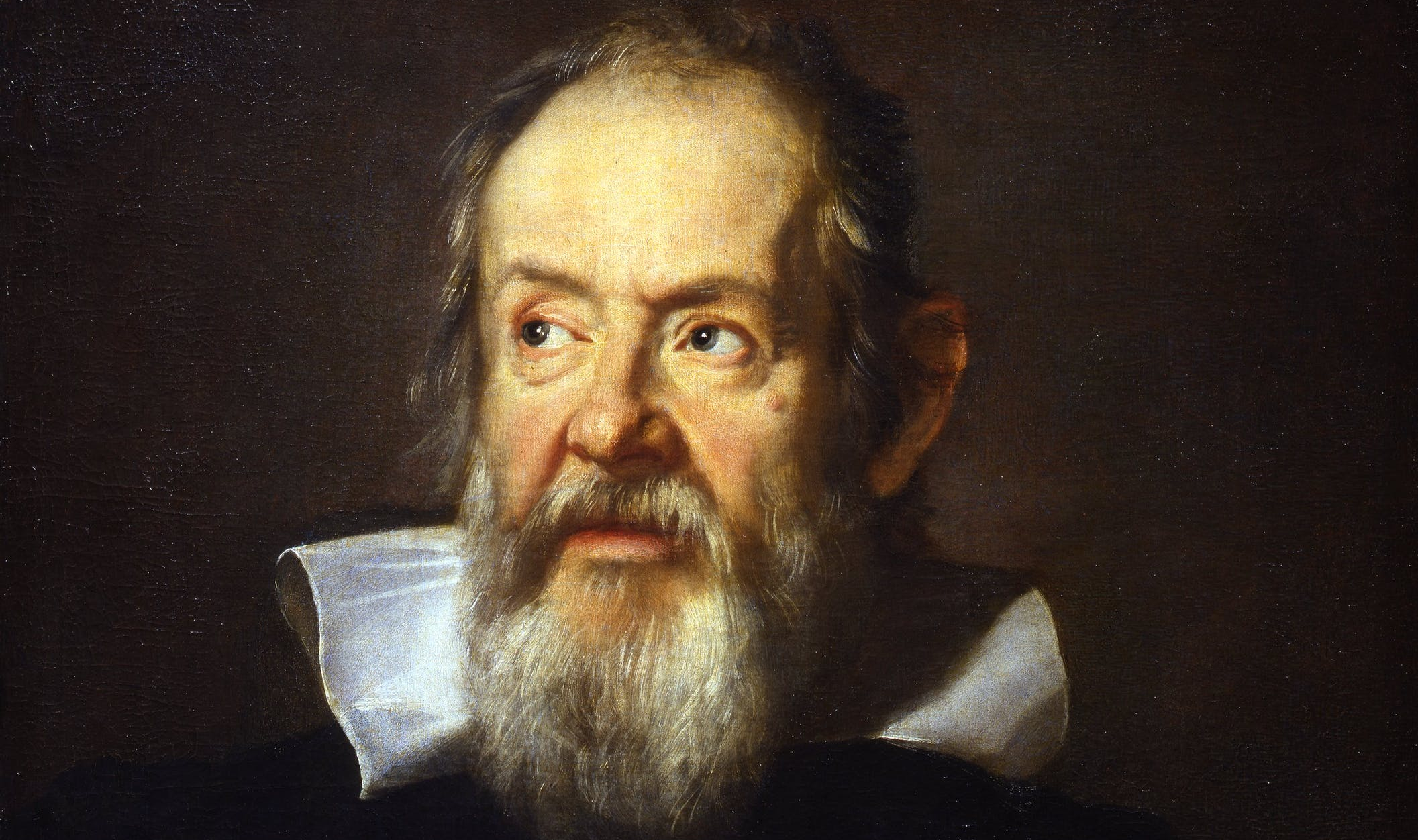
 Galileo Galilei transformed humanity’s understanding of the universe. By combining mathematics, observation, experimentation and ingenious instruments, he challenged ideas about nature that had remained dominant for centuries.
His telescopic discoveries revealed mountains on the Moon, countless stars invisible to the naked eye, four moons orbiting Jupiter and the changing phases of Venus. These observations undermined the traditional belief that every heavenly body revolved around an immobile Earth.
Yet Galileo’s importance extends well beyond astronomy. His investigations of falling bodies, acceleration, projectiles and inertia helped establish the foundations of modern physics. Just as importantly, his lucid and argumentative prose presented scientific ideas to readers outside universities. Galileo was not simply a man who made discoveries; he helped change how reliable knowledge is produced.
His support for the Copernican system eventually brought him before the Roman Inquisition. Condemned in 1633 and forced to renounce his position, he spent the remainder of his life under house arrest. Even then, nearly blind and closely supervised, he completed one of his most influential scientific works.
Early Life in Pisa and Florence
Galileo Galilei was born in Pisa on February 15, 1564. At the time, Pisa formed part of the Grand Duchy of Tuscany, governed by the Medici dynasty.
His father, Vincenzo Galilei, was a musician, composer and music theorist. Vincenzo questioned accepted musical doctrines and tested ideas about pitch by experimenting with strings of different lengths and tensions. Although it would be simplistic to describe the father as a modern experimental scientist, his willingness to challenge authority through measurement may have influenced Galileo’s intellectual development.
Galileo’s mother was Giulia Ammannati. The family belonged to the lesser Florentine nobility but was often troubled by financial difficulties. Galileo, the eldest surviving son, would carry substantial family responsibilities throughout his life.
The Galilei family moved to Florence when Galileo was still a child. He initially received part of his education at the monastery of Vallombrosa, in the wooded hills east of the city. For a time, he apparently considered joining the religious order, but his father had other plans.
In 1581 Galileo enrolled at the University of Pisa to study medicine. Medicine promised a more dependable income than mathematics, but lectures in geometry awakened his interest in mathematical reasoning. He left the university without completing a medical degree and began studying mathematics, mechanics and natural philosophy.
This change of direction would prove decisive, not only for Galileo but for the history of science.
The Young Mathematician
One of the most famous stories about Galileo’s youth claims that he watched a lamp swinging inside Pisa Cathedral and used his pulse to compare the duration of its movements. The story may contain an element of truth, although later retellings have embellished it considerably.
What matters is that Galileo became interested in pendular motion and recognized that the time taken by a pendulum to swing was related primarily to its length rather than the weight attached to it. He never constructed a practical pendulum clock, but his research helped prepare the way for later developments in timekeeping.
In 1589 Galileo obtained the chair of mathematics at the University of Pisa. There he began investigating motion and questioning the physics traditionally associated with Aristotle.
According to another celebrated story, Galileo dropped objects of different weights from the Leaning Tower of Pisa to demonstrate that they would reach the ground at nearly the same time. There is no firm contemporary evidence that this public experiment occurred exactly as later described. Galileo did, however, conduct extensive investigations into falling bodies and argue against the simple Aristotelian claim that heavier objects must fall proportionally faster.
His real achievement was more substantial than a dramatic tower experiment. Galileo gradually showed that motion could be studied through measurement, idealized experiments and mathematical relationships.
Galileo’s Productive Years in Padua
In 1592 Galileo accepted a position at the University of Padua, then part of the Republic of Venice. He remained there for approximately eighteen years and later remembered the period as among the happiest and most productive of his life.
At Padua, he taught geometry, astronomy and mechanics. He also gave private lessons, designed instruments and advised the Venetian Republic on technical and military questions. His geometric and military compass could be used for calculations involving artillery, surveying, currency and proportions.
These activities remind us that Galileo was not an isolated thinker looking at the stars. He was also a skilled instrument maker, teacher, courtier and entrepreneur who understood the practical value of scientific knowledge.
During his Paduan years, Galileo had a long relationship with Marina Gamba. They had three children: Virginia, Livia and Vincenzio. Because the daughters were considered unlikely to marry, both eventually entered the convent of San Matteo at Arcetri. Virginia took the religious name Sister Maria Celeste and maintained an affectionate correspondence with her father.
Her surviving letters provide an intimate portrait of Galileo’s domestic life, financial worries, illnesses and relationship with his family. Readers interested in this personal side of the scientist can find several editions of Dava Sobel’s book Galileo’s Daughter on Amazon.
Galileo and the Telescope
Galileo did not invent the telescope. The first practical spyglasses appeared in the Netherlands in 1608. When Galileo heard about the device the following year, he worked out how it functioned and began constructing greatly improved versions.
His early instruments provided only modest magnification, but he rapidly refined their lenses and design. In August 1609 he demonstrated a telescope to Venetian officials from the bell tower of San Marco. The instrument’s potential for identifying distant ships gave it immediate military and commercial value.
Galileo then turned the telescope toward the night sky.
This decision changed astronomy forever. Earlier observers had studied the heavens with the naked eye. Galileo made the telescope into an instrument of systematic scientific investigation, extending human vision beyond its natural limits.
His observations showed that the Moon was not a perfectly smooth celestial sphere. Its surface appeared irregular, with mountains, valleys, shadows and depressions. The Milky Way, previously seen as a luminous band, resolved into an immense concentration of stars.
In January 1610 Galileo observed several small points of light near Jupiter. By following their changing positions over successive nights, he concluded that four bodies were orbiting the planet. These objects—Io, Europa, Ganymede and Callisto—are now known collectively as the Galilean moons.
Their existence provided a powerful response to those who insisted that everything in the universe had to revolve around Earth. Jupiter possessed its own system of orbiting bodies.
Galileo published these discoveries in March 1610 in Sidereus Nuncius, or The Starry Messenger. He named Jupiter’s satellites the “Medicean Stars” in honor of the ruling Medici family, a clever act of patronage that helped him secure an appointment in Florence as chief mathematician and philosopher to Grand Duke Cosimo II de’ Medici.
Venus, Sunspots and the Copernican Universe
After returning to Tuscany, Galileo continued his observations. He studied sunspots, the strange appearance of Saturn and, most decisively, the phases of Venus.
Venus displayed a complete series of phases comparable to those of the Moon. This observation was incompatible with the traditional Ptolemaic arrangement in which Venus moved on an orbit located entirely between Earth and the Sun.
The phases did not, by themselves, prove that Earth moved around the Sun. They were also compatible with alternative systems, including the geoheliocentric model associated with Tycho Brahe. Nevertheless, they dealt a serious blow to the traditional Ptolemaic universe and strengthened Galileo’s belief in the heliocentric model proposed by Nicolaus Copernicus.
Galileo’s observations of sunspots presented another challenge to inherited cosmology. The heavens were traditionally described as perfect and unchanging, yet dark marks appeared to move across the Sun’s surface. Galileo argued that these spots were on or near the Sun and that their movement indicated solar rotation.
The rugged Moon, new stars, moons of Jupiter and changing Sun collectively revealed a universe very different from the orderly and immutable heavens described in traditional Aristotelian cosmology.
Science, Scripture and the Copernican Controversy
Galileo’s growing support for heliocentrism created both scientific and theological controversy. Biblical passages were commonly interpreted as describing a stationary Earth and moving Sun. Critics therefore claimed that Copernicanism contradicted Scripture.
Galileo responded that the Bible teaches spiritual truths using language appropriate to ordinary human understanding. When physical questions could be settled through observation and demonstration, he argued, interpreters should reconsider readings of Scripture that depended upon outdated natural philosophy.
He developed this position in letters to Benedetto Castelli and to Grand Duchess Christina of Lorraine. Galileo was not attempting to reject Christianity. He considered himself a Catholic and believed that properly understood Scripture could not contradict truths demonstrated in nature.
The difficulty was that the evidence available in the early seventeenth century was not yet sufficient to provide a complete physical proof of Earth’s motion. Galileo possessed compelling evidence against the old Ptolemaic model, but some of his preferred arguments—especially his explanation of the tides—were incorrect.
In 1616 Church authorities declared the proposition that the Sun stood motionless at the center of the universe contrary to Scripture and ordered Copernicus’s book suspended until corrected. Galileo was instructed not to hold or defend heliocentrism as established physical truth.
The exact nature of the warning later became an important issue during his trial.
The Assayer and Galileo’s Philosophy of Nature
A dispute over the nature of comets led Galileo to write Il Saggiatore, or The Assayer, published in 1623. Although Galileo’s actual explanation of comets was mistaken, the book contains some of his most influential statements about scientific reasoning.
Galileo argued that the universe was written in the language of mathematics. Its characters were geometrical forms, numbers and measurable relationships. Without learning that language, he suggested, humanity would wander through nature without understanding it.
The statement captures an essential feature of Galileo’s approach. He did not believe that observation alone was enough. The scientist had to simplify complex events, identify measurable properties, construct experiments and express the results mathematically.
Galileo also possessed an extraordinary talent for communicating difficult ideas. He frequently wrote in Italian rather than limiting himself to scholarly Latin, contributing to the development of scientific prose within the history of the Italian language.
His dialogues, metaphors, jokes and thought experiments made scientific disputes accessible to educated readers throughout Europe. In this respect, Galileo belongs not only to the history of science but also to the broader tradition of Italian literature and intellectual writing.
Dialogue Concerning the Two Chief World Systems
The election of Galileo’s admirer Maffeo Barberini as Pope Urban VIII in 1623 initially appeared to create a more favorable climate for discussing Copernican ideas.
Galileo eventually received permission to write a balanced examination of the competing cosmological systems, provided that heliocentrism was treated as a hypothesis rather than an established fact.
The resulting Dialogo sopra i due massimi sistemi del mondo—Dialogue Concerning the Two Chief World Systems—was published in Florence in 1632. Written in Italian, it presents a four-day conversation among three characters.
Salviati argues for the Copernican position. Simplicio generally defends Aristotelian and Ptolemaic ideas, while Sagredo serves as an intelligent and open-minded participant. Although presented as a balanced discussion, the dialogue clearly gives the strongest reasoning and rhetoric to Salviati.
The book was intellectually brilliant but politically dangerous. Arguments associated with Pope Urban VIII were placed in the mouth of Simplicio, whose name and role could make him appear foolish. Whether Galileo intended a personal insult remains debatable, but the pope felt that his trust had been betrayed.
Publication was halted, and Galileo was summoned to Rome.
The Trial of Galileo
Galileo arrived in Rome in February 1633. He was nearly seventy years old and in poor health.
The central legal question was not simply whether heliocentrism was scientifically correct. The tribunal examined whether Galileo had violated the instruction issued to him in 1616 and whether the Dialogue had defended a doctrine he was permitted to discuss only hypothetically.
On June 22, 1633, Galileo was declared “vehemently suspected of heresy.” He was forced to abjure the belief that Earth moves around the Sun, and the Dialogue was prohibited. His sentence of imprisonment was soon commuted to house arrest.
Popular tradition claims that after recanting, Galileo whispered “Eppur si muove”—“And yet it moves.” There is no reliable contemporary evidence that he said this. The phrase appears to have become attached to him much later as a symbol of scientific truth surviving institutional repression.
The real Galileo was more complicated than either a fearless modern rebel or a helpless victim of medieval ignorance. His trial emerged from a mixture of scientific uncertainty, personal conflict, institutional authority, theological interpretation and the tense politics of the Counter-Reformation.
Recognizing that complexity does not diminish the injustice of his condemnation. It makes the episode more historically meaningful.
House Arrest and Personal Loss
Galileo was first allowed to stay with Archbishop Ascanio Piccolomini in Siena and was then confined to his villa at Arcetri, outside Florence.
Nearby stood the convent where his daughters lived. Sister Maria Celeste cared deeply for her father, prepared remedies for him and helped manage his household through letters. She died in 1634, only months after Galileo returned to Arcetri. Her death was a devastating loss.
Despite declining health and official restrictions, Galileo continued working. He returned to subjects he had studied for decades: the strength of materials, falling bodies, acceleration and projectile motion.
By 1638 he was completely blind. Nevertheless, with assistance from pupils and visitors, he remained intellectually active.
Two New Sciences and the Foundations of Physics
Galileo’s Discourses and Mathematical Demonstrations Relating to Two New Sciences was published in Leiden in 1638, beyond the effective reach of the Roman censorship imposed upon him.
The “two new sciences” concerned the strength of materials and the study of motion. In the work, Galileo examined uniform acceleration, the trajectory of projectiles and mathematical relationships governing falling bodies.
He showed that, under ideal conditions, a falling body’s velocity increases regularly with time and that the distance traveled is proportional to the square of the elapsed time. He also analyzed projectile motion as a combination of horizontal and accelerated vertical movement, producing a parabolic path.
Galileo never formulated Newton’s laws, and some of his concepts remained tied to older intellectual traditions. Yet his work helped create the conditions in which Isaac Newton and other later scientists could develop classical mechanics.
Galileo’s experiments were not always performed exactly as simplified textbook stories suggest. He combined physical trials with mathematical deduction, idealization and thought experiments. Inclined planes allowed him to slow falling motion sufficiently to measure it, while imagined experiments helped him expose contradictions in established theories.
This union of mathematics and controlled investigation became one of his most important legacies.
Galileo’s Death and Burial
Galileo died at Arcetri on January 8, 1642, at the age of seventy-seven.
The Medici initially hoped to honor him with a prominent tomb in Florence’s Basilica of Santa Croce. Church opposition prevented such a memorial immediately after his death, and his remains were placed in a less conspicuous location.
In 1737 his body was transferred to the monumental tomb now visible inside Santa Croce, opposite the tomb of Michelangelo. The setting reflects Galileo’s eventual recognition as one of Italy’s most consequential historical figures.
Centuries after the trial, the Catholic Church formally reconsidered the case. In 1992 Pope John Paul II addressed the conclusions of a commission established to study the Galileo controversy and acknowledged errors committed by the Church authorities involved in the affair.
Galileo’s Scientific Legacy
Galileo is often called the “father of modern science,” “father of observational astronomy” or “father of modern physics.” These titles capture his enormous importance but can also oversimplify history. Modern science was created through the work of many thinkers, instrument makers, mathematicians and observers across different countries and centuries.
What makes Galileo exceptional is the way he brought several traditions together. He was a mathematician who demanded measurable explanations, a craftsman who improved scientific instruments, an observer who patiently recorded unfamiliar phenomena and a writer capable of turning technical disputes into compelling literature.
Like Leonardo da Vinci, Galileo crossed boundaries that modern institutions often keep separate. Artisanship, geometry, philosophy and visual observation all contributed to his work.
He also understood that scientific knowledge needed an audience. Galileo cultivated patrons, exchanged letters, staged demonstrations and wrote books designed to persuade. His sharp language sometimes created enemies, but it also gave his scientific arguments unusual force.
The Galileo affair continues to influence discussions about intellectual freedom, censorship and the relationship between science and religion. However, his most enduring achievement lies in something even more fundamental: his insistence that claims about the natural world must answer to evidence.
Myths and Facts About Galileo
Galileo invented the telescope: False. He learned of an existing Dutch spyglass and constructed greatly improved versions for observation.
Galileo proved heliocentrism beyond all doubt: Not entirely. His observations severely weakened the Ptolemaic system and supported Copernicanism, but a complete physical and mathematical account of planetary motion required contributions from Kepler, Newton and others.
Galileo dropped objects from the Leaning Tower of Pisa: Possibly, but the famous public demonstration is not securely documented.
Galileo said “And yet it moves” after his trial: Almost certainly a later legend.
Galileo was tortured by the Inquisition: He was threatened with torture according to the judicial procedure, but historians have found no evidence that physical torture was actually carried out.
Galileo was imprisoned in a dungeon for the rest of his life: False. After the trial, his sentence was commuted to house arrest, eventually at his villa in Arcetri.
Where to Follow Galileo’s Life in Italy
Museo Galileo, Florence
The Museo Galileo is the essential destination for understanding Galileo’s instruments, discoveries and historical setting. Located near the Uffizi Gallery, it preserves two of his surviving telescopes, objective lenses and other objects associated with his scientific work.
Visitors combining the museum with Florence’s major art collections can reserve Uffizi Gallery tickets through Weekend in Italy.
Basilica of Santa Croce, Florence
Galileo’s monumental tomb stands inside the Basilica of Santa Croce, alongside memorials to other major figures of Italian history. Its prominent position contrasts sharply with the discreet burial he received in 1642.
Villa Il Gioiello, Arcetri
Galileo spent his final years under house arrest at Villa Il Gioiello in Arcetri. The villa is associated with the University of Florence and is generally accessible only through scheduled visits or special openings, so arrangements should be checked in advance.
Padua
At the University of Padua’s historic Palazzo Bo, visitors can see the wooden teaching platform traditionally associated with Galileo. The city remembers the eighteen years during which he developed many of his ideas about mechanics and began his telescopic research. Visitor information is available through the University of Padua.
Pisa
Galileo’s birthplace connects his story to Pisa, while the Leaning Tower preserves the most famous—if not firmly documented—legend about his experiments. The city offers a useful starting point for understanding his education and early academic career.
Why Galileo Still Matters
Galileo’s life reminds us that scientific progress rarely follows a simple path. Evidence must be gathered, instruments improved, theories debated and assumptions questioned. Social position, patronage, personality, religion and politics can influence whether new ideas are accepted or resisted.
He made mistakes, defended several incorrect arguments and sometimes presented disputes with unnecessary aggression. But he also demonstrated the extraordinary power of looking carefully at nature and following what the evidence revealed.
Galileo did not single-handedly invent modern science. He did something more believable and, in many ways, more inspiring: he helped teach Europe how to ask nature questions that could be answered through observation, experiment and mathematics.
Four centuries after his death, his telescopes remain in Florence as modest objects with an immense historical meaning. Through them, Galileo showed that the universe contained realities no human eye had previously seen—and that even the most deeply rooted understanding of the world could be revised.
External Sources
Museo Galileo: Galileo’s Life and Chronology
Museo Galileo: Galileo’s Works
Stanford Encyclopedia of Philosophy: Galileo Galilei
Vatican Apostolic Archive: Documents from Galileo’s Trial
Encyclopaedia Treccani: Galileo Galilei