
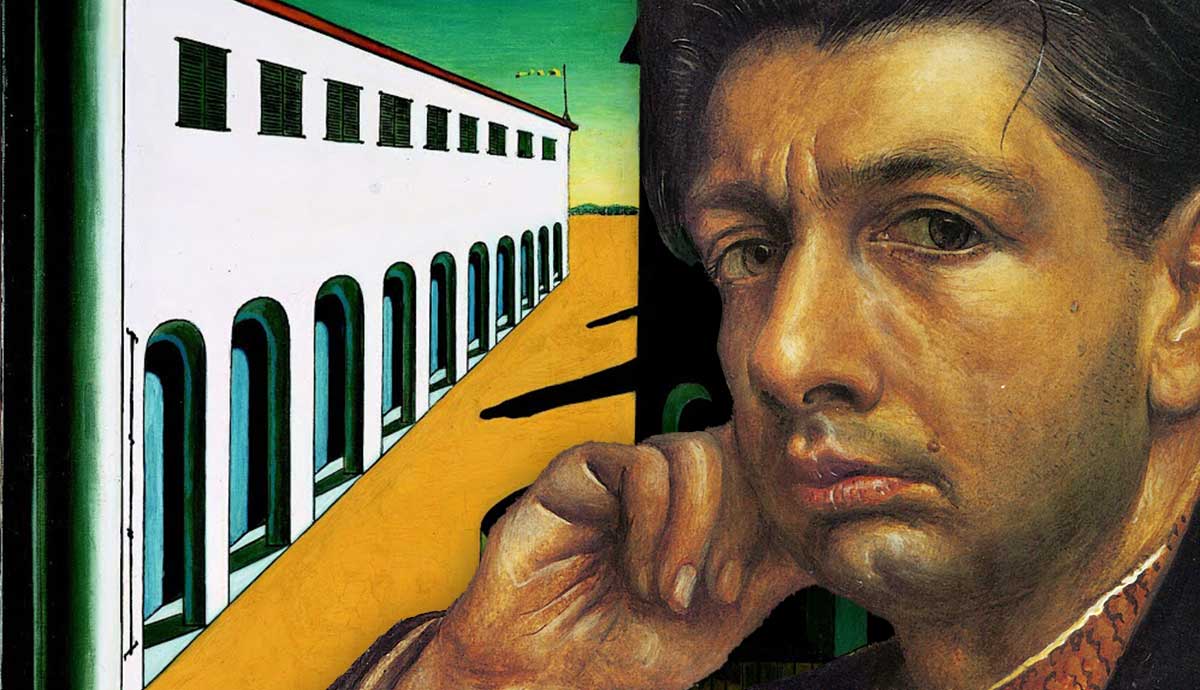
 Giorgio de Chirico created some of the most mysterious and influential images in modern European art. His deserted squares, silent arcades, distant trains, classical statues and faceless mannequins appear to belong to a recognizable world, yet their relationships defy ordinary logic.
These unsettling scenes became the foundation of Pittura Metafisica, or Metaphysical Art. Although de Chirico never joined the Surrealist movement, his paintings helped provide its visual language. René Magritte, Salvador Dalí, Max Ernst and other artists found in his work a way to transform familiar objects into carriers of dreams, memories and psychological tension.
Early Life in Greece and Germany
Giorgio de Chirico was born on July 10, 1888, in Volos, Greece, to Italian parents. His father, Evaristo, was an engineer involved in developing the Greek railway system. Trains, stations, signals and distant locomotives would later become recurring elements in his paintings.
Growing up in Greece also immersed the future artist in classical mythology, ancient ruins and Mediterranean light. Images of Ariadne, Apollo, gladiators, temples and statues remained central to his imagination throughout his career.
Following his father’s death, de Chirico moved with his mother and younger brother Andrea—later known as the artist and writer Alberto Savinio—to Munich. He studied at the Academy of Fine Arts and encountered the work of Arnold Böcklin and Max Klinger, whose symbolic, dreamlike images showed him that painting could suggest realities beyond straightforward observation.
The writings of Friedrich Nietzsche were equally important. De Chirico was fascinated by Nietzsche’s descriptions of Turin, melancholy and the sensation that ordinary appearances might conceal another level of existence. He would later transform such ideas into silent cityscapes in which time seems suspended.
The Birth of Metaphysical Art
De Chirico began developing his new visual language around 1910 while living in Florence. According to his own account, the sight of Piazza Santa Croce during a period of illness produced an intense feeling of revelation. The square suddenly appeared strange and unfamiliar, as if he were seeing its hidden reality for the first time.
Works such as The Enigma of an Autumn Afternoon emerged from this experience. Instead of documenting a real location, de Chirico simplified architecture, distorted perspective and removed most signs of everyday activity.
After moving to Paris in 1911, he refined these ideas in paintings now considered the heart of his Metaphysical period. Guillaume Apollinaire admired the young Italian artist, while collectors and writers began noticing his disturbing combinations of classical references and modern urban life.
The term “metaphysical” does not mean that the paintings illustrate a particular religious system. It describes de Chirico’s attempt to reveal the mystery concealed behind the visible world—the unfamiliar character that familiar things can acquire when removed from their normal context.
His paintings frequently contain understandable objects, but their relationships remain impossible to explain. A plaster head may appear beside a rubber glove. A train passes behind an ancient piazza. A giant artichoke occupies the foreground of an otherwise empty city. Perspective lines lead toward incompatible vanishing points, while shadows suggest people or structures outside the picture.
Metaphysical Art therefore differs from fantasy painting. De Chirico did not invent an entirely imaginary universe. He made the ordinary world feel inexplicable.
The Metaphysical Squares
The deserted piazza became one of de Chirico’s defining subjects. Paintings such as The Enigma of a Day, The Nostalgia of the Infinite and The Melancholy of Departure present arcades, towers, statues and railway infrastructure beneath unnaturally clear skies.
These spaces appear Italian, but they cannot be identified as accurate representations of a particular city. Turin’s long arcades and formal squares were important inspirations, while Florence, Ferrara and memories of Greece contributed additional elements.
De Chirico disrupted traditional perspective to create psychological unease. Buildings may recede at conflicting angles. Foreground objects appear disproportionately large, and tiny figures stand at impossible distances. Long shadows stretch across the ground even when their sources remain invisible.
The atmosphere is often beautiful but threatening. Bright sunlight illuminates the architecture, yet the squares seem abandoned. A small human figure may appear on the horizon, too distant to offer companionship. Time is suggested by clocks, trains and lengthening shadows, but it never seems to move forward.
Recurring Symbols and Their Meanings
De Chirico repeatedly returned to a relatively small group of images. Their precise meanings remain open to interpretation, but their autobiographical and philosophical associations are often clear.
Trains and Railway Stations
Railways connected de Chirico’s childhood memories with the modern world. His father’s profession gave trains a personal significance, while stations also represented separation, travel and departure.
A locomotive crossing the distant horizon introduces movement into an otherwise motionless scene. Yet the train usually remains inaccessible, separated from the viewer by walls or buildings. It promises escape while emphasizing isolation.
Arcades, Towers and Empty Piazzas
Arcades create alternating passages of light and darkness. They invite viewers to imagine what might be hidden within them while preventing a clear view.
Towers rise above the deserted city as symbols of ambition, memory or unreachable knowledge. De Chirico’s piazzas resemble stages awaiting an event that never occurs.
Classical Statues
Ancient sculptures connect modern urban space with Greece and Rome. They may represent cultural memory, but their stone bodies also appear lifeless and emotionally remote.
The sleeping Ariadne became especially important. In Greek mythology, Theseus abandoned Ariadne on Naxos while she slept. De Chirico associated the figure with loneliness and separation, particularly after moving to Paris. The Metropolitan Museum’s Ariadne of 1913 places the reclining statue in a desolate square, turning classical mythology into a personal image of exile and isolation.
Mannequins
Faceless mannequins began appearing prominently in de Chirico’s work during the First World War. These figures possess human proportions but lack eyes, mouths and individual identities.
They can be interpreted as modern people reduced to mechanical actors, as philosophical beings without personal history, or as symbols of human communication becoming impossible. In compositions such as The Seer, The Duo and Hector and Andromache, mannequins replace the heroes of mythology with fragile constructed bodies.
Gloves, Biscuits, Maps and Measuring Instruments
Ordinary objects take on an uncanny quality when enlarged, isolated or combined unexpectedly. Gloves suggest a human presence while remaining empty. Set squares and measuring tools evoke calculation but fail to impose order on the surrounding world. Maps, fragments of buildings, toys and biscuits create private visual puzzles.
In The Song of Love of 1914, a rubber glove, a classical head and a green ball appear together beside a passing train. MoMA describes this unlikely meeting of objects as an important precedent for the Surrealists, while noting that de Chirico sought to disclose a reality hidden beyond outward appearances.
Ferrara and the Metaphysical School
When Italy entered the First World War, de Chirico and Savinio returned to Italy for military service. De Chirico was stationed in Ferrara, whose Renaissance streets, arcades, shop windows and enclosed interiors inspired a new phase of his work.
In Ferrara he met Carlo Carrà, formerly associated with Futurism. Their exchange helped consolidate what became known as the Scuola Metafisica, or Metaphysical School. Giorgio Morandi was also briefly associated with its ideas.
The movement was never a formal organization with a fixed program. Its artists shared an interest in stillness, enigmatic combinations of objects, simplified architectural settings and the poetic possibilities of apparently ordinary things.
De Chirico’s Ferrara paintings frequently replaced open squares with claustrophobic interiors. Biscuits, picture frames, maps, geometric constructions and fragments of architecture crowd the shallow space. These “Metaphysical Interiors” suggest workshops, storerooms or theatrical sets whose objects have been arranged according to an unknowable system.
For a wider historical context, see Italia Mia’s guide to Italian art movements and periods.
Giorgio de Chirico and Surrealism
Surrealism officially emerged in Paris during the 1920s, after de Chirico had created his most celebrated Metaphysical paintings. The Surrealists nevertheless recognized him as a crucial predecessor.
André Breton admired the early paintings and treated de Chirico as an artist who had discovered how to make visible the irrational structure of dreams. The empty cities, abrupt changes of scale and unexplained encounters between objects anticipated the Surrealist practice of bringing unrelated realities together.
René Magritte later recalled the impact of seeing a reproduction of The Song of Love. Its apparently realistic objects formed an impossible visual statement, demonstrating that painting could challenge thought instead of simply representing the world.
Max Ernst responded to de Chirico’s strange dramas of inanimate objects. Salvador Dalí developed similarly extended perspectives, deserted spaces and elongated shadows, while Paul Delvaux placed dreamlike figures within silent classical cities. MoMA has described de Chirico’s early Metaphysical pictures as prophetic works that anticipated Surrealism and directly affected artists including Magritte, Dalí, Ernst and Yves Tanguy.
De Chirico’s relationship with the Surrealists soon deteriorated. When he embraced classical technique and began moving away from the appearance of his early work, Breton and his circle accused him of betraying his own achievement. De Chirico, fiercely independent and hostile to artistic movements that attempted to claim him, rejected their authority to divide his career into an inspired early period and an inferior later one.
The Return to Tradition
Around 1919, de Chirico began studying Old Master techniques and advocating a return to craftsmanship, drawing and museum traditions. This change was part of a broader European “return to order” following the disruptions of the First World War.
He produced portraits, self-portraits, still lifes, landscapes, mythological scenes, horses and paintings inspired by Renaissance and Baroque art. His brushwork became heavier and more overtly painterly, moving away from the smooth, sharply defined surfaces of his early Metaphysical pictures.
Many critics considered this transition a decline. The Surrealists were particularly severe, insisting that his truly important work had ended around 1917 or 1919. De Chirico rejected this interpretation for the rest of his life. He believed that critics were overly attached to one short stage of a career that continued for nearly seven decades.
Today, his later work receives more serious attention. Although uneven and radically different from the early paintings, it reveals his persistent engagement with artistic tradition, theatrical illusion, memory and the idea that images can exist outside a simple chronological progression.
Replicas, Revisions and the “True-Fake” Controversy
The most complicated aspect of de Chirico’s legacy concerns his decision to recreate earlier compositions.
From the 1920s onward, he painted new versions of successful Metaphysical works, sometimes repeating images decades after their first appearance. These were not necessarily forgeries: many were painted and signed by de Chirico himself. The difficulty arose when later versions carried early dates or circulated without a clearly documented history.
De Chirico considered a composition his intellectual property and believed he had the right to return to it. He also resented a market that valued his early Metaphysical paintings while dismissing his later development. Repainting the famous subjects allowed him to challenge the notion that artistic authenticity depended on a single first version.
The Uffizi describes its Metaphysical Composition, probably painted during the 1950s, as a faithful replica of The Song of Love. According to the museum, de Chirico’s systematic reproduction of earlier paintings questioned the conceptual distinction between original and copy and made a straightforward chronology of his work more difficult.
This practice caused lasting problems for collectors, museums and scholars. Several versions of the same composition may be authentic works painted by de Chirico at different dates. Others may have been altered, incorrectly dated or falsely attributed. The existence of genuine repetitions also created favorable conditions for conventional forgery.
De Chirico himself repeatedly denounced paintings he considered false, sometimes disputing works accepted by collectors or institutions. Authentication consequently became unusually contentious. The controversy should not be reduced to the claim that all his replicas were fakes. The more accurate distinction is between an autograph repetition painted by de Chirico, a deceptively dated work, an authorized edition and an object produced by somebody else.
Rather than diminishing the early paintings, this complicated history adds another dimension to de Chirico’s lifelong investigation of time. His repetitions destabilize the comforting belief that every artwork belongs to a single fixed moment.
Major Works
Among de Chirico’s most important paintings are:
- The Enigma of an Autumn Afternoon (1910)
- The Child’s Brain (1914)
- The Melancholy of Departure (1914)
- The Song of Love (1914)
- The Mystery and Melancholy of a Street (1914)
- The Seer (1915)
- The Disquieting Muses (1917)
- The Great Metaphysical Interior (1917)
- Hector and Andromache (multiple versions)
- The Archaeologists (multiple versions)
These works demonstrate how de Chirico transformed buildings, objects and classical subjects into psychological landscapes. MoMA alone holds more than 100 works by the artist in its online collection.
Where to See Giorgio de Chirico’s Art
The Giorgio de Chirico House Museum occupies the apartment at 31 Piazza di Spagna in Rome, where the artist settled in 1948. The rooms contain paintings, sculpture, furniture, personal objects and his studio, offering an unusually intimate view of his later life and working methods. The museum opened to the public in 1998.
Important works can also be found at:
- Museum of Modern Art, New York
- Metropolitan Museum of Art, New York
- Peggy Guggenheim Collection, Venice
- Galleria Nazionale d’Arte Moderna e Contemporanea, Rome
- Museo Carlo Bilotti, Rome
- Tate, London
- Centre Pompidou, Paris
- Kunstsammlung Nordrhein-Westfalen, Düsseldorf
- Pinakothek der Moderne, Munich
- Gallerie degli Uffizi, Florence
Readers planning an art-focused journey can also explore Italia Mia’s guides to Italy’s greatest art cities and the best places to see artworks in Italy.
Giorgio de Chirico’s Legacy
De Chirico died in Rome on November 20, 1978. By then, the strange imagery he had developed before the First World War had transformed the possibilities of modern painting.
His importance extends beyond Metaphysical Art and Surrealism. Filmmakers, photographers, architects, designers and later painters have drawn upon his empty urban spaces, cinematic shadows and theatrical arrangements. His influence can be recognized wherever an ordinary location is made to feel dreamlike, timeless or quietly threatening.
De Chirico’s art remains powerful because it refuses to solve its own mysteries. His clocks do not tell us precisely when we have arrived. His trains travel toward destinations we cannot see. His statues sleep, his mannequins cannot speak, and his arcades conceal more than they reveal.
The world in these paintings is physically familiar but psychologically unstable. That tension—between recognition and uncertainty—is Giorgio de Chirico’s enduring contribution to modern art.
External Links
- Fondazione Giorgio e Isa de Chirico
- Giorgio de Chirico at the Museum of Modern Art
- Giorgio de Chirico at the Peggy Guggenheim Collection
- Ariadne at the Metropolitan Museum of Art
- Metaphysical Composition at the Uffizi Galleries
- Giorgio de Chirico House Museum in Rome