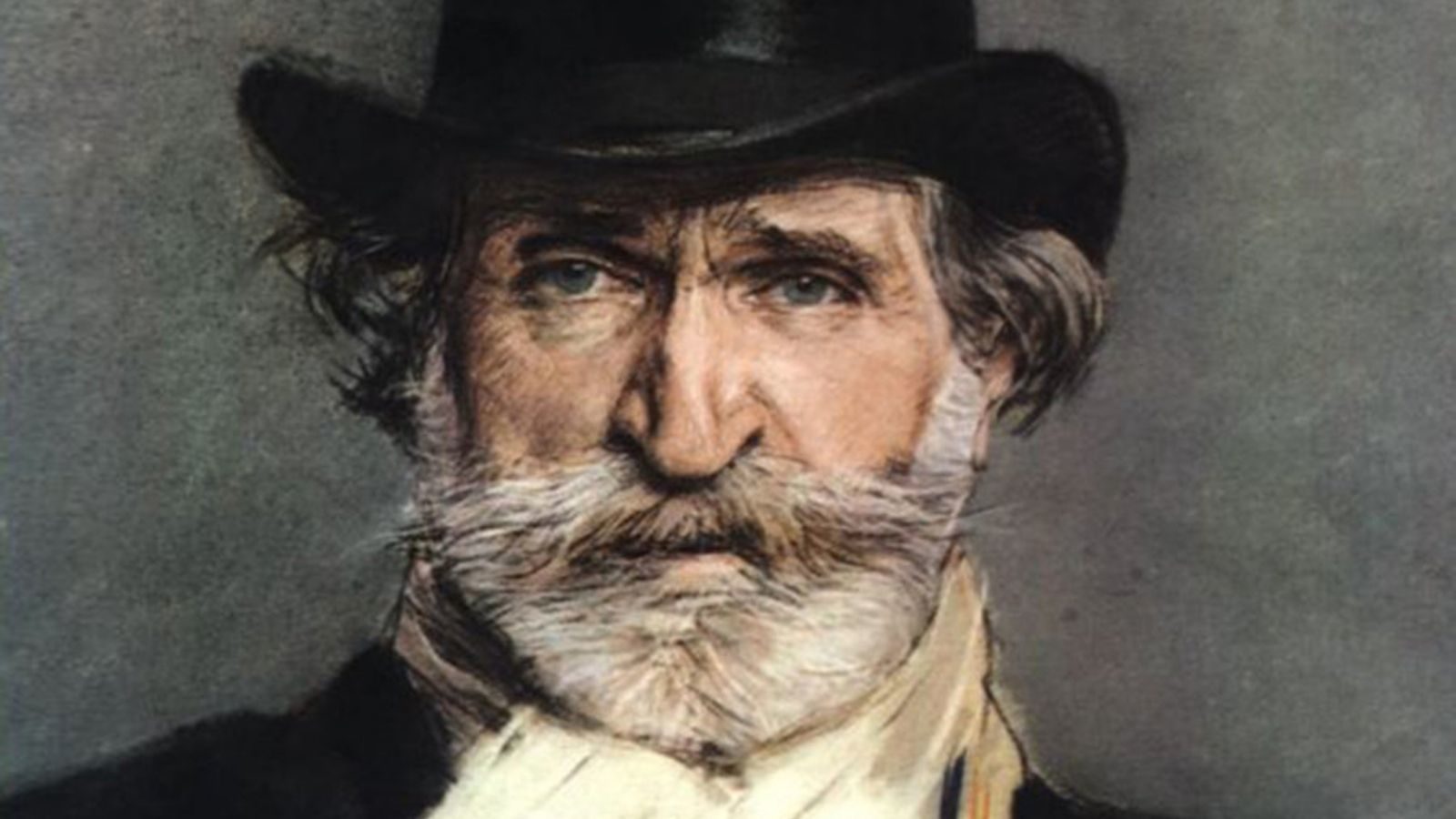
 Few composers are as closely identified with their country as Giuseppe Verdi. His melodies became part of Italy’s collective memory, his name was linked to the struggle for national unity, and his operas still form the backbone of the international repertoire.Yet Verdi was more than the author of stirring choruses and instantly recognizable arias. Across a career lasting more than half a century, he transformed Italian opera from the conventions of bel canto into a psychologically powerful form of musical drama. From Nabucco and Rigoletto to Aida, Otello and Falstaff, he created characters whose private conflicts unfold against forces such as political oppression, social prejudice, religious authority and family duty.
Childhood Between Roncole and Busseto
Giuseppe Fortunino Francesco Verdi was born on October 10, 1813, at Le Roncole, a rural settlement near Busseto in today’s Emilia-Romagna. At the time, the area formed part of the French Empire; after Napoleon’s fall, it became part of the restored Duchy of Parma.
His father, Carlo, operated an inn and sold provisions, while his mother, Luigia Uttini, worked as a spinner. The family was not wealthy, but neither was Verdi quite the destitute peasant later patriotic mythology sometimes made him.
His musical ability emerged early. He played the organ at the Church of San Michele in Roncole and continued his education in nearby Busseto. There he came under the protection of Antonio Barezzi, a prosperous merchant, amateur musician and president of the local Philharmonic Society. Barezzi recognized the young man’s talent, welcomed him into his home and helped finance his studies.
Verdi received instruction from Ferdinando Provesi, Busseto’s organist and music director, before travelling to Milan in 1832. He applied to the Milan Conservatory but was rejected, principally because he was considered too old for admission. Instead, he studied privately with Vincenzo Lavigna, a former musician at Teatro alla Scala, while attending performances and learning the practical workings of Italian theatre.
Readers interested in the wider tradition from which Verdi emerged can also explore Italia Mia’s guide to the most famous Italian opera composers.
Marriage, Bereavement and the First Operas
Verdi returned to Busseto and married Margherita Barezzi, his patron’s daughter, in 1836. The couple moved to Milan, where Verdi worked to establish himself as a composer.
His first staged opera, Oberto, conte di San Bonifacio, premiered at La Scala in November 1839 and achieved enough success to earn him another commission. His personal life, however, was collapsing. His two young children died in infancy, followed by Margherita in June 1840.
While suffering these losses, Verdi completed the comedy Un giorno di regno. Its La Scala premiere was a failure, and the grieving composer later recalled that he had considered abandoning music altogether.
The impresario Bartolomeo Merelli nevertheless encouraged him to examine a libretto by Temistocle Solera about the Babylonian king Nebuchadnezzar. The resulting opera changed Verdi’s life.
Nabucco and the Beginning of Fame
Nabucco premiered at La Scala on March 9, 1842, with the soprano Giuseppina Strepponi as Abigaille. Its dramatic scale, forceful rhythms and powerful choral writing electrified audiences.
The opera’s most famous number, “Va, pensiero,” is sung by the exiled Hebrews as they remember their lost homeland. Italian audiences living under foreign domination could later identify with its longing, and the chorus eventually became an unofficial expression of national identity.
It is tempting, however, to imagine the premiere as an overt political demonstration. Modern scholarship has shown that the story is more complicated. “Va, pensiero” became firmly established as a Risorgimento anthem largely through later performances, political circumstances and the creation of a national Verdi legend. Its patriotic meaning is real, but it developed over time rather than emerging fully formed on opening night.
Nabucco also brought Verdi closer to Giuseppina Strepponi. After her retirement from the stage, they became partners and eventually married in 1859. Strepponi remained an important source of emotional and intellectual support throughout his mature career.
Verdi’s “Galley Years”
The success of Nabucco began an exhausting period that Verdi later described as his “anni di galera,” or “galley years.” Between 1842 and 1850, he produced operas at remarkable speed for theatres throughout Italy and Europe.
I Lombardi alla prima crociata followed in 1843, while Ernani, based on Victor Hugo’s drama, premiered at Venice’s Teatro La Fenice in 1844. These works established the direct, energetic style of early Verdi: urgent vocal writing, strong contrasts and choruses capable of representing entire communities.
With Macbeth in 1847, Verdi began his lifelong engagement with Shakespeare. He was less interested in conventional vocal beauty than in the frightening atmosphere and psychological disintegration of Macbeth and Lady Macbeth. He even insisted that Lady Macbeth’s voice should possess a harsh, unsettling quality suitable for the character.
The political revolutions of 1848 gave Verdi’s music a more explicit patriotic context. La battaglia di Legnano, premiered in republican Rome in January 1849, depicted medieval Italian cities joining forces against an invading emperor. Its celebration of collective resistance spoke directly to contemporary hopes for independence.
Other operas from this demanding period, including Attila, I masnadieri, Il corsaro, Luisa Miller and Stiffelio, reveal a composer constantly testing how music could intensify dramatic action.
The Great Popular Trilogy
Between 1851 and 1853, Verdi composed the three works often called his “popular trilogy”: Rigoletto, Il trovatore and La traviata. Together they established the mature Verdi and remain among the world’s most frequently performed operas.
Rigoletto
Based on Victor Hugo’s controversial play Le roi s’amuse, Rigoletto faced severe censorship. Verdi and his librettist Francesco Maria Piave were forced to change the setting and transform the original French king into the Duke of Mantua.
Beneath its memorable melodies lies a bleak drama about power, exploitation and parental love. The Duke’s carefree “La donna è mobile” contrasts brutally with the suffering he causes, while Rigoletto’s relationship with his daughter Gilda gives the opera its emotional centre.
Il trovatore
Premiered in Rome in January 1853, Il trovatore is built around civil conflict, concealed identities, vengeance and a mother’s traumatic memories. Its complicated story is carried by extraordinarily concentrated music, including the Anvil Chorus, Leonora’s lyrical scenes and Manrico’s famous “Di quella pira.”
La traviata
Only six weeks later, La traviata premiered at La Fenice. Its heroine, Violetta Valéry, is a Parisian courtesan who sacrifices her happiness to protect the respectable family of the man she loves.
Instead of distant kings or medieval warriors, Verdi placed a socially marginalized contemporary woman at the centre of a tragedy. The first performance was poorly received, but the opera soon established itself as one of his supreme achievements. Violetta’s music evolves from the brilliance of “Sempre libera” to the heartbreaking restraint of her final act.
International Success and Grand Opera
Having mastered the Italian theatres, Verdi increasingly accepted international commissions. Parisian grand opera—with its large choruses, historical conflicts and elaborate staging—influenced Les Vêpres siciliennes, first performed at the Paris Opéra in 1855.
Simon Boccanegra followed in Venice in 1857. Although the first version was unsuccessful, Verdi later revised it extensively with Arrigo Boito. Its dark orchestral colours and political story about reconciliation, leadership and civic responsibility make it one of his most profound works.
Censorship again complicated Un ballo in maschera in 1859. The plot was inspired by the assassination of King Gustav III of Sweden, but officials objected to showing the murder of a monarch onstage. After numerous changes, the action was transferred to colonial Boston.
Verdi then travelled to St Petersburg for La forza del destino, premiered in 1862 and substantially revised for La Scala in 1869. Its characters are swept across years and countries by war, prejudice, coincidence and an apparently inescapable fate.
The French-language Don Carlos, first staged in Paris in 1867, brought his political theatre to its greatest scale. The personal tragedy of Carlos and Elisabeth unfolds within the oppressive court of Philip II, while the terrifying Grand Inquisitor represents religious authority capable of dominating even a king.
Verdi and the Risorgimento
Verdi’s association with the movement for Italian unification was partly musical, partly political and partly symbolic.
Audiences found patriotic meaning in the choruses of Nabucco, I Lombardi and Ernani, while La battaglia di Legnano responded directly to the revolutionary atmosphere of 1848–49. During the late 1850s, “Viva VERDI” also functioned as an acrostic for “Vittorio Emanuele Re d’Italia”—Vittorio Emanuele, King of Italy.
Verdi was not merely a passive patriotic symbol. At the urging of Count Camillo di Cavour, he stood for election in 1861 and became a deputy in the first Parliament of unified Italy. He was later appointed a senator of the Kingdom of Italy.
Nevertheless, reducing every early opera to coded nationalism oversimplifies his achievement. Verdi’s deepest political instinct was his sympathy for people trapped by abusive institutions: exiles, outsiders, persecuted minorities, compromised rulers, rebellious children and women condemned by social hypocrisy.
Aida, the Requiem and the Mature Master
Aida was commissioned by Khedive Isma’il Pasha for Cairo’s recently opened opera house. Contrary to a frequently repeated story, it did not inaugurate either the opera house or the Suez Canal. The theatre opened in 1869 with Verdi’s Rigoletto, while Aida received its premiere in Cairo on December 24, 1871.
Although remembered for the Triumphal March and its spectacular Egyptian setting, Aida is fundamentally an intimate tragedy. Aida, Radamès and Amneris are caught between private love, national loyalty and the demands of political and religious power. Some of the opera’s most affecting moments are quiet rather than monumental.
After the death of the writer Alessandro Manzoni, whom Verdi deeply admired, he composed the Messa da Requiem. First performed in Milan’s Church of San Marco in 1874, it combines sacred text with an almost operatic understanding of fear, grief and human mortality. The explosive “Dies irae” is balanced by passages of remarkable tenderness and uncertainty.
The Final Shakespearean Operas
Many believed Verdi had retired from opera after Aida. His publisher Giulio Ricordi and the composer-librettist Arrigo Boito gradually persuaded him to return, beginning with the revision of Simon Boccanegra.
Their collaboration culminated in Otello, premiered at La Scala in 1887. Boito’s compact libretto allowed Verdi to create an almost continuous dramatic structure. The opening storm immediately places the audience inside the action, while Otello’s jealousy and psychological collapse unfold without the conventional separation between decorative arias and drama.
Verdi was nearly 80 when his final opera, Falstaff, premiered in 1893. Based principally on Shakespeare’s The Merry Wives of Windsor, it is a fast-moving comedy filled with ensembles, shifting rhythms and affectionate wisdom. Its closing fugue declares that everything in the world is a jest—a surprisingly playful conclusion to one of opera’s most serious careers.
Verdi’s final compositions included the Quattro pezzi sacri, completed during the 1890s.
Philanthropy, Death and Casa Verdi
Away from the theatre, Verdi managed his estate at Sant’Agata with close attention to agriculture and local affairs. He supported charitable projects, including a hospital at Villanova sull’Arda, but his most enduring philanthropic achievement was the Casa di Riposo per Musicisti in Milan.
Designed as a home for elderly musicians, Casa Verdi was financed by the composer, who called it his finest work. He arranged for residents to be admitted only after his death, avoiding any suggestion that they should be personally grateful to him.
Verdi died at Milan’s Grand Hotel et de Milan on January 27, 1901, after suffering a stroke. His original funeral was deliberately private. The following month, when Verdi and Giuseppina Strepponi were transferred to the crypt of Casa Verdi, an enormous public procession accompanied them. Arturo Toscanini conducted a vast chorus in “Va, pensiero,” completing the transformation of the composer into a national figure.
Places in Italy Associated With Verdi
Travellers can follow Verdi’s life through Emilia-Romagna, the neighbouring province of Piacenza and Milan.
- Roncole Verdi: His modest birthplace is now the Museo Casa Natale Verdi. The nearby Church of San Michele is where he was baptized and played the organ as a boy.
- Busseto: Casa Barezzi preserves memories of Verdi’s patron and first family. The small Teatro Giuseppe Verdi, inaugurated in 1868, remains one of the most atmospheric places to experience his music.
- Villa Verdi at Sant’Agata: Verdi developed this country estate into his principal home and lived there with Giuseppina Strepponi. Because access arrangements can change, visitors should consult the official Villa Verdi information from Italy’s Ministry of Culture before travelling.
- Parma: The Teatro Regio is one of Italy’s great opera houses and the centre of the annual Festival Verdi, with performances held in Parma, Busseto and other nearby locations.
- Milan: La Scala launched Verdi’s career with Oberto and witnessed the premieres of Nabucco, Otello and Falstaff. The Museo Teatrale alla Scala preserves documents, portraits and objects connected with Italian opera.
- Casa Verdi: The Casa di Riposo per Musicisti remains a home for musicians as well as Verdi and Strepponi’s burial place.
These destinations can be included in a wider journey through the cultural and culinary heritage of Emilia-Romagna.
Verdi’s Enduring Legacy
Verdi inherited an operatic tradition dominated by vocal display and transformed it into theatre of extraordinary emotional and moral force. He never abandoned melody, but increasingly made melody, harmony, orchestration and dramatic pacing serve the characters and their conflicts.
His operas can be spectacular, yet their survival does not depend on spectacle. At their heart are recognizable human experiences: the fear of losing a child, the pain of exile, the intoxication of love, the corruption of power and the search for dignity in an unjust world.
That combination of accessibility and depth explains why Verdi remains central to Italian music and to opera houses around the world. His choruses may speak for nations, but his most lasting achievement was his ability to make individual voices—kings and courtesans, fathers and daughters, jesters and soldiers—sound unmistakably human.
External Links