

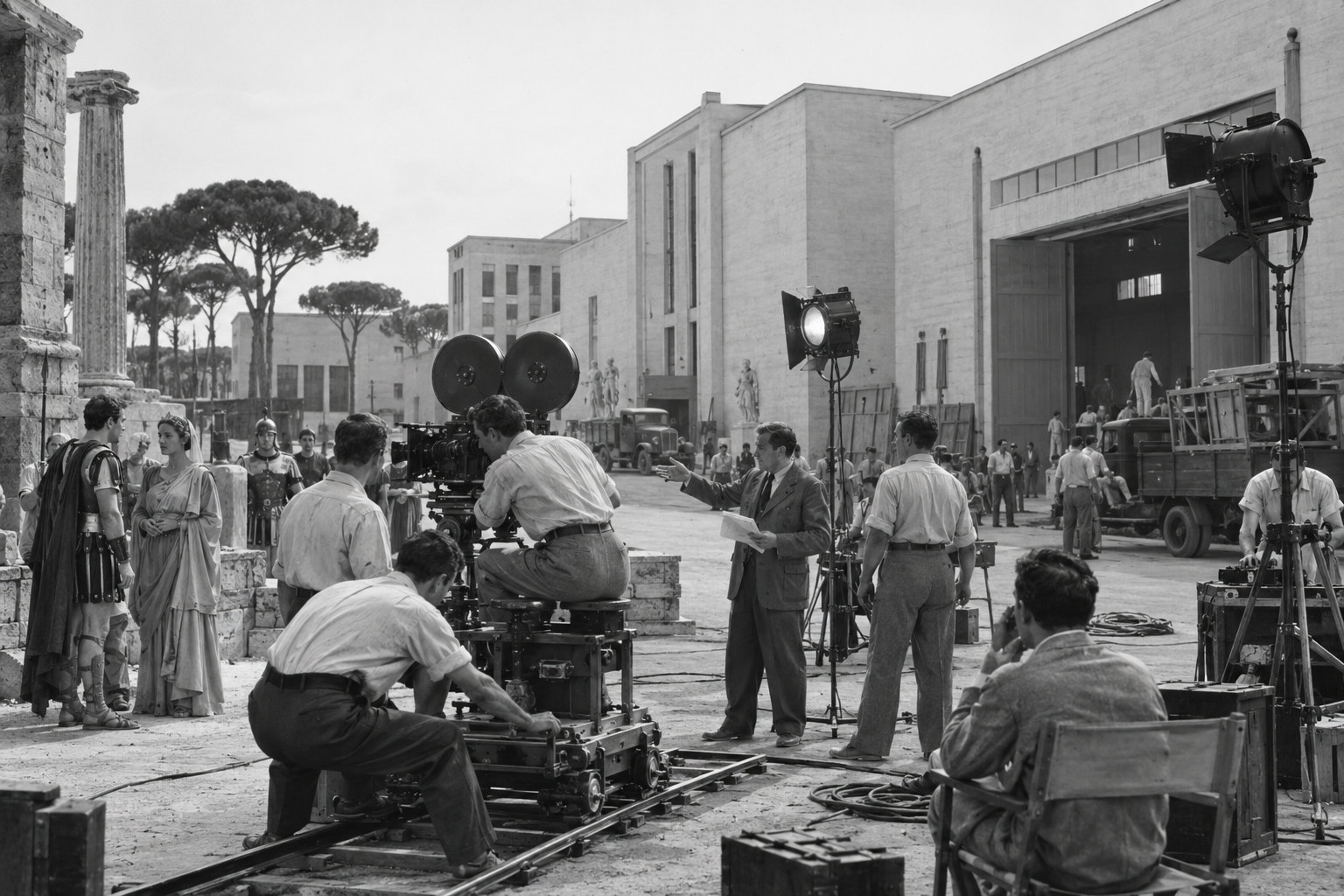
 During the late 1930s, Fascist Italy constructed an increasingly centralized film system encompassing production, professional training, censorship, distribution and exhibition. Cinecittà became its most visible symbol, but the celebrated Roman studios were only one part of a broader network of institutions and policies.
Two developments were especially important. Cinecittà opened in 1937 as a modern industrial production center, while legislation introduced in 1938 placed the importation of foreign films under state-controlled monopoly. Together, these measures expanded domestic film production and reduced Hollywood’s direct presence in the Italian market.
They also reveal the complexity of cinema under Fascism. The regime regarded film as an instrument of influence, yet most Italian features were not direct propaganda. Popular comedies, melodramas, literary adaptations and historical spectacles dominated commercial production, while more explicit political messages were frequently delivered through newsreels, documentaries and the activities of the Istituto Luce.
The Fascist State and the Reorganization of Cinema
When Benito Mussolini came to power in 1922, the Italian film industry was still struggling with the consequences of the severe postwar crisis. The international prominence achieved during the Golden Age of Italian silent cinema had largely disappeared, many studios had closed, and imported films—particularly American productions—occupied much of the domestic market.
The Fascist government did not immediately create a fully nationalized film industry. Instead, it gradually developed a system in which private companies operated under extensive state supervision and received public support.
A decisive step came in 1934 with the creation of the Direzione Generale per la Cinematografia, or General Directorate for Cinema. It brought responsibilities previously divided among several ministries under more centralized control. Luigi Freddi, who had studied aspects of the American studio system, became its influential director.
The government’s policy combined several objectives: increasing Italian production, reducing dependence on imported films, training a new generation of professionals and controlling what audiences could see. Economic support, censorship and institutional development therefore advanced together.
The Centro Sperimentale Predated Cinecittà
The Centro Sperimentale di Cinematografia must be distinguished clearly from Cinecittà. It was not created as one of the studio complex’s internal facilities.
The idea of a national cinema school had circulated since the beginning of the decade. After preliminary initiatives associated with Alessandro Blasetti and the National School of Cinematography, Luigi Freddi established the Centro Sperimentale under the direction of critic and educator Luigi Chiarini.
The institution formally took up temporary premises on April 13, 1935, and its courses began on October 1 of that year—approximately eighteen months before Cinecittà opened. Its first programs included acting, optics, sound, set design and production, together with shared courses in film aesthetics, history and the social function of cinema.
The Centro combined technical instruction with a broader cultural education. Chiarini worked with figures such as Umberto Barbaro, Alessandro Blasetti and Francesco Pasinetti, while the institution developed a library, a film collection and the influential journal Bianco e Nero.
Construction of the Centro’s permanent complex on Via Tuscolana began in 1937. Its location near Cinecittà reflected the concentration of Rome’s cinema institutions in the same area, but administrative proximity should not be confused with institutional identity. The school and the studios had related roles within the national film system, yet they were separate organizations with different purposes.
The Centro trained or influenced many people who later became important to Italian cinema, including Michelangelo Antonioni, Giuseppe De Santis, Pietro Germi, Luigi Zampa, Steno and cinematographer Gianni Di Venanzo. Its intellectual environment also helped expose students to international film theory, including Soviet approaches to editing and cinematic realism.
Why Cinecittà Was Built
Cinecittà emerged from the regime’s determination to rebuild production capacity on a much larger scale. The destruction of the Cines studios in a fire in September 1935 helped accelerate plans for a new complex, although Cinecittà should not be explained solely as a response to that event.
The first stone was laid in early 1936 on a large site along Via Tuscolana, southeast of central Rome. Architect Gino Peressutti designed an integrated complex containing sound stages, laboratories, workshops, offices, editing facilities and spaces for building sets and costumes.
The project was completed with remarkable speed. Cinecittà was officially inaugurated in the presence of Mussolini on April 28, 1937. The new studios were conceived as a place where many stages of filmmaking could be completed within a single production center.
Rather than being simply “Italy’s Hollywood,” Cinecittà represented an Italian adaptation of the industrial studio model. It provided infrastructure that private producers could use while allowing the state to exercise considerable influence over the direction of the national industry.
The original company was initially connected to entrepreneur Carlo Roncoroni. After his death in 1938 and the company’s financial difficulties, Cinecittà passed under direct state control. The transition strengthened the relationship between the studios and Fascist film policy, although production continued to involve numerous private companies.
Cinema as Industry, Entertainment and Political Instrument
Mussolini understood the persuasive potential of moving images, but it is misleading to imagine every feature made at Cinecittà as overt propaganda.
The regime exercised censorship, shaped access to financing and promoted films compatible with its desired image of the nation. Certain productions openly celebrated militarism, colonial conquest, national history or Fascist institutions. Alessandro Blasetti’s Vecchia guardia, released before Cinecittà opened, is a prominent example of an explicitly Fascist narrative.
Nevertheless, commercial entertainment remained essential to the industry. Romantic comedies, musical films, historical adventures and polished bourgeois dramas attracted audiences and helped normalize an image of Italy as orderly, prosperous and modern.
The distinction between entertainment and propaganda was therefore not always absolute. Films could avoid direct political declarations while still excluding poverty, conflict, repression and other realities that contradicted the regime’s preferred national image.
This ambiguity is particularly visible in the era’s elegant comedies, explored more fully in Telefoni Bianchi: Italian Cinema under Fascism. Their luxurious apartments, fashionable clothing and cosmopolitan settings offered escapism, but their artificial world also concealed the material and political conditions of contemporary Italy.
More direct and continuous propaganda was produced through the Istituto Luce, whose newsreels were shown in cinemas and presented carefully controlled images of Mussolini, military ceremonies, public works, colonial expansion and national life.
What the “Monopoly Law” Actually Did
The expression “Monopoly Law” can create the mistaken impression that the government simply prohibited foreign films on January 1, 1939. The actual institutional change began with legislation adopted in 1938 and concerned control over their importation and distribution.
Royal Decree-Law No. 1389 of September 4, 1938—commonly associated with Minister Dino Alfieri—established a state-controlled monopoly over the acquisition and importation of foreign films. The monopoly operated through ENIC, the Ente Nazionale Industrie Cinematografiche.
Foreign films were not completely banned. Instead, producers and distributors could no longer introduce them freely into the Italian market through their own established networks. The new arrangement gave the Italian state decisive control over which foreign titles entered the country and under what commercial conditions.
This policy formed part of Fascist autarky: the attempt to make Italy more economically and culturally self-sufficient. It also strengthened censorship by allowing the state to regulate access to foreign cinema before films reached Italian screens.
The major American companies reacted by withdrawing their regular distribution operations from Italy. The departure of companies including Metro-Goldwyn-Mayer, Paramount, Twentieth Century-Fox and Warner Bros. sharply reduced the availability of new Hollywood films.
The result was not the instant artistic liberation sometimes suggested in simplified accounts. Italian producers gained a protected domestic market, but audiences lost access to a substantial range of international films, while the industry became still more dependent on government regulation.
Expansion of Italian Film Production
Restrictions on foreign competition, combined with subsidies and improved studio infrastructure, stimulated Italian production. The number of domestically produced films rose rapidly as companies attempted to supply screens no longer receiving the same volume of American releases.
Cinecittà became the principal center of this expanding activity. Directors such as Mario Camerini, Alessandro Blasetti, Goffredo Alessandrini and Mario Mattoli worked within an industry that was developing a larger pool of actors, screenwriters, designers, cinematographers and technicians.
The studio system also helped consolidate the careers of performers such as Vittorio De Sica, Assia Noris, Amedeo Nazzari, Isa Miranda, Alida Valli and Clara Calamai.
Yet increased quantity did not create a single Fascist cinematic style. Films ranged from polished comedies and melodramas to literary adaptations, costume pictures and political spectacles. Some reflected official ideology directly, while others operated within the permitted boundaries of commercial entertainment.
The refined literary movement later called calligrafismo belongs mainly to the early 1940s and should not be presented as an immediate product of the 1938 monopoly. Its filmmakers favored carefully composed images, period settings and adaptations of nineteenth-century literature, sometimes creating an aesthetic distance from contemporary Fascist society.
Contradictions Within the Fascist Film System
The institutions built by the dictatorship did not always produce the political conformity their creators expected. Film schools, journals and studios brought together people with very different intellectual and political positions.
Bianco e Nero and the Centro Sperimentale introduced students to film history, criticism and international theories of cinema. Some future directors and writers who developed professionally within this system later contributed to antifascist culture and Italian Neorealism.
This does not make the institutions independent of the dictatorship. They existed because of Fascist cultural policy and operated under censorship. However, institutions can generate consequences that differ from the intentions of the political authorities that established them.
The skills developed during the 1930s—the training of actors and technicians, advances in cinematography, professional screenwriting and familiarity with film criticism—survived the collapse of the regime. After the war, some of the same professionals used them to create radically different images of Italy.
From Cinecittà to Neorealism
The years 1937–1939 did not constitute a completed golden age, nor did Cinecittà lead directly and inevitably to Neorealism. The Second World War disrupted production, damaged the studios and transformed Italian society.
During the German occupation, Cinecittà was looted and later used to shelter displaced people. Filmmakers working in the ruins of war increasingly turned toward streets, damaged neighborhoods, nonprofessional performers and stories about unemployment, resistance and survival.
The emergence of Italian Neorealism represented a break with the controlled and frequently artificial images associated with Fascist-era studio production. At the same time, many Neorealist filmmakers had acquired experience within the institutions and professional culture of the preceding decade.
Cinecittà itself recovered after the war and eventually became central to both Italian cinema and major international productions. Its postwar history, however, should not obscure its origins within the authoritarian cultural and economic policies of the Fascist state.
A More Accurate Historical Perspective
Cinecittà, the Centro Sperimentale and the foreign-film monopoly were related components of Fascist cinema policy, but they were not a single institution.
The Centro Sperimentale began operating in 1935 as a national school and cultural center. Cinecittà opened in 1937 as an industrial production complex. The 1938 monopoly placed the importation of foreign films under ENIC and prompted the major Hollywood companies to withdraw from the Italian market.
Together, these developments expanded Italy’s filmmaking capacity while increasing state control. They created opportunities for directors, actors and technicians, but they also served censorship, autarky and the cultural ambitions of a dictatorship.
That contradiction is essential to understanding Italian cinema between 1937 and 1939—and the very different cinematic movement that emerged after Fascism and war.
External Sources
Centro Sperimentale di Cinematografia – Institutional History
Archivio Storico Istituto Luce – The Birth of Cinecittà
Archivio Storico Istituto Luce – Cinecittà, the Home of Italian Cinema
Rai Teche – Cinecittà Opens in April 1937
Italia Taglia – The 1938 Foreign-Film Monopoly and Autarky