

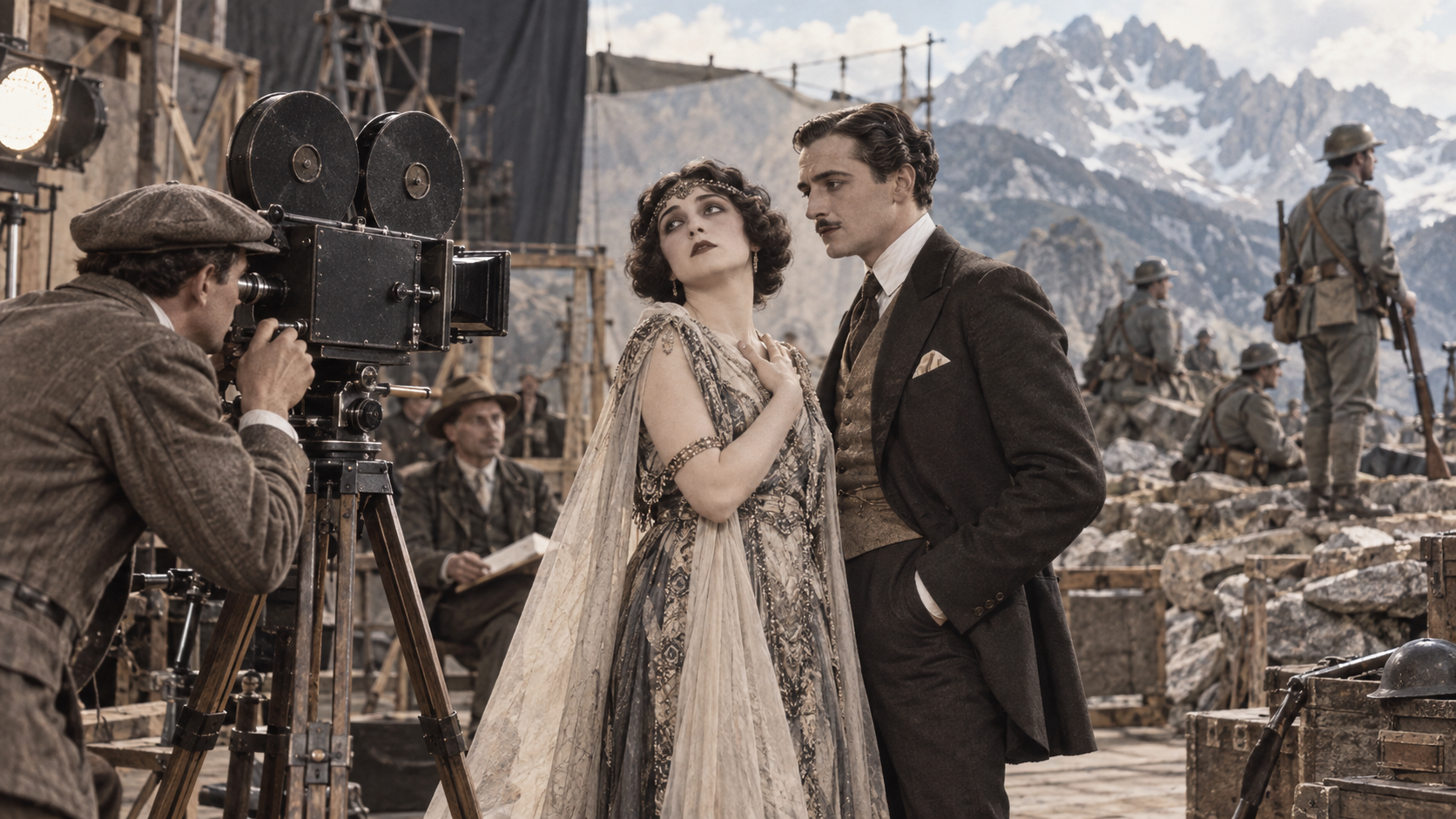
 Between 1914 and 1918, Italian cinema moved from the spectacular confidence of its first golden age into a far more uncertain wartime environment. Historical epics continued to circulate, but audiences were increasingly drawn to charismatic performers whose faces, gestures and carefully constructed public identities could carry a film.
This was the great age of the Italian diva. Lyda Borelli, Francesca Bertini, Pina Menichelli and Italia Almirante Manzini became much more than popular actresses: they were fashion models, cultural symbols and early examples of internationally recognized screen celebrities. Male performers such as Emilio Ghione, Mario Bonnard and Bartolomeo Pagano also developed distinctive screen identities.
When Italy entered the First World War in May 1915, cinema acquired another function. Fiction films, newsreels and documentaries were used to encourage patriotism, represent the armed forces and mobilize support on the home front. This wartime production should not be confused with the organized film policies of Mussolini’s dictatorship, which belonged to a later historical period.
From Historical Spectacle to the Star System
The years immediately before the war had been dominated by ambitious historical productions. Films such as Quo Vadis? and Cabiria established Italy as an international centre of cinematic spectacle, as explained in our guide to the Golden Age of Italian silent cinema.
The epic did not disappear after 1914, but another type of production became increasingly prominent: the melodrama built around a famous performer. Instead of monumental battles and ancient cities, these films often concentrated on forbidden desire, jealousy, betrayal, social ambition and emotional sacrifice.
The attraction was no longer simply the story. Audiences went to see a particular actress or actor, and film companies learned to promote performers as unique personalities. Portraits, postcards, magazines, publicity campaigns and extravagant costumes helped transform screen actors into celebrities whose influence extended beyond the cinema.
Lyda Borelli and the Birth of the Italian Diva
Lyda Borelli was one of the defining figures of Italian silent cinema. Already an acclaimed stage performer, she became a film sensation after appearing in Mario Caserini’s Ma l’amor mio non muore! in 1913.
Her style combined controlled movement, expressive poses, elaborate clothing and an intensely theatrical use of the body. Borelli frequently played elegant but tormented women whose passions led toward renunciation, madness or death. Her performances expressed the refined, decadent atmosphere associated with the literature and visual culture of the period.
Her fame generated a genuine cultural phenomenon. Contemporary expressions such as borellismo and borelleggiare were used to describe women who imitated her appearance, movements and languid poses.
Important Borelli films from the wartime period include La donna nuda (1914), La marcia nuziale (1915), La falena (1916), Malombra (1917) and Rapsodia satanica, filmed earlier but released in 1917. In Rapsodia satanica, directed by Nino Oxilia, Borelli plays an aging aristocrat who makes a supernatural bargain to recover her youth. The film combines melodrama, symbolism, music, colour tinting and an extraordinary visual performance by its star.
Borelli’s final film was La leggenda di Santa Barbara (1918), a patriotic production commissioned by the Ministry of Arms and Munitions. She left the stage and screen after marrying industrialist Vittorio Cini that same year.
Francesca Bertini: Glamour and Naturalism
Francesca Bertini offered a different version of the diva. While she could embody the fashionable, imperious and tragic woman associated with silent melodrama, she was also capable of a more restrained and naturalistic performance style.
Her most celebrated film of the period was Assunta Spina (1915), adapted from the drama by Salvatore Di Giacomo. Set in Naples, it tells the story of a woman caught in a destructive relationship shaped by jealousy, violence and social pressure. Bertini played the title role and also participated in the film’s direction, although Gustavo Serena received the principal directing credit.
Assunta Spina is important because its streets, working-class settings and emotional directness contrast with the artificial luxury of many diva films. Bertini’s performance is expressive without depending entirely on the sweeping gestures normally associated with silent-screen acting.
She also appeared in numerous romantic and tragic melodramas, including La signora dalle camelie (1915), Fedora (1916), Il processo Clémenceau (1917), Tosca (1918) and Frou-Frou (1918).
In the wartime film Mariute (1918), Bertini even parodied aspects of her own glamorous public image. Her ability to move between heightened melodrama, popular entertainment and greater naturalism helps explain why she became one of the most important stars of Italian silent cinema.
Pina Menichelli and the Dangerous Femme Fatale
Pina Menichelli represented the darker and more provocative side of Italian divismo. In films such as Il fuoco (1916) and Tigre reale (1916), both directed by Giovanni Pastrone, she played mysterious women whose beauty and independence unsettled the men around them.
Her screen persona relied on striking poses, sudden movements, intense facial expressions and carefully designed costumes. These elements could appear excessive to modern viewers, but they belonged to a sophisticated visual language created for silent cinema.
Menichelli’s characters were often less passive than conventional melodramatic heroines. They appeared dangerous because they pursued desire, controlled relationships or resisted respectable expectations. Her performances helped establish the femme fatale as one of the most recognizable figures in early Italian film.
Italia Almirante Manzini, remembered especially for playing Sophonisba in Cabiria, was another prominent actress of this generation. Together, these women demonstrated that the Italian star system did not depend on a single model of femininity. It offered audiences several competing versions of glamour, suffering, sensuality and independence.
Emilio Ghione, Mario Bonnard and the Male Film Star
Italian silent cinema also created influential male stars. Emilio Ghione developed one of the period’s most memorable recurring characters: Za la Mort, a criminal adventurer who gradually became a romantic defender of the oppressed.
Ghione’s thin figure, severe face and nervous physical energy distinguished him from the polished romantic leads of conventional melodrama. Za la Mort appeared in films including Nelly la gigolette (1914), Il triangolo giallo (1917) and the serial I topi grigi (1918). The character helped popularize action stories involving crime, disguise, pursuit and urban danger.
Mario Bonnard represented a more elegant type of male celebrity. Frequently cast as a handsome seducer or homme fatal, he became widely known through films such as Ma l’amor mio non muore! His popularity allowed him to establish his own production company, and in 1916 he began directing films as well as acting in them.
Bartolomeo Pagano offered yet another model of masculinity. After appearing as Maciste in Cabiria, he transformed the strongman into an independent screen hero. Maciste was removed from the ancient setting of the original film and placed in contemporary adventures, including a distinctly wartime story.
Italy Enters the First World War
Italy remained neutral during the opening months of the First World War and entered the conflict against Austria-Hungary on May 24, 1915. War placed severe pressure on the film industry. Studios faced shortages of raw film stock, higher costs, disrupted exports and the loss of employees called into military service.
Cinema nevertheless remained an important form of mass entertainment. Producers responded to the conflict with patriotic dramas, comic adventures, news films and documentary footage. The distinction between entertainment and propaganda was often fluid: an exciting popular film could promote national unity without resembling an official government statement.
Wartime films generally emphasized heroism, loyalty, sacrifice and the defence of Italian territory. The enemy was frequently reduced to a caricature, while the suffering, confusion and industrial violence of modern warfare were kept at a safe emotional distance.
Maciste Alpino: An Action Hero Goes to War
Maciste alpino, released in 1916, is one of the best-known examples of Italian wartime entertainment. Bartolomeo Pagano returned as Maciste, but the hero was no longer living in the ancient world of Cabiria.
The film begins with a company of actors working near the Austrian border as war breaks out. Maciste eventually joins the Alpini, the Italian Army’s mountain troops, and uses his exceptional strength to defeat enemy soldiers and rescue prisoners.
The result combines comedy, melodrama, action and patriotism. Maciste’s victories make war appear adventurous and manageable: physical courage, cleverness and national loyalty overcome every obstacle. The film reportedly became popular with soldiers as well as civilian audiences.
Maciste alpino also shows how effectively the emerging star system could serve wartime propaganda. Viewers already recognized Pagano and his heroic character, so the film could place an established popular icon directly inside the contemporary conflict.
Newsreels, Front-Line Film and Official Propaganda
During the early stages of Italy’s participation in the war, much of the filming was undertaken by private companies. Cameramen worked under strict military restrictions, and some scenes presented as authentic battlefield records were staged or reconstructed away from immediate danger.
Luca Comerio became one of the most important civilian filmmakers documenting the Italian front. His surviving work includes images of mountain warfare, artillery, military transport and soldiers operating in the difficult conditions of the Alps.
Official organization developed more slowly. Film sections connected to the Royal Army and Royal Navy were established during the second half of 1916. They produced documentary records and newsreels intended to present the armed forces as disciplined, technically capable and united.
The camera could not show the war without limits. Censorship restricted images that might reveal military information or weaken morale. As a result, official footage usually emphasized movement, equipment, ceremonies and organized activity rather than mutilated bodies, panic or military failure.
The Ministry of Arms and Munitions also used film to represent industrial mobilization and the contribution of civilians—particularly women—to wartime production.
Fantasy, Animation and the War
Not every wartime film relied on straightforward patriotic realism. La guerra e il sogno di Momi (1917), directed by Giovanni Pastrone with special-effects work by Segundo de Chomón, combined live action with animated puppets.
The story follows a child who falls asleep after hearing a letter from his father at the front. In his dream, toy soldiers come to life and fight a miniature war. The animated sequences are imaginative and technically remarkable, but they also convey something unsettling about mechanized conflict.
The film demonstrates that Italian wartime cinema was more varied than simple patriotic spectacle. Fantasy and visual experimentation could communicate the fascination of military technology while also suggesting its destructive character.
Wartime Cinema Was Not Fascist Cinema
The propaganda produced between 1915 and 1918 must be distinguished from the cinema of Mussolini’s dictatorship. Benito Mussolini did not become prime minister until 1922, while the major Fascist film institutions, state-sponsored newsreel system and Cinecittà studios developed later.
Italian First World War films promoted patriotism and support for the national war effort, but they were created under Italy’s liberal monarchy, not under a Fascist state. Describing them as products of Mussolini’s regime creates a serious chronological error.
For this reason, the later history of censorship, the LUCE newsreels, colonial propaganda, Cinecittà and the white telephone films belongs in separate articles.
The End of the Wartime Period
The armistice of November 1918 ended the fighting, but it did not restore the conditions of Italian cinema’s prewar success. Many companies had expanded rapidly without establishing a stable industrial foundation. Foreign markets had changed, American films had become increasingly dominant, and Italian studios struggled to adjust to new commercial realities.
Some silent stars continued working into the early 1920s, but the cultural world that had created the divas was beginning to fade. Lyda Borelli retired in 1918, while Francesca Bertini and Emilio Ghione faced an industry entering a period of contraction and reorganization.
Those problems are examined in the next chronological chapter, the great crisis of Italian cinema, 1919–1929.
The years from 1914 to 1918 nevertheless left a lasting legacy. Italian filmmakers refined one of cinema’s earliest star systems, created female screen personalities of extraordinary cultural power and learned how popular genres could be adapted to national propaganda. Their films preserve both the glamour of silent cinema and the tensions of a society living through modern war.
For the complete chronological sequence, visit ItaliaMia’s History of Italian Cinema.
Further Reading
For a broader scholarly study of the films, studios and performers of this era, see Italian Silent Cinema: A Reader on Amazon.com.
External Sources
1914–1918 Online – Film and Cinema in Italy During the First World War