

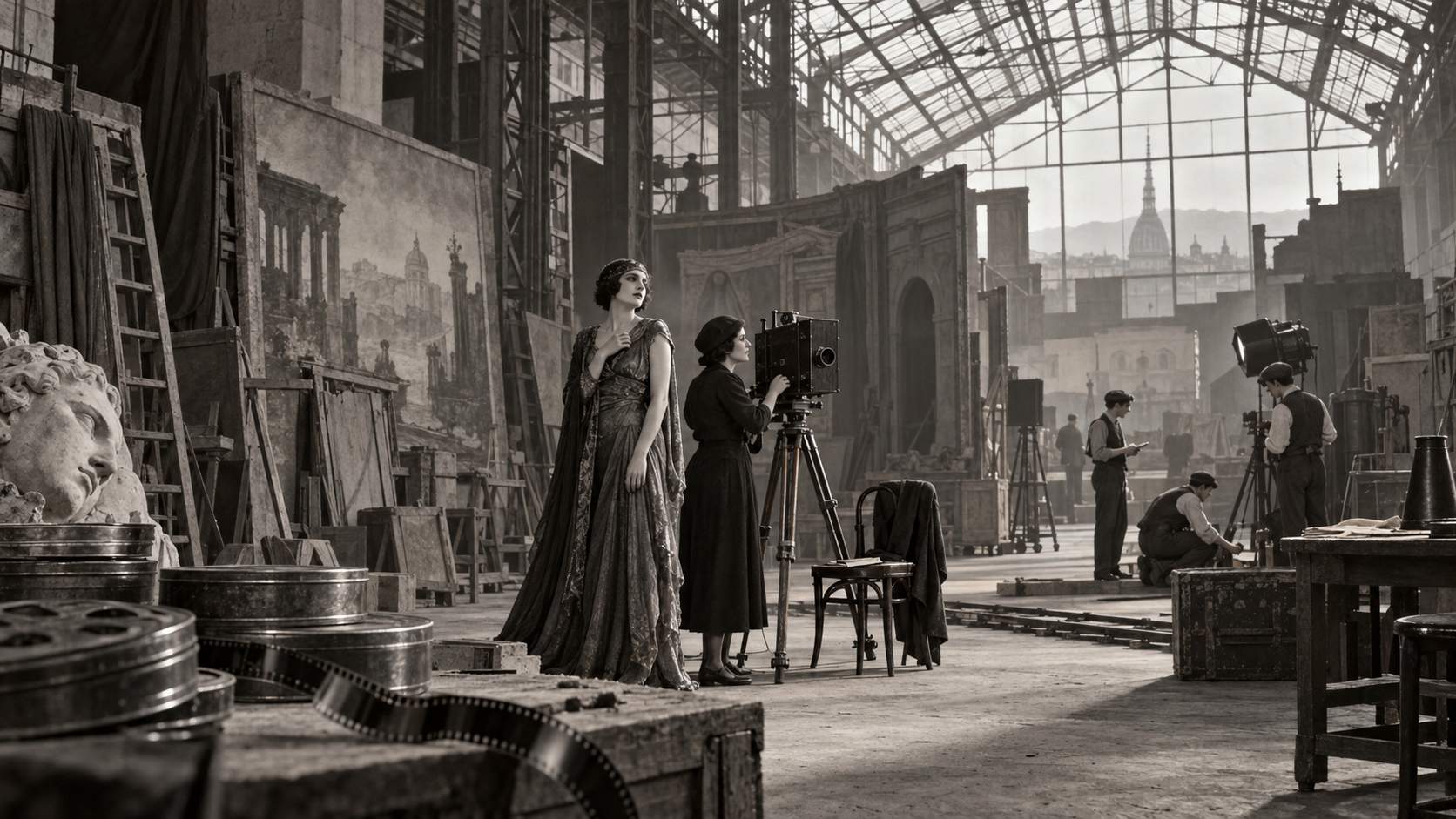
 The decade after the First World War was one of the most difficult periods in the history of Italian cinema. An industry that had recently impressed international audiences with historical spectacles, literary adaptations and stars such as Francesca Bertini entered a prolonged decline.
The crisis was not a complete disappearance of Italian filmmaking. Important films were still produced, regional traditions survived and a new generation began searching for a more modern cinematic language. Nevertheless, between 1919 and 1929, Italy lost much of the industrial strength and international influence it had enjoyed during the Golden Age of Italian silent cinema.
This period should therefore be understood as both a collapse and a transition: the old studio system weakened, but filmmakers such as Elvira Notari, Alessandro Blasetti and Mario Camerini pointed toward different possible futures.
From International Success to Industrial Crisis
Before the First World War, Italy had been one of the world’s leading film-producing countries. Turin, Rome, Milan and Naples supported companies capable of producing films for domestic and international distribution.
Productions such as Quo Vadis? and Giovanni Pastrone’s Cabiria demonstrated Italy’s command of large sets, historical reconstruction, crowd scenes and feature-length storytelling. Italian divas became internationally recognizable, while characters such as Maciste developed into popular screen icons.
The war disrupted many of the conditions that had made this success possible. Production materials became more expensive, foreign distribution networks were interrupted and European markets were transformed. When peace returned, Italian companies did not simply resume where they had stopped.
The international film business had changed. American studios had expanded their production and distribution systems, supplying exhibitors with a regular flow of technically polished films featuring internationally promoted stars. Italian producers remained divided among numerous companies, many of them undercapitalized and unable to guarantee a continuous program of releases.
Audiences were also changing. The monumental historical epic and emotionally extravagant diva film no longer possessed the novelty they had enjoyed before the war. Italian companies often continued to depend on established formulas while foreign competitors developed faster editing, new genres and more efficient methods of marketing and distribution.
The Failure of the Unione Cinematografica Italiana
In 1919, several producers attempted to confront the crisis by forming the Unione Cinematografica Italiana, generally known as UCI. The consortium brought together a number of important companies and was intended to consolidate resources, reduce damaging competition and restore Italian cinema’s position in international markets.
The idea appeared reasonable, but its execution was deeply problematic. UCI inherited the expenses and weaknesses of the companies it absorbed without creating an efficient, modern production system. Administrative costs, accumulated debt, expensive contracts and an inconsistent output made recovery increasingly difficult.
Instead of solving the industry’s structural problems, the consolidation often made them larger. Production decisions remained tied to established stars and genres, while American, German and French competitors continued to strengthen their control of European screens.
UCI’s collapse in 1925 became one of the clearest symbols of the crisis. Its failure affected associated companies, performers and technicians and confirmed that Italy could no longer sustain the industrial model that had produced its prewar cinematic triumphs.
The Decline of Turin’s Film Studios
Turin had been the principal center of early Italian filmmaking. Companies such as Ambrosio Film, Itala Film and Pasquali Film had built studios, trained technicians and established international reputations there.
The city’s importance rested on a combination of industrial knowledge, entrepreneurial investment and access to skilled craftspeople. Turin’s studios had helped produce the elaborate sets, costumes, photography and mechanical effects that distinguished the Italian kolossal.
During the 1920s, however, that network steadily weakened. Companies closed, reduced production or were absorbed into larger and often unstable organizations. Expensive studio spaces became difficult to maintain when films were no longer being produced regularly.
Itala Film never regained the extraordinary international momentum it had achieved with Cabiria. Ambrosio Film, after participating in UCI, also declined. Rodolfi Film remained active during the early part of the decade, but its studios were acquired in 1924 by the distributor and producer Stefano Pittaluga.
Pittaluga became one of the most influential figures in the weakened industry because he understood that control of distribution and cinemas could be more valuable than maintaining the old production model. His growing network helped reorganize Italian film exhibition, although it could not immediately restore the scale of national production.
Turin did not cease to be part of Italian film culture, but it lost its earlier position as the country’s dominant filmmaking capital. Talent, investment and institutional power gradually moved elsewhere, particularly toward Rome. That shift would become much more pronounced with the arrival of sound and the state-supported expansion of Roman production during the 1930s.
The Migration of Italian Film Talent
The domestic contraction forced many Italian filmmakers to look abroad for opportunities. Directors, actors, cinematographers and technicians found employment in France, Germany and other European production centers where studios remained more active.
Augusto Genina developed an international career that took him to France and Germany. Carmine Gallone also worked outside Italy, participating in the increasingly interconnected European film industry. Other filmmakers adapted by moving between countries, joining international productions or working for foreign-backed companies.
This migration was both a symptom of the crisis and a means of preserving Italian professional experience. Filmmakers who worked abroad encountered different production systems, visual styles and technical practices. Some later brought that experience back to Italy.
However, the departure of established talent made domestic recovery more difficult. Studios could not easily rebuild when experienced directors and technicians were making films elsewhere, while young filmmakers had few opportunities to develop their skills at home.
Francesca Bertini and the Decline of the Diva Film
Francesca Bertini had been one of the greatest stars of Italian silent cinema. Her performances in films such as Assunta Spina and La signora delle camelie helped define the diva film: an intensely emotional form of melodrama centered on female desire, suffering, social conflict and personal sacrifice.
Bertini was more than a performer presented by the camera. She exercised unusual influence over her productions and carefully constructed a screen identity combining glamour, emotional intensity and dramatic authority.
Her continued commercial importance was demonstrated by the extraordinarily valuable contract she received in 1920 for a series of films connected with Caesar Film and UCI. Yet the size of such contracts also revealed the industry’s dependence on famous personalities at a time when its financial foundations were already unstable.
During the 1920s, Bertini continued to appear in films and worked beyond Italy, including in France. Nevertheless, the cultural moment that had created the great Italian divas was passing. Audiences increasingly responded to different types of performance, while American stars benefited from much stronger publicity and distribution systems.
Bertini’s reduced presence should not be interpreted as a sudden loss of talent or importance. It reflected the breakdown of the industrial and cultural environment that had supported the diva film. Her career remains essential to understanding how early Italian cinema placed women at the center of internationally successful screen narratives.
Elvira Notari and a Different Cinema of Naples
While the large northern studios struggled, Elvira Notari and Dora Film maintained a remarkably distinctive form of filmmaking in Naples.
Notari was one of the most important women working in silent cinema. She wrote, directed and edited films, while her husband Nicola Notari operated the camera. Their sons and other family members also participated in the company, giving Dora Film the character of a small but integrated family enterprise.
Her films differed sharply from the monumental epics and upper-class diva dramas associated with earlier Italian success. Notari filmed streets, courtyards and working-class neighborhoods, combining melodrama with recognizable details of Neapolitan life.
Films such as ’A Santanotte, È piccerella and Fantasia ’e surdato drew upon popular songs, crime stories, family conflicts and the theatrical tradition of the sceneggiata. Musical performers could accompany screenings, connecting the silent images with songs already familiar to audiences.
These productions also circulated among emigrant communities, particularly Neapolitan audiences in the United States. They preserved dialect, gestures, music and urban settings that offered emigrants a powerful connection with the culture they had left behind.
Notari’s cinema was not documentary in the modern sense, and it should not be casually labeled an early version of Neorealism. Her stories were highly melodramatic and shaped by popular entertainment. Nevertheless, their streets, crowds and working-class characters preserved a view of Italian life largely absent from more prestigious studio productions.
Increasing censorship created serious difficulties for Dora Film. Fascist authorities objected to representations of Naples associated with poverty, crime, disorder and social marginality. The transition to sound imposed additional costs that a relatively small company could not easily absorb. Dora Film ended production around 1930.
Only a small part of Notari’s extensive output survives. Her rediscovery has therefore required film restoration, archival research and the reconstruction of works from documents, reviews and surviving fragments.
Fascism, Newsreels and Limited Support for Feature Films
Benito Mussolini came to power in 1922, but the Fascist regime did not immediately rebuild commercial feature-film production. During the first half of the decade, private studios continued to struggle with debt, shrinking output and foreign competition.
The regime recognized cinema’s usefulness most clearly in nonfiction and propaganda. The organization that became the Istituto Luce was founded in 1924 and brought under government control in 1925. Its newsreels, documentaries and educational films helped the regime circulate carefully managed images of political ceremonies, modernization and national life.
Compulsory exhibition of Luce material gave the state an increasingly visible presence inside Italian cinemas. This should not be confused, however, with a complete revival of the feature-film industry. During most of the 1920s, Italian screens remained heavily dependent on imported films.
Government measures introduced toward the end of the decade offered some protection to domestic production, but the systematic institutions associated with Fascist-era cinema developed mainly during the 1930s. The establishment of Cinecittà, for example, did not occur until 1937.
Film Culture Begins to Reorganize
The crisis also encouraged debate about what a renewed Italian cinema should become. Film journals, critics and young enthusiasts argued that national production needed stronger organization, new subjects and a visual language suited to contemporary audiences.
Alessandro Blasetti emerged from this critical culture. In 1927, he helped establish the journal Cinematografo, which advocated a revival of Italian filmmaking. He subsequently became involved with the Augustus production cooperative and moved from criticism into direction.
This activity mattered because it treated cinema as both an art and an industry. The problem was no longer simply how to imitate the successes of the prewar era. Italian filmmakers needed to create new production structures and reconnect cinema with modern national life.
Alessandro Blasetti and Sole
Blasetti’s Sole, released in 1929, became one of the most discussed films of the decade’s closing years. Set against a rural land-reclamation project, it combined landscape, labor, machinery and collective action with a strongly constructed visual style.
Most of the film is lost, making sweeping judgments about it difficult. Surviving fragments and contemporary documentation nevertheless indicate Blasetti’s ambition to move beyond the declining formulas of Italian silent cinema.
Sole also reflected ideas compatible with Fascist celebrations of rural transformation and collective national effort. It should therefore not be presented simply as a politically neutral step toward postwar Neorealism. Its historical importance lies in its attempt to create an energetic, modern Italian cinema during a period of industrial weakness.
Blasetti would become a major and sometimes politically complicated figure in the cinema of the following decades, working across historical films, comedy, spectacle and other genres.
Mario Camerini: From Kif Tebbi to Rotaie
Mario Camerini offered another route out of the crisis. His Kif Tebbi, released in 1928, was an adventure film set during the conflict between Italy and the Ottoman Empire in Libya. Its dynamic outdoor photography and action sequences distinguished it from many routine Italian productions of the period.
The film also belongs to the history of colonial representation and must be viewed critically within the political culture of Fascist Italy. Its technical vitality cannot be separated entirely from the ideology surrounding its North African setting.
Camerini followed it with Rotaie, produced in 1929. The film tells the story of a financially desperate young couple whose encounter with money and luxury changes the direction of their lives. Railway stations, hotels, gambling rooms and moving trains create an atmosphere of uncertainty and modernity.
Although conceived as a silent film, Rotaie was released in a synchronized version after sound began entering Italian production. Its expressive images, restrained performances and attention to everyday emotion helped establish Camerini as one of the most accomplished Italian directors of his generation.
Camerini later became especially important for sophisticated comedies featuring contemporary characters and settings. Those films helped shape Italian popular cinema during the 1930s, although it would be misleading to treat all his work as belonging neatly to the “white telephones” category.
Why 1929 Marks a Turning Point
The year 1929 did not bring an immediate end to the industry’s problems. Italian production remained fragile, foreign films continued to dominate many screens and the expensive transition to synchronized sound created another major challenge.
Yet Sole, Kif Tebbi and Rotaie demonstrated that a new generation was emerging. These films did not revive the lost world of the prewar kolossal or the diva melodrama. Instead, they experimented with landscape, movement, modern environments, social themes and more controlled screen performances.
The following decade would bring sound production, increasing state intervention and the concentration of the industry in Rome. It would also produce popular comedy, historical spectacles, propaganda, censorship and the sophisticated urban films discussed in our guide to white-telephone cinema and Cinecittà.
The crisis of 1919–1929 was therefore not a forgotten interval between two golden ages. It changed where Italian films were made, weakened the old studios, dispersed creative talent and exposed the structural problems of the national industry.
At the same time, Elvira Notari preserved an alternative regional cinema, Francesca Bertini carried the legacy of the diva era into a changing market, and Blasetti and Camerini opened paths toward renewal. Their different experiences make this decade an essential chapter in the broader history of Italian cinema.
Further Reading
For a scholarly collection covering Italian silent-film studios, performers, genres and international circulation, see Italian Silent Cinema: A Reader on Amazon.com.
External Sources
Museo Nazionale del Cinema – Collections and Italian film heritage
European Film Gateway – Silent films from the Museo Nazionale del Cinema
Women Film Pioneers Project – Research on women in silent cinema
Treccani – Italian cinema history and reference archive
Cineteca di Bologna – Film restoration, archives and Italian cinema