 Italian Superstitions Explained: Luck, the Evil Eye and Strange Traditions
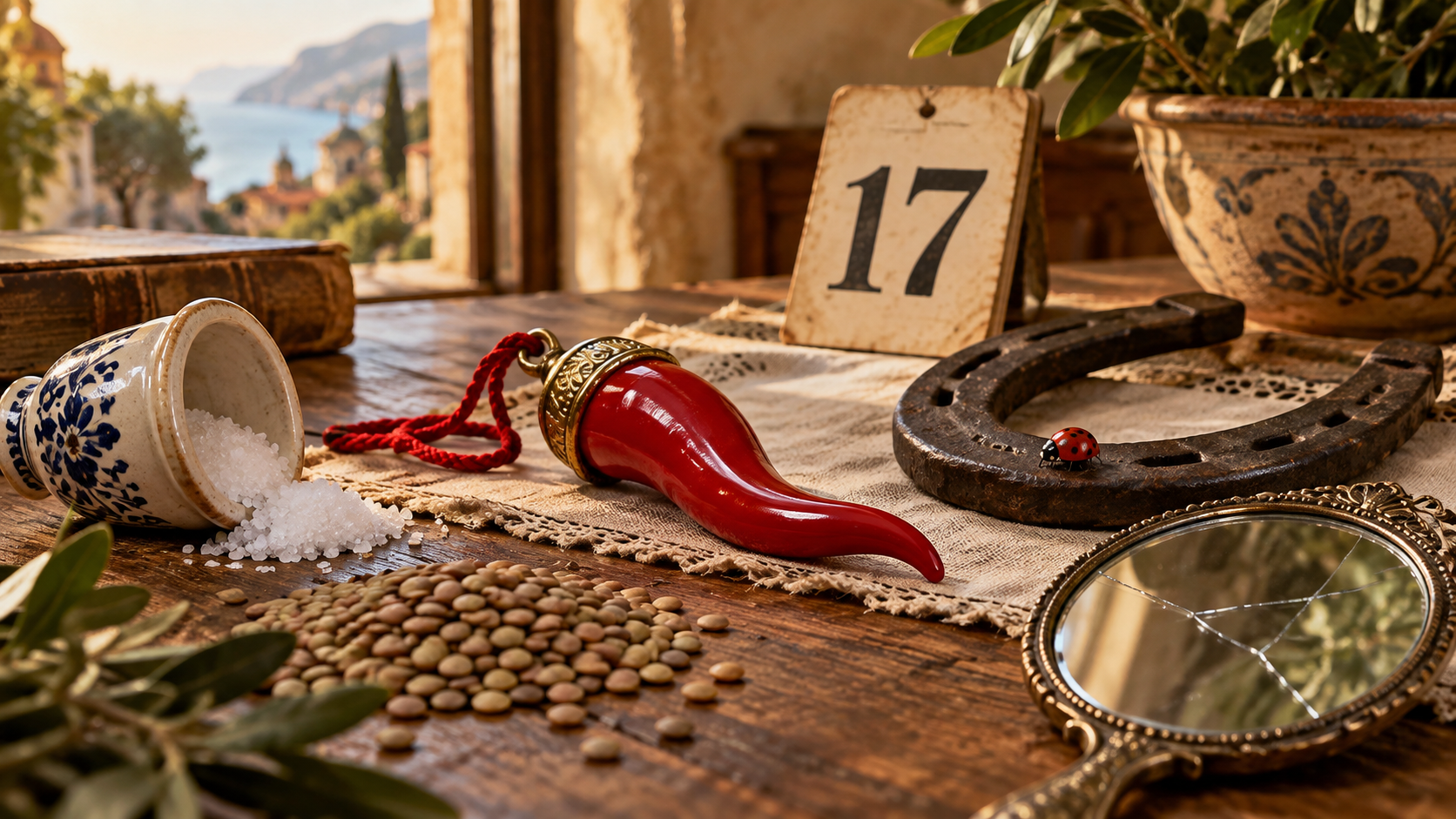
An Italian spills salt at the dinner table and immediately throws a pinch over a shoulder. A hotel avoids giving a room the number 17. Someone mentions a promising new opportunity, and a friend reaches for the nearest piece of iron. In Naples, a small red horn hangs from a doorway, while on New Year’s Eve families eat lentils in the hope of attracting prosperity.
These gestures may seem mysterious to visitors, but they belong to a remarkably rich world of Italian superstitions, protective rituals and popular beliefs.
Italy is a modern country, yet ancient customs continue to appear in ordinary conversation and daily life. Some Italians sincerely believe in them. Others repeat them jokingly, as habits inherited from parents and grandparents. Many claim not to be superstitious at all—right before touching iron to avoid tempting fate.
A popular expression captures this contradiction perfectly:
Non è vero, ma ci credo.
“It isn’t true, but I believe it.”
Italian superstitions are not a single, organized system. They are a mixture of Roman beliefs, medieval religion, rural folklore, local legends and family traditions. Customs can change from one region to another, and sometimes even from one village to the next.
Together, however, they reveal something captivating about Italian culture: the enduring human desire to negotiate with luck, protect loved ones and make sense of life’s uncertainties.
Superstition, Folklore and Scaramanzia
The Italian word for superstition is superstizione. A closely related term is scaramanzia, which refers to words or actions intended to prevent bad luck.
A person particularly concerned about such matters may be described as superstizioso or scaramantico.
Not every traditional gesture is performed with complete seriousness. Italians may touch iron, make the horn gesture or say a protective phrase while laughing. The ritual can survive even when literal belief has faded.
These customs belong to folklore: traditions, stories, sayings, rituals and beliefs transmitted from person to person, often through families rather than formal education.
That explains why an Italian may be unable to tell you exactly where a superstition originated. The most common explanation is simply:
“My grandmother always did it.”
Why Friday the 17th Is Unlucky in Italy
In much of the English-speaking world, Friday the 13th is considered unlucky. In Italy, the more ominous date is traditionally Friday the 17th: venerdì 17.
One frequently repeated explanation involves the Roman numeral for 17:
XVII
The letters can be rearranged to form:
VIXI
In Latin, vixi means “I have lived.” On a tomb, the expression implied that a person’s life had ended. Through this association, the number 17 became connected with death and misfortune.
Friday already carried negative religious associations because Christian tradition identifies it as the day of Christ’s crucifixion. Combining Friday and 17 consequently produced an especially unlucky date.
The belief remains visible in modern Italy. Some hotels omit room 17, certain buildings avoid a seventeenth floor and the number may be missing from rows of seats.
Nevertheless, not every Italian worries about it. For some, Friday the 17th is frightening; for others, it is merely a familiar cultural joke.
The number 13, surprisingly, has sometimes been regarded as lucky in Italy. An old expression, fare tredici—to make thirteen—referred to winning the top prize in the football-pool competition Totocalcio.
Beliefs evolve, however, and international films and popular culture have made Friday the 13th recognizable in Italy as well.
The Malocchio: Italy’s Evil Eye
The malocchio, or evil eye, is among the best-known Italian folk beliefs.
According to tradition, envy, jealousy or excessive admiration can direct harmful energy toward another person. The supposed effects might include headaches, weakness, a succession of unfortunate events or a general feeling that something is wrong.
The word combines male, meaning evil or harm, and occhio, meaning eye.
Belief in the evil eye is not unique to Italy. Variations exist throughout the Mediterranean, the Middle East, the Balkans and other parts of the world. In Italy, it became particularly associated with southern regions, although versions of the belief can be found elsewhere.
The malocchio does not always require a deliberate curse. In some traditions, even an envious glance or excessive praise may bring unwanted attention from fate.
This helps explain an old reluctance to praise a baby’s beauty without adding a protective expression or gesture. Compliments were welcome, but people did not want fortune to notice that a family possessed something precious.
How the Malocchio Was Traditionally Diagnosed
In some families, a person believed to be suffering from the evil eye was examined through a ritual involving water and drops of olive oil.
The exact procedure varied by region and household. Typically, a few drops of oil were placed in a bowl or dish of water. The way the oil behaved was then interpreted as evidence of whether the malocchio was present.
Prayers or formulas might accompany the ritual. In some traditions, these words could be taught only on a particular religious occasion, such as Christmas Eve, and passed privately from one generation to another.
Such practices should be understood as folklore rather than medical diagnosis. They remain culturally interesting, but unexplained physical or psychological symptoms require proper medical attention.
Today, many Italians know about the ritual without practicing it. Others remember seeing a grandmother or elderly relative perform it during childhood.
The Cornicello: Italy’s Famous Red Horn
One of the most recognizable Italian lucky charms is the cornicello, also known simply as the corno.
It is a long, curved horn, traditionally red, worn as jewelry or placed in homes, shops and vehicles. It is especially associated with Naples and southern Italy.
At first glance, visitors sometimes mistake it for a chili pepper. Its shape, however, represents a horn rather than a vegetable.
Horns have symbolized strength, fertility and protection since antiquity. The cornicello is traditionally used to defend its owner from envy, misfortune and the evil eye.
An authentic traditional cornicello is often said to be most effective when received as a gift. Buying one for yourself may look attractive, but according to the superstition, a charm given with affection carries greater protective power.
Modern cornicelli appear in coral, gold, silver, ceramic and inexpensive plastic. They can be found on necklaces, bracelets, keychains and decorations.
For many people, the object expresses Neapolitan or Italian identity as much as literal belief in magic.
The Mano Cornuta
The hand gesture known as the mano cornuta imitates a pair of horns. It is made by extending the index finger and little finger while folding the middle fingers toward the palm.
Its meaning depends heavily on its direction and context.
When pointed downward or used discreetly, the gesture can be intended to repel bad luck or the evil eye. Someone may make it after hearing an ominous prediction or when confronted with a person considered unlucky.
Pointing the same gesture directly at a man can have a completely different—and insulting—meaning. In that context, the “horns” suggest that his partner is unfaithful and that he is a cornuto.
The gesture is also familiar internationally from rock and heavy-metal culture. Visitors should therefore avoid assuming that every use carries the same meaning.
As with the many gestures accompanying Italian greetings and everyday communication, situation and body language are essential.
Touching Iron Instead of Knocking on Wood
English speakers often knock on wood to avoid tempting fate. Italians traditionally say:
Tocca ferro.
“Touch iron.”
Someone discussing a hope for the future might reach toward a metal object after another person warns, “Don’t speak too soon.”
Iron has long been associated with protection and strength. One explanation connects the custom to the horseshoe, an object traditionally considered fortunate. Other interpretations link iron with ancient weapons and the supposed ability of metal to repel threatening forces.
Modern life has added an amusing problem: furniture and offices do not always provide a convenient piece of iron. People may touch keys, a railing or whatever metal object happens to be nearby.
Italians are also familiar with toccare legno, or touching wood, partly because the custom exists in other cultures. Nevertheless, toccare ferro remains the characteristically Italian expression.
Never Place Bread Upside Down
In many Italian households, placing a loaf of bread upside down on the table is considered disrespectful or unlucky.
Bread carries profound symbolic importance in Italian culture. It represents nourishment, work, hospitality and, in Christianity, the body of Christ. Treating it carelessly could therefore be interpreted as a lack of respect.
Several historical explanations have been proposed for the upside-down loaf taboo. One story claims that bakers once placed bread intended for an executioner upside down so that other customers would recognize and avoid it. The details vary, and the tale is difficult to verify, but the association between inverted bread and misfortune survives.
Even Italians who reject the superstition may instinctively turn a loaf back to its proper position.
The custom reflects the special place food occupies in Italy, where eating is connected not only with taste but also with family, memory and identity. Italia Mia’s broader introduction to Italian culture explores how deeply food and social tradition are intertwined.
Spilling Salt and Olive Oil
Spilling salt is considered unlucky in numerous cultures, including Italy.
Historically, salt was valuable. Wasting it could therefore represent a meaningful household loss. Salt also acquired religious and symbolic associations connected with purity, preservation and loyalty.
A person who spills it may throw a pinch over the left shoulder to counteract the bad luck.
Spilling olive oil can be treated even more seriously in some Italian households. Olive oil was expensive, labor-intensive to produce and essential to family life. Losing it was economically unfortunate long before it became symbolically unlucky.
One traditional remedy involves sprinkling salt over the spilled oil before cleaning it. This may have had a practical purpose because salt helps absorb the liquid, but practicality and superstition frequently overlap in folk customs.
A Broken Mirror Brings Seven Years of Bad Luck
The idea that a broken mirror causes seven years of misfortune is widespread in Italy.
Mirrors have long been associated with personal identity, the soul and the mysterious power of reflections. Breaking one therefore became more ominous than breaking an ordinary household object.
The seven-year duration may be linked to ancient ideas about cycles of renewal in human life, although no single origin is universally accepted.
In practical terms, mirrors were once rare and expensive. Breaking one was enough of a domestic disaster to feel like bad luck even without supernatural consequences.
Avoid Walking Under a Ladder
Walking underneath an open ladder is considered unlucky in Italy as it is in many other countries.
There is an obvious practical explanation: tools, paint or the person standing above could fall. Yet the superstition also has symbolic interpretations.
A leaning ladder creates a triangular space. The triangle has been associated with sacred concepts, including the Christian Trinity, and passing through it could once be interpreted as violating a protected shape.
Whatever its origin, avoiding the space beneath a ladder remains one of the easiest superstitions to follow—particularly when someone is working overhead.
Do Not Cross Arms While Shaking Hands
When several people exchange greetings at the same time, Italians may avoid crossing their arms with those of another pair.
The resulting cross is traditionally considered an unlucky symbol. At a crowded dinner table, this can produce a moment of confusion as people pause and rearrange their handshakes.
The custom also illustrates the social importance of greetings in Italy. A handshake is not merely a mechanical gesture; it participates in a larger ritual of acknowledgment and respect.
Understanding these small conventions can help visitors interact more naturally, just as recognizing the distinction between ciao, buongiorno and buonasera can prevent awkward first encounters.
Do Not Put a Hat on a Bed
Placing a hat on a bed is considered bad luck in many Italian families.
One possible explanation comes from the historical behavior of priests visiting the dying. A priest who arrived to administer last rites might remove his hat and place it on the bed, connecting the gesture with death.
Others associate the taboo with hygiene. Hats collected dust and dirt, and putting one on clean bed linens was undesirable.
Whatever the origin, the reaction can be surprisingly strong. A person who casually tosses a hat onto a bed may be instructed to remove it immediately.
Brooms, Feet and Unmarried Women
An old superstition warns that if a broom accidentally sweeps across the feet of an unmarried woman, she will never marry.
Like many traditional beliefs, this one reflects the social world in which marriage was viewed as a central measure of a woman’s future. The saying survives mostly as folklore or humor rather than a serious prediction.
In some variations, the person whose feet have been touched must step on the broom or spit on it to cancel the effect.
Visitors may encounter different versions because oral traditions rarely remain perfectly consistent.
Toasting With Water Is Bad Luck
At an Italian table, making a toast with water instead of wine or another beverage is sometimes considered unlucky.
The custom is frequently linked to ancient funerary traditions, when water may have been used in rituals honoring the dead. Whatever its precise historical foundation, many Italians will tell you not to raise a glass filled only with water.
Eye contact may also matter. Some people insist that everyone must look at each other while clinking glasses.
Crossing arms during a toast is best avoided, and setting down the glass before drinking can supposedly spoil the good fortune of the occasion.
These rules are not universally observed, but following the group’s example is an easy solution.
Italian meals are filled with customs that strengthen social connection. Food, conversation and presentation all participate in making a good impression—an attitude explored in Italia Mia’s article about la bella figura.
Saying “In Bocca al Lupo”
Before an examination, performance, interview or difficult undertaking, Italians frequently say:
In bocca al lupo!
Literally, the expression means “into the wolf’s mouth,” but its practical meaning is “good luck.”
The traditional response is:
Crepi il lupo!
“May the wolf die.”
In everyday speech, this is often shortened to:
Crepi!
In recent years, some speakers have preferred viva il lupo—“long live the wolf”—arguing that wolves should not symbolically be killed. However, crepi remains the traditional and widely recognized response.
Simply replying grazie was once thought to interfere with the good-luck formula, although many people now use it without concern.
The expression shows how language itself can function as a protective ritual. Saying “good luck” too directly might tempt fate, so the wish is delivered through metaphor.
Lucky Lentils on New Year’s Eve
Few Italian good-luck traditions are as delicious as eating lentils on New Year’s Eve.
Their small, round shape resembles coins. Eating them around midnight is therefore believed to attract money and prosperity during the coming year.
Lentils are commonly served with cotechino or zampone, rich pork specialties especially associated with northern Italy. Pork itself symbolizes abundance and forward movement in various European traditions.
Many families eat at least one spoonful of lentils even after an enormous cenone di Capodanno, the traditional New Year’s Eve feast. Refusing them might seem like turning down a year’s worth of financial luck.
Red clothing or red underwear is another Italian New Year custom. Red symbolizes vitality, love and good fortune. According to some versions of the tradition, the garment should be new, received as a gift and discarded afterward.
Italy’s official tourism portal also identifies lentils and wearing red among the country’s characteristic New Year traditions.
Throwing Old Things Out of the Window
In the past, certain areas of southern Italy observed the dramatic New Year custom of throwing old household objects from windows.
Getting rid of broken dishes, furniture or unwanted possessions symbolized abandoning the problems of the old year and making space for the new one.
The custom has declined considerably because dropping objects into streets is obviously dangerous and often illegal. Modern celebrations may preserve the idea in safer forms, such as clearing clutter, breaking an inexpensive plate in a controlled setting or simply discarding unwanted belongings before midnight.
Travelers should not expect furniture to rain from every Neapolitan balcony. The tradition is culturally famous, but contemporary reality is far less theatrical.
The Lucky Ladybug
A ladybug—coccinella in Italian—is generally considered a sign of good luck.
If one lands on you, the usual advice is to let it fly away naturally rather than brushing it off or harming it. Its bright red color and usefulness in agriculture may have contributed to its positive reputation.
The number of spots is sometimes interpreted as the number of months before good fortune arrives, although versions differ.
Ladybug charms and decorations are popular gifts for graduations, new businesses and other beginnings.
The Horseshoe
The horseshoe, or ferro di cavallo, is another traditional protective object.
Its iron material and crescent-like shape both contributed to its reputation. It might be placed near an entrance to guard a home or business.
But which way should it point?
There is no universal agreement. Some say the open ends must face upward so that luck remains inside. Others point them downward so that good fortune pours over everyone passing beneath.
This disagreement is typical of folklore. A custom can remain powerful even when neighboring communities interpret it in opposite ways.
Seeing a Nun—or a Black Cat
Traditional beliefs about people encountered on the street can be contradictory and regionally sensitive.
Seeing a nun was once considered unlucky in certain areas, particularly at the beginning of a journey. Some remedies involved touching iron or a button. Elsewhere, religious figures could be seen as positive or protective.
A black cat crossing the road is widely associated with bad luck, a belief found far beyond Italy. Yet animal-welfare organizations regularly remind the public that such fears have no rational basis and can harm animals.
Superstitions involving categories of people or animals should be treated as historical folklore—not as permission for prejudice or mistreatment.
The Unlucky Wedding Ring
Italian wedding traditions include numerous protective beliefs.
Dropping the rings during the ceremony can be interpreted as a sign of future trouble. According to one custom, only the officiating priest or civil official should pick them up.
Rain on the wedding day, however, is often considered fortunate:
Sposa bagnata, sposa fortunata.
“A wet bride is a lucky bride.”
The saying comforts couples when carefully planned outdoor ceremonies meet unpredictable weather.
Other customs involve the bride avoiding mirrors while fully dressed, carrying something old, new, borrowed and blue, or wearing a small green accessory for luck. Some of these traditions arrived or became popular through international influence, demonstrating how folklore continually borrows and adapts.
Superstitions Change Across Italy
It is impossible to create a definitive list followed uniformly by all Italians.
Italy was politically unified only in the nineteenth century, while its regional cultures developed over many centuries. Geography, language, local saints, agriculture and historical events all shaped different customs.
Southern traditions often receive the most attention, particularly those associated with Naples, Sicily and the malocchio. Yet northern and central regions have their own beliefs concerning weather, farming, marriage, death, religious festivals and household life.
One village may consider an encounter lucky while the next regards it as ominous. A ritual performed by one family may be unknown to its neighbors.
This regional diversity is also visible in Italy’s food, dialects, celebrations and social habits. Italian culture is national, but it is also intensely local.
The attachment to one’s town or territory helps explain why Italy’s piazzas remain centers of community identity. Traditions survive because they are repeatedly shared in homes, streets and public spaces.
Do Italians Still Believe in Superstitions?
The honest answer is: some do, some do not, and many occupy the territory in between.
A highly educated professional might dismiss the evil eye while refusing to sit in seat 17. A young Italian may laugh at a grandmother’s warnings but still eat lentils on New Year’s Eve. Someone may wear a cornicello as a regional symbol while insisting it has no supernatural power.
Superstitions often survive because they provide more than explanations of luck.
They can offer:
- A sense of control during uncertain moments
- Continuity between generations
- A connection with family and regional identity
- Humor in uncomfortable situations
- Rituals for marking beginnings and endings
- Familiar words of encouragement
Many Italian customs also endure because they make everyday life more expressive. A person does not merely hope things will go well; they touch iron. They do not simply wish a friend success; they send them into the wolf’s mouth.
This theatrical quality should not be mistaken for ignorance. People can understand perfectly well that a ritual has no scientific foundation while still finding comfort or pleasure in performing it.
The same mixture of tradition and modernity appears in the Italian passeggiata. Its practical purpose may have changed, but the custom continues because it gives shape and meaning to social life.
How Visitors Should Respond
Travelers do not need to imitate every superstition they encounter.
The best approach is curiosity without mockery. If someone touches iron or objects to a hat on a bed, there is little reason to challenge the belief. Moving the hat or joining the gesture can become a friendly cultural exchange.
At the same time, visitors should avoid treating all Italians as superstitious. Italy is a diverse modern society, and individuals relate to traditions differently.
A useful response when someone explains an unexpected ritual is:
Davvero? Non lo sapevo.
“Really? I didn’t know that.”
You may then discover a family story, a regional variation or an affectionate memory of a grandparent. Those conversations often reveal more about Italy than a list of rules ever could.
Between Belief and Tradition
Italian superstitions occupy the fascinating space between the ancient and the contemporary.
A Roman numeral becomes a warning about death. A red horn from Naples guards against envy. A spoonful of lentils promises prosperity. Iron protects the hopeful from fate, while a wolf delivers good wishes before an examination.
Most of these customs cannot be reduced to a single origin. They accumulated meanings as they traveled through centuries, regions and families.
That uncertainty is part of their appeal.
Superstitions show how traditions endure even when beliefs change. They turn anxiety into ritual, coincidence into story and ordinary objects into symbols.
An Italian may not genuinely believe that spilled salt controls the future. But why take the risk?
Better to throw a pinch over the shoulder, touch iron and continue with the day.
After all:
Non è vero, ma ci credo.
Related Italia Mia Articles
- Italian Culture: An Introduction
- Italian Greetings and Etiquette: How to Say Hello and Goodbye in Italy
- La Bella Figura: The Italian Art of Making a Good Impression
- The Italian Passeggiata: The Art of the Evening Stroll
- The Italian Piazza: History, Architecture and the Heart of Italian Life
- Italian Coffee Culture: Espresso, Cappuccino and the Italian Bar