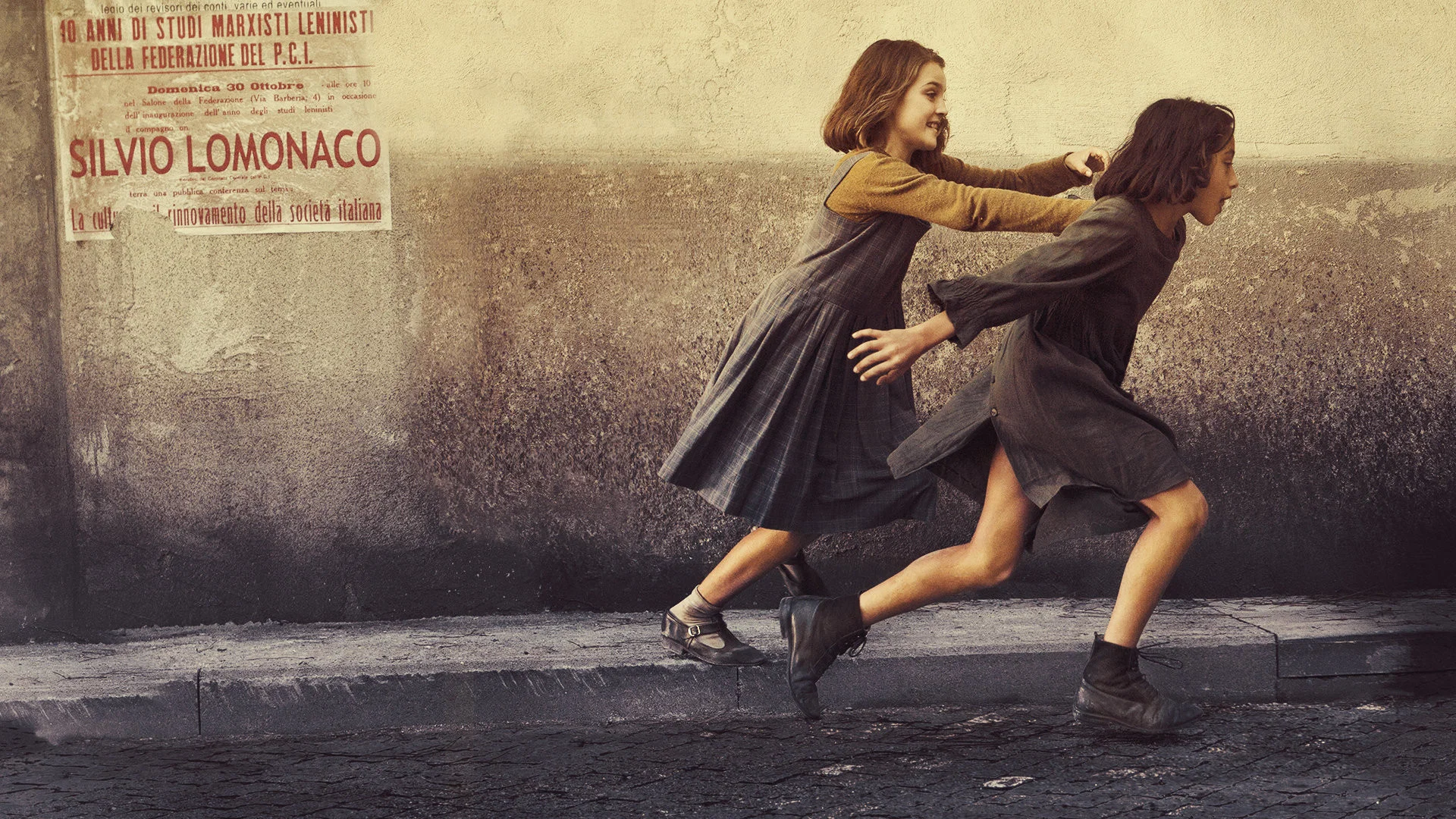
 My Brilliant Friend brings Elena Ferrante’s Neapolitan novels to the screen through an extraordinary friendship. Known in Italy as L’amica geniale, the series follows Elena “Lenù” Greco and Raffaella “Lila” Cerullo from childhood into adulthood. Their bond survives distance, ambition, disappointment and the pressure of a changing country.
The drama is also a compelling portrait of place. Naples shapes the girls’ earliest expectations, while Ischia opens a window onto another kind of life. Later, education and work carry Elena beyond the neighborhood that continues to influence both women.
For readers exploring Italian television, this is an essential series: intimate in its storytelling, rich in social history and visually memorable.
The Story: A Friendship That Lasts a Lifetime
Spoiler note: This guide discusses the basic premise and the broad development of the four seasons. It does not reveal the final resolution.
The story begins with a disappearance. An older Elena learns that Lila has vanished and starts writing about their shared life. Her account returns to their childhood in a working-class neighborhood of Naples, where the two girls recognize each other’s intelligence.
Elena is diligent, observant and eager to earn approval. Lila is fierce, inventive and often unwilling to accept the limits placed around her. Their differences create attraction and friction. Each girl sees possibilities in the other that she struggles to recognize in herself.
School becomes an early dividing line. Elena continues her education, while Lila’s opportunities narrow. Yet leaving the classroom does not diminish Lila’s insight or creativity. The series repeatedly asks who gets the chance to develop a talent and who must struggle to keep it alive.
As the girls grow older, romance, marriage, employment and motherhood reshape their friendship. Elena seeks independence through study and writing. Lila remains more closely connected to Naples, finding ways to exercise influence within a world that often restricts her.
Their relationship resists easy labels. They encourage each other, compete with each other and sometimes cause lasting hurt. Affection and resentment can occupy the same conversation. That emotional complexity gives the drama much of its force.
The Four Seasons and Elena Ferrante’s Novels
The complete adaptation has four seasons and 34 episodes. Each season follows one book in Ferrante’s Neapolitan Quartet.
| Season | Novel | Main focus |
|---|---|---|
| 1 | My Brilliant Friend | Childhood, school and adolescence in Naples |
| 2 | The Story of a New Name | Early marriage, education and a pivotal summer |
| 3 | Those Who Leave and Those Who Stay | Work, family, political tensions and different paths |
| 4 | The Story of the Lost Child | Mature adulthood, return, memory and loss |
The fourth season completed the television story in 2024. New viewers can therefore watch the full adaptation without waiting for another installment.
Watching in order is especially rewarding. Small childhood experiences acquire greater weight as the women age. Family loyalties, old humiliations and early acts of kindness remain part of their adult decisions.
Ferrante’s books also offer a useful companion to the series. They give more room to Elena’s thoughts and to the uncertainty behind her account. The screen adaptation makes those tensions visible through performances, settings and pauses.
Cast and Characters
The leading roles change as Elena and Lila grow older. This allows the series to show age through more than costumes and makeup.
| Character | Childhood performer | Performer through adolescence and early adulthood | Mature adult performer |
|---|---|---|---|
| Elena “Lenù” Greco | Elisa Del Genio | Margherita Mazzucco | Alba Rohrwacher |
| Raffaella “Lila” Cerullo | Ludovica Nasti | Gaia Girace | Irene Maiorino |
Margherita Mazzucco gives Elena an attentive, inward quality. Her performance conveys a young woman who measures herself against others while trying to build an independent identity.
Gaia Girace makes Lila’s intelligence feel restless and immediate. Her character can dominate a room, then reveal how little control she has over the conditions of her life.
In the final season, Alba Rohrwacher and Irene Maiorino carry those histories into mature adulthood. Their performances suggest both continuity and change: the women remain recognizable, but experience has altered their expectations.
Nino Sarratore is another important figure. Francesco Serpico plays him in the earlier seasons, and Fabrizio Gifuni takes over the mature role. Nino’s confidence and intellectual appeal affect both friends, complicating their ideas about love and freedom.
The wider ensemble includes Anna Rita Vitolo as Elena’s mother, Immacolata, and Dora Romano as the teacher Maestra Oliviero. Families, classmates, partners and neighborhood rivals give the central friendship a dense social setting.
How the Series Was Made
The series is an Italian-American collaboration associated with Rai and HBO. Saverio Costanzo established its screen identity, with Alice Rohrwacher also directing episodes in the second season. Daniele Luchetti directed the third season, and Laura Bispuri directed the fourth.
Despite those changes, the adaptation maintains a strong connection to Ferrante’s world. Domestic rooms, school corridors and neighborhood streets carry as much emotional weight as major dramatic events.
Language plays an essential role. Characters speak both Italian and Neapolitan, reflecting differences in background, intimacy and social situation. For international viewers, subtitles preserve access to performances whose meaning often depends on rhythm and tone.
The production also had to recreate several decades of everyday life. Clothes, shopfronts, furnishings and cars establish the period, but the most revealing details are often smaller. A schoolbook, a pair of shoes or the arrangement of a family meal can show what a character hopes to gain or fears losing.
Filming Locations in Naples
Naples supplies many of the series’ real exterior locations. However, the setting of a scene and the place where it was filmed are not always identical.
The neighborhood near Caserta: Much of the early neighborhood action was filmed on a purpose-built reconstruction at the former Saint-Gobain industrial site in Marcianise, near Caserta. The set recreated a mid-century Naples neighborhood associated with Rione Luzzatti. The present-day neighborhood in Naples should therefore be distinguished from the screen set.
Lungomare Caracciolo: The waterfront appears in Elena’s discovery of the city beyond her familiar streets. Its open views help explain why the sea feels like a revelation.
Piazza del Plebiscito: This monumental square offers another contrast with the girls’ immediate surroundings. It remains an accessible stop for visitors exploring central Naples.
Palazzo Gravina: The production used this historic building for school scenes. It houses the University of Naples Federico II’s architecture department, so interior access depends on the building’s current arrangements.
Via dei Tribunali and Galleria Principe di Napoli: These locations place the characters within the wider city, where encounters with wealth and status sharpen their awareness of social differences.
Posillipo: Coastal locations include Bagno Elena and Lido Sirena. In the final season, Via Petrarca also provides a setting for Elena’s apartment.
For a practical visit, combine the historic center with Piazza del Plebiscito and the waterfront. Leave time for Posillipo on a separate outing. The locations work best as part of an exploration of Naples, rather than a hurried checklist of scenes.
Ischia and the Beach Scenes
Ischia represents a major opening in Elena’s life. Away from the neighborhood, she encounters new people, unfamiliar freedoms and a different sense of herself.
Ischia Ponte, with the Aragonese Castle in the background, is among the most recognizable locations. The waterfront and castle views give visitors a strong connection to the island sequences.
Other connections include Barano d’Ischia, the Testaccio area and the landscape around Maronti Beach. The island’s slopes, coastal paths and settlements help create the sense of a summer that changes the characters’ lives.
Some beach scenes set on Ischia were filmed near Gaeta in Lazio. Anyone trying to identify an exact stretch of sand should keep that distinction in mind.
A trip to Ischia offers more than a television connection. Allow time to explore the island’s villages and coast, rather than treating it as a brief extension of Naples.
Beyond Naples: Casertavecchia and Tuscany
The production also used Casertavecchia for Lila’s wedding reception. This historic village is distinct from the industrial site where the neighborhood set was constructed.
As Elena’s life expands, the story introduces other Italian cities. Pisa is central to her education, while Florence becomes important to her adult life. Production information also documents filming in Florence, Turin and Caserta for the final season.
These changes of place support one of the series’ central questions: how much can leaving home change a person? Elena gains distance and opportunity, but she continues to understand herself through Lila and Naples.
Why My Brilliant Friend Still Matters
The series gives sustained attention to women’s intellectual and emotional lives. Education, paid work and domestic responsibilities influence every stage of the friendship.
It also shows how personal choices develop within social conditions. A decision about school or marriage can reflect family finances, local expectations and the power held by other people.
Neither protagonist remains a simple example of success or failure. Elena’s achievements do not remove her insecurity. Lila’s restricted opportunities do not prevent her from shaping the lives around her.
That complexity makes the drama rewarding beyond its period setting. It asks viewers to consider how they remember friendship, how they measure achievement and how often they misunderstand the people closest to them.
For language learners, it can also be a fascinating listening experience. The mixture of Italian and Neapolitan makes it challenging for beginners. Start with English subtitles, then revisit short scenes with Italian subtitles when the platform provides them.
Where to Watch or Buy
Availability checked on October 6, 2026. Catalogs, season coverage and subtitle options can change.
United States: Current listings identify HBO Max and its Amazon channel as subscription options. Digital purchases are listed through Amazon Video, Apple TV Store and Fandango at Home. Check the season and language details before buying.
Italy: RaiPlay’s L’amica geniale page is the main broadcaster destination to check. RaiPlay requires an account for many programs, and viewing depends on territorial rights. Additional platforms may carry the series; consult the current Italian availability listing for season coverage.
Other countries: Use a local streaming guide and confirm that the full series is available in your territory.
DVD and Blu-ray: Search Amazon.com for My Brilliant Friend editions or Amazon.it for L’amica geniale editions. Check region compatibility, included seasons and English subtitles.
Read the novels: Find Elena Ferrante’s Neapolitan Quartet on Amazon.com or the Italian editions on Amazon.it.
For background on accessing Italian broadcasters while traveling, read Italia Mia’s guide to NordVPN and Italian television. NordVPN plans are available here. A VPN does not replace a subscription or guarantee streaming access; broadcaster terms and territorial rights still apply.
Affiliate disclosure: Italia Mia may earn a commission from qualifying Amazon and NordVPN purchases made through these links, at no additional cost to you.
External Sources
- RaiPlay: L’amica geniale
- Rai Cultura: The final season
- Italy for Movies: First-season filming locations
- Toscana Film Commission: Locations and the fourth season
- JustWatch: United States viewing options
- JustWatch: Italian viewing options