

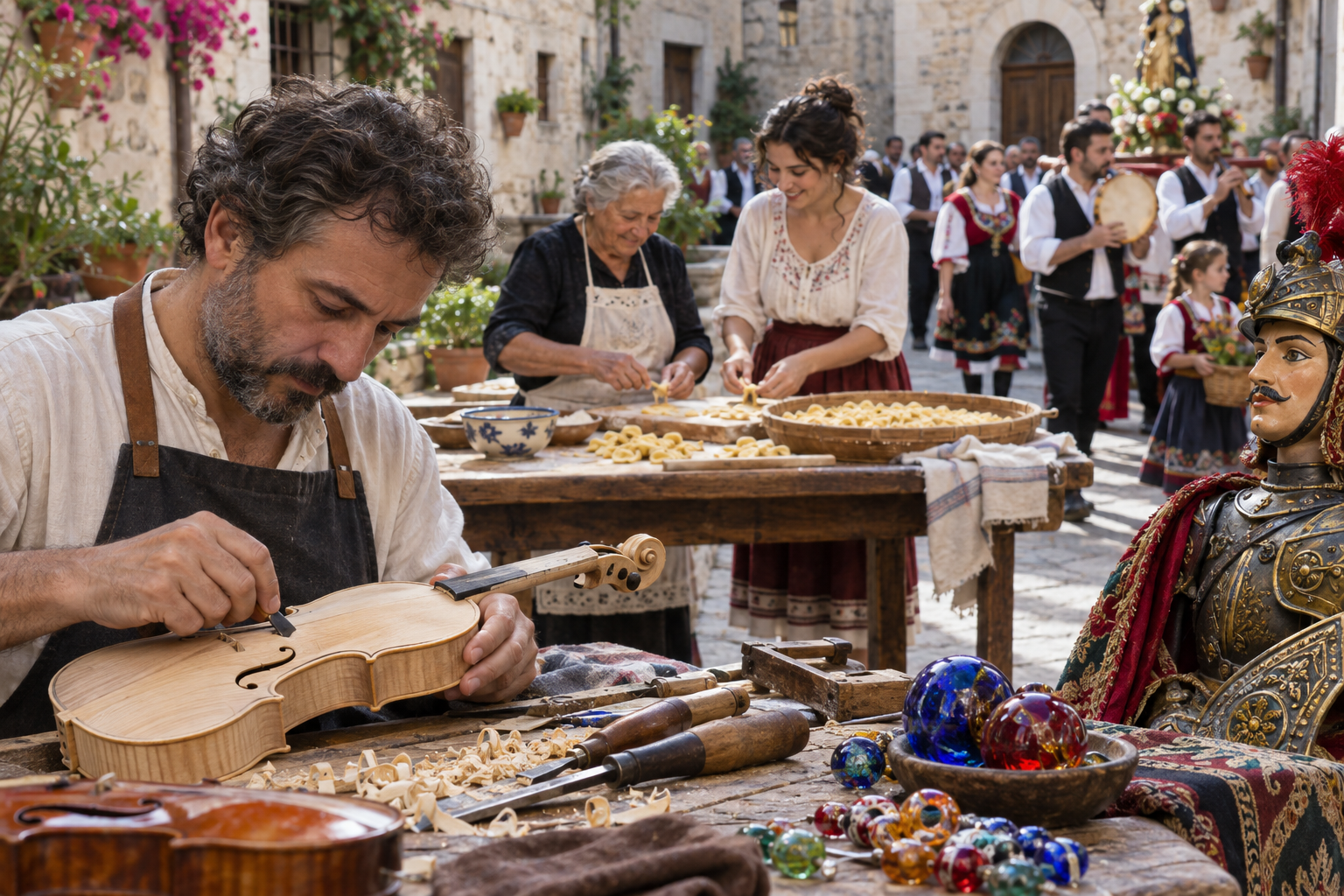
 Italy’s cultural heritage does not live only inside monuments, archaeological sites and museums. It can also be heard in Sardinian singing, watched in a Sicilian puppet theatre, tasted around a family table and observed in the practiced hands of a Cremonese violin maker.
These living traditions form Italy’s UNESCO Intangible Cultural Heritage. Unlike a cathedral or historic center, intangible heritage cannot be protected simply by restoring a building. It survives when knowledge is practiced, adapted and passed from one generation to the next.
UNESCO’s profile for Italy currently records 21 inscribed elements. Twenty appear on the Representative List of the Intangible Cultural Heritage of Humanity, while Tocatì is included in the Register of Good Safeguarding Practices. Some recognitions belong to Italy alone; others are shared with countries whose communities maintain related traditions.
What Does “Intangible Cultural Heritage” Mean?
UNESCO uses the term for traditions, knowledge and skills that communities recognize as part of their cultural identity. These can include:
- Oral traditions and forms of storytelling
- Music, dance and performing arts
- Religious and secular celebrations
- Traditional craftsmanship
- Knowledge connected with agriculture, food and nature
- Community games, rituals and social practices
The emphasis is on people rather than objects. A handcrafted violin is tangible, but the knowledge required to select the wood, construct the instrument and transmit the craft is intangible. A plate of food is tangible, but the family customs, agricultural knowledge and shared rituals surrounding its preparation form the living heritage.
UNESCO recognition also does not mean that a tradition is more authentic or valuable than every unlisted practice. The lists are intended to increase visibility and encourage safeguarding, not to create a ranking of cultures.
Italian Cooking: A National Tradition Built Around the Table
Italian cooking, described by UNESCO as a practice connecting sustainability and biocultural diversity, was inscribed in 2025. The recognition does not belong to one dish or standardized national menu. It concerns the social and cultural practices surrounding the preparation and sharing of food.
Italian cooking changes dramatically from one region, province and household to another. What unites these traditions is the relationship between ingredients, seasons, local environments, practical knowledge and human connection.
Recipes are frequently transmitted by observation rather than through precise written instructions. Children learn by watching parents and grandparents knead dough, prepare sauces, preserve vegetables or judge when a dish has reached the right consistency. Meals also structure social life, from everyday cooking to the extended Italian Sunday lunch.
The UNESCO recognition celebrates this adaptable culture of cooking rather than freezing Italian cuisine at one point in history. New ingredients, migrations and changing lifestyles have always influenced what Italians eat. The continuity lies in the way food connects people with family, memory and place.
The Mediterranean Diet
The Mediterranean diet was inscribed in 2010 and later expanded to include communities in Italy, Croatia, Cyprus, Greece, Morocco, Portugal and Spain.
Despite its name, it is not simply a nutritional plan or a list of approved foods. UNESCO describes a much broader cultural system involving cultivation, harvesting, fishing, preservation, cooking and communal eating. Hospitality, conversation and the transmission of knowledge are central to it.
In Italy, the tradition is associated particularly with communities in Cilento, where cereals, vegetables, legumes, olive oil, fruit and modest quantities of animal products have historically reflected the agricultural rhythms of the Mediterranean countryside.
The inscription should not be interpreted to mean that everyone in modern Italy follows a traditional Mediterranean way of eating. Industrial food, changing working patterns and declining home cooking have altered Italian diets, as explored in Italia Mia’s article about why the Mediterranean diet is disappearing in Italy.
The Art of the Neapolitan Pizzaiuolo
Inscribed in 2017, the art of the Neapolitan pizzaiuolo concerns the knowledge, gestures and social culture of pizza-making in Naples.
The practice involves preparing and stretching the dough, rotating it by hand, adding ingredients and managing a wood-fired oven. One of its most recognizable gestures is the lo schiaffo technique, in which the dough is passed rapidly between the hands while being shaped.
Yet the tradition is about more than technique. Pizzerias are social spaces, and knowledge has traditionally passed from master pizzaiuoli to apprentices through observation and repeated practice. Songs, stories, local expressions and a strong sense of professional identity surround the craft.
UNESCO did not declare every pizza to be intangible heritage, nor did it award the inscription to pizza as a physical product. The recognized element is the living art of the Neapolitan pizza maker. Visitors can learn more about the country’s customs in Italia Mia’s guide to enjoying pizza like an Italian.
Truffle Hunting and Extraction in Italy
Italy’s truffle-hunting knowledge and practices entered the Representative List in 2021.
Tartufai must understand soil, trees, weather, seasonal cycles and the habitats in which different truffle species grow. Trained dogs help locate the underground fungi, but the hunter’s knowledge determines where and when to search.
The tradition includes specialist vocabulary, stories, local customs and an ethic of protecting productive woodland. Its techniques are found in several regions, including Piedmont, Tuscany, Umbria, Marche, Molise and Abruzzo.
Public truffle fairs are the most visible side of the culture, but the UNESCO element centers on the knowledge maintained by truffle-hunting communities. Italia Mia’s guide to Italian truffle culture explores the principal varieties, regions and seasonal fairs.
Pantelleria’s Head-Trained Bush Vines
The traditional agricultural practice of cultivating vite ad alberello on Pantelleria was inscribed in 2014. It was the first agricultural practice to be added to UNESCO’s Representative List.
Pantelleria is a windy volcanic island between Sicily and Tunisia. To protect grapevines from difficult conditions, growers train them close to the ground inside carefully prepared hollows. The vines are pruned to produce six low branches, while surrounding soil is shaped to collect scarce rainwater.
The practice requires extensive manual work and detailed knowledge of the island’s terrain. Families and agricultural workers transmit the techniques through practical participation in the vineyards.
Zibibbo grapes grown using these methods are closely associated with Pantelleria’s celebrated passito wine, but the UNESCO recognition belongs to the agricultural knowledge and community practices rather than to the wine itself.
Traditional Violin Craftsmanship in Cremona
Cremona’s violin-making tradition was added to the Representative List in 2012. The city is associated with celebrated families of luthiers, including Amati, Guarneri and Stradivari, but the inscription recognizes a continuing craft rather than only its historic masters.
A Cremonese violin is assembled from numerous individually shaped wooden components. Makers select and season the wood, carve the front and back, construct the internal structure, apply varnish and adjust the completed instrument. Much of this work is performed by hand, and every instrument responds differently.
The knowledge is passed through violin-making schools, workshops and relationships between masters and apprentices. It combines acoustics, woodworking, aesthetic judgment and experience that cannot be reduced to a mechanical formula.
Visitors can explore this heritage at Cremona’s Museo del Violino and hear its results in concerts, workshops and instrument demonstrations.
The Art of Glass Beads
The art of glass beads, a shared inscription between Italy and France, entered the Representative List in 2020. In Italy, it is concentrated principally in Venice and Murano.
Italian bead makers use several methods. Some work over a flame to shape molten glass around a metal rod, while others produce beads from hollow canes or create tiny components used in intricate compositions.
The heritage also involves designers, teachers, specialist toolmakers and associations that help transmit the craft. Finished beads may become jewelry, decorative objects or components of elaborate artworks, but the protected element is the accumulated knowledge of glass preparation, shaping, color and design.
Although Venetian glass is sold throughout the city, visitors interested in the living tradition should look for genuine workshops, demonstrations and pieces made by identifiable craftspeople rather than mass-produced souvenirs.
Dry-Stone Construction
The art of dry-stone construction is a multinational tradition shared by Italy and several other European countries. Originally inscribed in 2018, the element was expanded in 2024.
Dry-stone walls are constructed by carefully selecting and placing stones without using mortar. Their apparent simplicity conceals a sophisticated understanding of weight, balance, drainage, geology and local terrain.
Across Italy, these structures shape vineyard terraces, olive groves, pastures and rural boundaries. They help limit erosion, manage water and create habitats for plants and small animals. Regional forms include the stone walls of Puglia, Liguria, Sicily, Sardinia and the Alpine valleys.
The tradition demonstrates that cultural heritage can also contain practical environmental knowledge. When agricultural land is abandoned and maintenance stops, both the walls and the skills required to rebuild them can disappear.
Opera dei Pupi: Sicilian Puppet Theatre
Opera dei Pupi was proclaimed a Masterpiece of the Oral and Intangible Heritage of Humanity in 2001 and incorporated into the Representative List in 2008.
The theatre developed in Sicily during the nineteenth century. Armored puppets enact stories involving Charlemagne, Orlando, Rinaldo and other heroes drawn from medieval chivalric literature. Battles, betrayals, romances and questions of loyalty unfold across continuing episodes.
Palermo and Catania developed distinct puppet styles, performance methods and stage traditions. Puppeteers do far more than move the figures: they provide voices, narrate the action, improvise dialogue and maintain the dramatic rhythm of the performance. Families of pupari have also constructed puppets, painted scenery and preserved extensive repertoires.
Performances can still be seen in Sicilian theatres and museums. Watching an actual production provides a much richer understanding than seeing the puppets displayed as decorative objects.
Canto a Tenore: Sardinian Pastoral Singing
Canto a tenore is a form of polyphonic singing associated particularly with the pastoral communities of central Sardinia. It was proclaimed by UNESCO in 2005 and transferred to the Representative List in 2008.
A traditional group consists of four male voices: boghe, mesu boghe, contra and bassu. The lead voice carries the poetic text while the others create a dense and highly recognizable vocal accompaniment.
Songs may be performed at celebrations, religious events, village gatherings and informal meetings. The repertoire includes poetry about love, work, landscape and contemporary life as well as traditional pastoral subjects.
The vocal technique is learned through listening and participation. Its survival therefore depends on opportunities for younger singers to perform with experienced groups, not merely on recordings or staged demonstrations.
The Practice of Opera Singing in Italy
The practice of opera singing in Italy joined the Representative List in 2023.
Italian opera grew from courtly experiments at the end of the sixteenth century and later became an international art form. Its cultural ecosystem includes singers, vocal teachers, coaches, conductors, musicians, craftspeople, audiences and the many theatres where opera is performed.
The inscription emphasizes the knowledge behind the voice: breath control, projection, pronunciation, interpretation and the relationship between music and dramatic expression. These techniques are transmitted in conservatories, academies, rehearsal rooms and private teaching.
Opera also extends beyond elite theatres. Famous melodies appear in public celebrations, community performances and everyday cultural memory. Composers such as Rossini, Bellini, Donizetti, Puccini and Giuseppe Verdi helped make the Italian language of opera familiar throughout the world.
Celebrations of Big Shoulder-Borne Processional Structures
Inscribed in 2013, this element brings together four major Italian religious celebrations:
- The Macchina di Santa Rosa in Viterbo
- The Festa dei Gigli in Nola
- The Varia di Palmi in Calabria
- The Faradda di li Candareri in Sassari
During these events, teams carry enormous ceremonial structures through crowded streets. The machines differ in design, religious meaning and local history, but all require cooperation, physical preparation and carefully coordinated movement.
The celebrations involve builders, costume makers, musicians, religious organizations, neighborhood groups and generations of bearers. Participation creates a powerful sense of belonging, particularly among families connected with the events over many years.
These are religious traditions, but they are also complex community performances in which engineering, devotion, music and collective identity come together.
The Celestinian Forgiveness Celebration
The Celestinian Forgiveness celebration, or Perdonanza Celestiniana, was inscribed in 2019.
Held in L’Aquila, it recalls the pardon issued by Pope Celestine V in 1294. The annual observance centers on the opening of the Holy Door of the Basilica of Santa Maria di Collemaggio and includes a civic and religious procession.
Local authorities, religious communities, associations, schools, musicians, flag bearers and residents participate in the celebration. Its continued observance has taken on additional meaning since the destructive L’Aquila earthquake of 2009, becoming a symbol of resilience as well as forgiveness and reconciliation.
Transhumance
Transhumance is the seasonal movement of livestock between different grazing areas, often from lowland winter pastures to mountain meadows in summer and back again in autumn.
First inscribed as a multinational element in 2019 and expanded in 2023, it connects Italian communities with pastoral traditions across Europe. In Italy, historic routes known as tratturi cross regions such as Abruzzo, Molise and Puglia, while related movements occur in the Alps and other mountain areas.
Shepherds need detailed knowledge of animals, water sources, weather, vegetation and routes. The practice has also generated food traditions, festivals, songs, stories and forms of social cooperation.
Modern roads, land-use changes and the economic difficulties of pastoral farming have disrupted many routes. Safeguarding transhumance therefore requires support for active shepherding communities, not only the promotion of picturesque commemorative walks.
Alpinism
Alpinism was inscribed in 2019 through a joint nomination by Italy, France and Switzerland.
It combines physical skills with knowledge of mountains, weather, snow, ice, rock and risk. Its culture also includes ethical principles, teamwork, oral histories, specialist vocabulary and respect for the Alpine environment.
Knowledge is passed through mountain guides, alpine clubs, rescue organizations, families and groups of climbers. Italy’s Alpine communities play a central role, from the Western Alps and Aosta Valley to the Dolomites.
UNESCO recognition should not be understood as an invitation to treat the mountains as an amusement park. Preparation, local guidance, environmental responsibility and respect for changing conditions remain essential.
Falconry
Falconry is one of UNESCO’s broadest multinational intangible-heritage elements. Italy participates alongside communities from Europe, the Middle East, Asia and North Africa.
The practice involves training and flying birds of prey while maintaining knowledge of their behavior, health and natural environment. Falconers transmit skills through mentoring, demonstrations, clubs and field practice.
Although falconry has aristocratic associations in European history, UNESCO presents it as a living tradition that has developed in varied social and cultural settings. Contemporary safeguarding also emphasizes the welfare of birds and the conservation of habitats and wild raptor populations.
The Musical Art of Horn Players
Inscribed in 2020, this multinational element is shared by Italy, Belgium, France and Luxembourg.
Horn playing brings together instrumental technique, singing, breath control, vibrato and awareness of how sound resonates within a landscape or architectural space. The tradition is associated with hunting culture, ceremonial occasions and musical gatherings, although it has developed beyond its original functions.
Players learn not only how to produce notes but how to listen and respond as a group. Associations, schools and informal gatherings help transmit a repertoire and a strong culture of conviviality.
Traditional Lipizzan Horse Breeding
The traditions of Lipizzan horse breeding were inscribed in 2022 through a multinational nomination involving Italy and seven other European countries.
The heritage includes knowledge of breeding, bloodlines, animal care, training and the relationship between horses and the cultural landscapes in which they are raised. In Italy, the tradition is particularly connected with the state stud at Monterotondo and with historic breeding practices linked to Central Europe and the Adriatic world.
UNESCO’s focus is not simply the appearance of the Lipizzan horse. It is the human knowledge and community culture that have maintained the breed across generations.
Traditional Irrigation
Traditional irrigation knowledge, techniques and social organization were inscribed in 2023 as a shared element involving Italy, Austria, Belgium, Germany, Luxembourg, the Netherlands and Switzerland.
These systems distribute water according to community rules shaped by local geography and seasonal availability. Their maintenance requires practical engineering, environmental observation, negotiation and collective responsibility.
In the Italian Alpine context, traditional channels carry water toward fields, orchards and pastures. The practice illustrates how communities developed sustainable methods of sharing a limited natural resource long before modern pumping and automated irrigation.
Manual Bell Ringing
Manual bell ringing became a shared Italian-Spanish inscription in 2024 following the expansion of an earlier Spanish recognition.
Ringers use ropes and other mechanisms to create sound patterns associated with religious services, funerals, weddings, festivals, emergencies and civic events. Different rhythms communicate different meanings to the surrounding community.
The heritage includes technical knowledge of bells, towers, timing and acoustic coordination. Because electric systems have replaced human ringers in many locations, safeguarding depends on training new participants and preserving opportunities for manual performance.
Tocatì and the Safeguarding of Traditional Games
Tocatì differs from the other entries in this article. It is not an individual tradition on the Representative List. In 2022, UNESCO added it to the Register of Good Safeguarding Practices as a shared program led by Italy with Belgium, Croatia, Cyprus and France.
Developed around the Tocatì festival in Verona, the program supports traditional games and sports through community participation, education, documentation and international exchange.
The initiative treats games as living social practices rather than nostalgic displays. Players help decide how their traditions are presented and transmitted, while public spaces become meeting places for different generations and cultures.
Its inclusion recognizes a successful method of safeguarding heritage—one that could be adapted by communities elsewhere.
How to Experience Italy’s Living Heritage Responsibly
Intangible heritage is best encountered in the communities that maintain it, but visitors should remember that these practices do not exist solely for tourism.
Check official local schedules before traveling, especially for religious processions and seasonal agricultural events. Some celebrations occur on fixed feast days, while others depend on harvests, weather or community decisions.
During a visit:
- Follow local instructions and safety barriers.
- Avoid obstructing processions, performers or working craftspeople.
- Ask permission before photographing people at close range.
- Buy directly from recognized artisans when possible.
- Choose workshops and demonstrations that explain the tradition rather than merely using UNESCO as a marketing label.
- Treat religious observances as acts of faith, not only as spectacles.
- Never enter vineyards, truffle grounds, pastures or workshops without permission.
The most meaningful experiences often come from listening: to a craftsperson explaining a technique, a singer describing how a part is learned or a resident recalling what a celebration means to the community.
Why Safeguarding Matters
UNESCO inscription provides visibility, but it does not guarantee survival. Many Italian traditions face declining participation, rural depopulation, commercial imitation, environmental change and the loss of spaces where knowledge was once transmitted naturally.
Tourism can generate income and interest, but excessive commercialization may separate a tradition from the community that created it. A festival redesigned entirely for visitors may remain visually impressive while losing much of its original meaning.
Successful safeguarding keeps practitioners involved in decisions. It supports apprenticeships, access to materials, documentation, education and the continued use of cultural spaces. Most importantly, it allows traditions to evolve. Living heritage survives not because every detail remains unchanged, but because communities continue to find meaning in practicing it.
Italy’s intangible heritage reveals a country held together by thousands of local skills and memories. A puppet performance in Sicily, a procession in Sardinia, a stone wall in Puglia and a shared meal in an ordinary home may appear unrelated. Each, however, represents knowledge carried forward through human participation.
That is what makes this heritage intangible—and what makes it alive.
External Sources
UNESCO – Italy: Intangible Cultural Heritage
UNESCO – Italian Cooking, Between Sustainability and Biocultural Diversity
UNESCO – Browse the Lists of Intangible Cultural Heritage
Italian Ministry of Culture – UNESCO Cultural Heritage
Italian Ministry of Foreign Affairs – Italy and UNESCO