 What Is La Bella Figura?
Spend enough time in Italy and you may eventually hear someone speak about fare bella figura — literally, “to make a beautiful figure.”
The English translation, however, does not quite capture its meaning.
Fare bella figura means making a good impression. It can refer to the way you dress, but it can just as easily describe how you speak, how you behave at dinner, how you welcome guests into your home or how you conduct yourself in public.
At its heart, la bella figura is the art of presenting the best version of yourself to the world.
That helps explain something visitors to Italy often notice very quickly. An Italian may put on an elegant jacket simply to meet friends for an aperitivo. Someone going to the supermarket may appear surprisingly well dressed. A host may spend hours preparing the table before guests arrive. A barista may arrange cups carefully on a counter that will be crowded again minutes later.
These apparently unrelated behaviors share a common idea: presentation matters.
Yet reducing bella figura to vanity would miss the point entirely.
It is equally about courtesy, dignity, self-respect and respect for other people.
To understand Italian culture, therefore, it helps to understand la bella figura.
The Meaning of Bella Figura
The expression consists of two simple Italian words:
bella — beautiful, good, attractive
figura — figure, appearance, impression or image
But Italian expressions frequently carry meanings that go well beyond their literal translations.
If someone says:
Hai fatto una bella figura.
They are not necessarily saying that you looked beautiful.
They mean:
You made a good impression.
Perhaps you handled a difficult situation gracefully. Maybe you were charming at dinner. You might have given an excellent presentation, dressed appropriately for an important event or behaved generously toward someone.
The opposite expression is equally revealing:
fare una brutta figura — to make a bad impression, embarrass yourself or appear badly in the eyes of others.
For many Italians, avoiding a brutta figura can be almost as important as achieving a bella figura.
That distinction tells us that the concept involves something deeper than clothes.
It concerns how a person is perceived within society.
Bella Figura Is Not Just About Fashion
Because Italy is internationally associated with fashion, outsiders sometimes assume bella figura simply means dressing stylishly.
Clothing certainly plays a role.
Italian culture has long placed considerable importance on personal presentation, something reflected in the country’s extraordinary influence on international fashion.
Italia Mia’s guide to Italian fashion explores how clothing, craftsmanship and design became such recognizable elements of Italian identity.
But bella figura extends much further.
A person can wear an expensive designer suit and still make a terrible figura.
Someone who interrupts constantly, treats a waiter rudely, arrives dramatically late to an important appointment or behaves arrogantly may be impeccably dressed while nevertheless making a brutta figura.
Conversely, someone wearing simple clothing can make a wonderful impression through warmth, confidence, generosity and good manners.
The ideal combination is not extravagance.
It is appropriateness.
Knowing what is suitable for the occasion is one of the unwritten rules behind bella figura.
Looking Presentable in Everyday Life
Visitors sometimes notice that Italians traditionally maintain a distinction between clothing worn privately and clothing worn outside the home.
That distinction has certainly become less rigid, especially among younger generations. Sneakers, jeans, sportswear and casual clothing are now completely normal throughout Italy.
Nevertheless, the idea of looking presentable remains influential.
An outfit does not have to be expensive. What often matters more is that it appears deliberate.
Clothes fit properly.
Shoes are appropriate.
Hair looks cared for.
Accessories complement rather than overwhelm.
There is often a preference for quality over quantity and for an outfit that appears coordinated rather than accidental.
This approach is discussed further in Italia Mia’s How to Look Like a Local in Italy: Clothing and Style Guide.
The objective is rarely to look as though you have spent three hours getting ready.
Paradoxically, successful Italian style often aims to create the impression that elegance required almost no effort at all.
The Passeggiata: Bella Figura on Display
Perhaps nowhere is the concept easier to observe than during the traditional Italian passeggiata.
In towns and cities across Italy, people emerge in the late afternoon or early evening to walk through the center, meet friends, stop for an aperitivo and observe who else is out.
Historically, the passeggiata was partly a social stage.
People saw and were seen.
Families dressed children carefully. Young people encountered potential romantic partners. Adults greeted acquaintances and exchanged news. Clothing, manners and social behavior all contributed to one’s public image.
The tradition survives today in a more relaxed form, particularly in smaller cities and towns.
The relationship between the evening stroll and personal presentation is one reason bella figura cannot be separated completely from Italian social life.
You are not simply walking through the town.
You are participating in it.
Bella Figura at the Italian Table
Food provides another excellent example.
Imagine being invited to an Italian family’s home for Sunday lunch.
The host may have cleaned the house carefully, chosen a tablecloth, arranged the table, purchased wine and spent hours preparing several dishes.
Why make such an effort?
Hospitality itself is a form of bella figura.
A generous table tells guests:
You are important enough for me to make an effort.
The guest has responsibilities too.
Arriving with flowers, chocolates, wine or another small gift may be appropriate depending on the situation. Complimenting the food, participating in conversation and thanking the host all contribute to making a good impression.
Turning up empty-handed is not necessarily offensive, but arriving with a thoughtful gesture often communicates consideration.
Again, bella figura operates as a kind of social exchange.
The host demonstrates generosity.
The guest demonstrates appreciation.
Coffee, Bars and Everyday Rituals
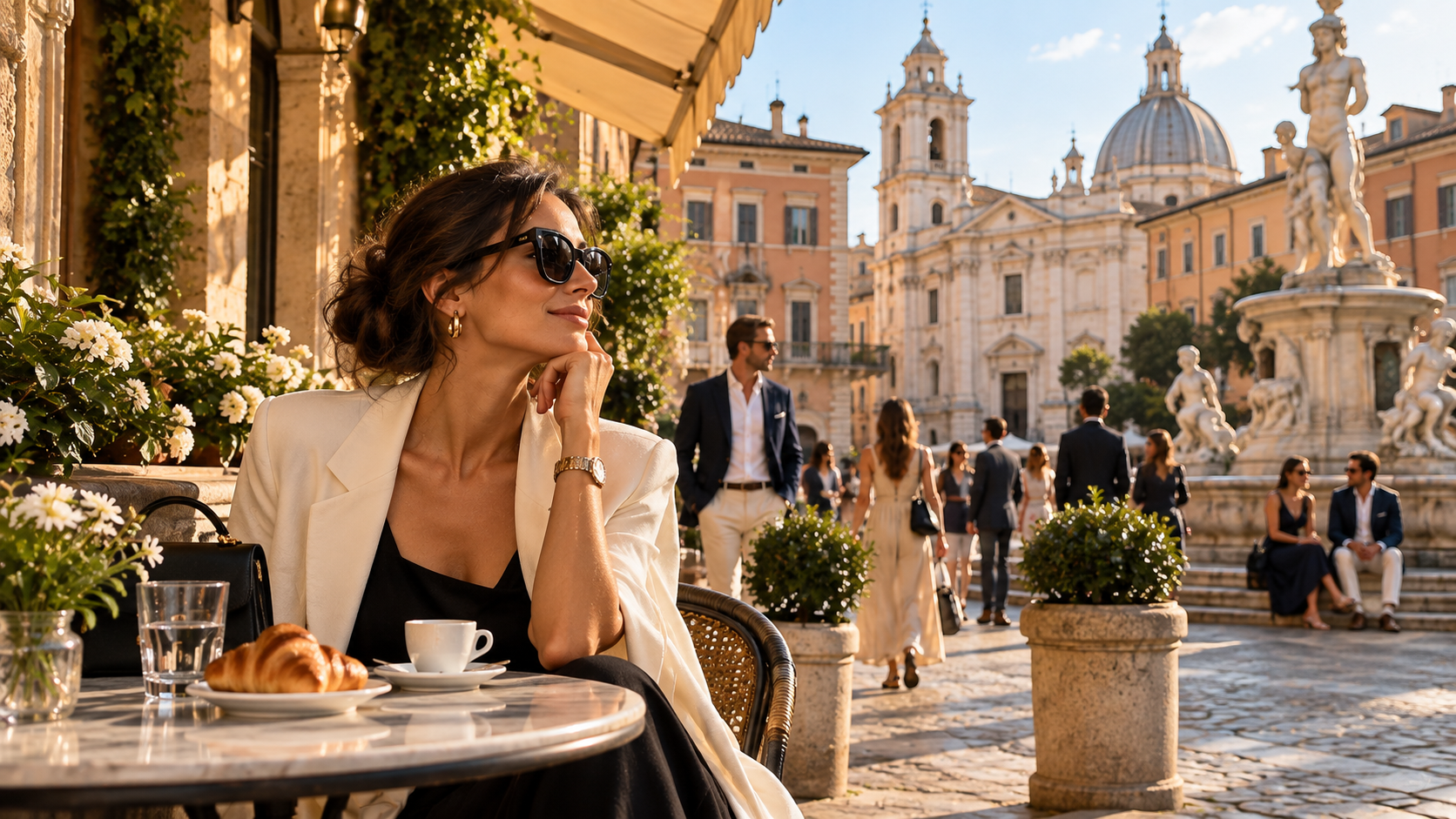
Even something as ordinary as drinking coffee can reveal the Italian preference for rituals performed properly.
Italian coffee culture developed its own vocabulary and conventions: espresso at the counter, cappuccino traditionally associated with breakfast, quick exchanges with the barista and familiar neighborhood bars where customers may return every day.
The details vary enormously between individuals and regions, but the ritual itself matters.
A coffee may take only two minutes.
Those two minutes can still have style.
The same principle appears throughout daily Italian life.
Setting a table.
Serving wine.
Wrapping a gift.
Greeting someone.
Choosing flowers.
Preparing food.
Walking through the piazza.
None of these actions needs to be elaborate. They simply deserve a certain degree of attention.
Greetings Matter
Making a good impression begins before a conversation has even started.
Greetings therefore play an important role in Italian social etiquette.
Depending on the relationship and circumstances, Italians might use buongiorno, buonasera, salve or the informal ciao.
Titles such as dottore, professore, signore and signora may also appear in situations where respect or formality is expected.
The choice between the formal Lei and informal tu can communicate social distance, familiarity, age differences or professional respect.
These conventions are explored more fully in Italia Mia’s guide to Italian Greetings and Etiquette: How Italians Say Hello, Goodbye and Everything in Between.
The important point for bella figura is simple: acknowledging other people properly matters.
Walking into a small shop and immediately demanding something without saying buongiorno, for example, can sound abrupt.
A greeting recognizes the other person’s presence.
That tiny gesture is part of good manners — and therefore part of making a bella figura.
The Importance of the Italian Piazza
The concept also makes more sense when considered alongside another essential element of Italian culture: the piazza.
For centuries, Italian towns developed around public spaces where religious, commercial, political and social life intersected.
The piazza was where people gathered, conducted business, attended ceremonies, heard news and met neighbors.
It was therefore also a place where reputation mattered.
Italia Mia’s guide to The Italian Piazza explores the role these spaces continue to play in Italian life.
Modern Italians obviously live in a far more private and mobile society than their ancestors. Yet the cultural memory of life conducted partly in public remains powerful.
The café terrace, neighborhood bar, church square and pedestrian street continue to function as social stages.
And whenever society becomes a stage, presentation acquires importance.
Bella Figura and Reputation
Historically, reputation mattered enormously within Italian communities.
Before mass transportation, television, social media and large anonymous cities transformed society, many Italians lived in relatively small communities where families knew one another for generations.
People remembered behavior.
Your reputation could influence business relationships, marriage prospects, friendships and the standing of your family.
Under those conditions, maintaining dignity was practical as well as personal.
The idea that an individual’s behavior reflects upon a wider group — family, profession or community — remains recognizable today.
Someone may therefore worry about making a brutta figura not only because they personally feel embarrassed, but because their behavior reflects badly on others.
This helps explain why the concept can occasionally feel stronger than the English idea of simply “making a good impression.”
Bella Figura in Business
The principle also appears in professional life.
First impressions can carry considerable weight in Italian business culture.
Appearance, introductions and personal relationships may matter alongside technical competence.
Someone attending an important business meeting generally benefits from looking polished and prepared. Professional titles may be used more frequently than visitors from particularly informal cultures expect.
But the deeper principle remains the same.
A successful bella figura comes from demonstrating that you understand the importance of the occasion.
That might mean dressing appropriately, arriving prepared, greeting everyone correctly and showing respect for professional roles.
Trying too hard to impress, however, can have the opposite effect.
Italian elegance often works best when it appears natural.
The Home and Bella Figura
The home is another arena where the concept becomes visible.
An Italian household does not need to resemble an interior-design magazine. Nevertheless, when guests are expected, considerable attention may be devoted to presentation.
The living room is arranged.
The bathroom is checked.
The table is prepared.
The good glasses appear.
Food is plentiful.
Coffee is offered.
Perhaps a bottle of digestivo emerges after dinner.
This is not necessarily an attempt to demonstrate wealth.
Often it expresses hospitality through care.
Making one’s home attractive for visitors is another way of telling them that their presence matters.
Family and Children
Traditionally, bella figura also extended to family behavior.
Parents wanted children to appear clean, well dressed and polite because children’s behavior reflected upon the family.
Older Italians may remember being instructed to behave properly because:
“Che figura ci facciamo?”
Roughly: “What kind of impression will we make?”
The phrase reveals the collective dimension of the concept.
The question is not simply what you will look like.
It is what we will look like.
Although modern parenting styles have changed considerably, echoes of this attitude remain familiar in Italian family life.
Regional Differences
There is no single Italian personality, and bella figura should never be treated as a rigid national rule.
Italy contains enormous regional, generational and social differences.
Milanese professional culture differs from village life in Sicily.
A university student in Bologna may dress differently from a lawyer in Rome.
A beach town in August follows different standards from a business district in Turin in November.
Nevertheless, the underlying concern with presentation appears throughout the country in different forms.
In Milan it might manifest itself through understated fashion.
In Naples it might appear through expressive tailoring and personal style.
In Florence it may be connected with craftsmanship and refinement.
In smaller towns it may emerge through manners, family reputation and participation in community life.
The form changes.
The underlying idea remains recognizable.
Sprezzatura and Effortless Elegance
Another Italian concept occasionally associated with bella figura is sprezzatura.
The word became famous through Baldassare Castiglione’s Renaissance work The Book of the Courtier (Il Cortegiano), published in 1528.
Castiglione described an ideal courtier who could perform difficult things with apparent ease.
The key was to conceal the effort.
Centuries later, the idea remains remarkably compatible with Italian style.
The perfectly fitted jacket should not appear uncomfortable.
The elegant dinner should not feel staged.
The beautifully prepared meal should be presented naturally.
The sophisticated host should appear relaxed.
In other words:
Make an effort — but don’t make everyone watch you making it.
That is sprezzatura.
And it fits beautifully beside bella figura.
When Bella Figura Becomes Excessive
Like many cultural values, bella figura has another side.
Concern about appearances can become excessive.
The desire to avoid embarrassment can sometimes encourage people to hide problems, exaggerate success or spend beyond their means.
A beautiful car, designer clothing or elaborate celebration can become symbols of social status rather than expressions of genuine taste.
Critics sometimes use bella figura negatively to describe a culture that cares too much about appearances and not enough about substance.
That criticism is worth acknowledging.
The Italian language itself recognizes the tension.
Making a bella figura is positive.
Being obsessed with what others think is something else entirely.
The healthiest interpretation of the tradition is therefore not:
Appear successful at any cost.
It is:
Present yourself and treat others with care.
Bella Figura in Modern Italy
Italy today is not the Italy of the 1950s.
Dress codes have relaxed.
Young Italians wear hoodies, sneakers and sportswear.
International fashions circulate instantly through social media. Remote work has changed professional clothing. Traditional distinctions between formal and casual behavior have weakened.
Yet bella figura has not disappeared.
It has adapted.
Someone may wear sneakers rather than polished leather shoes, but they may choose those sneakers carefully.
A young Italian may reject formal dining etiquette while still preparing an attractive aperitivo for friends.
A modern apartment may be minimalist rather than traditionally decorated, yet considerable attention may still be given to lighting, furniture and presentation.
The aesthetic vocabulary changes.
The instinct survives.
Italia Mia’s comparison of living in Italy and the United States also highlights how Italian attitudes toward presentation can differ from the more casual approach common in parts of American culture.
Bella Figura vs. Showing Off
There is an important distinction between bella figura and simple ostentation.
Showing off says:
Look how much I have.
Bella figura says:
I understand how to present myself appropriately.
The difference can be subtle.
A beautifully tailored €200 jacket might make a better figura than an €2,000 jacket covered in conspicuous logos.
A simple homemade dinner served thoughtfully can create a better impression than an expensive meal presented carelessly.
An inexpensive bouquet chosen with attention may communicate more than an extravagant gift given without thought.
True bella figura depends less on money than on judgment.
How Visitors Can Make a Bella Figura in Italy
Foreign visitors do not need to imitate Italians or arrive in designer clothing.
A few simple habits go much further.
Dress appropriately for the situation. Beachwear belongs at the beach. Churches require respectful clothing, and a sophisticated restaurant may call for something smarter than sightseeing clothes.
Greet people. Saying buongiorno or buonasera when entering a small shop, hotel, café or restaurant is a simple courtesy.
Learn a few Italian words. Even imperfect Italian often communicates goodwill.
Avoid being unnecessarily loud. Italian streets and restaurants can certainly be lively, but dominating a space attracts the wrong kind of attention.
Treat service workers respectfully. Courtesy toward waiters, shopkeepers, hotel staff and taxi drivers is an easy way to make a good impression.
Respect food culture. You do not need to memorize dozens of supposed “Italian food rules.” Curiosity and appreciation matter more than rigid imitation.
Make some effort with appearance. Comfortable travel clothes are perfectly acceptable, but looking tidy and appropriate goes a long way.
Most importantly, remember that bella figura is not a performance designed to fool people.
It is a way of demonstrating awareness of the people and environment around you.
What La Bella Figura Reveals About Italy
Italy’s international image is filled with beautiful things.
Renaissance paintings.
Roman architecture.
Fashion.
Sports cars.
Furniture.
Food.
Gardens.
Ceramics.
Leather.
Opera.
Even ordinary household objects have repeatedly become opportunities for Italian designers to combine usefulness with beauty.
Italia Mia’s broader introduction to Italian culture shows how strongly aesthetics have influenced the country’s art, architecture, fashion, food and design.
Against that background, bella figura begins to look less like an isolated social custom and more like part of a broader cultural tendency.
How something is presented matters alongside what it is.
A plate of pasta should taste wonderful, but presenting it attractively does no harm.
A building must function, but why shouldn’t it also be beautiful?
Clothes protect the body, but they can also express identity.
Conversation communicates information, but it can also demonstrate grace.
Everyday life itself can contain aesthetics.
The Enduring Appeal of Bella Figura
Perhaps the most attractive interpretation of bella figura is also the simplest.
It asks people to make an effort.
Dress with care.
Welcome guests generously.
Speak politely.
Respect an occasion.
Present food attractively.
Maintain your dignity.
Notice the people around you.
None of this requires wealth.
It requires attention.
That distinction helps explain why la bella figura remains relevant even as Italian society changes.
The clothes may become more casual. Social conventions may become less formal. Young Italians may interpret etiquette differently from their grandparents.
But the desire to present oneself well — and to show others that they were worth the effort — remains deeply recognizable.
Visitors sometimes arrive in Italy searching for la dolce vita: beautiful landscapes, leisurely meals, piazzas, espresso, fashion and evening walks.
But behind much of that famous Italian beauty lies another principle.
Beauty rarely happens entirely by accident.
Someone prepared the table.
Someone polished the shoes.
Someone arranged the flowers.
Someone chose the jacket.
Someone made the coffee.
Someone restored the building.
Someone decided that an ordinary moment deserved a little extra attention.
That, perhaps more than anything else, is la bella figura.
Related Italia Mia Articles
For readers interested in exploring Italian culture and everyday life further:
Italian Culture: An Introduction
How to Look Like a Local in Italy: Clothing and Style Guide
The Main Differences Between Living in USA and Italy You Should Know
Italian Fashion: An Introduction
External Links
For additional information about Italian language, culture and etiquette:
Accademia della Crusca — Italy’s leading institution dedicated to the study and preservation of the Italian language.
Treccani – Italian Encyclopedia and Dictionary — Authoritative Italian-language reference for Italian words, expressions, history and culture.
Encyclopaedia Britannica – Italy — Background information on Italian history, society and culture.
Italia.it — Official Italian tourism portal with information about Italian destinations, traditions, food and culture.