

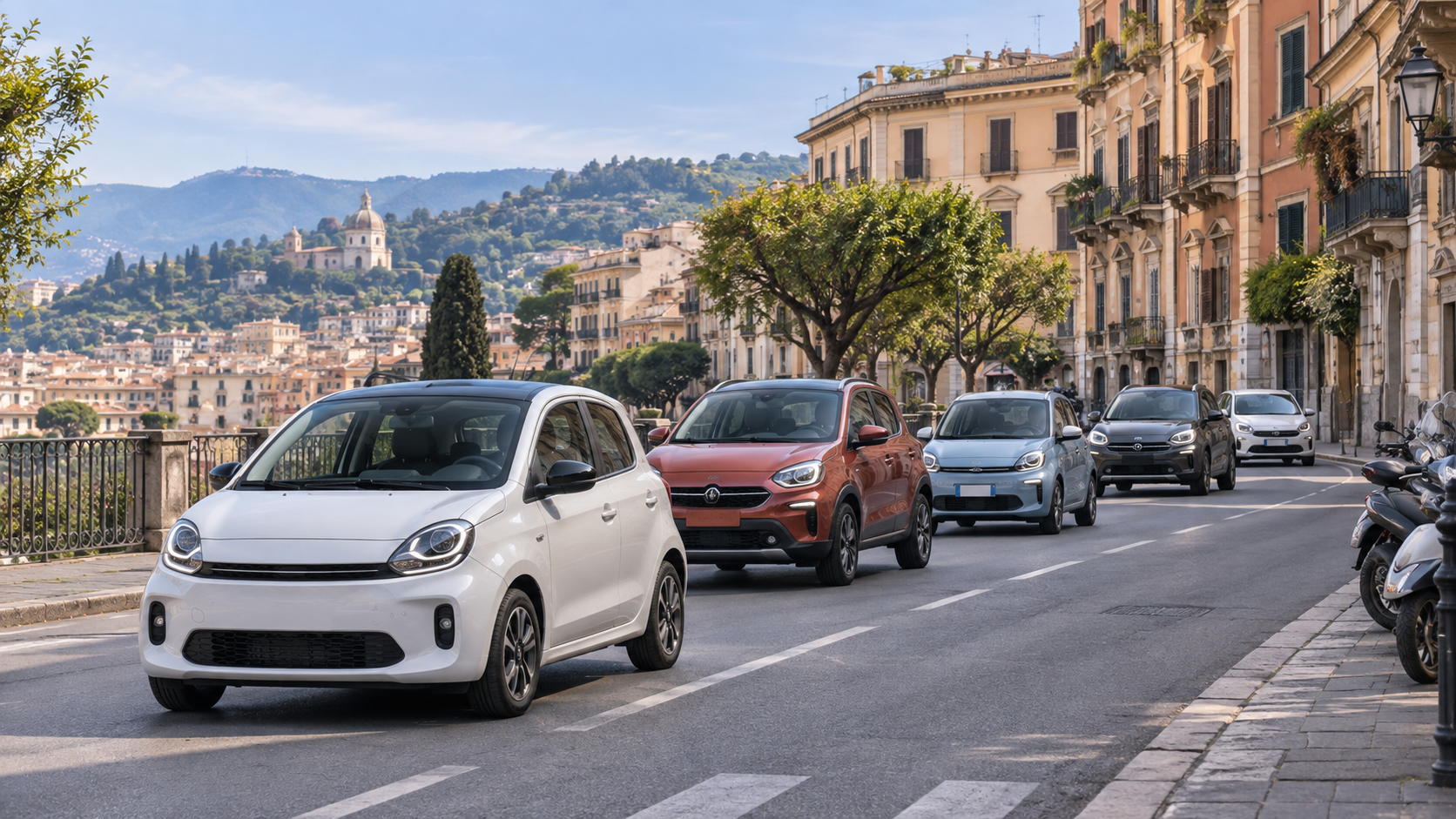
 Italy may be famous for Ferrari, Lamborghini, Maserati and Alfa Romeo, but the cars Italians buy most often are usually smaller, more practical and more economical.
Compact dimensions matter in historic city centers, where streets and parking spaces can be extremely tight. Fuel consumption, purchase price and everyday versatility are equally important. At the same time, crossovers, hybrids and electric vehicles are changing the composition of the Italian market.
The following ranking is based on new-car registrations recorded by UNRAE from January through August 2026. Because the year is still in progress, positions may change when the final annual figures are published.
Italy’s Best-Selling Cars at a Glance
| Rank | Model | Registrations, January–August 2026 |
|---|---|---|
| 1 | Fiat Panda | 75,998 |
| 2 | Jeep Avenger | 31,938 |
| 3 | Dacia Sandero | 29,106 |
| 4 | Fiat Grande Panda | 27,558 |
| 5 | Citroën C3 | 25,396 |
| 6 | Toyota Yaris Cross | 22,639 |
| 7 | Leapmotor T03 | 22,545 |
| 8 | Renault Clio | 21,979 |
| 9 | Toyota Aygo X | 21,686 |
| 10 | Peugeot 208 | 21,183 |
These figures refer to registrations rather than customer orders or vehicles manufactured. They provide the clearest available indication of which new cars are actually entering circulation in Italy.
1. Fiat Panda
The Fiat Panda remains the undisputed queen of the Italian automobile market. With almost 76,000 registrations during the first eight months of the year, it sold more than twice as many units as its nearest competitor.
Its appeal is easy to understand. The Panda is compact enough for congested city streets, inexpensive to operate and sufficiently versatile for families, commuters and older drivers. It is equally at home in Rome traffic, a Tuscan village or a small mountain community.
The model also benefits from extraordinary familiarity. Generations of Italians have owned a Panda, and its simple shape has become part of the country’s everyday visual landscape.
Those interested in the story behind Italy’s most influential mass-market automaker can read our History and Evolution of Fiat Automobiles.
2. Jeep Avenger
The Jeep Avenger has become one of the strongest success stories in the Italian market. Although it carries an American badge, it was designed primarily for European customers and has dimensions particularly well suited to Italian roads.
The Avenger combines the elevated seating position of an SUV with the manageable size of a city car. Different powertrain options broaden its audience, while its rugged styling gives buyers the appearance of a larger sport utility vehicle without the inconvenience of driving one through narrow streets.
Its second-place position confirms how strongly Italian buyers have embraced compact crossovers.
3. Dacia Sandero
The Dacia Sandero continues to attract buyers who want space and practicality without paying a premium price. It is larger and roomier than many traditional city cars, yet it remains one of the most accessible new vehicles in its class.
Italian motorists appreciate its straightforward design, usable passenger space and economical engine choices. The availability of LPG versions is another important advantage in a country where GPL remains an established alternative to petrol and diesel.
The Sandero’s success demonstrates that value for money remains one of the most powerful forces in the Italian car market.
4. Fiat Grande Panda
The Grande Panda is not simply a larger version of the familiar Panda. It represents Fiat’s attempt to reinterpret one of its best-known names for a new generation of drivers.
Its boxy shape, practical cabin and crossover-inspired appearance fit current tastes, while its dimensions remain appropriate for European cities. The model is available with electrified powertrains, helping Fiat compete as Italian buyers gradually move away from conventional petrol and diesel vehicles.
Its rapid rise into the top five is especially significant because it is much newer than most of the other cars in the ranking.
5. Citroën C3
Comfort has always been central to the Citroën identity, and the latest C3 combines that tradition with a more upright, crossover-like design.
The car offers a comfortable seating position, distinctive styling and versions aimed at different budgets and driving needs. Its relatively compact footprint makes it practical in urban areas, while its interior and ride are suitable for longer journeys.
The C3 appeals to motorists who want an affordable small car but prefer something visually different from the most familiar Italian models.
6. Toyota Yaris Cross
The Toyota Yaris Cross brings together three qualities that are particularly attractive to Italian buyers: compact dimensions, an SUV-style body and an efficient hybrid system.
It provides a higher driving position than a conventional hatchback without becoming difficult to park or maneuver. Toyota’s long experience with full-hybrid technology also appeals to drivers looking for lower fuel consumption without depending entirely on charging stations.
The Yaris Cross is especially well suited to motorists who divide their time between city traffic and longer suburban or regional journeys.
7. Leapmotor T03
The Leapmotor T03 is the most surprising entry in the ranking. This small Chinese electric car has moved rapidly into the Italian mainstream, helped by competitive pricing and its suitability for urban use.
Its success shows that Italian motorists are increasingly willing to consider unfamiliar brands when the price, equipment and running costs are attractive. It also demonstrates that electric cars can gain traction in Italy when they are compact and positioned within reach of ordinary buyers.
Leapmotor’s connection with Stellantis has helped give the brand greater visibility and a stronger European presence.
8. Renault Clio
The Renault Clio has been a familiar sight on Italian roads for decades. Its enduring appeal comes from its balance of compact dimensions, mature road manners, efficient engines and everyday practicality.
Unlike a very small city car, the Clio can comfortably perform family and motorway duties. At the same time, it remains easy to use in crowded urban environments. Hybrid versions have further strengthened its position as drivers look for ways to reduce fuel consumption.
It remains one of the most versatile conventional hatchbacks available in Italy.
9. Toyota Aygo X
The Toyota Aygo X is designed around the needs of urban drivers. Its short length makes it easy to park, while its raised stance and crossover styling give it more visual presence than a traditional small hatchback.
The model is particularly attractive to younger drivers, couples and households looking for a second car. Toyota’s reputation for reliability also gives the Aygo X an advantage among buyers who intend to keep their vehicle for many years.
Its strong performance illustrates that there is still considerable demand for genuinely compact cars in Italy.
10. Peugeot 208
The Peugeot 208 combines compact-car practicality with one of the most distinctive interiors in its category. Its modern exterior design and choice of powertrains have helped it remain competitive in a crowded segment.
The 208 appeals to motorists who want a small car that feels more stylish and sophisticated than a basic economy model. The availability of electric and electrified versions also allows buyers to choose a powertrain suited to their driving patterns.
What the Ranking Reveals About Italian Drivers
The list reflects several important changes in Italian motoring.
Small Cars Still Matter
Despite the international growth of large SUVs, compact cars remain central to Italian life. The Panda, Sandero, C3, Clio, Aygo X and 208 are all well adapted to narrow roads, restricted parking and densely populated towns.
Compact Crossovers Are Replacing Traditional Hatchbacks
The Jeep Avenger, Grande Panda and Yaris Cross show how buyers increasingly prefer crossover styling and a higher seating position. However, the most successful models remain considerably smaller than many SUVs sold in the United States.
Hybrid Cars Have Become the Mainstream Choice
During the first eight months of 2026, hybrid-electric vehicles accounted for 49.3% of Italian new-car registrations. Petrol represented 19.6%, plug-in hybrids 9.4%, battery-electric vehicles 8%, LPG 7% and diesel just 6.7%.
This does not mean that every hybrid is capable of driving significant distances on electricity. The category includes both full hybrids and mild hybrids, but the figures clearly demonstrate how rapidly conventional petrol and diesel cars are losing ground.
For a closer examination of the different technologies, see our guide to electric and hybrid cars in Italy.
Chinese Brands Are Becoming Serious Competitors
The appearance of the Leapmotor T03 in seventh place is a major development. MG also sits just outside the top ten, while models from BYD, Omoda and Jaecoo appear elsewhere in the wider ranking.
Chinese manufacturers are using competitive prices, generous equipment and electric technology to challenge the established European and Japanese brands.
Fiat Remains Central, but the Market Is International
Fiat placed two models in the top four, and the Panda remains far ahead of every rival. Nevertheless, the ranking also includes models from Jeep, Dacia, Citroën, Toyota, Leapmotor, Renault and Peugeot.
Modern Italian motoring culture therefore combines loyalty to familiar domestic names with a willingness to buy French, Romanian, Japanese, American and Chinese-branded vehicles.
What Happened to the Fiat 500 and Lancia Ypsilon?
Two historically popular Italian models are absent from the top ten.
The Fiat 500 placed 27th for the January–August period, while the Lancia Ypsilon did not enter the top 50. Their lower positions reflect major product transitions, changing price structures and increasingly intense competition in the small-car market.
The results do not diminish their cultural importance, but they show how quickly buyer preferences can change.
Choosing a Car for Italian Roads
Sales rankings can reveal popular choices, but the best vehicle depends on where and how it will be used.
For historic city centers, a Panda, Aygo X, T03 or another very small car makes parking and maneuvering easier. Drivers who regularly travel outside cities may prefer the additional space and higher seating position of an Avenger, Grande Panda or Yaris Cross.
An electric car can make sense for drivers who have reliable access to home or workplace charging. A full hybrid may be more convenient for motorists who frequently travel long distances or cannot charge at home.
Anyone unfamiliar with Italian roads should also read our complete guide to driving in Italy and our explanation of Italian autostrade, tolls and motorway routes.
Frequently Asked Questions
What is the best-selling car in Italy?
The Fiat Panda is by far Italy’s best-selling car. It recorded 75,998 registrations between January and August 2026, substantially more than any competing model.
What is the best-selling SUV in Italy?
The Jeep Avenger leads Italy’s compact SUV and crossover market. It ranked second overall during the first eight months of 2026.
Are diesel cars still popular in Italy?
Diesel cars remain in circulation, especially among drivers covering long distances, but their share of new registrations has fallen sharply. Diesel represented only 6.7% of the new-car market from January through August 2026.
Are electric cars becoming popular in Italy?
Yes, although they still represent a minority of the overall market. Battery-electric vehicles accounted for 8% of registrations during the first eight months of 2026, up from 5.2% during the same period in 2025.
Why are small cars so popular in Italy?
Italian cities often have narrow streets, limited parking and restricted-traffic zones. Smaller cars are easier to maneuver, less expensive to operate and generally better suited to everyday urban travel.
The Future of Italy’s Car Market
Italy’s best-selling cars reveal a market in transition. Compact vehicles remain essential, but traditional petrol and diesel models are steadily giving way to mild hybrids, full hybrids, plug-in hybrids and electric cars.
The Fiat Panda continues to dominate, yet the success of the Jeep Avenger, Grande Panda and Toyota Yaris Cross confirms the growing importance of compact crossovers. Meanwhile, the rapid rise of Leapmotor signals a new phase of international competition.
For Italian motorists, the ideal car is still practical, economical and easy to park. What is changing is the technology—and the increasingly global selection of brands offering it.
External Links
- UNRAE: Italian vehicle-registration statistics
- ACI: Automobile Club d’Italia
- European Automobile Manufacturers’ Association