

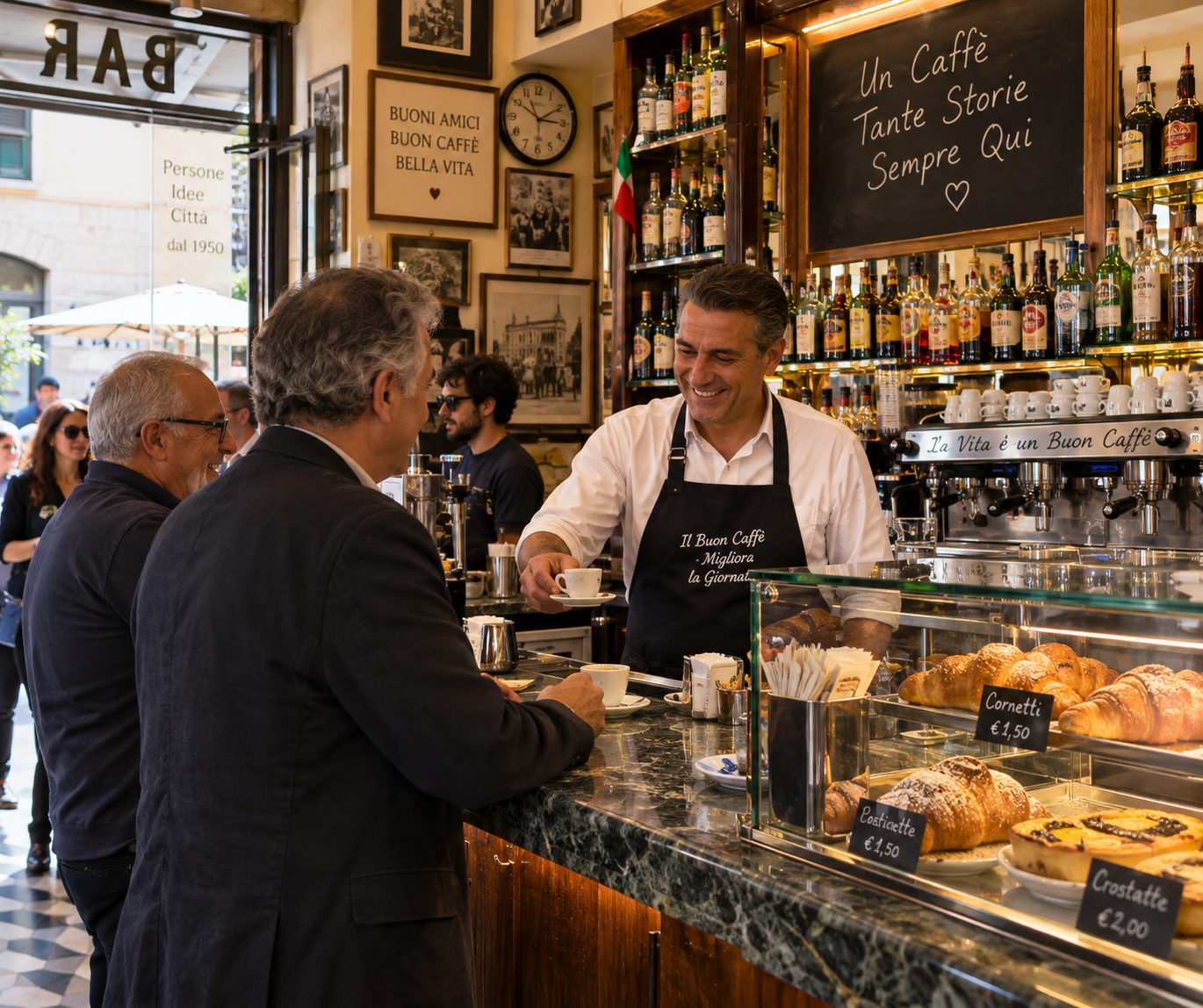
 In Italy, the word “bar” means something quite different from what many English-speaking visitors expect.
An Italian bar can certainly serve wine, beer and cocktails, but alcohol is only a small part of its identity. From early morning until evening, the neighborhood bar may be a breakfast stop, coffee counter, meeting place, informal office, lunch spot, news exchange and social club.
In many Italian towns and neighborhoods, it is one of the places where everyday community life still happens face to face.
More Than a Place to Drink
Walk into a typical neighborhood bar at different hours and you might think you have entered several different businesses.
At seven in the morning, customers arrive for espresso, cappuccino and cornetti before work.
By mid-morning, someone stops for a quick coffee while running errands. A retired customer reads the newspaper. Two tradesmen discuss the day’s work over espresso.
Around lunchtime, the counter may display panini, tramezzini, focaccia or simple prepared dishes.
During the afternoon, parents may arrive with children for a snack, while other customers stop for coffee or mineral water.
Toward evening, bottles appear on the counter and the atmosphere changes again. Wine, beer, Spritz, vermouth and other aperitivi replace cappuccino.
The same establishment has accompanied the neighborhood through an entire day.
The Bar as an Extension of the Neighborhood
The traditional Italian bar occupies an interesting space between private and public life.
You do not need an invitation to enter, yet regular customers can feel almost at home.
The relationship between customers and the barista is particularly important. Someone who visits the same bar every morning may barely need to order.
“Il solito?”
“The usual?”
The barista may already know whether that means an espresso, macchiato, cappuccino or another favorite drink.
Over time, these repeated encounters create familiarity.
Customers recognize one another. People discuss football, weather, politics, family, work and neighborhood events. Someone may ask whether a person who usually appears every morning is feeling well because they have not been seen for several days.
This does not happen in every bar, particularly in busy city centers, but it remains characteristic of many neighborhood establishments.
A Social Space Open to Almost Everyone
One reason the Italian bar has remained socially important is its accessibility.
Going to a restaurant involves having a meal. Spending an evening at a nightclub requires time and money. Meeting someone at home involves an invitation.
Stopping at the bar requires very little.
An espresso can take only a few minutes.
That makes the bar useful for spontaneous encounters. Friends can meet there without elaborate planning. Colleagues can continue a conversation outside the office. Neighbors can exchange news without formally arranging to see one another.
The expression “Prendiamo un caffè?” — “Shall we have a coffee?” — therefore often means more than the beverage itself.
It can simply mean: let’s meet and talk.
The Morning Regulars
Early morning reveals the neighborhood bar at its most characteristic.
People tend to arrive according to their routines. The same customers may appear at roughly the same time every day.
Some stay for ten minutes. Others drink an espresso standing at the counter and leave almost immediately.
The ritual is repetitive, but that repetition is precisely what creates community.
A person may exchange only a few sentences with the barista or another customer, yet doing so hundreds of times over several years creates a relationship.
Italy’s official tourism website notes how breakfast traditions vary significantly between regions and cities, while coffee remains a common element of the morning ritual.
For a detailed look at espresso, cappuccino and ordering customs, see Italia Mia’s guide to Italian Coffee Culture.
Standing at the Counter
The counter — il banco — is central to the traditional bar.
Drinking an espresso standing up may appear hurried to visitors accustomed to spending an hour in a café, but the experience is not necessarily antisocial.
Quite the opposite.
The counter puts customers beside one another.
Someone comments on the football match. Another joins the conversation. The barista adds an opinion while preparing three coffees simultaneously.
Within minutes, people who did not arrive together may be talking to one another.
The interaction ends just as casually as it began.
“Ciao, buona giornata.”
And everyone continues with the day.
The Bar and Italian Local Identity
No two Italian bars are exactly alike.
A polished bar in central Milan may have little visually in common with a small-town bar in Tuscany or a busy establishment in Naples.
Regional food and drinking traditions also influence what appears behind the counter.
Pastries change. Sandwich fillings change. Wines change. Aperitivo snacks change. Even coffee preferences and terminology can have regional variations.
The neighborhood bar consequently reflects its surroundings.
It is another example of the strong local identity that continues to characterize Italian life despite national chains, supermarkets, shopping centers and global consumer culture.
Newspapers, Football and Conversation
For decades, newspapers were another fixture of Italian bar life.
A customer could order coffee and browse the sports pages or local newspaper while other customers discussed the headlines.
Football naturally generated some of the liveliest conversations.
Team loyalties can be highly visible, particularly when the owner supports the local club. Photographs, scarves or memorabilia may appear behind the counter.
After an important match, the bar can become an unofficial debating chamber.
The decline of printed newspapers and rise of smartphones have changed this scene considerably. People now arrive already carrying the day’s news in their pockets.
Yet conversation survives.
The subject may originate on a phone screen rather than a newspaper, but the argument can still happen across the counter.
The Bar as an Informal Information Network
Before social media and neighborhood messaging groups, the local bar was already a social network.
People heard who was getting married, who had opened a new shop, whose apartment was for rent and what was happening in town.
This function remains particularly visible in smaller communities.
Posters near the entrance may advertise a local festival, concert, sports event or community initiative. Business cards and notices sometimes accumulate near the cash register.
The information may seem trivial, but collectively it gives the bar an important role: it connects people with the place where they live.
From Coffee to Lunch
Many Italian bars also provide a practical alternative to restaurants at lunchtime.
The selection varies enormously. A small establishment may offer only panini and pastries, while a larger bar may serve salads, pasta, vegetables and other prepared dishes.
For office workers, this can provide a quick and relatively informal lunch.
The bar therefore adapts naturally to the rhythm of the working day.
Morning coffee becomes lunch, lunch becomes afternoon coffee, and eventually the bottles and snacks for aperitivo begin appearing.
When the Bar Changes Character in the Evening
Late afternoon brings another transformation.
Coffee continues to be served, but customers begin ordering wine, beer and aperitivi.
Friends who would have spent five minutes drinking espresso in the morning may now sit together for an hour.
This is where the Italian bar overlaps with another important social tradition: aperitivo.
Italia Mia has a separate guide to Italian Aperitivo, including drinks, food, etiquette and regional differences.
The important point here is how effortlessly the neighborhood bar moves between these functions.
There is no need to create a separate establishment for breakfast, coffee, lunch and an early evening drink.
One bar can provide all of them.
The Bar in Small-Town Italy
The social importance of the bar becomes particularly apparent in smaller Italian towns.
Where entertainment options are limited, the bar can become a principal meeting point.
Older residents may gather there in the morning or afternoon. Workers stop on their way home. Young people meet friends there before going elsewhere.
Tables outside become observation posts from which customers watch the town pass by.
In some communities, a bar beside the main piazza effectively becomes an extension of the square itself.
The boundaries between café, street and public space begin to disappear.
The Bar in the Big City
Large Italian cities have a different rhythm.
Rome, Milan, Turin, Florence, Bologna and Naples contain historic cafés, fashionable cocktail bars, specialty coffee shops and establishments designed largely for tourists.
Yet neighborhood bars continue to exist away from the principal attractions.
These are often the places where visitors get a more convincing glimpse of ordinary urban life.
Rather than searching for the most famous café, walk a few streets away from the major sights early in the morning.
A modest bar filled with local workers and residents may reveal more about contemporary Italian life than a celebrated café surrounded by visitors.
Tabacchi, Lottery Tickets and Other Services
Some bars perform additional functions that can surprise foreign visitors.
A bar may also be a tabaccheria selling cigarettes, stamps and other regulated products. Depending on its licenses and services, customers may also be able to buy lottery tickets, make certain payments or purchase other everyday items.
This makes the establishment even more deeply integrated into neighborhood routines.
Someone enters to make a payment, buys something at the counter and decides to have an espresso before leaving.
Practical errands and social life overlap.
Changing Habits
The traditional Italian bar is not immune to change.
Large coffee chains, specialty cafés, food-delivery services, smartphones and changing work patterns are reshaping how Italians spend their time.
Younger consumers may want different coffee preparations, international foods, Wi-Fi or spaces suitable for working on laptops.
Tourist centers have developed another type of bar entirely, sometimes bearing little resemblance to the neighborhood institution.
Economic pressures are also significant. Running a small independent establishment requires long hours, and family businesses do not always pass to the next generation.
Yet the traditional bar has one considerable advantage: it provides something difficult to reproduce online.
Familiarity.
Why Regular Customers Matter
A successful neighborhood bar does not need to reinvent itself every week.
Its attraction can be precisely the opposite.
The coffee tastes the way you expect. The same person is behind the counter. You recognize the customers. Someone notices when you arrive.
In an increasingly anonymous world, predictability can have social value.
This helps explain why some Italians remain extraordinarily loyal to a particular bar even when several alternatives are nearby.
They are not choosing solely on the basis of coffee.
They are returning to a familiar place.
How Visitors Can Experience a Real Italian Bar
You do not need a guidebook recommendation.
In fact, one of the best ways to experience Italian bar culture is to leave the busiest tourist streets and look for an ordinary establishment used by local residents.
Go in during the morning.
Say “Buongiorno” when you enter.
Watch whether customers pay before or after ordering, because practices vary.
Have your coffee at the counter rather than automatically choosing a table.
Return another day if you are staying nearby.
By the third or fourth visit, you may receive a greeting of recognition.
That tiny change — from anonymous customer to familiar face — explains something fundamental about the Italian neighborhood bar.
Italy’s Everyday Social Club
Italy is famous for monumental public spaces: piazzas, churches, markets and historic streets.
But everyday Italian social life also depends on much smaller places.
The neighborhood bar is one of them.
It asks very little of its customers. You can stay for an hour or leave after three minutes. You can meet friends or arrive alone. You can have breakfast, eat a sandwich, drink an espresso or meet someone for an aperitivo.
Most importantly, you can return tomorrow.
And the next day.
Eventually the person behind the counter knows what you drink, the other customers recognize your face and an ordinary commercial establishment begins to feel like part of the neighborhood.
That is why the traditional Italian bar is about much more than coffee.
It is one of the places where the small, repeated encounters of Italian daily life still take place.