 Italy is often imagined as a country where work pauses for long lunches, evenings are reserved for family, and nobody would dream of answering an email during an aperitivo. Like many appealing images of Italian life, this contains a grain of truth—but it is far from the complete picture.
The reality of work-life balance in Italy depends on where you live, what you do, the kind of contract you have and whether you work for a traditional Italian business, a public institution, a multinational company or yourself. A professional in Milan, a public employee in Florence, a hotel worker in Venice and a remote worker in rural Sicily may experience four completely different versions of Italian working life.
Italy does offer generous legal protections, paid holidays and a culture that values food, family and social connection. At the same time, many workers face long commutes, rigid schedules, modest salaries, precarious contracts and an expectation that personal responsibilities will somehow fit around the working day.
So, does Italy really offer a better work-life balance? The most honest answer is: sometimes, for some people, and in some regions.
The Myth of the Effortless Italian Lifestyle
From abroad, Italian life can look wonderfully unhurried. Shops may close during the afternoon, families gather for Sunday lunch, August empties the cities and the evening passeggiata still brings people into streets and piazzas.
These traditions are real, but they should not be confused with a lack of professional commitment.
Italy has major manufacturing centers, busy commercial cities, competitive professional sectors and millions of small-business owners who work extremely hard. Restaurant owners, artisans, agricultural workers, medical professionals, tradespeople and family-business operators may work well beyond the hours visible to customers.
The famous midday closure is also frequently misunderstood. In smaller towns, some businesses close for several hours after lunch, but employees may return in the afternoon and remain at work until 7:00 or 8:00 p.m. Their day is divided rather than shortened.
In Milan, Turin, Bologna and other important employment centers, a conventional office schedule can look much like one in London, Paris or New York—except that salaries may be lower and commuting can consume a substantial part of the day.
What Italian Employment Law Provides
The legal framework offers employees a meaningful foundation for work-life balance.
A standard working week is generally 40 hours, although the applicable national collective agreement—known as a Contratto Collettivo Nazionale di Lavoro or CCNL—may establish a shorter schedule. Total weekly working time, including overtime, normally cannot exceed an average of 48 hours within the relevant reference period.
Employees are entitled to at least four weeks of paid annual leave. Collective agreements often provide additional vacation days, leave, working-time rules and other protections. Public holidays provide further time away from work, although the exact benefit depends on whether a holiday falls on a normal working day.
Workers generally receive a daily rest period and at least one weekly rest day. Maternity, parental, family-care and sick-leave rights also exist, although eligibility, payment and duration vary according to employment status and circumstances.
These protections are important, but written rights do not always describe an employee’s daily experience. Workplace culture, management style, staffing levels, contract security and the willingness to use available leave can make a major difference.
Anyone evaluating an Italian employment offer should examine the applicable CCNL, not merely the proposed salary. Our guide to finding a job in Italy explains the principal contract types, employment sectors and regional opportunities.
The Italian Lunch Break: Pleasure or Inconvenience?
Lunch remains more important in Italy than in many countries where workers routinely eat at their desks. Some employees have enough time to leave the workplace, visit a bar or trattoria and eat a proper meal. Others use employer-supported meal vouchers known as buoni pasto.
However, the two-hour lunch break familiar from romantic descriptions is not a universal benefit. In many modern offices, lunch lasts between 30 and 60 minutes. Retail employees may work shifts, while healthcare, hospitality and transport workers often eat whenever their schedules permit.
A long midday interruption can also extend the working day. Finishing at 7:30 p.m. after a substantial lunch break may be less compatible with family life than finishing at 5:00 p.m. after a shorter one.
Italy’s relationship with food undoubtedly humanizes the working day, but it does not automatically reduce the number of hours spent away from home.
Holidays, August and the Right to Disconnect
August remains the symbolic center of the Italian holiday calendar. Many offices and family businesses slow down or close around Ferragosto, celebrated on August 15. Coastal resorts become crowded, while parts of major business cities grow unusually quiet.
Nevertheless, Italy does not simply stop working for a month. Tourism, restaurants, transportation, healthcare, retail and essential services continue operating—and August can be the busiest and most stressful period of the year for their employees.
Vacation timing may also be partly determined by the employer. Some companies close for one or two weeks and require employees to use part of their annual leave during that period. This creates a shared national pause, but it does not always give workers complete freedom to choose when they travel.
Italy has also introduced protections concerning disconnection for some forms of remote and agile working. In practice, however, after-hours availability still depends heavily on the employer and industry. A well-written remote-work agreement should define rest periods, communication expectations and when the employee is not required to respond.
Milan and Lombardy: Opportunity at a Price
Milan offers Italy’s largest concentration of jobs in finance, fashion, media, technology, consulting and international business. Salaries are frequently higher than elsewhere in the country, and multinational employers may provide flexible schedules, hybrid work and modern employee benefits.
The tradeoff is intensity. Housing costs are high, competition is strong and commuting from the metropolitan outskirts can add hours to the working week. Employees may gain professional opportunity while losing time to crowded trains, traffic and expensive urban routines.
Workplace culture in Milan is generally faster and more internationally oriented than the relaxed Italian stereotype suggests. Business lunches exist, but so do early meetings, deadlines and evening emails.
For ambitious professionals, Milan can provide an excellent career-life balance if the salary is sufficient and the commute is controlled. For someone earning a modest local wage while paying metropolitan rent, the same city may feel exhausting.
Before accepting an offer, compare take-home pay with our realistic guide to the cost of living in Italy.
Turin, Bologna and the Productive North
Turin combines important automotive, aerospace, engineering and technology industries with a somewhat calmer pace and generally lower housing costs than Milan. Its wide avenues, public transportation and access to the Alps can support an attractive lifestyle, although the local job market is less diverse.
Bologna and the wider Emilia-Romagna region offer one of Italy’s most appealing compromises. The region has a powerful economy based on manufacturing, food production, engineering, logistics and services, while Bologna provides excellent rail connections and a lively cultural environment.
Modena, Parma and Reggio Emilia can offer strong employment prospects without the size and cost of Milan. However, many jobs are located in industrial districts where a car may be necessary. What appears to be a peaceful provincial lifestyle can still include a substantial daily commute.
Veneto also has a dense network of successful businesses, particularly in machinery, eyewear, furniture, fashion, wine and tourism. Working conditions vary considerably between internationally competitive manufacturers and small family-run companies.
Central Italy: Culture, Public Employment and Commuting
Florence combines tourism, fashion, education, public administration and cultural institutions. Its beauty and compact historic center are obvious advantages, but housing costs and overtourism can complicate everyday life. Hospitality workers may face seasonal pressure, evening shifts and weekend work while serving visitors who are enjoying their own leisure time.
Rome offers a vast and varied labor market encompassing government, media, film, healthcare, education, tourism, professional services and international organizations. The principal threat to work-life balance is often not the job itself but the commute.
Traffic, unreliable connections between peripheral neighborhoods and long cross-city journeys can turn a normal workday into a much longer absence from home. Someone living near a metro or railway line may have a radically better daily routine than a colleague making the same salary but driving across the city.
Smaller cities in Tuscany, Umbria and Marche can provide a gentler pace, stronger community ties and easier access to nature. The limitation is a smaller job market, particularly for people who need an international workplace or a highly specialized position.
Southern Italy and the Islands
Southern Italy offers many qualities normally associated with a good life: a warmer climate, strong family and community connections, extraordinary food, access to the sea and, in many areas, lower housing costs.
Yet work-life balance cannot be separated from access to stable employment. The South continues to experience lower employment levels and fewer high-paying opportunities than much of the Centre-North. Informal work, seasonal jobs and limited career progression can undermine the apparent advantages of a slower lifestyle.
Conditions also differ substantially within the South. Naples has a large and complex economy but considerable congestion. Bari has developed growing service, technology and professional sectors. Puglia, Sicily and Sardinia attract remote workers and entrepreneurs, while tourism creates jobs across coastal areas—but many of those positions involve intense summer schedules and reduced security during winter.
Official statistics continue to show a significant territorial employment divide, although recent growth in southern employment offers grounds for cautious optimism. Lower living costs can make the South attractive to someone bringing a secure income from elsewhere, but the calculation is different for a person dependent on the local labor market.
Remote professionals considering the region should read our guide to Italy’s visas for digital nomads and expats. Immigration permission, taxation, social security and an employer’s remote-work policy must all be considered before relocating.
Small Towns Versus Major Cities
A smaller Italian town may offer affordable housing, shorter journeys, less pollution and a stronger sense of community. Daily errands can be completed on foot, and access to beaches, countryside or mountains may be far easier than from a metropolitan center.
The disadvantages can include fewer employers, lower salaries, weaker public transportation and limited childcare or specialized healthcare. A short commute is only an advantage if an appropriate job exists nearby.
Major cities provide more employment, services, international schools, hospitals and professional networks. They also bring higher rents, congestion, noise and competition.
For remote workers and financially independent residents, a medium-sized city may offer the best compromise. Places such as Parma, Verona, Padua, Trieste, Perugia, Lecce and Cagliari can provide urban services without the scale of Milan or Rome.
The Gender Divide Behind the Italian Ideal
Any honest discussion of Italian work-life balance must address unpaid care.
Family support is one of Italy’s great social strengths, but it frequently compensates for limited childcare, eldercare and flexible employment. Grandparents may provide essential daily assistance, while women continue to perform a disproportionate share of domestic and caregiving work.
This affects career progression, income, employment continuity and the ability to accept demanding positions. Part-time employment may help a family manage its responsibilities, but it is not always chosen freely.
Therefore, the appearance of strong family life can conceal an unequal distribution of work. A long family lunch may be deeply rewarding, but someone must shop, cook, serve and clean.
Foreign residents without an established family network can discover that the Italian model is less effortless than it appears. Before choosing a location, parents should investigate nursery availability, school schedules, after-school care and the practical distance between home and work.
Public-Sector and Private-Sector Experiences
Public employment is often associated with predictable schedules, job security and clearly regulated leave. These advantages can support family life, although access normally requires formal recruitment procedures, appropriate qualifications and strong Italian-language ability.
Private-sector experiences range widely. Large corporations may offer hybrid work, welfare benefits, meal vouchers and structured parental policies. Small businesses can provide personal relationships and flexibility, but arrangements may be informal and depend heavily on the owner.
Self-employment promises freedom but can result in the opposite. Freelancers, shopkeepers, consultants and hospitality operators often struggle to disconnect because income depends directly on availability and demand. Italy’s bureaucracy and payment delays can add invisible hours to the working week.
Remote Work Changes the Equation
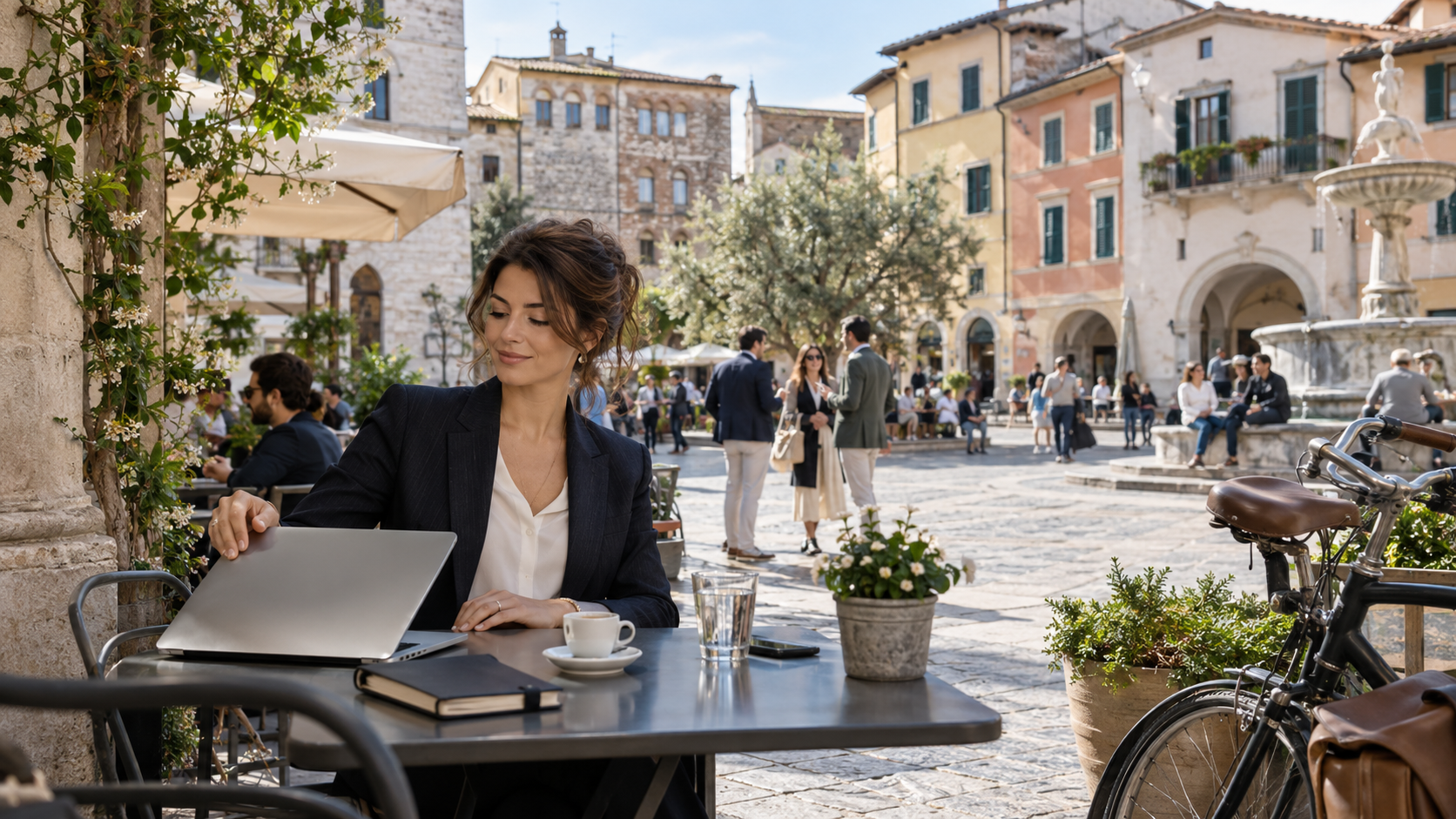
Remote work can transform Italian work-life balance by removing the commute and allowing people to live outside the most expensive employment centers. A professional earning an international salary while living in a smaller Italian city may enjoy a combination that is difficult to reproduce through local employment.
However, the romantic vision of working from a Tuscan farmhouse has practical limits. Reliable broadband, heating costs, transportation, workspace, time-zone differences and access to services all matter. Working North American hours from Italy can mean sacrificing evenings, precisely when Italian social life is most active.
Remote work also raises legal questions. Spending significant time in Italy can create immigration, tax and social-security consequences. A foreign employer may face Italian compliance obligations even if the employee works online.
Our guide to moving to Italy as an expat provides a broader overview of residence, housing, healthcare and financial planning.
How to Evaluate a Job Offer in Italy
Do not judge an Italian job solely by gross annual salary. Ask for a complete picture of the working arrangement:
- Which CCNL governs the position?
- What are the actual starting and finishing times?
- How long is the lunch break?
- Is overtime paid, exchanged for time off or considered part of the role?
- How many vacation and permit days are included?
- Can the employer determine when holidays are taken?
- Is remote or hybrid work written into the contract?
- How often are employees contacted outside working hours?
- Is the workplace accessible by public transportation?
- Are meal vouchers, transport support or company welfare benefits provided?
- Is the quoted compensation paid over 12, 13 or 14 installments?
- How much will housing and commuting cost in that particular city?
A slightly lower salary in a well-connected provincial city may produce a better standard of living than a higher salary in central Milan. Conversely, a southern location with inexpensive housing may not be advantageous if work is unstable or poorly paid.
Making Italian Work-Life Balance Work for You
The best balance usually comes from aligning employment, housing and transportation—not simply choosing the most beautiful region.
Living near work may be more valuable than having a larger home in a distant suburb. A modest city with rail connections may be more practical than an isolated village. A clearly defined hybrid agreement may matter more than a company’s general promises about flexibility.
If you are free to choose your location, spend time there during an ordinary working month rather than only during a holiday. Test the commute, internet connection, supermarkets, healthcare access and evening routine.
You can compare accommodation in potential base cities through Trip.com Italy, ideally staying in a residential neighborhood rather than the historic center. A short trial stay can reveal far more than photographs or cost-of-living tables.
Readers planning a longer move may also find practical guidance in Working in Italy: How to Find a Job and Build a Career and Cost of Living in Italy: A Realistic Monthly Budget.
Recommended Reading
For a deeper exploration of Italian habits, family life and social expectations, consider the following books:
The Italians by John Hooper
A lively examination of Italian society, politics, family relationships and everyday contradictions.
View The Italians on Amazon
La Bella Figura by Beppe Severgnini
An entertaining guide to the customs, instincts and unwritten rules that shape life in Italy.
View La Bella Figura on Amazon
Italian Neighbors by Tim Parks
A perceptive account of ordinary life in an Italian community, including the relationships and routines visitors rarely see.
View Italian Neighbors on Amazon
The Verdict: Myth or Reality?
Italian work-life balance is neither a complete myth nor an automatic reward for moving to Italy.
The country genuinely values holidays, meals, family, public life and time spent outside work. Legal protections give many employees a solid entitlement to rest. Medium-sized cities and provincial communities can offer a remarkably humane daily rhythm.
But Italy also has demanding employers, long commutes, regional inequality, precarious work and persistent gender imbalances. A relaxed public atmosphere does not necessarily mean that the people serving, producing and maintaining it have relaxed working lives.
Italy offers the ingredients for an excellent balance: walkable communities, social rituals, varied landscapes, paid leave and a culture that recognizes pleasures beyond productivity. Whether those ingredients create a better life depends on income, employment security, commuting time, family responsibilities and location.
The real Italian advantage is not that people avoid work. It is that life outside work remains visible, valued and worth protecting.
External Sources
European Commission EURES: Living and Working Conditions in Italy
Eurostat: Actual and Usual Hours of Work
ISTAT: Preliminary Estimate of Regional GDP and Employment
ISTAT: Sustainable Development Goals and Territorial Inequalities
Eurofound: Minimum Wage and Collective Bargaining in Italy