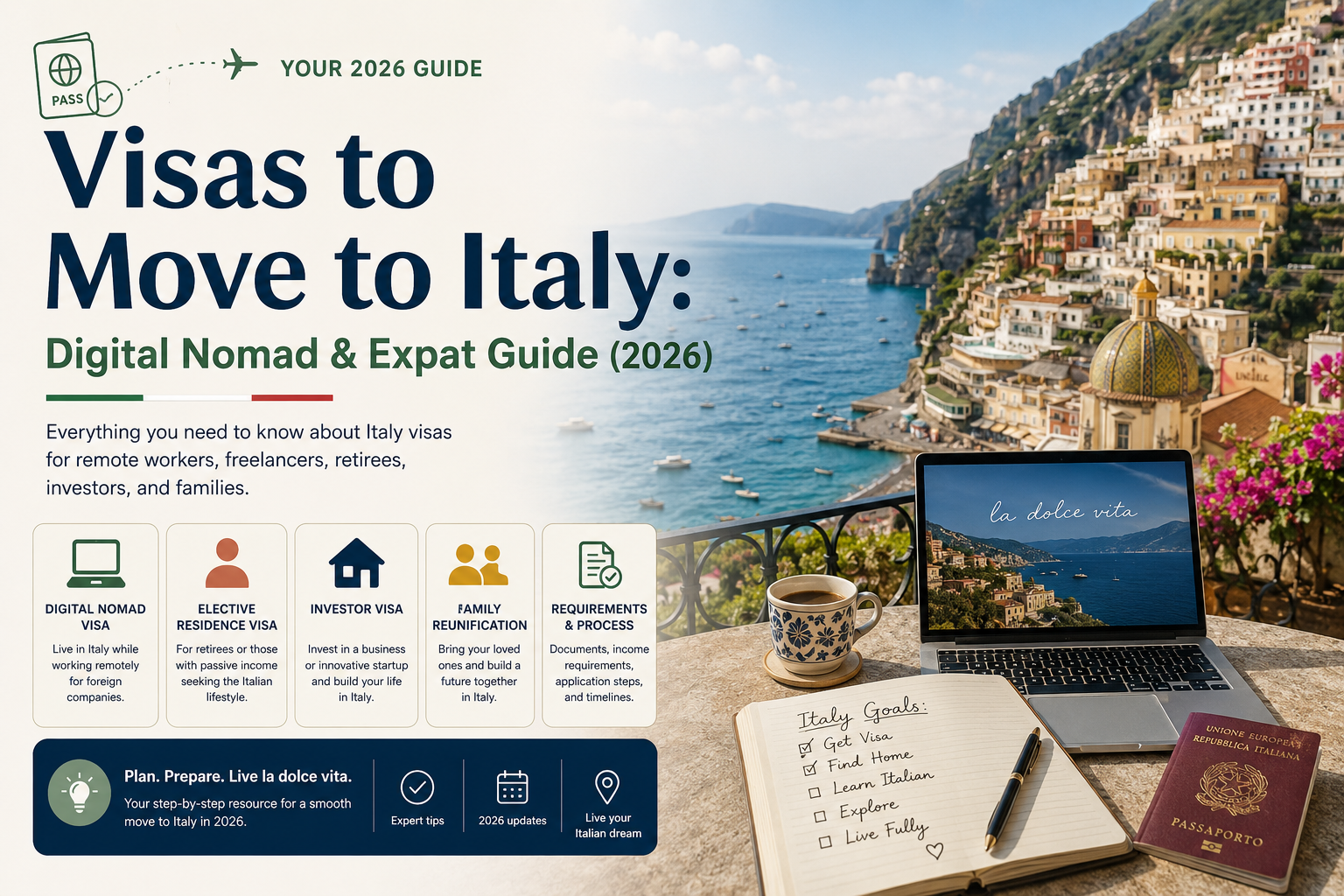
Visas to Move to Italy: Digital Nomad & Expat Guide 2026
Italy has become one of Europe’s most attractive destinations for people who want to build a new life abroad. Retirees are drawn by the lifestyle, food, climate and culture. Entrepreneurs see opportunities in the Italian market. Students come for universities and language programs. Remote professionals can combine an international career with life in an Italian city, coastal town or countryside village.
But there is an important distinction between visiting Italy and moving to Italy.
For non-EU citizens, spending a few weeks or even a few months in Italy as a tourist is very different from establishing legal residence. If you intend to remain in Italy for more than 90 days, the appropriate long-stay immigration route becomes essential.
Italy issues national long-stay visas, known as Type D visas, for stays exceeding 90 days. The exact visa depends on the purpose of the move: employment, self-employment, digital nomad work, study, family reasons, elective residence, investment and other categories.
For prospective expats, the most important question is therefore not simply, “How do I get an Italian visa?”
It is:
Which Italian visa matches the reason I want to live in Italy?
This 2026 guide explains the principal options, with particular attention to the Digital Nomad/Remote Worker Visa, the Elective Residence Visa, employment and self-employment routes, family visas, study visas and the Investor Visa.
Important: Immigration rules, consular requirements and administrative procedures can change. Requirements can also differ according to nationality and the Italian consulate responsible for your application. Always verify the current requirements with the Italian embassy or consulate that has jurisdiction over your legal residence before submitting an application.
Who Needs a Visa to Move to Italy?
The first distinction is between EU/EEA/Swiss citizens and non-EU citizens.
EU citizens
Citizens of EU countries generally have the right to move to Italy without obtaining an Italian immigration visa for employment, self-employment, study or retirement.
That does not mean there is no bureaucracy. Someone establishing a permanent home in Italy will generally need to deal with residence registration, healthcare, taxation and other local administrative requirements.
Italia Mia’s guide to Moving to Italy as an Expat provides a useful overview of the practical issues involved in establishing yourself in Italy.
Non-EU citizens
For citizens of countries outside the EU/EEA/Switzerland, the situation is different.
A non-EU citizen who intends to live in Italy for more than 90 days will generally need an appropriate national long-stay visa before entering Italy.
Italy’s official Visa for Italy system distinguishes numerous long-stay categories, including elective residence, investors, self-employment, salaried employment, family reasons, research, study and other purposes.
A tourist visa—or visa-free tourist admission for nationalities that do not require a Schengen visa—does not automatically give someone the right to move to Italy, establish residence or work.
This is one of the most common mistakes made by prospective expats.
The 90-Day Rule: Visit Versus Live
Italy is part of the Schengen Area.
For short visits, eligible non-EU nationals can generally stay for a maximum of 90 days in any 180-day period, subject to the applicable rules and nationality. The Schengen short-stay visa is a Type C visa.
A long-term move is different.
A national Type D visa is designed for stays exceeding 90 days. It permits long-term entry into Italy, while its holder can generally travel within the other Schengen countries for short periods subject to the applicable 90-days-in-180-days rules.
The important point is that you should not attempt to turn repeated tourist stays into de facto Italian residence.
If your real intention is to live in Italy, choose an immigration category that corresponds to your circumstances.
The Main Italian Visas for Expats in 2026
There is no single “Italian expat visa.”
Instead, Italy has several immigration pathways.
The most relevant include:
- Digital Nomad / Remote Worker Visa
- Elective Residence Visa
- Employment Visa
- Self-Employment Visa
- Investor Visa
- Family Visa
- Student Visa
- Research Visa
- Other specialized categories
The correct choice depends primarily on how you will support yourself and what you intend to do while living in Italy.
Italy’s Digital Nomad Visa
Italy’s Digital Nomad/Remote Worker Visa is one of the most interesting options for non-EU professionals who want to live in Italy while working remotely.
The program is designed for highly qualified non-EU workers whose work can be performed remotely using technology. Italian consular guidance divides applicants broadly into two groups:
Digital nomads are independent professionals such as freelancers, consultants and other self-employed specialists.
Remote workers are employees of a company who can perform their employment remotely.
This distinction is important because the supporting documentation differs between the two.
Who is eligible?
The visa is not intended for every person who happens to work online.
The applicant must qualify as a highly skilled worker under the relevant Italian immigration legislation.
The qualification can be demonstrated in different ways, including appropriate higher education, professional qualifications or substantial professional experience. For certain executives and ICT specialists, specific experience requirements can apply.
In other words, simply saying “I work remotely” is not enough.
You need to demonstrate that your profession falls within the qualifying category.
Digital Nomad Income Requirement
One of the most frequently discussed requirements is income.
Italian consular guidance currently references a minimum annual income threshold of €24,789, based on the legal framework and documentation published for the program. However, applicants should not assume that this figure will necessarily remain unchanged because the underlying calculation can be updated.
Another important point is the source of the income.
For the Digital Nomad/Remote Worker Visa, consular guidance states that the required income must derive from the work being performed in Italy. Passive income such as Social Security, rental income or investment income is not treated as the qualifying work income for this requirement.
This distinction can be crucial.
Someone with substantial savings and investment income may have plenty of money but still fail to qualify for the digital nomad route if they cannot demonstrate the required employment or professional income.
Six Months of Professional Experience
Applicants also need to demonstrate professional experience.
Current consular guidance requires evidence of at least six months of prior work experience in the relevant field. Documentation can include tax returns, client invoices, employment records, pay slips and similar evidence, depending on whether the applicant is an independent digital nomad or an employee.
The lesson is simple:
Document your career before you apply.
Do not wait until the visa appointment to start assembling evidence.
Education and Professional Qualifications
One route to demonstrating eligibility is a recognized university qualification.
Depending on the profession and circumstances, documentation may involve recognition through mechanisms such as CIMEA or a Declaration of Value.
Another possibility is qualification through professional experience.
Italian consular guidance describes routes involving substantial professional experience, including a higher professional qualification combined with documented experience. For executives and specialists in the ICT sector, a shorter specific experience period may apply.
Because regulated professions can involve additional requirements, applicants such as architects, engineers, teachers and healthcare professionals should investigate professional recognition separately.
Remote Employee Versus Freelancer
The difference between the two digital-worker categories matters.
Remote employee
A remote employee normally needs evidence of employment with the foreign employer.
The employer may also need to provide documentation concerning the employment relationship and compliance with Italian immigration requirements.
Consular guidance indicates that the employment contract must meet specified salary requirements, including applicable Italian collective-contract standards and an applicable minimum based on ISTAT data.
Digital nomad freelancer
A freelancer or independent professional needs to demonstrate the nature of their professional activity.
Evidence might include:
- Client contracts
- Invoices
- Tax returns
- Professional registrations
- Business records
- Evidence of professional experience
- Contracts with international clients
The objective is to show that the applicant has a genuine, sustainable professional activity rather than simply claiming to be a remote worker.
Health Insurance for Digital Nomads
Health coverage is another major component of the application.
Italian consular guidance requires appropriate medical insurance covering relevant healthcare expenses, hospitalization and, where applicable, repatriation.
Requirements and accepted forms of insurance can vary by consulate, so applicants should carefully follow the checklist issued by the consulate handling their application.
Do not assume that an ordinary travel insurance policy will automatically satisfy the requirement.
Ask the insurer for documentation specifically demonstrating the coverage required by the Italian consulate.
Housing Is Part of the Application
Another important feature of the Italian Digital Nomad Visa is the requirement for accommodation.
Consular guidance can require a lease, rental contract or deed for property in Italy, with the accommodation documented in the applicant’s name and covering the relevant period.
A hotel reservation may not be enough.
This creates an unusual challenge for applicants: you may need to secure housing before you know exactly when the visa will be issued.
That is why prospective digital nomads should plan their accommodation strategy carefully.
A short-term rental, for example, may be useful while deciding where to settle permanently, but the documentation must meet the requirements of the particular consulate.
How Long Does the Digital Nomad Visa Last?
The national visa itself can authorize a long stay, while the residence permit becomes the important document after arrival.
Current Italian consular guidance states that digital nomads can receive a residence permit for a limited period, with the digital-nomad permit generally issued for one year and renewable if the relevant conditions continue to be met.
The exact renewal process and documentation should be verified with the Questura responsible for your place of residence.
The Permesso di Soggiorno: What Happens After Arrival?
Getting the visa is not the end of the process.
For many non-EU long-stay visa holders, entering Italy is followed by the process of obtaining a Permesso di Soggiorno, or residence permit.
Italian guidance states that holders of long-stay visas generally must apply for the residence permit within the required period after arrival; consular guidance for digital nomads specifies the first eight working days.
The residence permit is what allows the foreign national to remain legally in Italy under the conditions of the relevant immigration category.
Depending on the category and local procedure, applications may involve the post office and/or the Questura.
Because procedures can differ locally, check the instructions applicable to the province where you will actually live.
Elective Residence Visa: The Option for Retirees and People With Passive Income
The Elective Residence Visa is another popular option for people moving to Italy.
It is particularly relevant to retirees, people with pensions, annuities, substantial investment income or other stable passive financial resources.
But there is one critical rule:
The Elective Residence Visa is not a work visa.
Italian consular guidance explicitly states that this visa does not permit employment or other work activity in Italy.
This makes it fundamentally different from the Digital Nomad Visa.
Who might use it?
Potential applicants include people who receive:
- Pensions
- Annuities
- Investment income
- Rental income
- Income from substantial assets
- Other stable passive income
The financial resources must be sufficient to support the applicant without relying on employment in Italy.
How Much Money Do You Need for Elective Residence?
There is no universally applicable single figure that every Italian consulate uses identically in every case.
Some Italian consular guidance references approximately €31,000 per person per year as a benchmark, while also emphasizing the need for substantial, steady financial resources and supporting documentation.
Applicants should therefore avoid relying on internet articles that promise a guaranteed minimum.
Consular officers evaluate the overall financial situation.
Evidence can include:
- Pension statements
- Bank statements
- Investment statements
- Rental income
- Annuity documentation
- Tax returns
- Property ownership
- Other reliable sources of passive income
The strongest applications usually make the financial picture easy to understand.
Digital Nomad or Elective Residence?
This is one of the most important decisions for people considering Italy.
| Situation | More appropriate route |
|---|---|
| Remote employee working for foreign company | Digital Nomad / Remote Worker |
| Freelancer with international clients | Digital Nomad |
| Consultant working remotely | Digital Nomad |
| Retired person living from pension | Elective Residence |
| Person living from investments | Elective Residence |
| Person living primarily from rental income | Elective Residence |
| Person who wants to work for an Italian employer | Employment route |
| Entrepreneur establishing qualifying business | Self-employment / other applicable route |
| Major qualifying investor | Investor Visa |
| University student | Student Visa |
| Joining qualifying family member | Family route |
The biggest mistake is choosing a visa based on the lifestyle you want rather than the legal activity that will support your stay.
Italian Work Visas
If you want to work for an Italian company, you generally need an immigration route based on employment.
Italy’s employment immigration system is closely connected with the Decreto Flussi, the framework governing certain entries of non-EU workers.
The Italian government explains that non-EU entry for many types of employment and self-employment occurs primarily within the entry quotas established through the Decreto Flussi. For standard employment, the Italian employer generally plays a central role in obtaining the necessary authorization before the worker applies for the visa.
This means moving to Italy first and then looking for an ordinary job is usually not the same as obtaining a digital nomad visa.
For many employment categories, the employer must initiate the immigration process.
Finding a Job Before Moving to Italy
If employment is your objective, start the process before you move.
Your strategy should include:
- Identify professions in demand.
- Research the Italian labor market.
- Find potential employers.
- Determine whether your qualification is recognized.
- Apply for jobs.
- Discuss sponsorship and immigration requirements with the employer.
- Obtain the necessary authorization.
- Apply for the appropriate visa.
- Enter Italy.
- Complete the residence-permit process.
Italia Mia’s recent guide, Finding a Job in Italy: Jobs, Requirements and Advice for Expats, looks more closely at employment opportunities, professional qualifications and regional labor markets.
Self-Employment and Freelance Work
Italy also provides visa categories for self-employment.
However, this should not be confused automatically with the Digital Nomad Visa.
The Digital Nomad route was created specifically for highly skilled remote professionals. Traditional self-employment can involve different requirements, authorizations, professional qualifications, business plans, quotas or other conditions depending on the activity.
Italy’s official Visa for Italy system lists self-employment separately from other categories, demonstrating that the immigration route depends on the specific nature of the work.
Anyone planning to open a business, practice a profession or establish a commercial activity should therefore investigate the specific immigration category before making commitments.
The Investor Visa for Italy
People with substantial capital have another option.
Italy’s Investor Visa is designed for non-EU nationals willing to make qualifying investments or philanthropic contributions in Italy.
The current qualifying routes include:
- €2 million in Italian government bonds
- €500,000 in an Italian company
- €250,000 in an Italian innovative startup
- €1 million in a philanthropic initiative supporting a qualifying project of public interest
The Investor Visa is not subject to the ordinary annual entry quotas that apply to many employment categories.
This is therefore a specialized route aimed at people who have substantial investment capital rather than ordinary retirees or remote workers.
Does Buying a House in Italy Give You Residency?
No.
Buying property in Italy does not automatically give a non-EU citizen the right to live permanently in Italy.
This is a very common misconception.
You can own Italian property without having an Italian residence permit, just as a foreign investor can own property in many countries without receiving immigration rights.
Your right to live in Italy must come from an appropriate immigration status.
This is particularly important for Americans, Canadians, British citizens and other non-EU nationals who may be tempted to purchase a home first and assume residency will follow.
Italia Mia’s Italy Moving Guide explains more about the relationship between housing, residence and the practical realities of relocating to Italy.
Family Visas and Bringing Your Family to Italy
Family reunification and family-member visas can provide another route to legal residence.
The specific rules depend on the relationship and the immigration status of the person already living in Italy.
For digital nomads and remote workers, current consular guidance provides routes for certain family members, including a spouse and children under 18, subject to the applicable requirements.
Families should not assume that every relative automatically qualifies.
Parents, adult children and other relatives can involve significantly different requirements.
For complex family situations, professional immigration advice can be worthwhile.
Student Visas
Italy is home to some of Europe’s oldest and most prestigious universities.
Non-EU citizens who plan to undertake long-term university study generally need the appropriate study visa.
Student status can also involve rules concerning employment, healthcare, residence and renewal.
The Italian Visa for Italy system identifies study, university study, apprenticeship and vocational training among the available visa categories.
For someone considering an Italian university, the immigration process should be coordinated with the educational institution well before arrival.
Tax Residency Is a Separate Question
Obtaining a visa and becoming an Italian tax resident are related but not identical questions.
This distinction is extremely important.
You can have an Italian residence permit without immediately understanding all of the tax consequences of your move.
Once you establish your life in Italy, questions can arise concerning:
- Italian tax residence
- Worldwide income
- Foreign bank accounts
- Investments
- Pension income
- Capital gains
- Rental income
- Social security
- Double-taxation treaties
- Reporting obligations
Anyone moving from the United States should be particularly careful because U.S. citizens generally continue to have U.S. federal tax filing obligations even when living abroad.
Italy’s Special Tax Regimes
Italy has several tax regimes that can be relevant to new residents, depending on their circumstances.
One widely discussed regime is the flat-tax system for certain new Italian tax residents with substantial foreign income.
However, this regime has changed significantly.
The Italian Revenue Agency currently states that for individuals who transferred their residence after August 11, 2024, the annual substitute tax under Article 24-bis is €300,000, rather than the previous €100,000 amount. Certain qualifying family members can be covered for an additional €50,000 per year.
This is a good example of why expats should be careful with older online articles.
A tax article published several years ago may describe rules that are no longer applicable.
The 7% Pensioner Tax Regime
Another potentially important tax provision applies to certain foreign pensioners who transfer their tax residence to qualifying small municipalities in parts of southern Italy and certain earthquake-affected areas.
The Italian Revenue Agency describes an optional 7% substitute tax for qualifying foreign pension income under Article 24-ter of the Italian tax code, subject to geographic and other requirements.
This can make some smaller communities in southern Italy particularly interesting to foreign retirees.
However, eligibility should be evaluated carefully before choosing a town based solely on taxation.
Healthcare for Expats
Healthcare is another major consideration when moving to Italy.
Italy operates the Servizio Sanitario Nazionale, or SSN, its national health service.
Access and registration depend on your legal status.
Some residents have mandatory or automatic access through employment, while others may need to register under the applicable rules or maintain private health insurance.
Digital nomads, elective residents and other categories can have different requirements.
Do not assume that obtaining a residence permit automatically means that every healthcare service will be immediately available under exactly the same conditions as an Italian citizen.
Healthcare should be part of your relocation budget and immigration plan from the beginning.
Choosing Where to Live in Italy
Your visa may allow you to live in Italy, but it does not tell you where you should live.
That is your lifestyle decision.
Milan
Best suited to people looking for:
- International business
- Finance
- Fashion
- Technology
- Higher salaries
- Major corporate employers
The downside is the cost of housing.
Rome
Rome offers:
- Government
- International organizations
- Tourism
- Culture
- Media
- Healthcare
- Services
It combines a large metropolitan economy with an extraordinary historical environment.
Florence
Florence is particularly attractive to:
- Artists
- Designers
- Students
- Tourism professionals
- English-speaking expats
- Cultural workers
Housing can be expensive, particularly in the historic center.
Tuscany
For remote workers and retirees, Tuscany remains one of Italy’s most attractive regions.
The combination of countryside, historic towns, food, wine and proximity to Florence makes it particularly appealing.
However, Tuscany is not uniformly inexpensive.
A smaller town may offer substantially lower living costs than Florence or other major tourist destinations.
Southern Italy
Southern Italy can offer lower housing costs and a slower pace of life.
Potential destinations include parts of:
- Puglia
- Calabria
- Sicily
- Basilicata
- Campania
- Sardinia
For retirees with qualifying foreign pension income, certain small municipalities in southern regions can also be relevant to the 7% tax regime discussed above.
How Much Money Should You Have Before Moving?
Visa minimums are not the same thing as a realistic relocation budget.
Someone might technically meet a visa requirement but still find it difficult to live comfortably in Italy.
Before moving, calculate:
Housing + utilities + food + transportation + healthcare + insurance + taxes + travel + emergency reserve
Your budget should also include the costs of setting up a new household.
These can include:
- Rental deposit
- First month’s rent
- Agency fees
- Furnishings
- Utility deposits
- Transportation
- Legal fees
- Translation
- Document legalization
- Visa fees
- Residence-permit fees
- Health insurance
The more complicated your immigration situation, the more important it is to maintain a financial reserve.
Documents You Should Prepare Before Applying
Although requirements vary by visa and consulate, prospective expats should expect to provide documentation such as:
- Valid passport
- Visa application
- Passport photographs
- Proof of legal residence in the consular jurisdiction
- Proof of accommodation
- Financial documentation
- Health insurance
- Employment or professional documentation
- Tax returns
- Bank statements
- Educational qualifications
- Professional licenses where applicable
- Criminal-record documentation where required
- Marriage and birth certificates where relevant
- Translations and certifications where required
One of the best strategies is to create a master immigration folder several months before your intended move.
Keep both digital and paper copies.
Apostilles, Legalization and Translation
Foreign documents may need to be:
- Apostilled
- Legalized
- Translated into Italian
- Certified
- Accompanied by a Declaration of Value or other recognition documentation
The exact requirements depend on the country that issued the document and the Italian authority requesting it.
Do not have every document translated and apostilled automatically.
First determine exactly what the Italian consulate and other authorities require.
This can save considerable money and time.
Applying at the Correct Italian Consulate
Visa applications are normally submitted through the Italian embassy or consulate responsible for the applicant’s legal place of residence.
The Italian Ministry of Foreign Affairs specifically states that visa applications should be submitted to the Italian diplomatic or consular office responsible for the applicant’s registered residence.
This is especially important for people who live abroad temporarily.
For example, simply being physically present in another country as a tourist does not necessarily mean that you can apply for an Italian visa there.
How Early Should You Apply?
The Italian Ministry of Foreign Affairs states that visa applications can generally be submitted no more than six months before the intended travel date and, as a rule, no later than 15 calendar days before departure, although specific circumstances and visa categories can affect timing.
For a permanent move, waiting until the final weeks is a poor strategy.
Start preparing months ahead.
The most time-consuming parts may not be the visa form itself but obtaining:
- Certified documents
- Apostilles
- Translations
- Employment letters
- Financial records
- Professional recognition
- Housing documentation
Common Mistakes Expats Make
Mistake 1: Assuming a tourist stay can become residency
It generally cannot.
If you intend to live in Italy, establish the correct legal basis first.
Mistake 2: Choosing the wrong visa
A retiree relying on pension income should not apply for a digital nomad visa simply because they own a computer.
Likewise, a freelancer who intends to continue working should not choose an Elective Residence Visa merely because they have savings.
Mistake 3: Assuming property ownership gives residency
It does not.
Mistake 4: Ignoring taxes
Your immigration status does not automatically determine your tax residence.
Mistake 5: Underestimating Italian bureaucracy
Italy can be extraordinarily rewarding, but paperwork can involve multiple authorities.
Mistake 6: Using outdated internet information
Visa and tax rules change.
A blog post from 2022 may be completely unsuitable for someone moving in 2026.
Mistake 7: Assuming English is enough
You can certainly live in parts of Italy using English, particularly in international communities.
But Italian becomes increasingly important for:
- Government offices
- Healthcare
- Banks
- Landlords
- Utilities
- Local businesses
- Employment
- Neighbors
- Everyday life
A Practical 2026 Relocation Timeline
9–12 months before moving
Decide why you want to move.
Determine whether you are:
- Retiring
- Working remotely
- Starting a business
- Seeking employment
- Studying
- Joining family
- Investing
Then identify the appropriate visa category.
6–9 months before moving
Research:
- Visa requirements
- Italian consulate
- Financial requirements
- Healthcare
- Housing
- Tax implications
- Required documents
Begin collecting certificates and professional documentation.
3–6 months before moving
Secure the documents required for the application.
If appropriate, begin looking for accommodation.
Arrange insurance.
Prepare translations and certifications.
Application period
Submit the visa application through the appropriate Italian diplomatic or consular office.
Keep copies of everything.
Arrival in Italy
Do not treat the visa as the end of the process.
Complete the required residence-permit procedure.
First months in Italy
Work through the practical settlement process:
- Residence registration where applicable
- Codice fiscale
- Healthcare registration
- Bank account
- Utilities
- Mobile phone
- Driving requirements
- Tax advice
- Local administration
What Is the Best Italian Visa for You?
There is no universal answer.
If you are a remote professional
The Digital Nomad/Remote Worker Visa may be the most logical option, provided you meet the highly skilled-worker, income, experience, insurance and other requirements.
If you are retired
The Elective Residence Visa may be more appropriate if your financial resources come from pensions, investments, property or other passive sources and you do not intend to work in Italy.
If you want an Italian job
Investigate employment visas and the Decreto Flussi or other applicable employment pathways.
If you want to establish a business
Investigate the appropriate self-employment or entrepreneurial route rather than assuming that the digital nomad category applies.
If you have substantial investment capital
The Investor Visa can provide a specialized route for qualifying investments.
If you are joining family
Investigate family-reunification or family-member provisions.
If you want to study
The student visa is the appropriate starting point.
Is Moving to Italy Difficult?
The answer depends on your circumstances.
For an EU citizen, the process is substantially easier because EU free-movement rights eliminate the need for an Italian immigration visa.
For a non-EU citizen, the process is more demanding, but it is entirely possible for people who meet the requirements.
The key is preparation.
Italy does not generally ask prospective residents to prove that they simply “love Italy.”
It asks them to demonstrate a legitimate reason for residence and the ability to comply with the conditions of that immigration category.
That means a successful move begins with choosing the correct legal pathway.
Final Advice for Prospective Expats
Moving to Italy can be one of the most rewarding decisions you make, but the romantic vision of life in Italy should be combined with practical preparation.
Before buying a plane ticket, determine:
Why am I moving?
How will I support myself?
Which visa legally permits that activity?
Where will I live?
How will I obtain healthcare?
What happens to my taxes?
What documents do I need?
What happens after I arrive?
For remote workers, Italy’s Digital Nomad/Remote Worker Visa has opened an important new pathway. For retirees and financially independent people, the Elective Residence Visa remains an important option. Employment, self-employment, family, study and investment provide additional routes.
The most important principle is simple:
Do not start with the apartment, the flight or even the Italian dream. Start with your legal immigration category.
Once you know that you can legally live in Italy, the rest of the relocation process becomes much easier to organize.
Italy has cities, villages, mountains, coastlines, historic towns and rural communities capable of offering radically different lifestyles. The challenge is finding the place—and the visa—that fits your circumstances.
For anyone seriously considering the move, preparation is not bureaucracy for bureaucracy’s sake.
It is the foundation of a successful Italian life.
Related Italia Mia Guides
- Moving to Italy as an Expat: A Comprehensive Guide — visas, residence, housing, employment, healthcare and settling into Italian life.
- Moving to Italy: A Guide for Expats — practical advice for planning an Italian relocation.
- Italy Moving Guide: Buying or Renting a Home — housing considerations for prospective expats.
- Finding a Job in Italy: Jobs, Requirements and Advice for Expats — employment opportunities and the Italian labor market.
- Expat Advice for an Italian Move — additional advice on work, healthcare and relocation.
- Landing a Job in Marketing as an Expat in Italy — useful for professionals considering remote or international work.
External Links
- Italian Ministry of Foreign Affairs – Visa Information
- Visa for Italy – Official Visa Database
- Italian Ministry of Foreign Affairs – Visa Types and Duration
- Italian Ministry of Foreign Affairs – Foreigners’ Stay in Italy
- Italian Revenue Agency
- Investor Visa for Italy