 If you plan to live, study, work, buy property, rent a home, open certain financial accounts, or deal with Italian public authorities, one of the first Italian administrative terms you will encounter is codice fiscale.
The codice fiscale is Italy’s tax identification code. Despite the name, you do not need to be an Italian taxpayer to need one. Foreign residents, students, property buyers, workers, retirees, and people conducting certain transactions in Italy may all require a codice fiscale.
Fortunately, obtaining one is generally free. The important part is knowing which authority should issue it in your particular situation.
This guide explains how foreigners can obtain a codice fiscale in Italy, what documents are normally required, how the procedure differs for EU and non-EU citizens, and what to do if you are still living abroad.
What Is an Italian Codice Fiscale?
The codice fiscale is an alphanumeric identification code assigned by the Italian Revenue Agency, the Agenzia delle Entrate.
For individuals, it normally consists of 16 letters and numbers derived from personal information such as your name, surname, date of birth, sex, and place or country of birth.
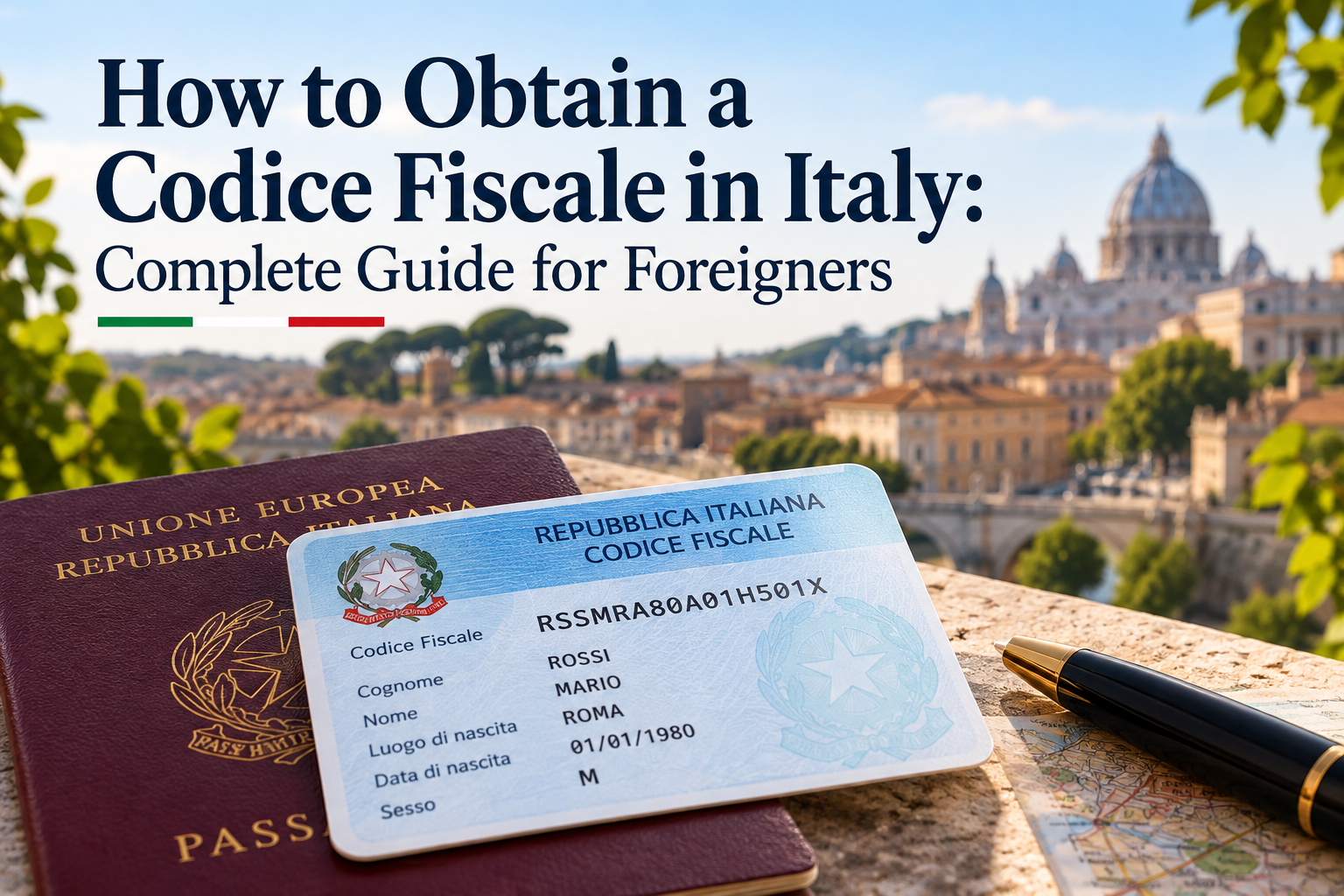
It might look something like this:
RSSMRA80A01H501X
That example is illustrative only. Your official codice fiscale must be the one assigned and recorded by the Italian authorities.
The codice fiscale identifies Italian and foreign individuals in dealings with public administrations and many private organizations. Official Italian consular guidance describes it as the code used to identify a person in dealings with Italian public authorities, private entities, and institutions. Consulado Italiano San Paolo
What Is a Codice Fiscale Used For?
Foreigners are often surprised by how frequently they are asked for a codice fiscale in Italy.
Depending on your circumstances, you may need it to:
- sign a residential rental contract;
- purchase Italian real estate;
- start employment;
- deal with Italian tax authorities;
- enroll in certain educational programs;
- apply for utilities or other services;
- complete banking or financial procedures;
- register with the Italian National Health Service when eligible;
- obtain a health card;
- accept an inheritance;
- enter into certain contracts;
- conduct business or professional activities.
It is therefore useful to think of the codice fiscale as an Italian personal administrative identifier, rather than simply as a tax number.
If you are planning a longer stay, see our guides in Living in Italy for more practical information about residency, banking, healthcare, housing, and everyday bureaucracy.
Who Can Obtain a Codice Fiscale?
You do not have to be an Italian citizen to obtain one.
A codice fiscale can be assigned to foreigners who have a legitimate reason to require one in connection with Italy.
The correct application procedure depends largely on:
- whether you are an EU/EEA or non-EU citizen;
- whether you are already in Italy;
- why you need the codice fiscale;
- whether your immigration procedure itself provides for its assignment.
This last point is particularly important for non-EU nationals.
How EU Citizens Can Obtain a Codice Fiscale in Italy
For an EU citizen who needs a codice fiscale while in Italy, one of the most straightforward routes is generally through an Agenzia delle Entrate territorial office.
Official Italian guidance states that EU citizens intending to stay in Italy can request a codice fiscale from a territorial office of the Revenue Agency using Form AA4/8, accompanied by a valid identity document and a reason for the request. Consulado Italiano San Paolo
Examples of legitimate reasons might include employment, study, renting or purchasing property, or another administrative or contractual need.
Before visiting an office, check current opening and appointment procedures with the Agenzia delle Entrate.
Agenzia delle Entrate official website
How Non-EU Citizens Obtain a Codice Fiscale
The procedure can be different for citizens from outside the European Union.
In many immigration cases, you should not independently apply for a second codice fiscale if one is already being assigned through your immigration procedure.
For non-EU citizens entering Italy for employment or family reunification, the codice fiscale can be assigned through the Sportello Unico per l’Immigrazione, the immigration desk operating through the Prefettura.
For foreigners applying for other types of residence permits, the codice fiscale can be assigned through the Questura as part of the residence-permit procedure. Consulado Italiano San Paolo
This distinction matters because having two different codes associated with the same person can create administrative problems.
If you have already begun your Italian immigration or residence-permit procedure, check whether a codice fiscale has already been assigned before submitting a separate application.
What About International Students?
The procedure depends on your nationality and length and type of stay.
For example, current official guidance states that a foreign student staying in Italy for less than 90 days may request a codice fiscale from an Agenzia delle Entrate office when one is required.
For a non-EU student staying for more than 90 days and applying for a residence permit, the codice fiscale may instead be assigned during the residence-permit procedure. Embassy of Italy Beijing
Some Italian universities also help international students obtain their codice fiscale, so new students should check with their university’s international office before making a separate application.
Applying Directly Through the Agenzia delle Entrate
When direct application through the Revenue Agency is appropriate, the principal form for individuals is:
Form AA4/8 – Domanda di attribuzione codice fiscale
The form is used for the assignment of a codice fiscale and for certain subsequent changes or requests relating to an existing code.
The Revenue Agency states that an individual who does not have a codice fiscale can apply using Form AA4/8 together with a valid identity document. The Agency also provides procedures allowing the form and supporting documentation to be transmitted to an office by email or PEC in appropriate circumstances. Agenzia Entrate
Agenzia delle Entrate — tax and identification services
Because procedures and individual office practices can change, verify the current instructions before sending documents.
Documents You May Need
The exact documentation depends on your nationality, status, and reason for applying, but you should normally be prepared to provide:
- completed AA4/8 application form when applicable;
- valid passport or qualifying identity document;
- personal details exactly matching your official documents;
- evidence explaining why you require the codice fiscale, when requested;
- immigration or residence documentation where relevant.
Foreign residents applying through an Italian consulate may be asked for additional documentation. Requirements can differ between consular jurisdictions, so always check the website of the Italian embassy or consulate responsible for your place of residence.
Can You Obtain a Codice Fiscale Before Moving to Italy?
In certain circumstances, yes.
Foreign citizens residing outside Italy can request assistance from the Italian diplomatic-consular office responsible for their area when there is a justified need.
The Ministry of Foreign Affairs states that foreign citizens residing abroad can make a motivated request through the appropriate Italian consular office, or apply through an Agenzia delle Entrate office in Italy personally or, where permitted, through a specially authorized representative. Ministry of Foreign Affairs
There is an important limitation, however.
Current Foreign Ministry guidance indicates that consular applications for foreign citizens are intended particularly for situations in which the codice fiscale is required for an online procedure and/or the applicant cannot delegate someone in Italy to make the request. Embassy of Italy Beijing
So you should not assume that every Italian consulate will automatically process a codice fiscale application simply because you would like to obtain one before traveling.
Find the Italian diplomatic office responsible for your residence through the official Ministry of Foreign Affairs consular services.
Italian Ministry of Foreign Affairs — consular services
Buying Property in Italy and the Codice Fiscale
If you are buying a home in Italy, you will normally need a codice fiscale for the legal and tax procedures surrounding the purchase.
This applies even if you have no intention of becoming an Italian resident.
Foreign property buyers should therefore deal with the codice fiscale early in the purchasing process rather than waiting until the final deed.
A representative may also be able to handle the application in Italy with the appropriate authorization. Official consular guidance specifically identifies property transactions and other legal transactions as situations in which the applicant or an authorized representative, such as a lawyer, notary, accountant, or real-estate professional, may deal with an Agenzia delle Entrate office. consmonacodibaviera.esteri.it
If you are considering a move as well as a property purchase, explore our Living in Italy section for related guides on residency, banking, healthcare, and settling in Italy.
Can Someone Apply for You?
In appropriate cases, yes.
Foreign citizens outside Italy may be able to authorize another person to submit the application at an Agenzia delle Entrate office.
This can be particularly useful for people buying Italian property from abroad.
However, the required form of authorization can depend on the transaction and circumstances. If a notary, lawyer, commercialista, or property professional is already handling your Italian transaction, ask whether they can arrange the codice fiscale application and exactly what authorization they require.
Is the Codice Fiscale Free?
The official assignment of a codice fiscale by the Italian authorities is free. Italian consular guidance explicitly describes the codice fiscale as being issued free of charge by the Agenzia delle Entrate. Conscanton
You may encounter private websites or agencies offering to obtain one for a fee.
Those companies are charging for their assistance or intermediary service — not for the codice fiscale itself.
For a straightforward application, many foreigners can complete the official procedure without paying an intermediary.
How Long Does It Take?
There is no single processing time that applies to every applicant.
Timing can depend on how you apply, which authority handles the request, whether your documentation is complete, and whether the codice fiscale is being assigned as part of an immigration procedure.
An application made directly at an Agenzia delle Entrate office may be relatively straightforward, while applications submitted from abroad through diplomatic channels can take longer.
If you need the codice fiscale for a property closing, university enrollment, employment contract, or another deadline, apply as early as the relevant procedure permits.
Codice Fiscale vs Tessera Sanitaria
These are related, but they are not the same thing.
The codice fiscale is your tax and administrative identification code.
The Tessera Sanitaria is Italy’s health card for people entitled to it through the Italian healthcare system. The card normally displays the person’s codice fiscale.
Having a codice fiscale does not automatically mean you are registered with the Italian National Health Service (SSN).
The Revenue Agency specifically notes that people who are not enrolled in the SSN may receive documentation relating to their codice fiscale without being entitled to a Tessera Sanitaria. Agenzia Entrate
This distinction is particularly important for new foreign residents.
Codice Fiscale vs Partita IVA
Another common source of confusion is the difference between a codice fiscale and a Partita IVA.
A codice fiscale identifies an individual for Italian administrative and tax purposes.
A Partita IVA is an Italian VAT number used by businesses and many self-employed professionals.
You can therefore have a codice fiscale without having a Partita IVA. In fact, most people living in Italy have a codice fiscale, while only people engaged in relevant business or professional activities need a Partita IVA.
Be Careful With Online Codice Fiscale Generators
Many websites can calculate what your codice fiscale would probably be from your name, birth date, sex, and place of birth.
These tools can be useful for understanding how the code is constructed, but a calculated code is not a substitute for an officially assigned codice fiscale.
There are situations in which the code produced by a simple calculator may differ from the official code, including cases involving people with similar identifying data and the Italian system known as omocodia.
For contracts, taxes, property transactions, banking, immigration, or official paperwork, use only the codice fiscale officially assigned to you.
What If Your Name or Personal Details Are Wrong?
Check the information carefully as soon as you receive your official codice fiscale documentation.
Problems can occur when foreign names are transcribed differently, when a person has several given names, or when the place of birth or other personal information does not match the applicant’s official documents.
If the information recorded by the Italian tax authorities is incorrect, contact the Agenzia delle Entrate to have the data corrected.
Do not simply generate a different codice fiscale yourself.
The Revenue Agency warns that if personal data associated with an assigned codice fiscale are incorrect, the taxpayer should request a correction from an Agency office. Info Precompilata
Do You Need a New Codice Fiscale If You Move?
Normally, no.
Your codice fiscale is intended to identify you personally. Moving from one Italian city to another does not mean you obtain a new one.
Likewise, leaving Italy and returning years later does not normally mean you should request another code.
If you have previously lived, studied, worked, owned property, or completed official transactions in Italy, check whether you already have a codice fiscale before applying again.
Common Mistakes Foreigners Should Avoid
The most frequent problems are often preventable.
Applying twice. If an Italian immigration authority, university, employer, or previous transaction has already resulted in a codice fiscale being assigned, do not request another without checking first.
Using an online calculator as proof. A mathematically generated code is not necessarily proof of official assignment.
Confusing the codice fiscale with healthcare registration. Having the number alone does not establish entitlement to the Italian National Health Service.
Paying unnecessary fees. Official assignment is free. Private agencies may legitimately charge for assistance, but their service is optional in many ordinary cases.
Waiting until the last moment. If you are buying a house, beginning work, enrolling at a university, or moving to Italy, establish early in the process how your codice fiscale will be assigned.
A Simple Checklist for Foreigners
If you need an Italian codice fiscale, first determine whether another authority will assign it automatically as part of your immigration or residence procedure.
If not, establish whether you should apply through an Agenzia delle Entrate office in Italy or, when you are still abroad and meet the relevant conditions, through the Italian consular authorities.
Prepare your identification documents and Form AA4/8 where required. Make sure every name, birth date, and place of birth matches your official documents exactly.
Most importantly, keep the official certificate or documentation showing the codice fiscale once it has been assigned. You are likely to use the number repeatedly if you live, work, study, invest, or own property in Italy.
The Bottom Line
For most foreigners, obtaining an Italian codice fiscale is not particularly difficult. The confusing part is that there is no single application route for everyone.
An EU citizen already in Italy may apply directly to the Agenzia delle Entrate. A non-EU citizen may receive the code through immigration authorities. A foreigner living abroad may, in qualifying circumstances, work through an Italian consular office or authorize someone in Italy to handle the application.
The key is to use the officially assigned code, not simply one produced by an online calculator, and to avoid applying for a duplicate if Italy has already assigned one to you.
Once you have it, keep a record of it. The codice fiscale will become one of the numbers you encounter again and again while dealing with Italian bureaucracy.
External Sources
Agenzia delle Entrate — Official Website
Italian Ministry of Foreign Affairs — Consular Services