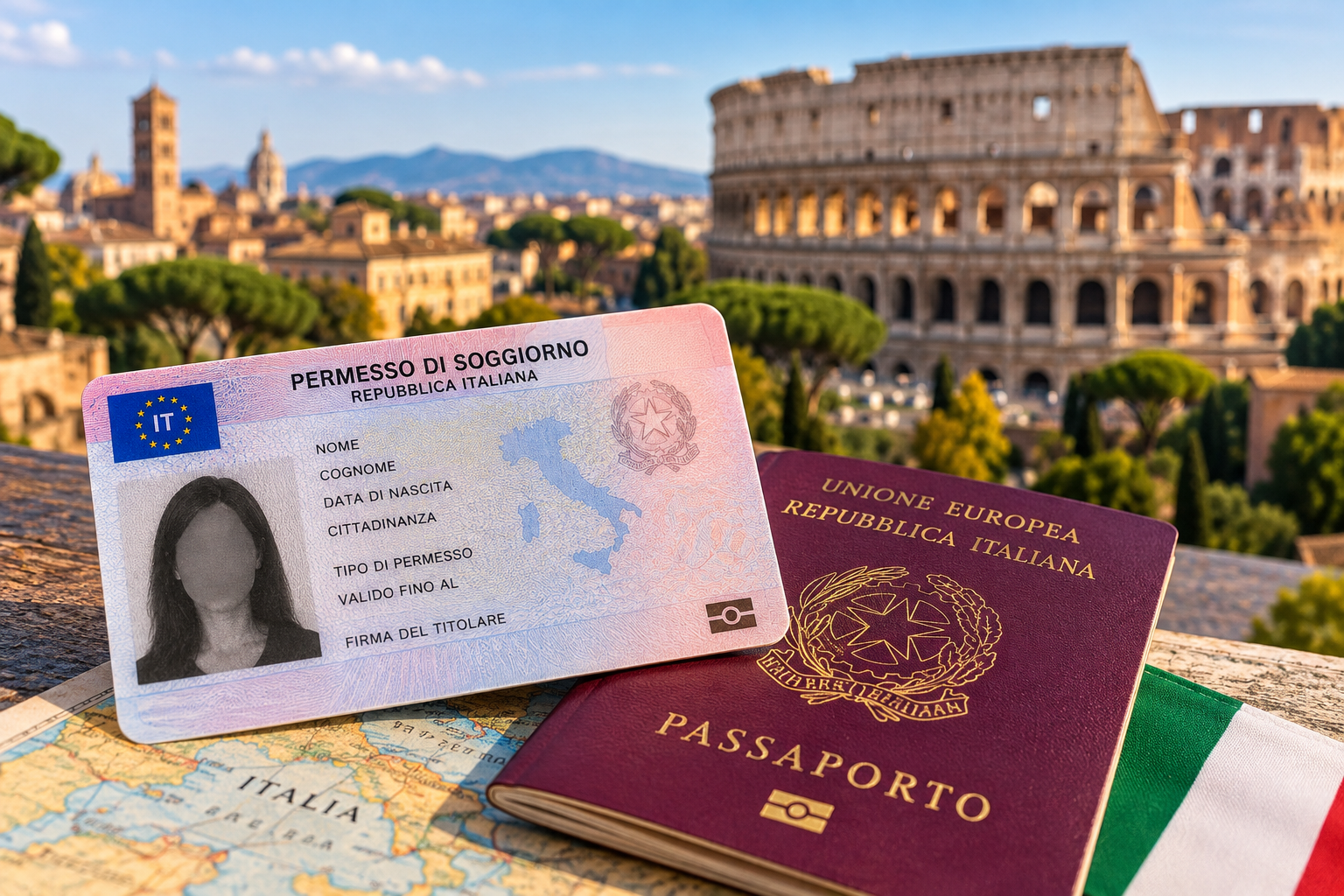
 Moving to Italy involves more than obtaining a visa and finding somewhere to live. For most non-EU citizens who intend to remain in Italy for more than a short visit, one of the most important documents is the permesso di soggiorno, or Italian residence permit.
The terminology can be confusing at first. A visa, a permesso di soggiorno and Italian residenza are related, but they are not the same thing.
A visa normally authorizes you to enter Italy for a particular purpose. The permesso di soggiorno authorizes a non-EU citizen to remain in Italy under the conditions associated with that immigration status. Residenza, meanwhile, refers to registration of your habitual address with an Italian municipality.
If you are still deciding which immigration route applies to you, start with our guide to Visas to Move to Italy: Digital Nomad & Expat Guide.
For a broader overview of relocation, housing, healthcare and bureaucracy, see Moving to Italy: Complete Guide for Expats in 2026.
What Is a Permesso di Soggiorno?
Permesso di soggiorno literally means “permission to stay.”
It is the residence permit issued in Italy to non-EU citizens who meet the requirements for a particular category of stay.
Depending on your circumstances, your permit may be connected to employment, self-employment, study, family reasons, elective residence or another legally recognized purpose.
The important distinction is that the permesso is not simply another name for an Italian visa.
A non-EU citizen moving to Italy will commonly obtain the appropriate long-stay visa from an Italian embassy or consulate before entering the country. After arriving in Italy, the person then follows the applicable procedure for obtaining the residence permit.
Italy’s Ministry of the Interior states that the residence permit is issued by the Questura responsible for the province where the foreign national is located.
Who Needs a Permesso di Soggiorno?
The requirement primarily concerns citizens of countries outside the European Union who intend to remain in Italy under a residence status that requires a permit.
This includes many Americans, Canadians, British citizens, Australians and nationals of other non-EU countries moving to Italy.
EU citizens are in a different legal position because of European freedom-of-movement rules. They generally do not obtain an ordinary permesso di soggiorno simply to exercise their right to live in Italy. However, people establishing their habitual home in Italy may have municipal registration requirements.
This distinction is important because immigration status and municipal residence are separate concepts.
Our complete guide to registering your residence in Italy explains residenza, domicilio and residence registration in greater detail.
When Should You Apply?
Timing matters.
The Italian Ministry of the Interior states that a residence permit should be requested within eight working days of arrival when the applicable immigration rules require one.
That means someone arriving with a long-stay visa should not treat the visa expiration date as the deadline for beginning the residence-permit procedure.
The first days after moving can already be hectic. You may be dealing with accommodation, a tax code, telephone service, banking and other practical matters.
Nevertheless, the permesso procedure should be near the top of your arrival checklist.
Before traveling, it is sensible to prepare copies of the documents connected with your visa and immigration category so that you are not trying to reconstruct your application immediately after arriving.
Where Do You Apply?
This is where newcomers frequently encounter one of the peculiarities of Italian immigration bureaucracy: not every residence-permit application follows exactly the same submission route.
Many common applications are submitted through designated Poste Italiane offices using the postal application system.
These offices belong to the Sportello Amico network.
Other types of residence permit must be handled directly through the immigration office of the Questura.
Therefore, do not assume that a friend, colleague or another expat followed the same procedure you will follow. The correct route depends on the type of permit.
Poste Italiane maintains the current list of residence-permit categories that can be submitted through its authorized post offices.
The Famous Yellow Kit
Anyone who has spent time in an Italian expat community has probably heard someone mention the kit.
For permit categories handled through the postal system, applicants can use the application package commonly called the kit a banda gialla, or yellow-striped kit.
It contains the forms and instructions needed for the postal application procedure.
However, you do not necessarily have to struggle through the paperwork alone.
Authorized patronati and participating municipalities can provide assistance with completing the application. The official Immigration Portal states that this assistance is available free of charge.
For someone completing a first permesso application, particularly with limited Italian, using an authorized patronato can be considerably less stressful than trying to interpret every section independently.
Documents You May Need
The exact documentation depends on the reason for your stay.
There is no single universal checklist appropriate for every permesso di soggiorno.
However, a postal application generally involves identification documents and evidence supporting the particular residence category.
Poste Italiane instructs applicants using the postal procedure to provide the required passport copies, including the relevant identification and visa or entry/exit pages, together with the documentation required for the particular type of permit.
Applicants renewing, updating or converting an existing permit must also provide a copy of the permit concerned.
Depending on the residence category, supporting documents might concern employment, study, family relationships, income, accommodation or other qualifying circumstances.
Do not rely on a generic internet checklist when preparing an important immigration application. Check the requirements applying to your particular permit category.
Submitting the Application at Poste Italiane
If your type of application uses the postal procedure, you submit it at an authorized Poste Italiane Sportello Amico.
The applicant must normally appear personally and present a valid passport or equivalent identity document.
One small but important detail: the application envelope is presented open, not already sealed.
The postal employee checks the submission, handles the applicable payments and provides documentation confirming that the application has been filed.
Keep everything you receive.
The postal receipt is particularly important because it contains the codes used to follow the progress of the application through the official Immigration Portal.
The Receipt Is an Important Document
Do not treat the postal receipt like an ordinary receipt for something you purchased.
It provides evidence that you submitted your residence-permit application.
Poste Italiane states that the receipt allows the applicant to circulate in Italy when accompanied by the appropriate documents: for a first issue, the passport or equivalent document; for a renewal, the expiring permit.
This receipt can therefore become an important part of your documentation while the physical residence permit is being processed.
Make copies or secure digital scans and keep the original safe.
The legal rules surrounding international travel while a permit is pending can be more complicated than simply carrying the receipt, particularly when travel involves other Schengen countries. Verify the rules applying to your situation before leaving Italy.
What Happens at the Questura?
Submitting the postal kit is not necessarily the end of the procedure.
Poste Italiane provides applicants with a letter of appointment for the Questura, indicating when and where they must appear for the subsequent stage of the application.
At the Questura, the authorities complete the necessary immigration checks and, where required, collect fingerprints and other biometric information.
Bring the documents specified in your appointment paperwork.
It is also prudent to organize your originals and copies carefully before arriving. Italian administrative appointments are much easier when you can immediately produce the document being requested.
How Long Does a Permesso di Soggiorno Take?
This is one of the questions newcomers most want answered and one of the hardest questions to answer with a single number.
Actual processing time can vary considerably according to the Questura, province, permit category, workload and whether additional documentation or investigation is required.
Consequently, you should distinguish between a statutory or administrative target and the time a particular applicant may actually experience.
Some applicants receive their permits relatively smoothly. Others encounter substantial waits.
Plan your first months in Italy with the possibility of administrative delays in mind.
The receipt issued after submission becomes especially important during this waiting period.
Checking the Status of Your Application
Keep the codes printed on your application receipt.
They can be used to follow the progress of the application through the official Portale Immigrazione.
The portal is operated as part of the immigration system involving the Ministry of the Interior, Poste Italiane, ANCI and participating patronati.
Checking online can help you determine whether your application is still being processed rather than repeatedly visiting an office without an appointment.
How Long Is a Permesso Valid?
The duration depends on the legal basis of the stay.
The Ministry of the Interior indicates maximum durations for several common categories. For example, permits connected with study or professional training are generally linked to the course and subject to the applicable limits and renewal provisions, while certain employment, self-employment and family permits can have longer validity.
Your own permit and immigration category determine your situation.
Do not assume that because another foreign resident received a two-year permit, you will receive the same duration.
Renewing a Permesso di Soggiorno
Renewal deserves advance planning.
The Ministry of the Interior advises requesting renewal from the competent Questura at least 60 days before expiration, so that the authorities can verify that the necessary conditions continue to be satisfied.
Do not wait until the final days unless circumstances leave you no alternative.
A renewal is not merely an administrative request for a new plastic card. Authorities may need to establish that you continue to meet the conditions associated with your residence category.
Your supporting documentation will therefore depend on the permit you hold.
For a work permit, employment circumstances may be relevant. For study, enrollment and academic circumstances may matter. Family-based permits have their own requirements. Other categories have different conditions.
Start assembling the necessary documents before the renewal window becomes urgent.
What If Your Permesso Expires While Renewal Is Pending?
This situation is common enough that the application receipt becomes particularly significant.
When you properly submit a renewal, retain both the receipt and the expiring or expired permit along with your other identification documents.
The fact that the physical card has reached its printed expiration date does not mean you should discard it.
Again, be especially cautious about international travel while waiting for a renewal. The rules governing departure, re-entry and transit through other Schengen countries can be more restrictive than ordinary travel with a valid residence card.
If travel is essential, confirm the current requirements with the competent authorities before booking your itinerary.
Permesso di Soggiorno and Residenza Are Not the Same
This distinction deserves repeating because it causes so much confusion among people moving to Italy.
A permesso di soggiorno concerns your legal immigration status as a non-EU national.
Residenza anagrafica concerns registration of your habitual home with the local Comune.
Obtaining one does not automatically complete the other.
Once you are establishing your permanent home, read Registering Your Residence in Italy: The Complete Residenza Guide for the next stage.
This municipal registration can matter for numerous aspects of life in Italy, including access to local services and dealings with public authorities.
What About Retirees?
Many non-EU retirees come to Italy through the Elective Residence Visa route.
After entering Italy, however, they still need to deal with the applicable residence-permit procedure.
This is another reason not to confuse the visa with the permesso.
The Elective Residence Visa gets an eligible applicant through the immigration-entry stage. Establishing legal residence after arrival involves additional steps.
If retirement is the reason for your move, our guide to Retiring to Italy: Visas, Taxes, Healthcare and Cost of Living explains the wider picture.
What About Digital Nomads and Remote Workers?
Italy’s immigration options for remote professionals have attracted considerable international attention.
But receiving a Digital Nomad or Remote Worker Visa is not the final bureaucratic step.
Once in Italy, the holder must follow the residence procedures applicable to that status.
If you are considering this route, read our 2026 guide to visas for moving to Italy before planning your relocation.
The correct sequence matters: determine your legal immigration category, obtain the appropriate visa when required, enter Italy under that status and then complete the applicable residence-permit formalities.
Common Mistakes to Avoid
One of the biggest mistakes is assuming that entering Italy legally as a tourist means you can simply remain and sort out residency later.
Tourism and immigration are different legal situations.
Another mistake is confusing owning property with having the right to live in Italy. Buying a house or apartment does not by itself give a non-EU citizen immigration status.
Other avoidable problems include waiting too long to begin the application, submitting incomplete documentation, losing the postal receipt, missing the Questura appointment and failing to begin renewal preparations early enough.
A little organization makes an enormous difference.
Keep a dedicated folder—physical, digital or preferably both—for your Italian immigration paperwork.
Include copies of your passport, visa, permesso, application receipt, Questura correspondence, tax code, housing documentation and other important records.
What to Expect From Italian Immigration Bureaucracy
The permesso process can be frustrating because different parts of the procedure involve different institutions.
Depending on your circumstances, you may encounter an Italian consulate abroad, Poste Italiane, a patronato, the Questura, the Prefettura and your local Comune.
These institutions do not all perform the same function.
Understanding which office is responsible for which part of the process will save considerable confusion.
A useful mental map is:
Consulate → entry visa
Poste/Questura → residence permit
Comune → municipal residence registration
Not every immigration case follows exactly that sequence, but it is a useful starting point for understanding the Italian system.
After You Receive Your Permesso
Receiving the residence card is an important milestone, but it is rarely the end of the administrative work involved in settling in Italy.
Depending on your situation, you may still need to complete municipal residence registration, arrange healthcare, deal with taxation, open or update financial accounts and establish the practical infrastructure of everyday life.
Our Living in Italy section brings together guides covering moving and residency, healthcare, housing, work, money and everyday Italian bureaucracy.
If you are at the beginning of the relocation process, Moving to Italy: Complete Guide for Expats in 2026 provides a useful starting checklist.
Final Advice
The permesso di soggiorno is one of the most important administrative steps for a non-EU citizen establishing a life in Italy.
The process becomes easier to understand once you separate its different components.
Your visa concerns entry into Italy. Your permesso concerns your authorization to remain. Your residenza concerns registration of your habitual home with the Comune.
Prepare before you arrive, begin the permit procedure promptly, keep every receipt and appointment document, and start thinking about renewal well before your permit expires.
Most importantly, verify the requirements for your specific residence category rather than assuming that another expat’s experience applies to you.
Italian immigration procedures and documentary requirements can change. For applications and renewals, always check the current instructions from the Ministry of the Interior, the Immigration Portal, Poste Italiane and the Questura responsible for your case before submitting documents.
External Sources
Italian Ministry of the Interior — Visa and Residence Permit
Portale Immigrazione — Official Residence Permit Portal
Poste Italiane — Residence Permit Applications and Renewals