Italian literature did not fall silent after the Renaissance. During the seventeenth and eighteenth centuries, writers across the peninsula responded to political upheaval, changing tastes in art and ideas arriving from elsewhere in Europe. The result was a succession of distinct movements: the inventive language of the Baroque, Arcadia’s search for restraint, new forms of theatre and the arguments of the Enlightenment.
This chapter follows Italian Literature: The Renaissance and leads into Italian Literature: Classicism and Romanticism.
The Baroque: Marino and the Art of Surprise
Seventeenth-century Baroque writers delighted in elaborate images, verbal ingenuity and unexpected connections. Giambattista Marino became its best-known Italian poet. His long mythological poem Adone, published in 1623, tells the story of Venus and Adonis, but its digressions, descriptions and sensual imagery matter as much as the plot. Marino’s work attracted imitators and critics alike; the debate over his style shaped Italian poetry well beyond his lifetime.
Baroque culture was more varied than its reputation for extravagance suggests. In Naples, the philosopher and poet Tommaso Campanella imagined a radically ordered society in The City of the Sun. He wrote it while imprisoned in 1602; it first appeared in print in Latin in 1623. His vision belongs to the wider European tradition of utopian writing, while also reflecting the political and religious conflicts of his own life.
Arcadia and a Change in Taste
By the end of the seventeenth century, some writers wanted poetry that sounded clearer and more measured. The Academy of Arcadia, founded in Rome in 1690, promoted a return to classical models and a pastoral ideal of simplicity. Its members did not all write in the same way, and the movement did not erase the Baroque overnight. It did, however, create a network through which writers across the politically divided peninsula could exchange ideas.
Pietro Metastasio brought the new taste for lucid, musical verse to the opera libretto. His dramas for music travelled widely through European courts and theatres. His career in Vienna is a reminder that Italian was an international language of opera even when Italy itself was divided into separate states.
Browse editions of Marino, Campanella and Metastasio on Amazon.com
Goldoni, Gozzi and the European Stage
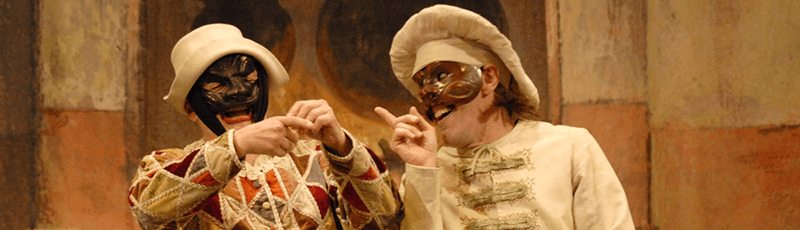
Theatre offered another place to rethink inherited forms. Venetian playwright Carlo Goldoni gradually moved beyond the improvised outlines and familiar masks of commedia dell’arte toward scripts with fuller dialogue and characters drawn from recognizable social settings. In La locandiera (1753), the resourceful innkeeper Mirandolina controls the action. Le baruffe chiozzotte (1762) turns the quarrels of a fishing community into a lively ensemble comedy.
Goldoni’s reform was neither a simple rejection of every theatrical mask nor an uncontested victory. Carlo Gozzi challenged his approach with theatrical fairy tales that favored fantasy, spectacle and traditional comic devices. Their rivalry shows how Italian theatre could move in different directions at once. Goldoni later worked in Paris, while Gozzi’s tales continued to inspire artists abroad.
Browse Goldoni’s plays on Amazon.com and Gozzi’s theatrical tales on Amazon.com.
Ideas Across Borders: Vico and the Enlightenment
Foreign influence was an exchange, not a one-way story of Italian writers copying France or England. Giambattista Vico’s New Science, first published in 1725 and substantially revised later, offered an original account of how human societies create languages, myths, laws and institutions. His attention to history and imagination set him apart from approaches that treated reason as the sole key to human knowledge.
In eighteenth-century Milan, the journal Il Caffè (1764–66) brought questions of economics, education and public reform to a wider readership. Cesare Beccaria, part of the circle around the Verri brothers, published On Crimes and Punishments in 1764. Its arguments against torture and excessive punishment circulated throughout Europe. French Enlightenment ideas helped shape the discussion, but Italian thinkers made contributions of their own.
Giuseppe Baretti provides a different example of cross-border exchange. Having spent years in England, he brought that experience to his sharp literary criticism. His journal La Frusta letteraria, published from 1763 to 1765, attacked what he saw as stale writing and unthinking imitation, whether the models were Italian or foreign.
Browse Vico’s New Science on Amazon.com and Beccaria’s On Crimes and Punishments on Amazon.com.
Parini and Alfieri: Literature and Public Life
Giuseppe Parini used satire to examine privilege from within aristocratic society. In Il giorno (The Day), published in stages, a tutor’s account of a young nobleman’s routine exposes a life of elaborate manners and little useful activity. Parini’s measured verse makes the criticism more pointed.
Vittorio Alfieri gave the stage a more forceful language of liberty and resistance to tyranny. Tragedies including Saul and Mirra explore intense personal conflict, while others place questions of power at their center. Later readers involved in Italy’s movement for national independence found meaning in his work, though Alfieri wrote before unification.
By the close of the eighteenth century, Italian literature had become a forum for debates about taste, justice, authority and national identity. The next chapter, Italian Literature: Classicism and Romanticism, follows those debates into the nineteenth century.
Some links to Amazon.com above are affiliate links. Italia Mia may earn a commission from qualifying purchases at no additional cost to you.
External Sources
Treccani: Arcadia
Treccani: Carlo Goldoni
Treccani: The City of the Sun
Treccani: On Crimes and Punishments
Treccani: La Frusta letteraria