
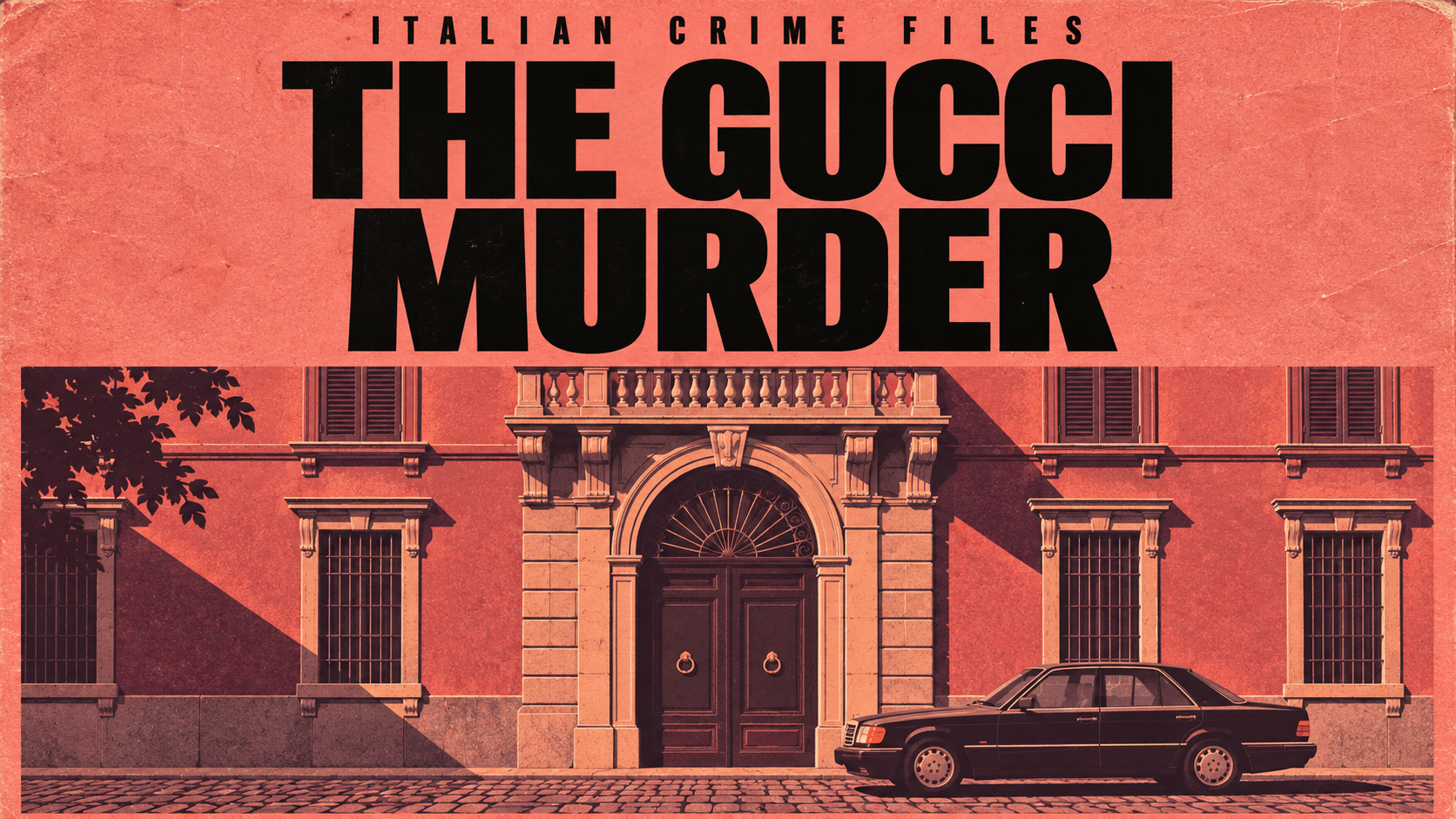
Giuseppe Onorato remembered the magazines. On the morning of March 27, 1995, he was sweeping the entrance of 20 Via Palestro in Milan when Maurizio Gucci came in carrying them and wished him good morning. It was the kind of exchange a building porter might forget by lunchtime. Minutes later, Gucci was dead and Onorato himself had been shot. More than twenty years afterward, he could still describe that greeting to a reporter from The Guardian.
Gucci was 46. He had two daughters, a new partner and a private office in the building where he was killed. He had already sold his share of the fashion house his grandfather founded. Nearly two years passed before police arrested five people, including his former wife, Patrizia Reggiani. The most consequential lead came from a Milan hotel porter who had talked about the murder to an acquaintance.
What Maurizio Gucci had already lost
Maurizio was the son of Rodolfo Gucci and the grandson of Guccio Gucci, who founded the business in Florence in 1921. When Maurizio married Patrizia Reggiani in 1972, Gucci was still a family enterprise. A change in the balance of power at home could affect who had a say at work. After Rodolfo died in 1983, Maurizio inherited his father’s half of the company. Within a decade he would sell that entire stake.
Those years played out differently for the two people in the marriage. Maurizio left Patrizia in 1985 and later made a home with Paola Franchi. The divorce became final in 1994. For Reggiani, belonging to the Gucci family had also meant having a voice in the business. In a 2016 interview, she still spoke angrily about Maurizio’s decision to sell his shares to Investcorp in 1993. She had been able to live apart from him for years and still feel a personal stake in what he did with the company.
The sale answers one question that the name above the boutiques can obscure. Whoever killed Maurizio in 1995 could gain no control of Gucci through his shares. The family no longer owned the label. Investigators nevertheless had sound reason to examine his business dealings, and for a time they had little evidence pointing them elsewhere.
The witness in Via Palestro
The shooting left two families to deal with its consequences. Onorato survived his wounds and gave investigators an account of Gucci’s last moments. His recollection also fixes the nature of the place. The entrance served people arriving for an ordinary working day. Descriptions of the killing as taking place at “Gucci headquarters” miss both the building’s purpose and the reason Onorato was there.
An eyewitness could tell police what had happened inside the doorway. The harder question was who had set the murder in motion. The eventual case against Reggiani rested on events far beyond Onorato’s view. It took another man with a similar job title, but an entirely different connection to the crime, to give the investigation its opening.
How a conversation reopened the investigation
Ivano Savioni worked as a hotel porter. According to the account published by the Italian daily l’Unità after the trial, he told an acquaintance, Gabriele Carpanese, that he had helped organize Gucci’s murder. Carpanese took the information to police. Detectives followed up with an undercover officer, and recorded conversations helped them piece together relationships among people whose names meant little to the public.
One of those relationships led from Savioni to Giuseppina “Pina” Auriemma, a close friend of Reggiani. The papers often described Auriemma as a clairvoyant. Her significance to investigators was more practical. She knew both the woman suspected of commissioning the crime and the man who had spoken to Carpanese. By the end of January 1997, police had arrested Reggiani, Auriemma, Savioni, Orazio Cicala and Benedetto Ceraulo.
What the defendants said in court
The trial opened in Milan in May 1998. Accounts given by the defendants overlapped in some places and broke sharply apart in others. Savioni admitted involvement. Auriemma implicated Reggiani. Cicala acknowledged that he had driven the car used in connection with the killing, yet denied that Ceraulo was the shooter. Ceraulo maintained his innocence. A reader looking back from the final verdict can easily miss how much the defendants disputed even among themselves.
Reggiani offered her own explanation for the money that changed hands. She acknowledged having expressed a wish to see Maurizio dead but maintained that others had acted on their own initiative and then demanded money from her. The distinction was central to her defense. A person could speak bitterly about a former spouse and still be the victim of extortion. The prosecution had to persuade the court that Reggiani had actually commissioned the killing.
Prosecutors pointed to resentment after the divorce and to the prospect that Maurizio might marry Franchi. Later interviews shed light on how Reggiani felt about losing her place in the family company. Neither a prosecutor’s account of motive nor a remark made in an interview can tell us exactly which grievance mattered most to her. The question the judges decided was narrower and more consequential. Who bore criminal responsibility for Maurizio’s death?
Why reports give two different sentences
On November 3, 1998, Milan’s Court of Assizes convicted all five defendants. It found Reggiani guilty as the mandante, the person who ordered the murder, and sentenced her to 29 years. Ceraulo was convicted as the gunman and initially received a life sentence. Cicala was convicted for his role as driver, and Auriemma and Savioni for helping arrange the murder.
The appeals court reduced Reggiani’s sentence to 26 years in March 2000. On February 19, 2001, Italy’s Court of Cassation upheld that sentence. Both figures that appear in accounts of the Gucci case are therefore accurate. A newspaper printed the morning after the Milan verdict correctly reported 29 years. A history of the completed proceedings should give 26.
For Alessandra and Allegra Gucci, the verdict meant that their mother had been convicted of ordering their father’s death. Both daughters challenged the refusal to reopen the proceedings. In May 2002 the Court of Cassation ruled their appeals inadmissible. Their intervention is one of the most revealing episodes in the family’s history, and one of the easiest to lose when the story ends with the verdict. The daughters had a public role in what followed, quite apart from being the heirs whose interests other people discussed at trial.
What House of Gucci leaves out
Ridley Scott’s 2021 film House of Gucci, adapted from journalist Sara Gay Forden’s book, brought the case to an audience who knew Lady Gaga and Adam Driver as Patrizia and Maurizio before they knew the real family’s names. One change is particularly telling. The film depicts one daughter, Alessandra. In the history of the case, her younger sister Allegra belongs beside her, including in the account of the effort to reopen their mother’s trial.
The film gives viewers access to private conversations. The surviving public accounts offer something a screenplay rarely can. In the trial coverage one can hear where two participants contradicted each other. In Onorato’s interview one can recover a few seconds of Maurizio’s life as another person actually remembered them. For all the attention paid to what the Gucci name was worth, the porter remembered a man who took a moment to greet him on his way to work.
Read more investigations and trial histories in Italia Mia’s Italian Crime Files.
External Links
- The Guardian — interviews with Patrizia Reggiani, Paola Franchi and Giuseppe Onorato
- L’Unità — contemporary report on the verdict, November 4, 1998 (Italian, PDF)
- Il Giorno — chronology of the investigation and appeals (Italian)
- Corriere della Sera — the daughters’ request for review and the final sentence (Italian)
- TheWrap — the family members omitted from House of Gucci