
Autumn Foliage in Italy: A Different Side of the Country
Mention autumn travel and many people immediately think of New England, Canada or Japan.
Italy deserves a place on that list.
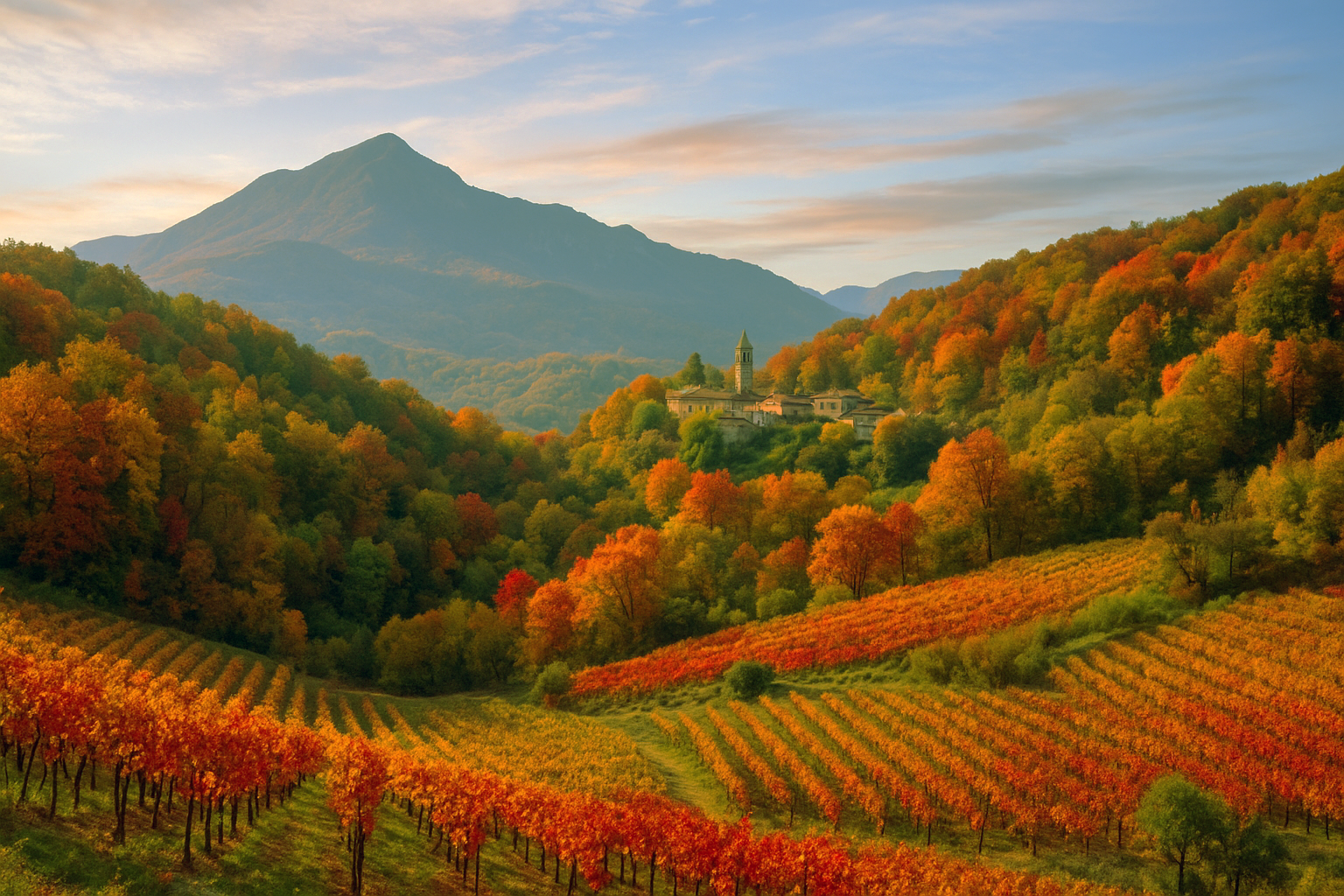
From September into November, forests, vineyards and mountain valleys across the country change from summer green to extraordinary shades of gold, amber, copper, orange and deep red.
In the Dolomites, larch trees turn brilliant yellow beneath pale limestone peaks. Piedmont’s vineyards become bands of rust and gold. Ancient beech forests in Tuscany, Marche and Abruzzo develop extraordinary color, while chestnut woods throughout the Apennines take on warm autumn tones.
The experience is also unmistakably Italian.
Autumn coincides with grape harvests, new wine, mushrooms, chestnuts, truffles and olive oil. Villages celebrate local harvests with sagre, restaurants change their menus and the crowds of high summer begin to disappear.
Italy’s official tourism portal specifically highlights autumn as a season for villages, parks, countryside and food-and-wine travel, with foliage becoming particularly noticeable from October onward.
If you are deciding whether autumn is right for your trip, see our Best Time to Visit Italy: Italy by Season and Month.
When Is the Best Time to See Autumn Foliage in Italy?
There is no national “peak foliage week.”
Italy stretches from the Alps to Sicily, and altitude can matter almost as much as latitude.
As a general guide:
| Area | Typical Best Period |
|---|---|
| High Alps and Dolomites | Late September to late October |
| Alpine valleys and northern forests | Early to late October |
| Piedmont vineyards | Mid-October to early November |
| Northern and central Apennines | Mid-October to early November |
| Tuscany, Umbria and Marche | Late October to early November |
| Lazio and Abruzzo | Late October into early November |
| Southern mountain forests | Late October to mid-November |
These dates are approximate, not guarantees.
Temperature, rainfall, wind and early snow can shift the display from one year to another. Foliage also moves downhill as autumn advances, so a mountain valley and nearby lowland may peak at very different times.
For travelers who want the greatest chance of seeing good color somewhere in Italy, mid-October through early November is an excellent overall window.
1. The Dolomites — Golden Larches Beneath Limestone Peaks
Few Italian autumn landscapes are as dramatic as the Dolomites.
Unlike forests dominated entirely by evergreens, many Dolomite valleys contain European larch, a deciduous conifer whose needles turn vivid golden-yellow before falling.
Against the pale rock towers of the Dolomites, the effect can be spectacular.
Some of the most rewarding areas include:
- Val di Funes
- Val Gardena
- Alta Badia
- Cortina d’Ampezzo
- Passo delle Erbe
- Alpe di Siusi
- Areas around Tre Cime di Lavaredo
Morning and late-afternoon light can make the yellow larches appear almost luminous.
Best time: generally early to late October, varying with altitude.
Best for: hiking, photography, mountain drives.
Be aware that autumn is a transitional season in the Dolomites. Some lifts, rifugi and seasonal businesses may close between summer and ski season, so always check local operations before traveling.
2. Val di Funes, South Tyrol
Val di Funes deserves special mention even within the Dolomites.
The famous view of Santa Maddalena with the Odle peaks behind it is beautiful throughout the year, but autumn gives the valley a richer palette.
Golden larches, green meadows, traditional farmhouses and pale mountains combine into one of northern Italy’s classic fall scenes.
The valley is excellent for:
- Easy walks
- Landscape photography
- Scenic driving
- Traditional South Tyrolean food
Stay overnight if possible. Sunrise and late-afternoon light are considerably more rewarding than a rushed midday visit.
Best time: approximately early to mid-October.
3. Lake Tovel and Val di Non, Trentino
Trentino offers a different kind of autumn landscape.
Around Lake Tovel, forests reflect in the clear mountain water, while nearby Val di Non combines woodland with apple orchards and rolling mountain scenery.
The area can be particularly attractive when yellow and orange foliage is reflected in calm water.
Val di Non is also strongly associated with apple production, making autumn an especially appropriate season to visit.
Nearby valleys such as Val di Sole and Val di Rabbi also provide excellent forest walks.
Best time: early to late October.
Best for: lakes, easy hikes, orchards and families.
4. Val Vigezzo and the Foliage Train
One of Italy’s most enjoyable autumn experiences doesn’t require hiking at all.
The Vigezzina-Centovalli Railway travels between Domodossola in Italy and Locarno in Switzerland through forests, mountain villages, bridges and valleys.
In autumn, the journey is popularly associated with the Treno del Foliage, when the surrounding landscape changes color.
Italy’s official tourism site highlights the Val Vigezzo foliage train as one of the country’s notable autumn experiences.
This is a particularly good choice for:
- Travelers who don’t want strenuous hiking
- Families
- Photographers
- Rail enthusiasts
Best time: usually October into early November.
Reservations can become important during popular foliage weekends.
5. Val Ferret, Aosta Valley
At the foot of the Mont Blanc massif, Val Ferret offers one of Italy’s most impressive combinations of Alpine peaks and autumn woodland.
Golden larches and changing deciduous trees contrast with snow-dusted mountain summits.
The valley is easily combined with Courmayeur, making it suitable for a short autumn mountain escape.
Italy’s official tourism portal identifies Val Ferret as a notable place for fall color.
Best time: late September through October.
Best for: Alpine scenery, walking and photography.
6. Panoramica Zegna, Piedmont
The Panoramica Zegna in the Biella Alps is a scenic mountain route created through an extraordinary landscape of woodland and mountain views.
Autumn brings intense color to the surrounding forests, and the area is particularly attractive for walkers who want something less internationally famous than the Dolomites.
The official Italian tourism portal includes the Biella woods and Panoramica Zegna among its recommended foliage destinations.
Best time: October.
Best for: scenic drives, walking, quieter mountain travel.
7. Langhe and Monferrato — Autumn Vineyards in Piedmont
Autumn foliage in Italy isn’t limited to forests.
In Langhe and Monferrato, vineyard leaves turn yellow, orange and red across rolling hills crowned by medieval villages and castles.
This landscape is beautiful at any time of year, but autumn offers a special combination of scenery and food.
The season coincides with:
- Grape harvest traditions
- Barolo and Barbaresco wine country
- White truffles
- Hazelnuts
- Rich Piedmontese cuisine
Alba and the surrounding Langhe are especially attractive for food-oriented travelers.
The scenery differs from Alpine foliage. Instead of dramatic forest color, you get a patchwork of vineyards glowing beneath autumn light.
Best time: mid-October through early November.
Best for: wine, food, photography and slow road trips.
8. Val Masino, Lombardy
Val Masino, north of Lake Como, combines dramatic granite mountains with forests that become richly colored in autumn.
Particularly impressive are the beechwoods near Bagni di Masino, where mature trees create an almost storybook forest atmosphere.
The official Italian tourism portal specifically highlights the Val Masino beech forest for its autumn reds and yellows.
The valley is a good alternative for travelers seeking mountain landscapes without the fame—and sometimes crowds—of the Dolomites.
Best time: October.
Best for: forest walks and mountain scenery.
9. Lake Como and Valle Intelvi
Lake Como is most famous for villas, boats and glamorous summer travel, but autumn changes its character.
Wooded hills around the lake begin turning yellow and rust while visitor numbers gradually decline.
For stronger foliage, explore the Valle Intelvi, between Lake Como and Lake Lugano.
This area combines:
- Forest
- Mountain viewpoints
- Small villages
- Lake scenery
Autumn is particularly suitable for travelers who want to combine a famous Italian destination with quieter countryside.
Best time: mid-October through early November.
Read our 25 Best Places to Visit in Italy for more ideas around Lake Como and northern Italy.
10. Foreste Casentinesi National Park — One of Italy’s Great Autumn Forests
For pure forest foliage, Parco Nazionale delle Foreste Casentinesi, Monte Falterona e Campigna is difficult to beat.
Straddling Tuscany and Emilia-Romagna, the park contains an extraordinary mix of:
- Beech
- Maple
- Oak
- Hornbeam
- Chestnut
- Fir
Italy’s official tourism website describes the Foreste Casentinesi among the country’s most colorful forests, noting the remarkable variety of tree species.
The historic forests around Camaldoli and La Verna add a cultural and spiritual dimension to the landscape.
Where to Go
Look at areas around:
- Campigna
- Camaldoli
- Badia Prataglia
- La Verna
- Monte Falterona
Best time: approximately mid-October to early November.
Best for: serious foliage, hiking, monasteries and photography.
If you’re exploring the region more broadly, see our Tuscany travel guide.
11. Garfagnana, Tuscany
Northwestern Tuscany offers autumn scenery very different from the vineyards around Chianti.
The Garfagnana, between the Apuan Alps and Apennines, is deeply forested.
Chestnut woods, beech trees and small stone villages create an especially atmospheric landscape during October and November.
Autumn food is part of the experience here.
Look for:
- Chestnuts
- Porcini mushrooms
- Farro
- Rustic soups
- Local cheeses
Combine forest walks with villages such as Barga and Castelnuovo di Garfagnana.
Best time: mid-October to early November.
Best for: mountain Tuscany, food and villages.
12. Chianti and Val d’Orcia
Tuscany’s most famous landscapes don’t produce the dense forest foliage seen in Casentino, but autumn transforms them in another way.
Vineyards change color after harvest, cypress trees remain dark green and fields become muted gold and brown.
The resulting contrast is unmistakably Tuscan.
Chianti
Travel between Florence and Siena through wine country, stopping in towns such as:
- Greve in Chianti
- Panzano
- Castellina in Chianti
- Radda in Chianti
Val d’Orcia
Farther south, combine autumn landscapes with:
- Pienza
- Montalcino
- San Quirico d’Orcia
- Bagno Vignoni
- Montepulciano
Best time: October into early November.
This is one of Italy’s best fall road trips.
Before renting a car, read our Driving in Italy for Tourists guide.
13. Faggeta di Canfaito, Marche
The Canfaito beech forest in Marche is one of central Italy’s most photogenic autumn woods.
Ancient beech trees develop yellow, orange and copper leaves, while fallen foliage carpets the forest floor.
The effect can be magical, especially when morning mist filters through the trees.
Italy’s tourism sources regularly identify Canfaito as a notable foliage destination.
Nearby medieval towns make it easy to turn the forest visit into a longer Marche itinerary.
Best time: late October to early November.
Best for: woodland photography and walking.
14. Monti Cimini, Lazio
Visitors staying in Rome don’t need to travel to northern Italy to experience fall color.
North of the capital, the Monti Cimini around Viterbo contain chestnut and beech forests that can become spectacular in autumn.
Places worth considering include:
- Monte Cimino
- Lake Vico
- Soriano nel Cimino
- Nearby Tuscia villages
This area works particularly well for travelers combining Rome with an autumn road trip through Lazio.
Best time: late October through early November.
Best for: Rome side trips, forests and medieval villages.
15. Bosco del Sasseto, Lazio
Near Torre Alfina, close to the border between Lazio, Tuscany and Umbria, the Bosco del Sasseto has an almost enchanted quality.
Large trees grow among volcanic rocks covered in moss, creating a forest atmosphere unlike typical Tuscan countryside.
Autumn intensifies the effect.
Combine the forest with a visit to Torre Alfina and nearby towns such as Orvieto.
Best time: late October to early November.
Best for: unusual woodland landscapes and photography.
16. Monti Sibillini — Umbria and Marche
The Sibillini Mountains form one of central Italy’s most dramatic autumn landscapes.
Wooded valleys change color beneath open mountain slopes, while medieval villages provide excellent bases for exploration.
Areas around:
- Norcia
- Visso
- Castelluccio
- Montefortino
can be particularly attractive.
Unlike summer—when Castelluccio is famous for flowering fields—autumn is quieter and moodier.
Best time: October.
Best for: mountains, walking and quiet road trips.
17. Majella National Park and Valle dell’Orfento, Abruzzo
Abruzzo is one of Italy’s great regions for autumn travel.
Majella National Park contains mountain forests, gorges and remote valleys where fall color can be exceptionally rich.
The Valle dell’Orfento, near Caramanico Terme, is particularly beautiful.
Wooded trails follow streams through a deep valley beneath the Majella massif.
Other areas of Abruzzo—including the Gran Sasso and Abruzzo, Lazio and Molise national parks—also offer excellent autumn scenery.
Best time: mid-October to early November.
Best for: wilderness, hiking and travelers seeking a less-touristed Italy.
18. Umbra Forest, Gargano
Puglia may be associated with beaches, olive groves and whitewashed towns, but the Gargano peninsula contains one of southern Italy’s most important forests.
The Foresta Umbra lies inside Gargano National Park and contains extensive woodland dominated in places by ancient beech trees.
The official Italian tourism website includes Foresta Umbra among its recommended foliage destinations.
Autumn here arrives later than in high Alpine destinations.
Best time: late October into November.
Best for: combining forest, coastal Puglia and road travel.
19. Sila National Park, Calabria
Calabria provides another reminder that autumn foliage is not exclusively a northern Italian phenomenon.
The Sila plateau is heavily forested, with beech, maple and other deciduous species mixed with conifers.
Lakes, mountain roads and woodland trails create a dramatically different image of Calabria from its Mediterranean coast.
Italy’s official tourism portal identifies Sila among its foliage destinations.
Autumn also brings cool mountain temperatures and traditional foods associated with mushrooms, potatoes and forest products.
Best time: late October through early November.
Best for: southern Italy, forests and road trips.
20. Nebrodi and Madonie Mountains, Sicily
Even Sicily has autumn foliage.
The Nebrodi and Madonie mountain ranges contain substantial forests at higher elevation.
Beech, oak and other deciduous trees create autumn colors far removed from the usual image of Sicilian beaches.
The contrast is remarkable: Mediterranean island below, cool mountain woodland above.
Combine autumn forests with villages, local cheeses, mushrooms and hearty Sicilian mountain cuisine.
Best time: late October into November.
Best for: an unexpected side of Sicily.
For a longer trip, explore our Sicily travel guide.
The Best Foliage Destinations by Month
Late September
Your best opportunities are generally at higher elevations:
- High Dolomites
- Aosta Valley
- Alpine passes
Colors are usually just beginning elsewhere.
Early October
Look toward:
- Dolomites
- Val di Funes
- Trentino
- Val Ferret
- Val Masino
Mid-October
The foliage season becomes much broader:
- Dolomites
- Piedmont
- Lake Como area
- Langhe
- Alpine valleys
- Central Apennines
Late October
This is probably the best overall foliage period in Italy.
Consider:
- Foreste Casentinesi
- Garfagnana
- Chianti
- Marche
- Abruzzo
- Umbria
- Lazio
- Piedmont vineyards
Early November
Color increasingly shifts toward lower elevations and southern regions:
- Tuscany
- Umbria
- Lazio
- Abruzzo
- Gargano
- Calabria
- Sicily
By this point, many high mountain areas may already be past peak.
Italy’s Autumn Vineyards
Forests aren’t the only reason to visit Italy in fall.
Autumn vineyards create some of the country’s most beautiful cultural landscapes.
The strongest regions include:
Piedmont — Langhe, Roero and Monferrato
Tuscany — Chianti, Montalcino and Montepulciano
Veneto — Valpolicella and Prosecco country
Trentino-Alto Adige — vineyards beneath Alpine landscapes
Friuli-Venezia Giulia — Collio hills
Harvest timing varies by grape variety, region and weather, and the actual grape harvest may take place before the best leaf color arrives.
But vineyard landscapes can remain beautiful well into October.
Autumn Food: Half the Reason to Go
Foliage is only part of Italy’s autumn appeal.
The season brings some of the country’s finest ingredients.
Porcini Mushrooms
Mountain and forest regions celebrate porcini with restaurant dishes and local festivals.
Chestnuts
Chestnut festivals—sagre della castagna—take place throughout the Apennines and Alpine regions.
Truffles
Piedmont becomes especially important during white-truffle season, but truffles also feature prominently in parts of Tuscany, Umbria and Marche.
New Olive Oil
Autumn olive harvests produce olio nuovo, fresh new-season olive oil with intense flavor.
Wine
Grape harvest and winemaking traditions make autumn especially rewarding in Italy’s wine regions.
The official Italian tourism portal specifically promotes autumn as a season for vineyards and local food experiences.
A 5-Day Northern Italy Foliage Road Trip
For a compact northern itinerary:
Day 1 — Bolzano
Explore the historic center and South Tyrolean food culture.
Day 2 — Val di Funes
Photograph golden larches beneath the Odle peaks.
Day 3 — Dolomites
Explore Val Gardena, Alta Badia or nearby mountain roads.
Day 4 — Lake Como
Travel toward the lake and explore surrounding valleys.
Day 5 — Langhe
Finish among autumn vineyards with Piedmontese food and wine.
This is an ambitious itinerary, so add additional days if possible.
A 5-Day Central Italy Foliage Road Trip
For forests and medieval towns:
Day 1 — Florence or Arezzo
Begin in Tuscany.
Day 2 — Foreste Casentinesi
Spend the day hiking through the forest.
Day 3 — Garfagnana or Chianti
Choose mountain forest or vineyard landscapes.
Day 4 — Umbria
Continue through Perugia, Assisi or the Sibillini area.
Day 5 — Marche
Visit the Canfaito beech forest and nearby villages.
For road-trip planning, see our Italian Autostrade Guide.
A 7-Day Southern Autumn Road Trip
Travelers looking for something less conventional could combine:
Rome → Monti Cimini → Abruzzo → Gargano → Sila
This trip moves gradually southward as foliage season advances.
You could also create a separate Sicily itinerary around the Nebrodi and Madonie mountains.
Photography Tips for Autumn in Italy
Autumn is one of Italy’s best seasons for landscape photography.
Try to photograph:
Early morning — soft light, mist and fewer visitors.
Late afternoon — warm light intensifies yellow and orange foliage.
After rain — wet leaves often produce stronger saturation.
Reflections — mountain lakes and rivers can double the color.
Villages and architecture — Italy’s stone churches, farmhouses and medieval towns provide context that distinguishes Italian foliage from other destinations.
Overcast weather can also be excellent for forest photography because it reduces harsh contrast.
What to Pack for an Autumn Foliage Trip
Italian autumn weather can change quickly, particularly in mountain areas.
Useful items include:
- Waterproof jacket
- Layers
- Comfortable waterproof walking shoes
- Warm sweater or fleece
- Light gloves for mountain mornings
- Small backpack
- Water
- Camera or phone charger
- Offline maps
For higher-altitude destinations, prepare for temperatures considerably colder than those in nearby cities.
Early snow is possible in the Alps and Dolomites.
Driving During Foliage Season
A car gives you much greater flexibility for many foliage destinations.
It is particularly useful in:
- Tuscany
- Abruzzo
- Marche
- Calabria
- Sicily
- Alpine valleys
However, autumn introduces its own driving conditions.
Watch for:
- Wet leaves
- Fog
- Shorter daylight
- Early ice at altitude
- Mountain-road closures
- Wildlife
- Sudden weather changes
Never stop on a narrow road simply because you’ve found a good photograph.
Use designated parking or viewpoints.
When Not to Chase Foliage
Foliage travel works best when you accept that nature doesn’t follow a tourism calendar.
A storm can strip leaves earlier than expected.
A warm autumn can delay color.
Early frost or snow can abruptly change mountain conditions.
For this reason, don’t build an expensive international vacation around one tree, one lake or one exact weekend.
Choose a region offering several types of scenery, good food, towns and cultural attractions.
Then the trip remains worthwhile even if peak color arrives five days earlier or later than expected.
Autumn Foliage Without Hiking
You don’t need to be a serious hiker.
Good options include:
- Vigezzina-Centovalli foliage train
- Scenic drives through Tuscany
- Langhe vineyard roads
- Lake Como ferries and lakeside towns
- Dolomite viewpoints accessible by road
- Short forest walks
- Hill towns surrounded by autumn countryside
Italy’s combination of natural and cultural landscapes makes foliage particularly accessible to travelers who prefer moderate activity.
Is Autumn a Good Time to Visit Italy?
Absolutely.
For many travelers, it is actually one of the best seasons.
Autumn offers:
- Cooler sightseeing temperatures
- Food and wine
- Fewer summer crowds
- Harvest traditions
- Dramatic landscapes
- Excellent photography
- Attractive road trips
September can still feel like summer in much of the country.
October provides the strongest overall combination of foliage, food and pleasant travel.
November becomes quieter and cooler but can still offer beautiful color at lower elevations and in southern regions.
Our Best Time to Visit Italy guide compares autumn with every other season.
Frequently Asked Questions
When does foliage peak in Italy?
There is no single national peak. High Alpine areas can begin changing in late September, while central and southern forests may remain colorful into November.
What is the best month for fall colors in Italy?
October is the strongest overall month, particularly from the middle toward the end of the month.
Where are the best fall colors in Italy?
Among the strongest choices are the Dolomites, Foreste Casentinesi, Val Vigezzo, Val Ferret, Val Masino, Langhe, Majella, Canfaito and the Sila.
Can you see autumn foliage in Tuscany?
Yes. The Foreste Casentinesi and Garfagnana provide strong woodland color, while Chianti and Val d’Orcia offer vineyard and countryside landscapes.
Can you see foliage near Rome?
Yes. The Monti Cimini, Lake Vico and Bosco del Sasseto make good autumn excursions from Rome.
Does southern Italy have fall foliage?
Yes. Forested mountain areas of Puglia, Calabria and Sicily can develop impressive autumn colors, generally later than northern Italy.
Is Italy crowded in October?
Popular destinations remain busy, especially Rome, Florence and Venice, but most forest and mountain destinations receive fewer visitors than during summer.
Famous foliage locations can become busy on sunny October weekends.
Autumn in Italy Is More Than Changing Leaves
The most memorable thing about autumn in Italy may not be the color alone.
It is the combination.
A golden forest above an ancient village.
Vineyards turning red around a medieval castle.
Morning mist over an Apennine valley.
Porcini on a restaurant menu after a forest walk.
Chestnuts roasting during a village festival.
A glass of Barolo while the hills outside the window turn bronze.
Italy doesn’t have the uninterrupted wilderness of Canada or New England.
What it has instead is something uniquely its own: autumn nature woven into centuries of villages, vineyards, farms, food and culture.
That is what makes fall foliage in Italy worth traveling for.
Related Italia Mia Guides
- Best Time to Visit Italy: Italy by Season and Month
- 25 Best Places to Visit in Italy
- 10 Must-See Destinations in Italy
- Italy on a Budget
- Driving in Italy for Tourists
- Italian Autostrade Guide
- Tuscany Travel Guide
- Sicily Travel Guide
External Links
- Italia.it — Autumn in Italy
- Italia.it — Italian Foliage and Forest Bathing Destinations
- Parco Nazionale Foreste Casentinesi
- Parco Nazionale della Majella
- Parco Nazionale della Sila
- Vigezzina-Centovalli Railway