
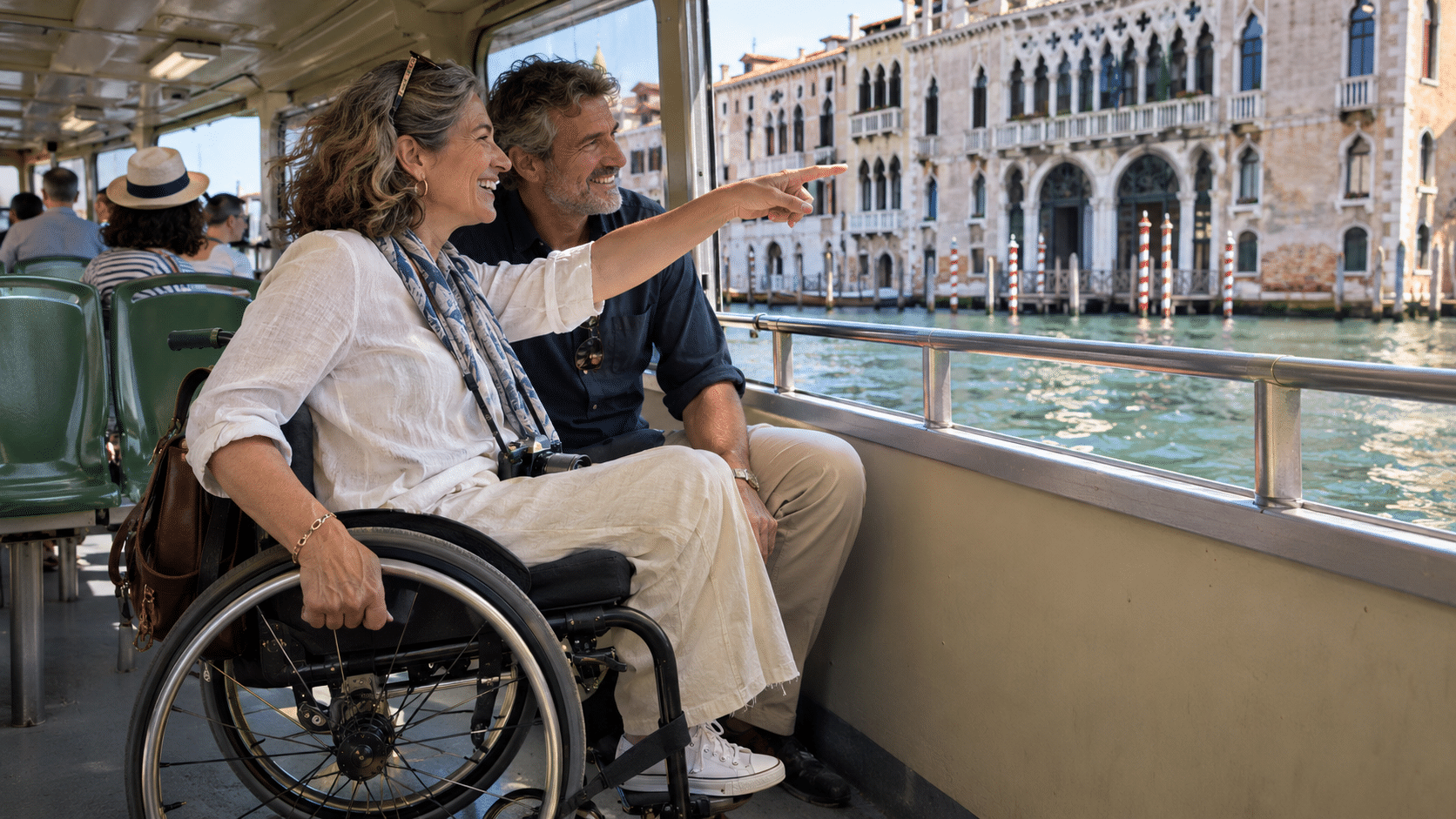
In Florence, a visitor who wants to see Michelangelo’s David can take the tram to San Marco and save their walking energy for the sculpture. In Venice, the ride itself can be the highlight. Take a waterbus along the Grand Canal and the palaces come to you. In Rome, getting to the correct entrance of the Vatican Museums can save more effort than buying a ticket that promises a shorter queue.
The right itinerary depends on what makes a visit possible for you. If you can walk a short distance but cannot stand for long, the questions are where you can sit, how long security takes and how far the exit is from your ride home. If you use a wheelchair, you also need to know whether you can board the vehicle, reach street level and enter the museum in your own chair. Here are five ways to plan a visit around those questions. For a broader choice of sights, see Italia Mia’s guide to Italy’s famous monuments and landmarks.
| City | Suggested visit | Accessibility detail |
|---|---|---|
| Rome | Choose the Colosseum or the Sistine Chapel for one outing. | Check the lifts at both metro stations. For the Sistine Chapel, use the Vatican Museums’ barrier-free map to plan the way back to the exit as well as the way in. (atac.roma.it) |
| Florence | Take tram T2 to San Marco for Michelangelo’s David, or approach the Uffizi from Via della Ninna. | The Accademia entrance is at Via Ricasoli 60. At the Uffizi, the entrance can differ for manual wheelchairs and powered mobility devices. (GEST) |
| Milan | Ride M3 directly from Centrale to Duomo and visit the cathedral square and museum. | Check ATM’s live lift status before boarding and identify the street-level lift you’ll use for the return. (YesMilano.it) |
| Venice | See the Grand Canal aboard vaporetto Line 1. | The boat ride can be the whole outing. For St Mark’s Square, use the city’s accessible route via Vallaresso and confirm which landing is served that day. (Comune di Venezia.) |
| Naples | Visit the National Archaeological Museum for finds from the Vesuvian sites. | Line 1 serves Museo. Check the station lift notice and use the museum floor plan to choose one collection within your range. (mann-napoli.it) |
Rome: Choose the Colosseum or the Sistine Chapel for one outing
For the Colosseum, Metro B serves Colosseo. Before leaving, look up both your departure station and Colosseo in ATAC’s accessibility directory. Check the line you will actually use, including any interchange. An escalator symbol does not tell you whether you can take a wheelchair from the platform to the street. ATAC identifies lifts, stairlifts and locations where boarding or access requires staff. If a lift is out, a surface bus with a boarding ramp may save a long diversion. Ask the driver to deploy it and confirm your stop before settling in.
Make the amphitheatre the whole visit if that is what you came to see. Ask staff to point out the lift route, the accessible toilet on the first tier and the way back to your chosen exit. The Roman Forum and Palatine deserve a separate decision. Their ancient paving, gradients and the distance between exits make them a different physical undertaking, even when your ticket covers all three. ATAC accessibility · Colosseum visitor facilities
For the Sistine Chapel, plan your arrival at the Vatican Museums entrance on Viale Vaticano. A ride to St Peter’s Square leaves you on a different side of the complex. Download the Vatican Museums’ barrier-free route before arrival. It marks lifts, ramps and toilets and shows how to reach the chapel. If walking endurance is your main concern, show staff the chapel on the map and ask how far you will have to go to reach it and return to the exit. If using a power chair, give the museum your chair dimensions when confirming the route. Vatican Museums barrier-free map (PDF)
Florence: Take the tram to David, or approach the Uffizi from Via della Ninna
For David, take tram T2 toward San Marco–Università. The line serves Peretola airport and the Santa Maria Novella station area. GEST identifies its trams and platforms as accessible. From San Marco, the Accademia entrance is on Via Ricasoli 60. There is still a street section between the tram and the door. Check that section against your own range, including the trip back. Inside, make the Tribune and David your first destination, then decide whether you want another gallery. GEST tram information · Florence museum accessibility guide (PDF)
For Botticelli at the Uffizi, the useful street name is Via della Ninna, between Palazzo Vecchio and the gallery. A ramp leads into the loggia. Florence’s access guide directs standard wheelchair users to Door 1 and describes a staff-assisted entrance at the Vasari Auditorium for powered wheelchairs and mobility scooters. Confirm which entrance staff want you to use before setting off. If arriving by taxi, give the driver the street name and ask how close they may legally drop you. Inside, ask for the shortest lift route to the Botticelli rooms and identify a place to rest before continuing. Piazza della Signoria makes a nearby outdoor stop if you still have energy. Uffizi accessibility and mobility aids
Milan: Ride directly from Centrale to the cathedral square
From Centrale FS, take the M3 toward San Donato and get off at Duomo. Staying on the same line avoids a platform change. Milan’s M3 has lifts between street, ticket hall and platform. ATM’s live accessibility service is particularly helpful here. Check both stations before boarding and identify the street-level lift at Duomo before choosing a meeting place in the square. For a bus or tram alternative, ATM also identifies vehicles with boarding ramps or moving platforms. ATM live accessibility · Milan metro access by line
At Piazza del Duomo, choose the cathedral interior or the Museo del Duomo, beside Palazzo Reale. The museum gives you a close view of sculpture associated with the cathedral without adding a rooftop excursion. If the terraces are your priority, ask the cathedral which sections you can reach in your own chair and whether the return uses the same lift before buying a ticket. For a shorter outing, see the façade from the square, visit one interior, then return to the same M3 lift. Cathedral access · Duomo Museum access
Venice: See the Grand Canal without crossing a bridge
From the Ferrovia waterbus stops outside Santa Lucia station, or from Piazzale Roma if arriving by road, take ACTV Line 1 toward San Marco. This puts the Grand Canal, Rialto and the palace façades on the sightseeing route without requiring you to cross the Rialto Bridge. Ask the crew about boarding conditions and space on the next boat. Landings are accessible, but the angle between boat and landing can change with the water level. If you need a seat, let the crew know before boarding.
For the square, follow the city’s accessible San Marco itinerary via San Marco–Vallaresso and check the landing served that day. Choosing a stop simply because it includes “San Marco” can put a bridge between you and your destination. Save the city’s map for the return as well. If visiting the Doge’s Palace, request its lift itinerary. The standard prison route descends stairs to the Bridge of Sighs. If you would prefer to remain on the water, the Grand Canal trip can be the entire outing. City of Venice accessible San Marco route · Accessible Venice map · Doge’s Palace prison route
Naples: See ancient art at the Archaeological Museum
If Pompeii’s uneven streets would use up your energy before you reached the objects you came to see, consider the National Archaeological Museum of Naples (MANN). Its collections bring finds from the Vesuvian sites indoors. Metro Line 1 serves Museo, and Line 2 serves Piazza Cavour. Select the station with the most manageable street route from an operating lift. A shorter trip on the metro map can still involve a long underground passage. ANM publishes lift outages by station. If your route is interrupted, ask a taxi dispatcher about the closest permitted drop-off to the museum entrance on Piazza Museo Nazionale.
Download the museum floor plan and pick one collection, such as the mosaics. Ask reception which galleries are open and which lift serves them that day. This gives you a complete visit even if you decide to leave after one floor. MANN floor plan (PDF) · ANM Line 1 lift notices
Between cities: Arrange railway assistance for the actual train
RFI’s Sala Blu provides free assistance for passengers with disabilities or reduced mobility at participating stations. You can request it even if you can walk but need help getting across a large station or boarding. Contact the service with the train number, date, departure and arrival stations, and any change of train. From abroad, call +39 02 32 32 32. Ask about the notice required for your journey, the meeting point and the time to arrive. If remaining in your own wheelchair, confirm the wheelchair space with the train operator as well as the boarding arrangements with Sala Blu. RFI Sala Blu assistance and booking
Book your accessible stay and experiences in Italy
Choose a hotel by the route from its door to the stop you will use most. In Venice, ask the hotel to name the landing and count the bridges. In Milan, ask which metro entrance has the lift. For a room, request the measurements that matter to you, such as lift-door width, space beside the bed or the height of a shower threshold. A photograph of the entrance and bathroom can answer questions a booking filter leaves open.
For taxis, two requests sound similar but describe different vehicles. “Posso salire in auto e la carrozzina si piega” means “I can transfer into the car and the wheelchair folds.” “Viaggio seduto in carrozzina. Mi serve un taxi con pedana” means “I travel seated in my wheelchair. I need a taxi with a lift or ramp.” Confirm the vehicle for the return journey as well. At a museum, “Dove posso sedermi mentre aspetto?” asks where you can sit while waiting. That can be the most useful question of the day for someone who can walk through a gallery but cannot stand through a queue.
External links
- Rome public transport accessibility
- Uffizi Galleries accessibility information
- Milan real-time transport accessibility
- Venice accessible itineraries and services
- Naples Line 1 lift and escalator updates
- Italian railway assistance