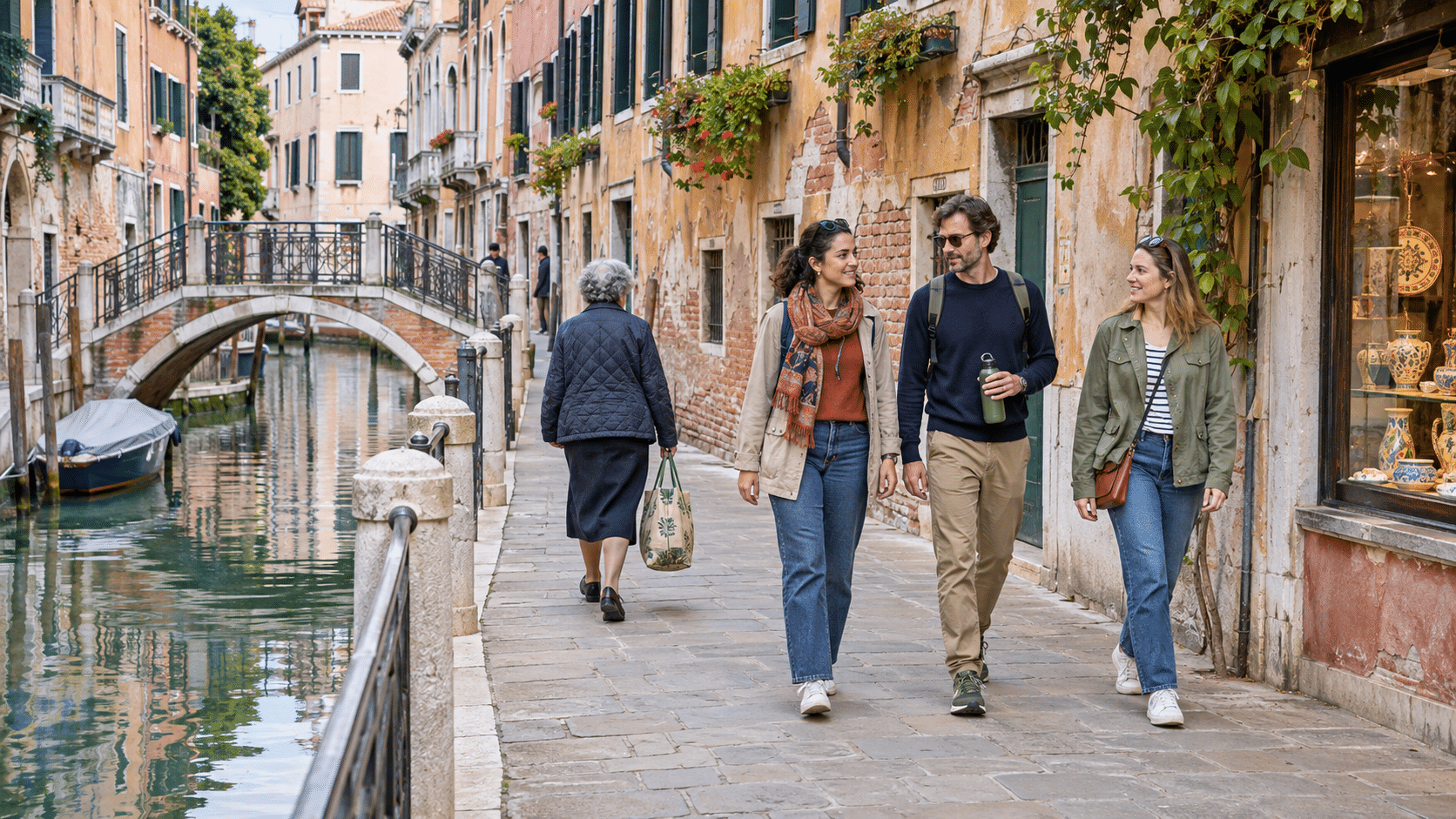
Venice rewards attention. A bridge is somewhere to admire the view, but it is also someone’s route to work. A small square may look like the perfect picnic setting, while its doorways belong to homes and businesses. The boat carrying you along the Grand Canal is also public transport.
Visiting Venice responsibly begins with recognizing those overlapping uses. You can enjoy the famous sights, eat well and explore the lagoon while making everyday choices that leave room for the people who live here.
The subject is especially timely following the city’s refreshed Enjoy Respect Venezia campaign, announced on November 10, 2026. Here is what that means for your trip, from finding an appropriate lunch stop to checking the access-fee calendar.
What Has Changed in Venice’s Visitor-Awareness Campaign?
The refreshed campaign starts around Piazza San Marco and Rialto, where new Italian-and-English posters have appeared on rubbish bins. They highlight four existing messages: avoid picnics in St. Mark’s Square, do not sit on the ground or on steps and monuments, do not feed pigeons or gulls, and dispose of rubbish properly.
The change is in presentation, rather than the creation of new prohibitions. The city is updating its visual language and extending its communication through public spaces and digital channels, with a wider rollout planned for 2027.
For travelers, the useful takeaway is to prepare before arrival. Knowing where you can stop, how you will reach your accommodation and which reservations you need makes considerate behavior much easier.
Check the Venice Access Fee Before Traveling
Information checked November 12, 2026: the official portal says the 2026 access-fee period ended on July 26. From July 27, no access-fee payment or exemption request is required for the remainder of that year.
The portal has also published designated dates for 2027, beginning March 26 and extending into August, with an indicated daily window of 8:30 a.m. to 4:30 p.m. It states that the arrangements will be announced by December 31, 2026.
Check the official Venice access-fee portal for your actual travel dates. Do not assume an old fee, booking procedure or exemption instruction will apply to a future visit.
The access fee is separate from accommodation tourist tax. If staying overnight, ask your property what documentation is required under the rules applying to your dates. Italia Mia’s guide to money, tipping and tourist taxes in Italy explains the wider distinction.
Plan a Day That Leaves Room to Breathe
Choose one main attraction and one additional area to explore, then build the rest of the day around meals, transport and breaks. Booking every available hour can turn a beautiful city into a sequence of deadlines.
For example, reserve a morning museum visit, arrange lunch nearby and leave the afternoon for an unhurried walk. If the lagoon islands are your priority, give them a substantial part of the day rather than squeezing them between central attractions.
For a longer Italian itinerary, our 10-day journey through Rome, Florence and Venice by train provides a useful starting point.
A considerate itinerary should also suit your mobility. Ask your accommodation about the easiest arrival route, including bridges, luggage and boat stops. A short line on a map does not tell you how comfortable the journey will be.
Keep Bridges, Doorways and Narrow Streets Clear
Before stopping for a photograph or opening your map, move somewhere that leaves a clear passage. Keep your group together without spreading across the entire street, and avoid waiting at the top of bridge steps.
If someone needs to pass, make room without expecting them to explain whether they are a resident, worker or another visitor. The same courtesy helps parents with pushchairs and travelers moving slowly.
Photographs deserve a little judgment, too. Ask before making a shopkeeper or craftsperson the subject of your picture. Avoid photographing through residential windows, entering private courtyards or using someone’s doorstep as a place to arrange bags and clothing.
These are practical courtesies, rather than a claim that every awkward photograph breaks a municipal rule.
Plan Your Lunch Stop Before You Get Hungry
Venice’s official rules prohibit eating and drinking while seated on the ground, and sitting or lying on protected features including bridges, steps and monuments. The refreshed campaign specifically warns against picnicking in Piazza San Marco.
A takeaway meal needs an appropriate place to eat it. Consult the city’s map of rest areas and public toilets before buying lunch, and follow signs at the location.
Near Piazzale Roma, the officially listed Rio Terà Sant’Andrea green area has benches and bins. It offers a practical break near the arrival area; public toilets are nearby. Check access and conditions on the day.
You do not have to purchase an expensive restaurant meal to behave responsibly. Budget for the breaks that suit you, identify permitted seating and avoid leaving the decision until everyone is exhausted.
Understand the Rules That Can Lead to Fines
The municipality’s visitor guidance identifies several prohibited behaviors:
- Swimming, bathing or diving in the canals.
- Feeding pigeons or gulls.
- Littering or dumping rubbish in public spaces.
- Walking around bare-chested or in swimwear.
- Camping or bivouacking in public areas.
Bicycles are generally prohibited in the historic center, including when pushed by hand. The city identifies a limited exception for the connection between Piazzale Roma and Santa Lucia station; check its specific guidance if arriving with a bicycle.
These are enforceable restrictions, not simply suggestions. Consult the municipal prohibited-behavior page for current details.
Dress for the places you intend to enter, too. Check individual churches’ and attractions’ admission instructions before leaving your accommodation.
Treat the Vaporetto as Shared Public Transport
Have your ticket ready and follow the validation instructions before boarding. AVM explicitly tells passengers to validate before embarking; do not assume that purchasing a ticket completes every required step.
Let passengers leave before moving aboard, keep luggage close and follow crew instructions about where to stand. If you have been taking photographs from a busy boarding area, move away as the boat approaches.
Before buying a pass, compare its coverage with the journeys you actually plan to make. ACTV’s visitor passes have exclusions, including Alilaguna services, and standard time-based urban passes do not automatically include Marco Polo Airport travel.
Use ACTV’s official visitor-ticket information to check the current product rather than buying solely because a pass sounds comprehensive.
Support Local Businesses With Informed Purchases
A useful shopping question is: Who made this, and where?
Ask a seller about the maker, materials and production process. For a purchase that matters to you, request written product information or a receipt describing it. A Venetian motif alone does not establish that an object was made locally.
The official tourism site’s Venetian craft and design guide is a starting point for exploring workshops and contemporary makers.
Set a realistic budget before shopping. Supporting a business can mean buying a modest item you will use, choosing a book or print, or paying for a worthwhile visit. There is no need to fill a suitcase with souvenirs.
For food, read menus and prices before ordering and ask about anything unclear. Our Italian aperitivo guide introduces Venice’s bacari and cicchetti, including the custom of paying for individual bites. Enjoy the experience without turning a small venue’s entrance into a gathering point.
Explore Beyond the Main Sights With Care
The city encourages visitors to look beyond St. Mark’s and discover more of Venice and its lagoon. That invitation works best when paired with restraint: a residential lane remains a residential lane even when it appears in a travel guide.
Choose an area because something there interests you—a collection, a workshop or a particular walk. Resist treating every quiet courtyard as a newly discovered attraction that needs to be photographed and shared.
If booking a guided visit, look for a licensed guide, manageable group size and a clear description of the route. Ask about steps and walking requirements before paying. A good experience should fit both your interests and your practical needs.
Make Your Stay Easier on Your Neighbors
Choose registered accommodation and ask for clear arrival and departure instructions. In an apartment, confirm how rubbish collection and recycling work before leaving bags outside.
Keep conversations low when returning late, especially near bedrooms and in shared entrances. Move suitcases carefully on stairs and arrange luggage storage instead of leaving bags in communal passages.
Carry a refillable bottle and use designated drinking-water fountains, observing any notices. If a bin is full, hold on to your rubbish until you find another suitable disposal point.
Book Your Venice Stay and Experiences
Choose accommodation by location, access and suitability, as well as price. Ask how many bridges separate the nearest useful stop from the property and whether your room requires stairs.
For museum visits, Italia Mia’s city-by-city attraction-booking guide includes Venice options and booking links. Some links in that guide are affiliate links; Italia Mia may earn a commission from qualifying bookings.
Compare the attraction’s official offer with any third-party package. Check what is included, cancellation conditions, meeting points and accessibility. Reserve the visits that matter to you, then leave enough unscheduled time to enjoy being in Venice.
External Links
- Enjoy Respect Venezia: official visitor guidance
- Municipal announcement of the refreshed campaign
- Official Venice access-fee portal
- Municipal rules on prohibited behavior
- Rest areas and public toilets
- ACTV public transport and visitor tickets