

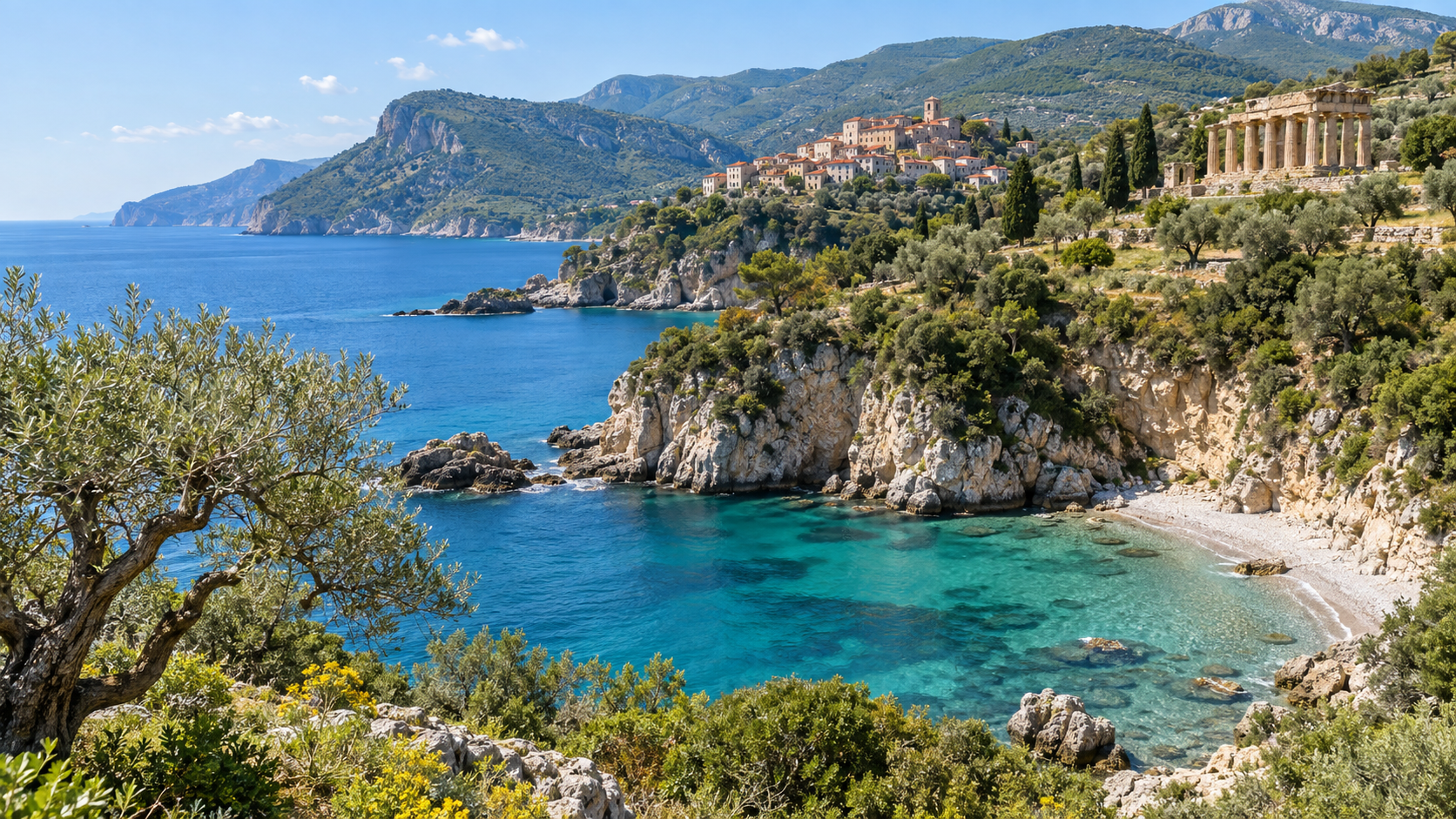
 South of Salerno and beyond the famous Amalfi Coast lies a quieter Mediterranean landscape of sandy beaches, rocky coves, medieval villages, Greek temples and forested mountains. This is Cilento, one of the most rewarding parts of the region of Campania and a destination that still feels closely connected to local life.
The Cilento Coast extends roughly from Paestum and Agropoli southward to Sapri and the Gulf of Policastro. Behind it rises the vast Cilento, Vallo di Diano and Alburni National Park, protecting mountains, river valleys, caves, olive groves and historic settlements.
Cilento does not offer the concentrated glamour of Positano or Capri. Its pleasures are more spacious and varied: a morning among ancient Greek temples, an afternoon swimming beneath limestone cliffs, dinner in a fishing village and a drive through hills covered with olive trees.
Why Visit Cilento?
Cilento combines several different types of Italian journey within one region. Beach travelers will find long sandy shores, clear water and secluded coves. History lovers can explore Paestum and Velia, two of southern Italy’s most important archaeological sites. Walkers can follow coastal paths or venture into the mountainous interior, while food enthusiasts can sample buffalo mozzarella, white figs, anchovies, olive oil and traditional pasta.
The area also tends to be less crowded and less expensive than the Amalfi Coast. July and August are busy in the main seaside resorts, but much of Cilento retains a relaxed atmosphere even during summer.
The national park, the archaeological sites of Paestum and Velia, and the Certosa di Padula were collectively added to the UNESCO World Heritage List in 1998. UNESCO recognizes the territory as a cultural landscape shaped over thousands of years by Greek colonists, indigenous communities, Roman settlements, medieval religious institutions and traditional agriculture.
The Northern Cilento Coast
Paestum
Paestum is the natural starting point for a Cilento itinerary. Founded by Greek settlers around the end of the seventh century BC, the city was originally known as Poseidonia. It later came under Lucanian and Roman control before being gradually abandoned.
The archaeological park contains three exceptionally well-preserved Doric temples. Two were dedicated to Hera, although the larger is traditionally called the Temple of Neptune, while the third is associated with Athena. Their massive columns and remarkably complete structures make Paestum one of the most impressive surviving examples of ancient Greek architecture anywhere in the Mediterranean.
The adjacent museum displays sculptures, pottery, architectural fragments and painted tombs discovered in the surrounding area. Its most celebrated work is the Tomb of the Diver, a rare example of Greek funerary painting from Magna Graecia.
Allow at least half a day for the archaeological area and museum. Paestum railway station is within walking distance, making this one of the easiest Cilento attractions to visit without a car.
The surrounding plain is also famous for Mozzarella di Bufala Campana DOP. Several local dairies allow visitors to see buffalo herds, learn about production and buy mozzarella shortly after it has been made.
Agropoli
Agropoli is a practical northern base with a railway station, beaches, restaurants and a lively waterfront. The modern town spreads around the port, while its historic quarter occupies a promontory above the sea.
Enter the old town through its monumental gate and climb the stepped street toward the medieval castle. From the walls and terraces, views extend across the Gulf of Salerno toward Capri and the Amalfi Coast on clear days.
West of the center, Baia di Trentova is Agropoli’s best-known beach. Its combination of clear water, rocky scenery and accessible facilities makes it popular with both residents and visitors.
Agropoli works especially well for travelers who want to combine Paestum, Castellabate and several beaches without changing hotels.
Castellabate and Santa Maria di Castellabate
Castellabate stands on a hill overlooking the coast, with narrow lanes, stone houses, small squares and panoramic terraces. The town grew around an abbey founded in the twelfth century and remains one of Cilento’s most atmospheric historic centers.
Below it, Santa Maria di Castellabate offers a very different experience. This is a welcoming seaside town with beaches, waterfront promenades, restaurants and a small historic center facing the sea. Nearby San Marco di Castellabate has a harbor and traces of an ancient Greco-Roman port.
The waters around Castellabate form a protected marine area. Punta Licosa, southwest of the main settlements, is particularly beautiful, with Mediterranean vegetation, rocky coves and views toward the small island of Licosa. Some sections are reached most comfortably on foot or by boat.
Acciaroli, Pioppi and the Coast of Pollica
Acciaroli
Acciaroli is one of the Cilento Coast’s most attractive fishing villages. Stone buildings surround a small harbor, while cafés and restaurants line the waterfront. Sandy beaches extend on both sides of the center, making the village suitable for travelers who want to walk between their accommodation, the beach and dinner.
Although Acciaroli has become fashionable, it remains relatively understated. There are no monumental attractions demanding a checklist. Its appeal lies in morning walks around the harbor, swimming, leisurely meals and evenings in the compact center.
Pioppi and the Mediterranean Diet
A short distance south, Pioppi is a peaceful seaside village associated with research into the Mediterranean diet. American physiologist Ancel Keys lived in the area for several decades and studied the relationship between local eating habits and cardiovascular health.
The traditional Cilento diet was based on seasonal vegetables, legumes, whole grains, olive oil, fruit, fish and relatively modest quantities of meat. Pollica and Cilento are now recognized as one of the emblematic communities connected to UNESCO’s designation of the Mediterranean diet as Intangible Cultural Heritage.
Pioppi has a small seafront, clear water and a museum dedicated to the living traditions of the Mediterranean diet. It is better suited to a slow stay than to intensive sightseeing.
Ascea and Ancient Velia
The long sandy beach at Marina di Ascea is among the most spacious on the Cilento Coast. It is a good choice for families and travelers who prefer an accessible beach to small rocky coves.
Nearby stand the ruins of Velia, known to the Greeks as Elea. Greek settlers from Phocaea founded the city during the sixth century BC. It later became famous as the home of philosophers Parmenides and Zeno and as the birthplace of the Eleatic school of philosophy.
Velia is less visually monumental than Paestum, but it rewards visitors who appreciate archaeology and landscape. Highlights include the remains of the ancient residential quarters, baths and public buildings, along with the Porta Rosa, an arched passage integrated into the city’s defensive and communication system.
The ruins rise through a green hillside overlooking the coast. Because the terrain is uneven, comfortable footwear is essential.
Pisciotta and Palinuro
Pisciotta
Pisciotta occupies a hillside surrounded by olive trees, with tightly arranged stone houses and lanes descending toward the sea. It is one of the best places to experience the inland character of coastal Cilento without traveling far from the beaches.
Below the historic village, Marina di Pisciotta retains a small fishing harbor. The community is known for alici di menaica, anchovies caught using a traditional net called the menaica. The technique allows smaller fish to escape and requires the remaining anchovies to be cleaned and processed quickly.
Pisciotta is quieter than Palinuro or Marina di Camerota and is a good base for couples, food lovers and travelers seeking a traditional village atmosphere.
Cape Palinuro
Palinuro is known for its headland, sea caves and beaches enclosed by dramatic limestone formations. Boat excursions circle the cape and enter caves when sea conditions permit. The most famous is the Grotta Azzurra, where reflected light gives the water an intense blue appearance.
Popular beaches include Spiaggia della Marinella, Spiaggia delle Saline and Buondormire Beach. Some coves are most easily reached by boat, while others have road or foot access.
The town itself is a well-developed summer resort with hotels, restaurants and tourist services. It becomes busy in July and August but makes a convenient base for boat trips and exploring the southern coast.
Marina di Camerota and Baia degli Infreschi
Marina di Camerota combines a working harbor, a compact center and some of the most beautiful coastal scenery in Campania. Beaches near town are easily accessible, while more isolated coves lie within the protected coastline to the east.
Cala Bianca, Pozzallo Beach and Baia degli Infreschi are surrounded by cliffs, caves and Mediterranean vegetation. They can be reached by boat from Marina di Camerota or by hiking trails of varying length and difficulty.
Baia degli Infreschi takes its name from freshwater springs that emerge near the shore and cool parts of the bay. Its sheltered water and rocky landscape make it one of Cilento’s signature destinations.
Visitors should bring suitable shoes, drinking water and sun protection when approaching the coves on foot. Boat departures depend on weather and sea conditions, so itineraries should remain flexible.
Above the coast, the older village of Camerota preserves stone lanes, churches and a much quieter atmosphere than the marina.
Scario, San Giovanni a Piro and Sapri
Scario faces the Gulf of Policastro and has an elegant waterfront lined with cafés and fishing boats. It is smaller than Palinuro or Marina di Camerota and makes an appealing base for travelers who value tranquillity.
Boat trips from Scario explore an undeveloped coast of cliffs and coves. Inland, San Giovanni a Piro offers views across the gulf and access to walking routes around Monte Bulgheria.
Farther south, Sapri sits on a broad bay close to the border with Basilicata. The town has a railway station, a long waterfront and useful connections to Naples, Salerno and other coastal destinations. It is associated with Carlo Pisacane’s unsuccessful revolutionary expedition of 1857, remembered in Luigi Mercantini’s poem La spigolatrice di Sapri.
Sapri is a practical final stop on a north-to-south Cilento itinerary and a useful base for exploring the Gulf of Policastro.
Exploring the Interior of the National Park
The coast represents only one part of Cilento. The national park extends deep into the province of Salerno, encompassing the Alburni Mountains, wooded valleys, river gorges and villages that receive far fewer visitors than the seaside resorts.
Popular natural attractions include the Gole del Calore near Felitto, where the Calore River passes through a forested gorge, and the caves of Castelcivita, a large underground system beneath the Alburni Mountains.
Near Casaletto Spartano, the Capelli di Venere waterfall descends over moss-covered rock beneath the ruins of an old mill. Monte Gelbison and Monte Cervati offer mountain landscapes, pilgrimage routes and more demanding hikes.
Teggiano is one of the most important historic towns in the Vallo di Diano. Its medieval center contains churches, noble residences and a castle. Farther north, Roscigno Vecchia is a largely abandoned settlement sometimes described as the “Pompeii of the twentieth century,” although its story is one of landslides and relocation rather than volcanic destruction.
At the eastern edge of the wider UNESCO site, the Certosa di Padula is one of Europe’s largest Carthusian monasteries. Its courtyards, cloisters, chapels and monumental staircase justify a dedicated visit.
What to Eat in Cilento
Cilento’s cooking reflects fishing traditions, pastoral life and small-scale agriculture. Meals are generally based on direct flavors rather than elaborate preparation.
Local foods to look for include:
• Mozzarella di Bufala Campana, especially around Paestum and the Sele Plain
• Fico Bianco del Cilento DOP, eaten fresh, dried or filled with nuts and chocolate
• Alici di menaica from Marina di Pisciotta
• Cacioricotta del Cilento, a firm cheese often grated over pasta
• Fusilli cilentani, traditionally shaped around a thin metal rod
• Lagane e ceci, broad strips of pasta served with chickpeas
• Maracucciata, a rustic dish prepared with maracuoccio, a local legume
• Extra-virgin olive oil produced from hillside groves
• Cilento DOC wines, including whites made with Fiano grapes
Travelers interested in regional food can continue exploring ItaliaMia’s guides to Italian cuisine.
Where to Stay on the Cilento Coast
Choose your base according to the part of Cilento you most want to explore:
• Agropoli is best for Paestum, northern beaches and railway connections.
• Santa Maria di Castellabate combines beaches, restaurants and access to the hill town.
• Acciaroli is ideal for a polished but relaxed seaside stay.
• Ascea provides long sandy beaches and convenient access to Velia.
• Palinuro is suitable for boat excursions, sea caves and a wider selection of tourist services.
• Marina di Camerota is the best base for Cala Bianca and Baia degli Infreschi.
• Scario offers a quieter harbor atmosphere and access to the Gulf of Policastro.
• Sapri has the most useful transportation connections in southern Cilento.
ItaliaMia’s guide to where to stay in every Italian region can help you combine Cilento with Naples, Salerno or another Campania destination.
Getting to and Around Cilento
The main railway line follows much of the coast. Useful stations include Paestum, Agropoli-Castellabate, Ascea, Pisciotta-Palinuro, Centola-Palinuro-Marina di Camerota and Sapri.
The station names can be misleading. Agropoli-Castellabate station is in Agropoli, not Castellabate, while Centola-Palinuro-Marina di Camerota requires onward transportation to reach the coastal resorts.
Seasonal train-and-bus services improve connections to some villages during summer. Local buses operate throughout the area, but frequencies may be limited, especially on Sundays and outside the high season.
A car provides the greatest flexibility for visiting hill towns, isolated beaches, trailheads and inland attractions. Roads are often winding, however, and parking can be difficult near popular beaches in August.
Travelers without a car should choose a base with a railway station or confirm bus and hotel-transfer arrangements before booking.
Best Time to Visit Cilento
May and June are excellent months for walking, archaeology and uncrowded beaches. The landscape is green, daytime temperatures are generally comfortable and most seasonal businesses have reopened by June.
July and August bring the warmest sea, the largest selection of boat trips and the liveliest resort atmosphere. They also bring higher prices, heavier road traffic and crowded beaches. The weeks around Ferragosto on August 15 are particularly busy.
September is one of the best months for a Cilento holiday. The sea usually remains warm, crowds diminish and restaurants and boat operators are still active in the main resorts.
October can be pleasant for archaeology, villages and food-focused travel, although weather becomes less predictable and seasonal coastal services begin to close. Winter is very quiet, with limited tourism infrastructure outside larger towns.
A Suggested Five-Day Cilento Itinerary
Day one: Visit the temples and museum at Paestum, taste buffalo mozzarella and spend the evening in Agropoli.
Day two: Explore Castellabate, Santa Maria di Castellabate and Punta Licosa.
Day three: Follow the coast through Acciaroli and Pioppi before visiting Velia and staying in Ascea or Pisciotta.
Day four: Take a boat trip around Cape Palinuro or continue to Marina di Camerota for Cala Bianca and Baia degli Infreschi.
Day five: Visit Scario and Sapri, or travel inland to the Certosa di Padula.
With seven or more days, add hiking in the national park, the Gole del Calore, Castelcivita Caves or a slower stay in one of the smaller coastal villages.
A Different Side of Campania
Cilento rewards travelers who resist the temptation to rush. Its archaeological sites reveal more than two thousand years of Mediterranean history, while its villages preserve traditions connected to fishing, farming and pastoral life. Between them lie beaches, caves, mountains and olive-covered hills that remain noticeably removed from Campania’s busiest destinations.
For a broader introduction to the surrounding area, visit ItaliaMia’s complete collection of Italian regional travel guides.
External Sources
UNESCO: Cilento, Vallo di Diano and Alburni Global Geopark
Paestum and Velia Archaeological Parks: Official Visitor Information
Italian Parks Portal: Cilento, Vallo di Diano and Alburni National Park
Trenitalia: Cilento Link Train and Bus Connections