 Choosing where to stay in Tuscany can shape your entire vacation. Although the region looks compact on a map, its Renaissance cities, medieval towns, vineyards, beaches and rural valleys are spread across a surprisingly large area.
Florence may be the ideal base for museums and train travel, while Siena offers medieval atmosphere and easier access to the countryside. Travelers dreaming of vineyards might prefer Chianti, while Val d’Orcia is the classic choice for rolling hills, cypress-lined roads and peaceful farmhouse stays.
The best place to stay ultimately depends on whether you plan to travel by car, rely on public transportation, explore wineries, visit historic cities or simply relax in the countryside.
This guide compares 12 of the best bases in Tuscany and explains which one is right for your trip.
Quick Guide: Where Should You Stay in Tuscany?
| Destination | Best for | Car needed? | Suggested stay |
|---|---|---|---|
| Florence | First-time visitors, art and museums | No | 3–4 nights |
| Siena | Medieval atmosphere and central location | Helpful | 2–3 nights |
| Chianti | Wine, vineyards and countryside | Yes | 3–4 nights |
| Val d’Orcia | Iconic scenery and romantic escapes | Yes | 3–4 nights |
| Lucca | Relaxed city break and northern Tuscany | No | 2–3 nights |
| Pisa | Short stays and convenient flights | No | 1–2 nights |
| Montepulciano | Wine and southern Tuscany | Yes | 2–3 nights |
| Arezzo | Art, antiques and fewer crowds | No | 2–3 nights |
| San Gimignano | Medieval charm and overnight atmosphere | Helpful | 1–2 nights |
| Cortona | Romantic hill town and eastern Tuscany | Helpful | 2–3 nights |
| Maremma | Beaches, nature and hot springs | Yes | 3–5 nights |
| Tuscan Coast | Beach vacation and family travel | Helpful | 4–7 nights |
Hotels and accommodation in Tuscany — Compare hotels, apartments, villas and countryside stays across Florence, Siena, Pisa, Lucca and other Tuscan destinations.
Find hotels throughout Tuscany with Expedia
1. Florence: Best for First-Time Visitors
Florence is the most convenient base for travelers visiting Tuscany for the first time. It contains enough artistic and architectural treasures to fill several days, while its railway connections make it possible to visit Pisa, Lucca, Arezzo and other Tuscan cities without renting a car.
Staying in Florence gives you easy access to the Uffizi Gallery, Accademia Gallery, Ponte Vecchio, Palazzo Pitti and the Cathedral of Santa Maria del Fiore. The historic center is highly walkable, although accommodation near the major monuments can be expensive.
Florence is also the best choice for travelers arriving from Rome, Milan, Venice or Bologna by high-speed train.
Best areas to stay:
- Duomo for a central first visit
- Santa Maria Novella for train convenience
- Santa Croce for restaurants and evening atmosphere
- Oltrarno for artisan workshops and a more residential character
- San Niccolò for a quieter stay near the historic center
Choose Florence if: museums, architecture, restaurants and public transportation are your priorities.
Avoid using Florence as your only base if: you want to explore remote wineries, small villages and the deepest parts of rural Tuscany.
For visual inspiration, visit Italia Mia’s collection of images of Florence.
2. Siena: Best All-Around Base in Central Tuscany
Siena is one of the most atmospheric cities in Italy and arguably the best compromise between urban convenience and countryside access.
Its remarkably preserved medieval center surrounds Piazza del Campo, the shell-shaped square where the famous Palio horse race takes place. Siena Cathedral, Palazzo Pubblico and the Torre del Mangia are among the city’s essential landmarks.
Unlike Florence, Siena becomes noticeably quieter after day-trippers leave. Staying overnight allows you to experience its narrow streets, neighborhood restaurants and illuminated piazzas at a more relaxed pace.
Siena is well positioned for excursions to Monteriggioni, San Gimignano, the Chianti countryside, Montalcino and Val d’Orcia. A car makes these trips easier, although regional buses connect Siena with several important destinations.
Choose Siena if: you want a beautiful historic city with access to both northern and southern Tuscany.
Important: The train station is outside and below the historic center. Travelers using public transportation should consider accommodation near a convenient bus stop rather than choosing a hotel based only on its distance from the railway station.
3. Chianti: Best for Wine and Vineyard Scenery
The Chianti countryside between Florence and Siena is one of the most famous landscapes in Tuscany. Vineyards, olive groves, stone farmhouses and small medieval villages cover its hills.
Popular bases include:
- Greve in Chianti
- Panzano in Chianti
- Castellina in Chianti
- Radda in Chianti
- Gaiole in Chianti
Greve is among the most practical choices because it has shops, restaurants and useful connections with Florence. Radda and Castellina offer a more intimate hill-town experience, while Gaiole is surrounded by castles, estates and rural roads.
Chianti is particularly appealing to couples, wine enthusiasts and travelers looking for an agriturismo with a swimming pool. Many properties are converted farmhouses surrounded by vineyards or olive groves.
A car is highly recommended. Public transportation exists, but it is not designed for visiting several wineries and villages in a single day.
Choose Chianti if: your ideal vacation includes wine tastings, countryside drives and long dinners at rural restaurants.
Do not stay here without a car unless: your accommodation provides transfers, excursions or a reliable local transportation service.
4. Val d’Orcia: Best for Classic Tuscan Landscapes
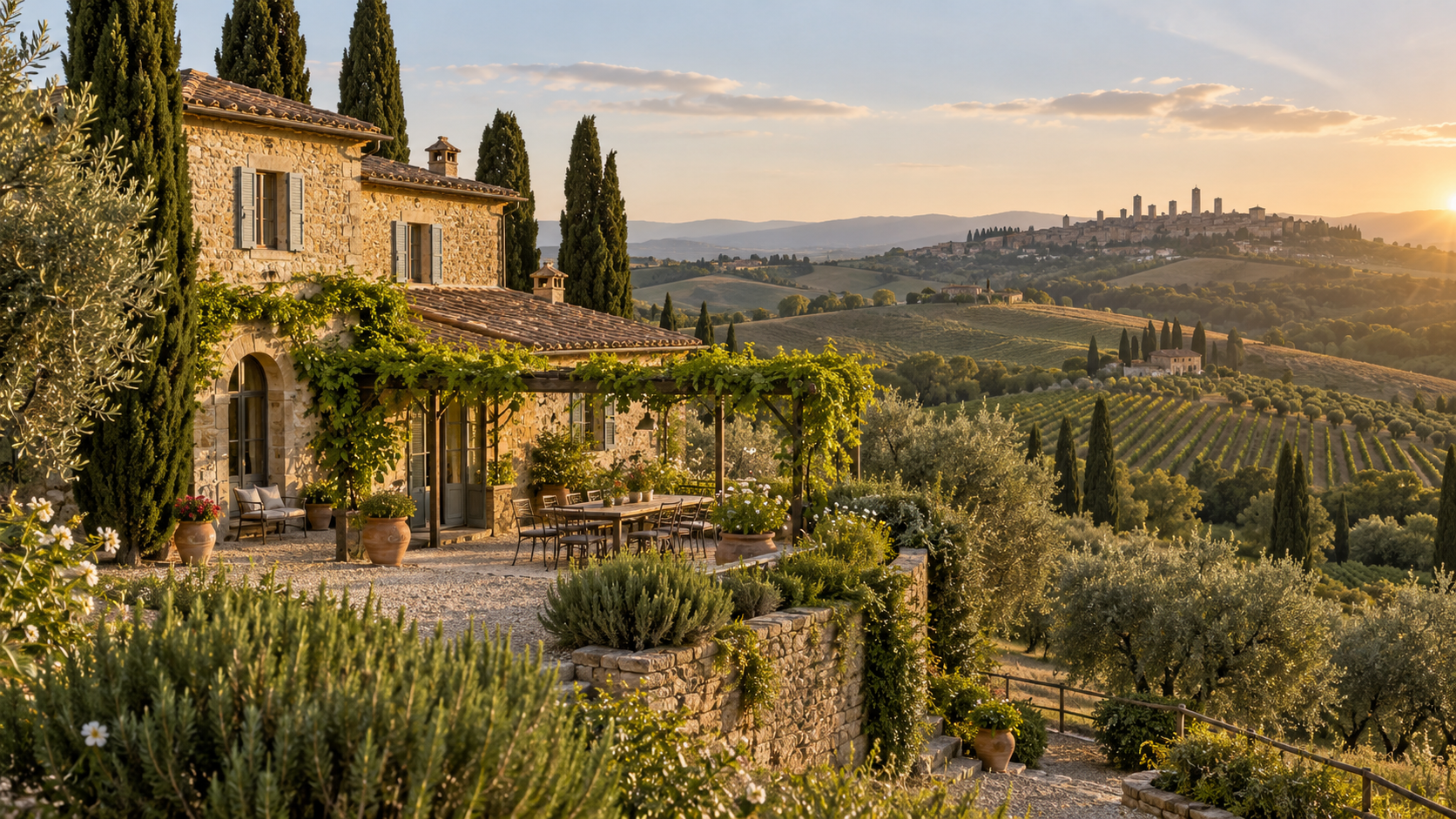
Val d’Orcia is the Tuscany many travelers imagine before arriving: undulating fields, isolated farmhouses, hilltop villages and rows of cypress trees disappearing into the distance.
The valley lies south of Siena and includes several exceptional bases:
- Pienza
- Montalcino
- San Quirico d’Orcia
- Bagno Vignoni
- Castiglione d’Orcia
The landscape is recognized by UNESCO for the way it reflects Renaissance ideas about beauty, nature and harmonious land management. The official UNESCO Val d’Orcia listing provides useful historical context.
Pienza is a lovely choice for couples and food lovers, especially those interested in pecorino cheese. Montalcino is ideal for Brunello wine enthusiasts. San Quirico d’Orcia offers a convenient central position, while tiny Bagno Vignoni is famous for its historic thermal-water square.
A car is essential for making the most of the valley. The official Val d’Orcia tourism website also recommends traveling by car to enjoy its villages and landscape.
Choose Val d’Orcia if: scenery, photography, wine, thermal baths and peaceful evenings matter more than nightlife.
5. Lucca: Best for a Relaxed and Walkable City
Lucca offers Renaissance walls, elegant piazzas and a slower atmosphere than Florence. Its largely traffic-free historic center makes it particularly enjoyable for walking and cycling.
Visitors can rent bicycles and ride along the broad, tree-lined walls that encircle the old city. Inside, highlights include Piazza dell’Anfiteatro, Torre Guinigi, San Martino Cathedral and the birthplace of composer Giacomo Puccini.
Lucca is an excellent base for northern Tuscany. Pisa is easily reached by train, while Viareggio and the Versilia coast are also accessible. Travelers with a car can explore the Garfagnana, the Apuan Alps and historic villas outside the city.
Choose Lucca if: you want a beautiful Tuscan city that feels calmer and more manageable than Florence.
It is also a good option for families, older travelers and anyone who prefers gentle sightseeing over a tightly packed museum itinerary.
6. Pisa: Best for Convenient Arrivals and Short Visits
Pisa is often treated as a quick excursion, but staying overnight can be practical for travelers using Pisa International Airport.
Beyond the Leaning Tower, the city has an attractive historic center, the River Arno, medieval churches and a lively university atmosphere. Once the busiest tour groups leave Piazza dei Miracoli, Pisa feels much more relaxed.
The city’s railway connections make Florence, Lucca and several coastal destinations relatively easy to reach.
Choose Pisa if: you have an early flight, a late arrival or want a well-connected base for northwestern Tuscany.
Consider another base if: vineyards, hill towns and rural scenery are the main purpose of your trip.
7. Montepulciano: Best for Wine and Southern Tuscany
Montepulciano rises dramatically above the Val di Chiana near Tuscany’s border with Umbria. Its steep streets lead past Renaissance palaces, wine cellars and panoramic terraces.
The town is associated with Vino Nobile di Montepulciano and makes a rewarding base for exploring Pienza, Monticchiello, Chiusi, Cortona and the Val d’Orcia.
Accommodation ranges from historic rooms inside the old town to farmhouses and wine estates in the surrounding countryside.
Staying inside Montepulciano provides atmosphere and restaurant access, but parking can be inconvenient. A countryside property is generally better for travelers planning frequent day trips.
Choose Montepulciano if: you want wine, Renaissance architecture and access to both Tuscany and nearby Umbria.
8. Arezzo: Best for Authentic City Life and Fewer Crowds
Arezzo receives fewer international visitors than Florence or Siena, yet it has outstanding art, beautiful architecture and excellent rail connections.
The city is known for Piero della Francesca’s fresco cycle in the Basilica of San Francesco, its sloping Piazza Grande and one of Italy’s best-known antiques markets.
Arezzo feels like a functioning Italian city rather than a destination built primarily around tourism. Accommodation and restaurants may also offer better value than in Tuscany’s most famous centers.
Direct trains connect Arezzo with Florence, while a car opens access to the Casentino Valley, Anghiari, Sansepolcro and eastern Tuscany.
Choose Arezzo if: you appreciate art and history but prefer a less crowded, more local atmosphere.
9. San Gimignano: Best for a Medieval Overnight Stay
San Gimignano is famous for the medieval towers that dominate its skyline. During the day, its streets can become crowded with visitors arriving from Florence and Siena. In the evening, however, the town recovers much of its medieval character.
Spending one or two nights allows time to enjoy the towers, collegiate church, museums and surrounding countryside without rushing.
San Gimignano can also serve as a base for Volterra and the Val d’Elsa, although its transportation connections are less convenient than those of Florence or Siena.
Choose San Gimignano if: you want to sleep inside one of Tuscany’s most famous medieval towns and enjoy it after the day tours depart.
10. Cortona: Best for Romance and Eastern Tuscany
Set high above the Val di Chiana, Cortona combines Etruscan history, medieval streets and extensive views across the countryside.
The town became especially familiar to American readers through Under the Tuscan Sun, but its appeal extends beyond literary associations. Cortona has significant museums, churches, restaurants and walking routes.
Camucia-Cortona railway station is located below the hill town, with local transportation connecting it to the center. A car is nevertheless useful for countryside excursions.
Cortona is well positioned for visiting Arezzo, Lake Trasimeno, Montepulciano and towns across the Umbrian border.
Choose Cortona if: you want a romantic hill town with access to both Tuscany and Umbria.
11. Maremma: Best for Nature, Hot Springs and Uncrowded Tuscany
Southern Tuscany’s Maremma offers a very different experience from Florence and Chianti. Its landscape combines coastal wetlands, wooded hills, agricultural land, Etruscan archaeological sites and thermal springs.
Good bases include:
- Grosseto
- Massa Marittima
- Pitigliano
- Sorano
- Saturnia
- Castiglione della Pescaia
Pitigliano, dramatically positioned on a volcanic-rock ridge, is ideal for history and photography. Saturnia attracts visitors with its thermal waters, while Castiglione della Pescaia combines beaches with an attractive medieval upper town.
The region is best explored by car because many of its most interesting sites are scattered across the countryside.
Choose Maremma if: you want a slower, wilder and less heavily visited side of Tuscany.
12. The Tuscan Coast: Best for Beaches and Family Vacations
Tuscany is not only an inland destination. Its long coastline includes fashionable resorts, family-friendly beaches, protected natural areas and islands.
Versilia, including Viareggio and Forte dei Marmi, is convenient for travelers combining beaches with Lucca and Pisa. Farther south, Castiglioncello, San Vincenzo, the Gulf of Baratti and Castiglione della Pescaia offer additional coastal experiences.
The island of Elba is a destination in its own right, with beaches, hiking trails and towns connected by ferry to Piombino.
Italia Mia’s guide to the beaches of Tuscany can help you select the right coastal area.
Choose the Tuscan coast if: swimming, seaside restaurants and a slower family vacation are more important than visiting several inland cities.
City Hotel, Agriturismo or Tuscan Villa?
Tuscany offers several distinct types of accommodation.
City Hotels
Hotels in Florence, Siena, Lucca and Pisa are best for short visits, public transportation and travelers who want restaurants and attractions within walking distance.
Before reserving a city-center hotel with a rental car, ask about parking and access restrictions. Florence, Siena, Lucca and many other historic towns have limited-traffic zones known as ZTLs. Tuscany’s official tourism website provides an introduction to driving and ZTL areas in Tuscany.
Agriturismi
An agriturismo is a working farm offering guest accommodation. Some are rustic family farms, while others resemble boutique countryside hotels with restaurants, swimming pools and organized tastings.
They are excellent for couples, families and travelers seeking a more personal rural experience. However, distances can be deceptive, and the final approach may involve an unpaved road.
Before booking, check:
- Distance from the nearest town
- Restaurant opening days
- Air conditioning
- Swimming-pool dates
- Road conditions
- Parking
- Breakfast availability
- Whether wine tastings require reservations
Villas and Apartments
A villa works particularly well for families or groups staying at least one week. Apartments are also useful for travelers who want a kitchen or more space.
Always check whether the quoted price includes cleaning, utilities, heating, local tourist tax and late-arrival fees.
A remote villa may look idyllic in photographs but become inconvenient if every restaurant, supermarket and attraction requires a long drive.
Where to Stay in Tuscany Without a Car
Travelers without a car should favor cities with railway stations and reliable public transportation.
The best choices are:
- Florence
- Lucca
- Pisa
- Arezzo
- Siena, using a combination of train and bus
Florence offers the broadest range of organized countryside excursions. It is therefore possible to see Chianti, Siena and San Gimignano without driving, although guided day trips provide less independence.
Use the official Trenitalia website to check rail schedules and Autolinee Toscane for regional bus information.
Italia Mia’s guide to train travel in Italy explains tickets, regional trains and the differences between Trenitalia and Italo.
Where to Stay in Tuscany With a Car
With a rental car, Siena, Chianti and Val d’Orcia become especially attractive. A car allows you to reach wineries, hill towns, country restaurants and panoramic roads that are difficult to visit by public transportation.
Avoid collecting the car while staying in central Florence unless you genuinely need it. A practical plan is to explore Florence first, then pick up the rental car when leaving for the countryside.
Read Italia Mia’s complete guide to driving in Italy before your trip. It covers ZTLs, parking, toll roads, speed cameras and other issues that can surprise foreign drivers.
One Base or Several?
One base can work for a short trip, but Tuscany is usually more enjoyable when divided into two or three distinct stays.
Five nights
- 3 nights in Florence
- 2 nights in Siena or Chianti
Seven nights
- 3 nights in Florence
- 2 nights in Siena or Chianti
- 2 nights in Val d’Orcia
Ten nights
- 3 nights in Florence
- 2 nights in Lucca
- 2 nights in Siena or Chianti
- 3 nights in Val d’Orcia
Changing hotels every night wastes time. Two- or three-night stays provide a better balance between variety and relaxation.
For a detailed driving route, follow Italia Mia’s Tuscany road-trip itinerary. You can also compare destinations in our guide to the 25 best places to visit in Tuscany.
Best Place to Stay in Tuscany by Travel Style
For a first trip: Florence and Siena
For couples: Val d’Orcia or Chianti
For art lovers: Florence and Arezzo
For wine enthusiasts: Chianti, Montalcino or Montepulciano
For families: Lucca, a countryside agriturismo or the Tuscan coast
For travelers without a car: Florence, Lucca or Pisa
For photographers: Val d’Orcia and San Gimignano
For fewer crowds: Arezzo, Maremma or the Garfagnana
For beaches: Versilia, Castiglione della Pescaia or Elba
For thermal springs: Bagno Vignoni, Saturnia or Chianciano Terme
When to Book Accommodation
April through June and September through October are among the most desirable periods for cultural and countryside trips. Popular hotels, agriturismi and villas can fill well in advance.
July and August bring heat and larger crowds, although these months are ideal for properties with swimming pools and for coastal vacations. Florence can be hot, while evenings in rural areas are often more comfortable.
Winter offers lower prices and quieter cities, but some countryside accommodations and restaurants close seasonally. Heating policies should be checked when renting an apartment or villa.
Italia Mia’s month-by-month guide to the best time to visit Italy provides more seasonal planning advice.
Recommended Tuscany Guidebooks
A printed guidebook remains useful for understanding the geography of Tuscany and identifying worthwhile stops between major destinations.
- Rick Steves Florence & Tuscany
- Lonely Planet Florence & Tuscany
- DK Eyewitness Florence and Tuscany
- Tuscany road maps and driving guides
Affiliate disclosure: Italia Mia may earn a commission from qualifying Amazon purchases made through these links, at no additional cost to the reader.
Final Recommendation
For most first-time visitors, the best solution is not choosing a single base.
Begin with three nights in Florence without a car. Then rent a car and spend two or three nights near Siena or in Chianti. Finish with two or three nights in Val d’Orcia.
This combination provides Renaissance art, medieval towns, vineyards, countryside landscapes and memorable drives without requiring a hotel change every day.
Travelers with less time should choose Florence for a car-free cultural trip or Siena for a balanced city-and-countryside experience. Those seeking a quiet, romantic Tuscan escape should stay in an agriturismo near Pienza, Montalcino or San Quirico d’Orcia.
Related Italia Mia Articles
- Region of Tuscany: Complete Travel Guide
- 25 Best Places to Visit in Tuscany
- The Perfect Tuscany Road Trip
- The Enchanting Beaches of Tuscany
- Images of Tuscany
- How to Travel by Train in Italy
- Driving in Italy: Complete Guide
External Sources
- Visit Tuscany — Official Tourism Website
- Italia.it — Tuscany
- UNESCO — Val d’Orcia
- Trenitalia
- Autolinee Toscane
- Val d’Orcia Official Tourism Information