
Part of Unexpected Italy: Stories from My Recent Travels
 I have never thought of Lucca as a city I simply visit.
My grandfather was from Lucca, and that fact changes the way I enter it. I am not searching for a family house, trying to reconstruct a genealogy or pretending that every old doorway contains a message meant for me. The connection is less precise and, for that reason, harder to explain. Lucca reminds me of a place I have known before—sometimes so strongly that the phrase “a past life” seems more accurate than memory.
I do not mean that as proof of anything supernatural. It is simply the closest description I have for the sensation. Some cities impress us immediately but remain foreign. Lucca does the opposite. Its streets seem familiar before I have remembered where they lead.
That is one reason I return. Another is more practical: I enjoy the city. I like walking without needing an itinerary, looking at men’s clothing along Via Fillungo, crossing Piazza San Michele and eventually climbing to the walls. Lucca is close enough to home that I do not have to turn every visit into an event. I can go there because I feel like going there.
On this particular afternoon, I expected nothing more than that familiar routine. Instead, on the walls, I heard a musician playing a song that did not seem to belong to any period I could identify. The encounter lasted only a few minutes, but it clarified something about why I keep returning to the city.
Entering Lucca Without a Plan
The historic center of Lucca is still defined by its Renaissance walls. They do not survive merely as a boundary or military relic; they form a broad, tree-lined public walk around the city. The entire circuit is more than four kilometers long, used by walkers, runners, cyclists, families and people crossing from one part of Lucca to another.
Once inside, the scale changes immediately. Cars become less important, distances shrink and the city begins to reveal itself through corners rather than vistas. Lucca is not organized around one monument that dominates every approach. Its churches, towers, palaces and piazzas appear in stages.
I walked toward Piazza San Michele, where the church façade rises in ranks of columns above the square. It is one of those buildings that can still command attention even when you have seen it many times. Yet the square itself remains active enough to resist becoming a formal display. People cross it on errands, sit at café tables, meet near the church and continue into the surrounding streets.
I stayed only a few minutes. I was not in the mood to inspect monuments. I wanted to walk through the city at its normal pace.
From Piazza San Michele, I continued toward Canto d’Arco, the intersection where Via Roma, Via Santa Croce, Via Cenami and Via Fillungo meet. The Torre delle Ore appeared above the narrow corridor of buildings. Then I turned into Via Fillungo.
Via Fillungo and the Business of Looking
Via Fillungo is Lucca’s principal shopping street, but it does not resemble the broad commercial avenues of Milan or Turin. It is narrow and irregular, enclosed by tall buildings, with medieval geometry and old shopfronts sharing the street with contemporary retail.
I have a particular interest in the men’s clothing shops. I do not necessarily go to buy something. Looking is part of the visit.
Italian menswear rewards attention to small distinctions: the weight of a jacket, the width of a lapel, the length of a coat, the difference between an item that looks refined and one that simply looks expensive. On Via Fillungo, I can spend time examining a window without the aggressive pace of a department store. Some displays are conservative, others make a determined effort to look younger, and a few seem designed for a man who exists mainly in the imagination of the person arranging the window.
I stopped at several shops, went into two and tried on a jacket in one of them. It fit well across the shoulders but not well enough to justify the price. The salesman agreed too quickly when I said I would think about it. We both understood that I would not be returning for the jacket.
That exchange pleased me more than a forced purchase would have.
Shopping streets are often dismissed as interruptions in a historic city, as if ordinary commerce contaminates culture. In Lucca, Via Fillungo shows the opposite. Trade has always been part of the center’s identity. The shops keep the street in use, and the mixture of residents and visitors prevents it from feeling like a preserved corridor between monuments.
I continued north, passing near the Torre delle Ore and the side streets leading toward Piazza dell’Anfiteatro. I did not enter the oval piazza immediately. It is one of Lucca’s best-known spaces, formed within the footprint of the Roman amphitheater, and it is worth seeing. But on busy days it can feel more self-conscious than the streets around it.
Instead, I continued along Via Fillungo toward Piazza Santa Maria. The retail traffic gradually thinned, and the northern edge of the historic center came closer.
A City Connected to My Grandfather
Walking through Lucca always brings me back to my grandfather, but not through a clear sequence of inherited memories. I do not see the city through his eyes, and I would not claim to know precisely what Lucca meant to him.
Family origins are often simplified after enough time has passed. A town becomes a name on a document, then a story repeated at the table, then part of the way later generations describe themselves. Much of the detail disappears. What remains can be powerful, but it should not be confused with complete knowledge.
My connection to Lucca contains that uncertainty. I know where my grandfather came from. I also know how I feel when I return. Between those two facts there is a large territory I cannot document.
Perhaps that is why the city affects me more than a place where every family address and event had already been identified. Lucca leaves room for recognition without explanation.
On Via Fillungo, that recognition does not come from imagining the street as it looked in my grandfather’s time. The shops have changed, the customers dress differently and the center serves a modern city. What remains is the physical rhythm: the narrow route, the interruptions of side streets, the sudden opening of a piazza, the walls waiting at the perimeter.
I have walked it often enough to know where I am. Yet I still occasionally experience the irrational impression that I knew it before I first arrived.
Climbing to the Walls
Near Piazza Santa Maria, I left the commercial street and made my way up to the walls.
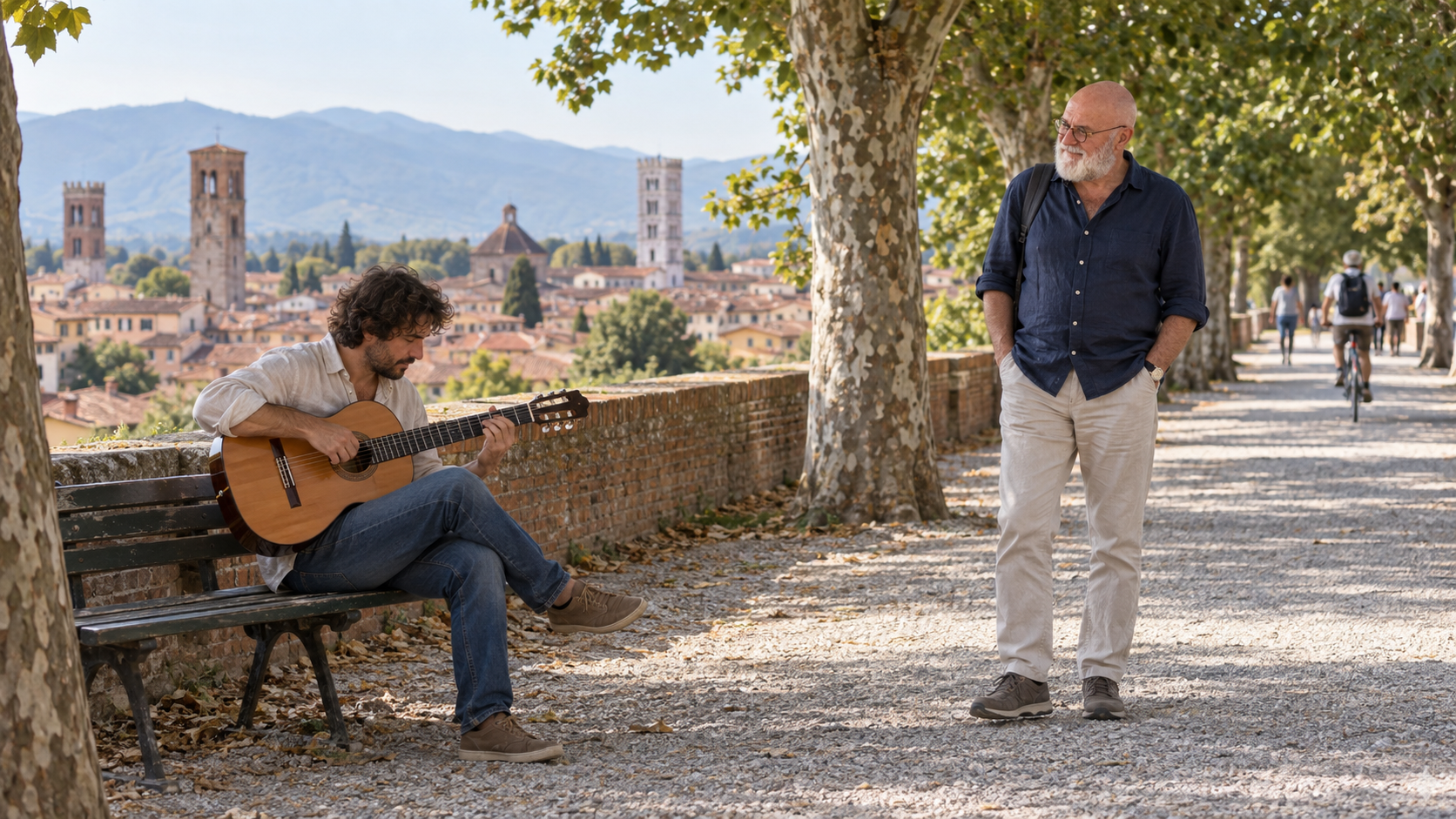
The walls of Lucca are unusual because they allow the visitor to step out of the density of the historic center without actually leaving it. From the elevated promenade, church towers and tiled roofs remain visible on one side, while the newer city and the surrounding landscape appear on the other. The route is broad enough that it feels less like walking on a fortification than crossing a linear park.
Bicycles passed at regular intervals. A man was running with the serious expression of someone measuring every second. Two women walked side by side, speaking rapidly and paying no attention to anyone trying to overtake them. A family had stopped near a bastion while a child investigated something at the base of a tree.
This was the ordinary Lucca I had come to see.
I began walking west, without deciding whether I would complete the circuit. The plane trees provided shade, and the pace on the walls was slower than it had been on Via Fillungo. Below me, the city was close but temporarily removed from the practical business of shops, traffic and finding the correct street.
Then I heard the guitar.
The Musician Who Was Not Performing
At first, the sound was too fragmentary to call a song. A few chords were followed by a pause, then the same passage began again. The musician was sitting on a bench away from the main flow of pedestrians, holding a classical guitar. There was no open case on the ground, no sign requesting money and no effort to gather an audience.
He was not performing. He was working.
I stopped at a reasonable distance. The melody moved forward for perhaps half a minute, broke off and returned to its beginning. It had something familiar in its structure, but I could not identify it. In Lucca, a city that places Puccini at the center of its musical identity, it is easy to assume that any unexpected melody must be connected to the composer. This was not an operatic aria, however, and the man did not play it with the exaggerated emotion of someone trying to attract tourists.
After several attempts, he looked up and noticed that I had been listening.
“Is it yours?” I asked.
He said it was, or at least that it might be if he could finish it.
I told him that I had been trying to recognize it.
“That is either a good sign or a very bad one,” he replied.
There was nothing theatrical about the conversation. He was a local musician using the walls as a place to work before meeting someone in the city. The weather was good, his house was noisy and nobody objected to a guitar on the ramparts. That was the complete explanation.
He played the passage again, this time continuing beyond the point where he had previously stopped. The new section lasted only a few measures before he shook his head and returned to the earlier chords.
I mentioned that my grandfather had been from Lucca and that I often came back because the city felt familiar to me. He asked my family name. I told him. He did not pretend to recognize it.
He simply nodded and said that people often leave Lucca but continue to measure other places against it.
It was an observation, not a piece of wisdom delivered for a traveler’s benefit. Then he looked down at the guitar and played the passage again.
A Song Without a Name
I listened for another minute and continued walking.
The encounter would have been easy to enlarge afterward. I could say that the melody connected me directly to my grandfather, that it sounded like something remembered from childhood or that the musician somehow understood my relationship with Lucca. None of that happened.
I did not recognize the song because I had never heard it. It did not yet have a title, and it may never have been completed. The musician did not know my family. We exchanged only a few sentences.
Yet the incident remained with me precisely because it resisted a grand interpretation.
Lucca often works that way. Its strongest impressions do not always come from major events. They accumulate through repetition: the turn into Via Fillungo, a jacket left in a shop, bicycles moving under the trees, the view down into streets you crossed earlier, and a man on a bench trying to solve a musical phrase.
Music is deeply embedded in Lucca’s public identity. Giacomo Puccini was born here, the Boccherini conservatory carries the name of another important native composer, and the city continues to host opera, classical music, rock and pop. But what I heard on the walls belonged to none of the official programs. It was music before it became a performance—private work taking place in public.
That distinction mattered. The man was not there to represent Lucca for visitors. He was simply using his city.
Completing the Walk
I continued around part of the wall circuit and eventually descended toward the center again. By then, Via Fillungo had changed character. The light was lower, some shoppers had gone home and other people were arriving for the early evening. The shop windows I had examined earlier now appeared brighter against the street.
I passed Piazza San Michele once more. Nothing about it had changed, but I had.
The phrase “past life” returned to me, not because the music had awakened a hidden memory, but because the day had reproduced a sensation I often have in Lucca. I can walk through the city as a visitor and still feel that I am returning rather than arriving.
Perhaps family origin is enough to create that response. Perhaps repeated visits have built their own memory and projected it backward. Perhaps certain cities simply match the internal scale by which we judge a place: large enough to remain interesting, compact enough to understand, formal without becoming impersonal.
I do not need to decide which explanation is correct.
My grandfather came from Lucca. Via Fillungo still draws me into its shops. The walls still give the city a shape that can be walked and understood. And somewhere along them, for a few minutes, a local musician played a song that had no name and was not meant for an audience.
I heard it by chance.
In Lucca, it felt less like a discovery than something I had returned to hear.
A Walk Through My Lucca
For travelers who want to follow a similar route, begin around Piazza San Michele and continue toward Canto d’Arco and Via Fillungo. Take time with the street rather than treating it only as the route to another attraction. The historic shopfronts, clothing stores, side streets and changing pedestrian traffic are part of the experience.
Continue north toward Piazza Santa Maria, with an optional detour into Piazza dell’Anfiteatro, then climb to the walls. A complete circuit is more than four kilometers, but there is no need to walk all of it. Even one section provides a clear view of the relationship between the historic center and the modern city around it.
For more regional context, see Italia Mia’s guide to the Region of Tuscany. Lucca’s official tourism website also provides dedicated routes for the city walls, Via Fillungo and the city’s musical history.
Do not expect a musician to be waiting on a particular bench. The point of the walk is not to reproduce someone else’s accident. It is to leave enough time and attention for Lucca to provide one of your own.
External Sources
- Lucca Tourism: The Walls of Lucca
- Lucca Tourism: The City Walls Park
- Lucca Tourism: Via Fillungo
- Lucca Tourism: Lucca, City of Music
- Visit Tuscany: The Places of Giacomo Puccini in Lucca