
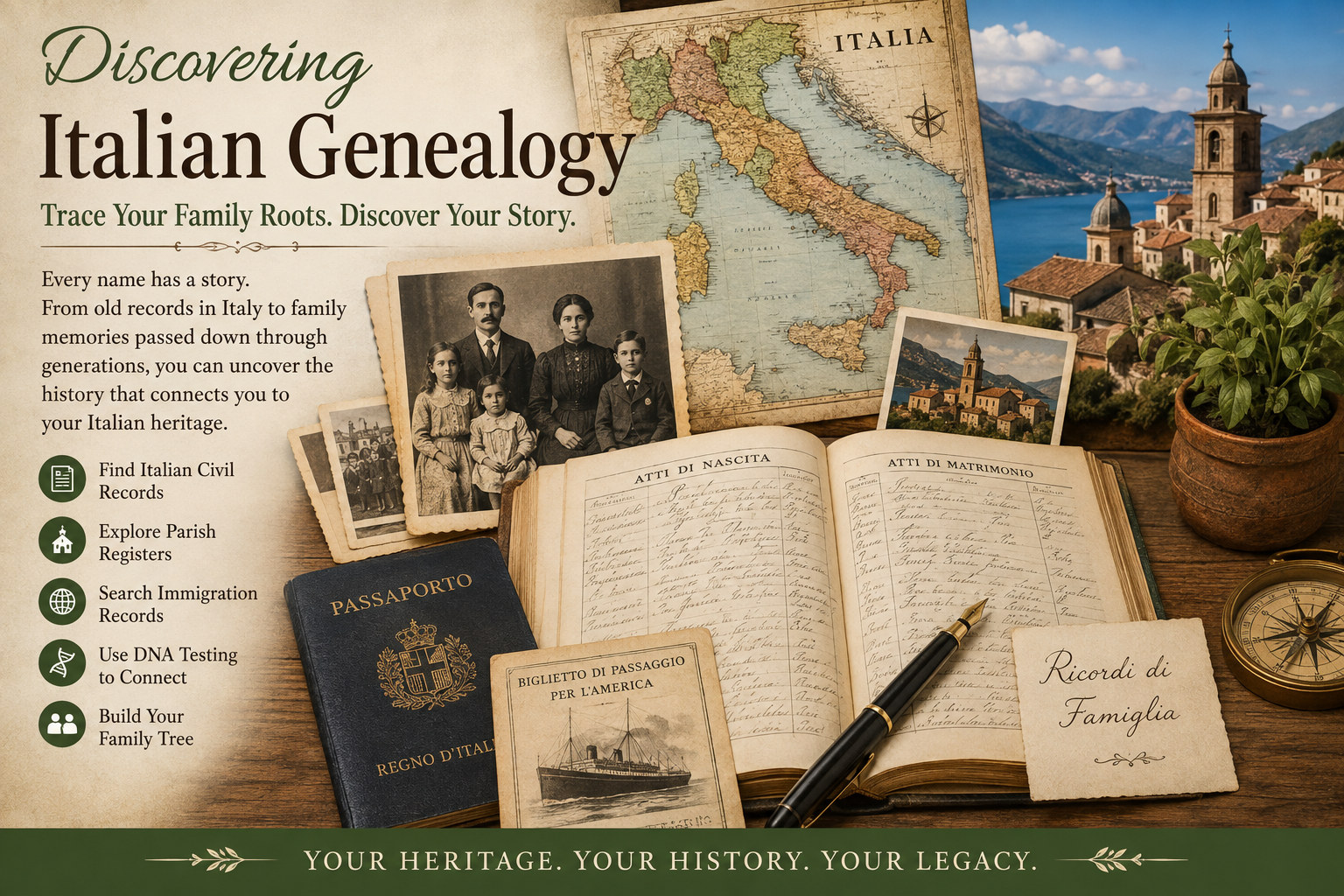
Millions of people around the world have Italian ancestry. For descendants of Italian immigrants, discovering where their family came from can be much more than a genealogical exercise. It can reveal the town where a great-grandfather was born, the name of a long-forgotten village, the occupation of an ancestor, or the circumstances that led a family to leave Italy.
The good news is that Italian genealogy research has become considerably easier in recent years. A growing number of historical records are available online, including birth, marriage and death records, while specialized websites and Italian archives can help researchers go considerably further.
The most important rule is simple: start with what you know and work backward one generation at a time.
You do not need to be a professional genealogist. With a few names, approximate dates and, ideally, the Italian town or province of origin, you can often uncover an extraordinary amount of information.
Start With Your Own Family
Before searching online databases, begin at home.
Talk to parents, grandparents, uncles, aunts and older relatives. Family stories can provide clues that do not appear in official records. Write down names, nicknames, dates, places, occupations and stories—even when you are not certain that every detail is correct.
Old family documents can be particularly valuable:
- Birth and baptism certificates
- Marriage certificates
- Death certificates
- Naturalization papers
- Passports
- Military documents
- Immigration records
- Ship passenger lists
- Obituaries
- Family Bibles
- Letters from Italy
- Old photographs
- Cemetery records
- Property documents
Pay particular attention to town names.
Knowing that your ancestor was “from Sicily” is useful, but knowing that he was born in Palermo, Messina, Agrigento or a particular small comune can transform the research process.
Family members may also remember an Italian surname in an older form. Immigration sometimes resulted in spelling variations, particularly when Italian names were recorded by officials in English-speaking countries.
Create a simple family tree before beginning your online research. Record what you know, but clearly distinguish between facts and family stories that still need to be verified.
Understanding Italian Immigration to America
Italian genealogy is particularly important in the United States because of the enormous Italian migration that took place during the late nineteenth and early twentieth centuries.
The largest wave of Italian immigration occurred roughly from the 1880s through the 1920s, although Italians had been arriving in North America much earlier and migration continued after that period.
Many immigrants came from southern Italy and Sicily, but Italian immigration was never exclusively southern. Families also arrived from Piedmont, Lombardy, Veneto, Liguria, Tuscany and other parts of the country.
Economic hardship, limited employment opportunities, agricultural difficulties, political and social conditions and the attraction of higher wages abroad all contributed to emigration.
Italian immigrants established communities throughout the United States. New York and other northeastern cities became particularly important destinations, while significant Italian-American communities also developed in cities such as Philadelphia, Chicago, Cleveland, Boston and San Francisco.
The Italian diaspora eventually became an important part of American history and culture. Italia Mia’s article on the Italian diaspora to the United States provides additional background on the continuing relationship between Italy and Italian communities abroad.
The Most Important Clue: Find the Town
For Italian genealogy, the ancestral town is often more important than the surname.
A surname may exist in dozens or even hundreds of Italian communities. A specific town, however, can dramatically narrow your search.
For example, discovering that your grandfather was born in Sicily is only the beginning. Finding a document stating that he was born in a particular comune in the province of Palermo gives you a precise starting point.
Try to establish:
- The comune where the ancestor was born
- The province
- The approximate birth year
- The names of the parents
- The name of the spouse
- The names of siblings
- The approximate date of immigration
Once you have the town, you can begin looking for Italian civil and parish records.
Italian Civil Registration Records
One of the most valuable sources for Italian genealogy is stato civile, or civil registration.
Depending on the period and location, these records can include:
- Nati — births
- Matrimoni — marriages
- Morti — deaths
- Marriage banns and related documents
- Supplemental documents
- Population and residency records
- Indexes
- Other administrative records
The Italian government’s Portale Antenati has made a huge amount of this material available online. The portal provides access to digitized records held by Italian State Archives, with searches organized by archive, locality, year and record type.
Portale Antenati — Italian Government genealogy archives
The availability of records varies considerably by locality and historical period. Some towns have extensive digitized collections, while other records may still require contacting an archive or municipality.
The Antenati portal also provides name indexes for many collections. Its published indexes include records from numerous Italian State Archives and can cover births, marriages and deaths across different periods.
Italian Birth Records
Birth records are usually one of the best places to begin.
An Italian birth record can potentially provide much more than the child’s name and date of birth. Depending on the period and type of document, it may identify the parents, their occupations, residence and other information that can help you move back another generation.
This is one reason Italian genealogy becomes increasingly interesting once you locate the correct town.
A single birth record may provide the names of the parents. You can then search for their marriage. The marriage record may identify their parents, allowing you to move another generation backward.
This process can produce a chain:
You → parent → grandparent → great-grandparent → great-great-grandparent
Rather than trying to build an enormous family tree immediately, concentrate on proving each generation before moving backward.
Marriage Records Can Be Especially Valuable
Italian marriage records are often among the richest genealogical documents.
A marriage record may contain information about both spouses and their parents. Additional documentation associated with the marriage can sometimes provide even more clues.
This makes marriage records particularly useful when you are trying to identify the previous generation.
Italia Mia’s guide to Italian civil vital records provides additional information about the types of Italian records researchers may encounter and the differences between regions and historical periods.
Keep in mind that Italian record-keeping was not identical everywhere. Historical administrations changed, borders changed and local practices differed. Researchers should therefore avoid assuming that one rule applies to every Italian province.
Death Records and Other Documents
Death records can also be extremely useful.
They may provide a person’s age, occupation, residence, spouse and parents, depending on the period and circumstances.
Do not automatically assume that the age recorded on a death certificate is correct. Historical records frequently contain discrepancies. A person’s age may differ by several years between documents.
This is why experienced genealogists compare multiple records rather than relying on a single document.
A useful approach is to build a timeline for each ancestor:
Birth → marriage → children → military service → immigration → residence → death
If dates do not fit the timeline, investigate rather than simply accepting the information.
Parish Records: Going Further Back
Civil registration is not the only source available.
Catholic parish records can take your research considerably further back, particularly when researching ancestors who lived before modern civil registration.
Parish registers may contain:
- Baptisms
- Marriages
- Burials
- Names of parents
- Godparents
- Witnesses
- Residence information
FamilySearch’s Italian research guide recommends identifying the ancestral town first, then learning how to use civil registration and Catholic Church records.
FamilySearch Italy Genealogy Guide
Church records can be challenging because they are often handwritten and may be written in Latin or older forms of Italian. Nevertheless, they can be indispensable for research extending well into the nineteenth century and earlier.
Online Italian Genealogy Resources
The internet has transformed genealogy.
Instead of writing letters to multiple municipalities and waiting weeks or months for responses, researchers can now search millions of digitized historical documents from home.
Several resources are particularly useful.
Portale Antenati
The Portale Antenati is one of the most important resources for Italian family history research.
It is operated by Italy’s Ministry of Culture and provides access to historical records held by State Archives. Researchers can search by locality, year, record type and, where indexes are available, name.
FamilySearch
FamilySearch provides extensive guidance and historical collections for Italian genealogy. Its Italian research resources cover civil registration, parish records, immigration and strategies for identifying an ancestral town.
FamilySearch Italy Collections and Research Guide
Some Italian collections are particularly valuable for researchers. For example, FamilySearch has a collection of Tuscan civil registration records held by the State Archive of Florence, including births, marriages and deaths, with records covering numerous Tuscan provinces and some neighboring areas.
Ancestry
Ancestry also maintains an extensive collection of Italian genealogy material. Its Italy research section includes civil registration collections and other historical records, with coverage varying by location and period.
Ancestry — Italy Genealogy Records
Ancestry can be particularly useful when Italian research needs to be combined with records from the country where an ancestor immigrated.
For example, you may find an Italian birth record and then use American census, marriage, naturalization or immigration records to reconstruct the individual’s life after leaving Italy.
American Records Can Solve Italian Mysteries
One of the biggest mistakes in genealogy is assuming that all the answers must be found in Italy.
Sometimes the best clue is actually in the United States.
U.S. census records, naturalization documents, passenger manifests, Social Security records, draft registrations, marriage certificates and obituaries may identify an immigrant’s Italian birthplace.
Naturalization records can be especially valuable because they sometimes contain the town or country of birth.
Passenger records may also provide information about the immigrant’s last place of residence or destination in America.
Once you discover the Italian town, return to Italian records and begin searching there.
This two-way approach—American records leading you to Italy and Italian records confirming the American information—is often far more effective than relying exclusively on one country’s records.
Don’t Trust Every Family Story
Family stories are valuable, but they are not automatically historical facts.
An ancestor described as being “from Naples” may actually have been born in a small town several hours away. Someone remembered as having arrived in America in 1905 may actually have arrived in 1902.
Even surnames can be misleading.
Always try to confirm family stories with original or reliable documentary evidence.
A useful genealogical rule is:
Treat every piece of information as a clue until it has been documented.
This approach prevents you from building an impressive family tree based on assumptions that later turn out to be wrong.
Italian Surnames and Spelling Variations
Italian surnames can provide clues, but they should not be treated as proof of geographic origin.
Names may be spelled differently in historical records because of handwriting, transcription errors, dialect, immigration officials or later Americanization.
For example, a surname may appear with slightly different spelling in an Italian birth record, a passenger list and an American census.
Search for variations when necessary.
Also pay attention to prefixes and compound surnames, including names containing Di, De, Della, Del, Da and similar forms.
However, do not automatically assume that two people with similar surnames are related. Genealogy requires documentary connections.
DNA Testing and Italian Ancestry
DNA testing has become another popular tool for genealogy.
Companies offering ancestry DNA tests can compare genetic markers with reference populations and identify potential relatives. The results may provide broad geographic or regional ancestry estimates and can sometimes connect you with genetic matches who share ancestors.
DNA can be extremely useful, but it should complement documentary genealogy rather than replace it.
A DNA ethnicity estimate generally cannot prove that your great-grandfather came from a particular Italian village. Genetic ancestry estimates are based on reference populations and statistical models, and results can change as companies update their databases and methodologies.
The strongest approach is to combine:
DNA matches + historical documents + family records + geographic research
If DNA suggests a connection to southern Italy, for example, use documentary records to determine whether the family came from Campania, Calabria, Puglia, Sicily or another region.
Understanding Regional Differences
Italy’s history is highly regional, and genealogy reflects that complexity.
Modern Italy was unified in the nineteenth century, but before unification the peninsula consisted of different states and political territories. Record-keeping therefore developed differently in different parts of the country.
Southern Italian and Sicilian civil records can sometimes be particularly useful for nineteenth-century genealogy. In other areas, handwriting, language and historical administrative changes can make research more complicated.
Italia Mia’s guide to Italian civil vital records discusses some of these regional differences and explains why researchers may encounter different types of records depending on where their ancestors lived.
Do not be discouraged if the records from one province look completely different from those of another.
That is normal.
When You Need Help From an Italian Researcher
Sometimes online research reaches a dead end.
Perhaps the records have not been digitized. Perhaps you cannot read the handwriting. Maybe you have identified the town but cannot determine which document belongs to your ancestor.
In these situations, hiring a professional genealogist in Italy can be worthwhile.
A local researcher may be able to:
- Contact a municipal registry office
- Visit an archive
- Search parish registers
- Read historical Italian handwriting
- Examine documents that are not online
- Investigate multiple families with the same surname
- Locate property or military records
- Verify information in original documents
Before paying anyone, ask what services are included and whether you will receive copies of the original documents.
A professional researcher should also be willing to explain the evidence supporting their conclusions.
Consider Visiting Your Ancestral Town
One of the most rewarding parts of Italian genealogy is eventually visiting the place where your ancestors lived.
Imagine finding a nineteenth-century birth record for your great-great-grandfather and then standing outside the church or town hall where that record originated.
You may be able to visit:
- The ancestral church
- The cemetery
- The town hall
- Historical neighborhoods
- Family homes, if they still exist
- Local museums
- Regional archives
A genealogy trip can become a completely different kind of Italian vacation.
Instead of simply visiting the famous tourist destinations, you are walking through a place connected to your own family history.
Italia Mia’s extensive guide to Italy’s regions and the differences between northern, central and southern Italy can also help put your ancestral community into its wider geographical and cultural context.
A Simple Italian Genealogy Research Strategy
If you are starting from scratch, follow this sequence:
1. Start with yourself.
Record your own birth information and work backward.
2. Interview older relatives.
Write down names, dates, towns and family stories.
3. Collect family documents.
Photographs and certificates may contain crucial clues.
4. Identify the Italian town.
Do not stop at “Sicily” or “Calabria.” Try to find the specific comune.
5. Search records in the country of immigration.
American census, naturalization and passenger records can identify Italian origins.
6. Search Portale Antenati.
Look for births, marriages, deaths and other records from the ancestral locality.
7. Search FamilySearch and Ancestry.
Compare databases and look for records that may not appear in one service.
8. Work backward one generation at a time.
Confirm parents before moving to grandparents.
9. Compare multiple documents.
Do not rely on a single record.
10. Explore parish records.
They can take your research further into the past.
11. Consider DNA testing.
Use DNA matches as supporting evidence rather than as a replacement for documents.
12. Hire local help if necessary.
A professional researcher may be able to access records that are difficult to obtain remotely.
Italian Genealogy Is More Than a Family Tree
Researching Italian ancestry is ultimately about much more than collecting names and dates.
Behind every birth certificate is a person. Behind every marriage record is a family. Behind every immigration document is a decision to leave one place and begin a new life somewhere else.
Italian genealogy can reveal occupations, migration patterns, family relationships and the social circumstances in which previous generations lived.
For descendants of Italian immigrants, the journey can eventually lead all the way back to a small comune that may have remained unknown for generations.
And sometimes the most remarkable discovery is not a famous ancestor or an impressive family name.
It is simply finding the place where your family’s Italian story began.
Internal Links
For readers interested in Italian ancestry, immigration and Italian culture, these Italia Mia articles are useful complementary resources:
- Italian Genealogy
- Italian Civil Vital Records
- The Italian Diaspora to the United States
- Italians in the World
- Italy North to South
- Living with Sicily
External Links
- Portale Antenati — Italian Ministry of Culture: https://antenati.cultura.gov.it/
- FamilySearch — Italy Genealogy Research: https://www.familysearch.org/en/help/helpcenter/italy
- Ancestry — Italy Genealogy Records: https://www.ancestry.com/search/places/europe/italy
- Italian Ministry of Culture — State Archives: https://archivi.cultura.gov.it/
- FamilySearch Historical Records: https://www.familysearch.org/search/