

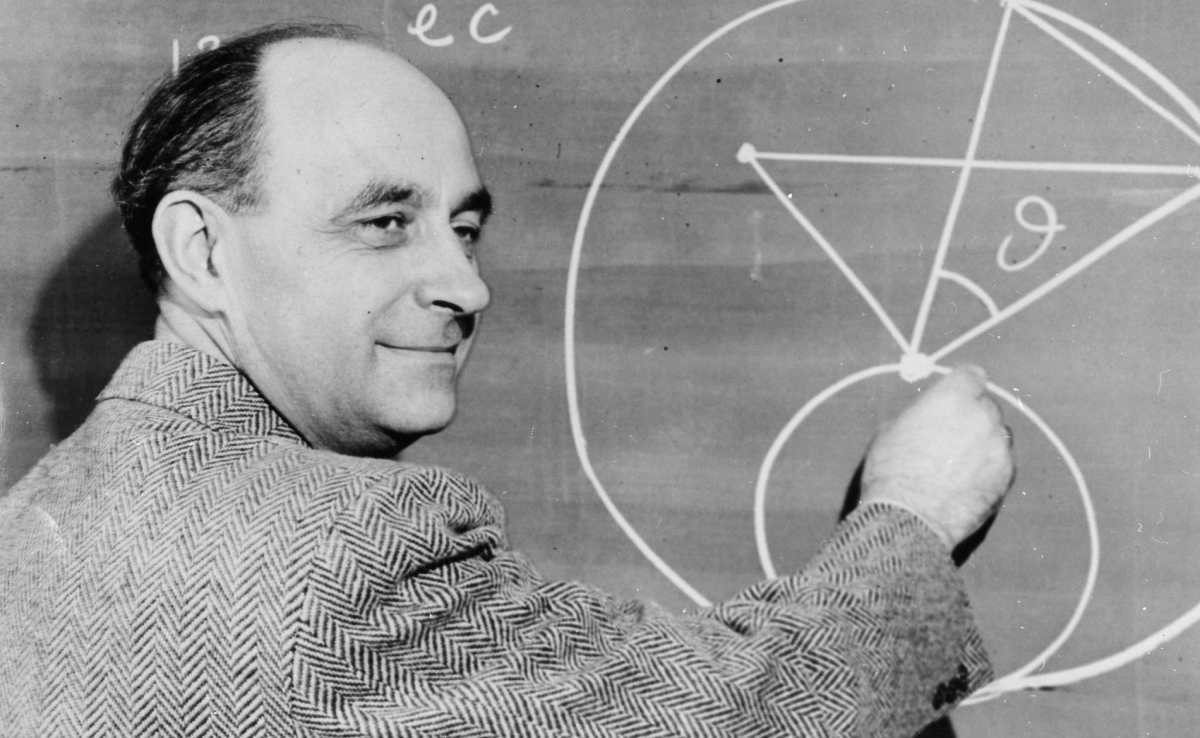
 Enrico Fermi was one of the most complete physicists of the twentieth century: a scientist equally gifted at constructing abstract theories, designing experiments and turning complicated problems into remarkably clear calculations.
His achievements transformed nuclear physics and helped open the atomic age. He developed the statistical laws governing an important class of subatomic particles, proposed the first successful theory of beta decay, discovered the effectiveness of slow neutrons in producing nuclear reactions and directed the experiment that achieved the first controlled, self-sustaining nuclear chain reaction.
His name survives throughout modern science. Fermions, Fermi–Dirac statistics, the chemical element fermium, Fermilab, the Enrico Fermi Institute, the Fermi Gamma-ray Space Telescope and the famous Fermi paradox all commemorate aspects of his work and influence.
Yet Fermi’s life was also inseparable from the upheavals of his era. Born and educated in Italy, he built an internationally important school of physics in Rome before Fascist racial laws threatened his Jewish wife and their children. He escaped to the United States after receiving the Nobel Prize in 1938 and later became a central figure in the Manhattan Project.
Fermi’s biography therefore belongs not only to the history of Italian science but also to the larger story of exile, war, scientific responsibility and the immense power released when theoretical insight is joined to experimental skill.
Childhood and Education in Rome
Enrico Fermi was born in Rome on September 29, 1901. His father, Alberto Fermi, worked for the Italian railway administration, while his mother, Ida de Gattis, was a schoolteacher. Enrico was the youngest of three children, following his sister Maria and his brother Giulio.
The young Fermi showed a remarkable ability to concentrate and an early fascination with mechanical devices. He constructed electric motors, played with gyroscopes and studied how machines worked. His intellectual development was profoundly affected by the death of Giulio, who died in 1915 following a medical operation. Enrico, devastated by the loss of the brother to whom he had been extremely close, increasingly immersed himself in mathematics and physics.
A family friend, Adolfo Amidei, recognized the teenager’s unusual talent and encouraged him to pursue advanced scientific study. Fermi worked through demanding books on geometry, mechanics and theoretical physics, often mastering subjects far beyond the level expected of a secondary-school student.
In 1918, he applied to the prestigious Scuola Normale Superiore in Pisa. For the entrance examination, he submitted an essay analyzing the vibrations of a rod. The sophistication of the work reportedly astonished the examiner, who recognized that the seventeen-year-old applicant was already reasoning at an unusually advanced level.
Fermi studied physics at the University of Pisa and the Scuola Normale Superiore, completing his degree in 1922 with experimental research involving X-rays. Although Italian physics was not yet at the forefront of the emerging quantum revolution, Fermi educated himself by reading the newest scientific papers and corresponding with other gifted young researchers.
His early career included periods at the University of Göttingen, where Max Born led one of Europe’s great centers of quantum physics, and at Leiden University in the Netherlands, where he worked in the intellectually stimulating circle surrounding Paul Ehrenfest. These experiences connected him with the international community that was redefining humanity’s understanding of matter.
Readers interested in the longer Italian scientific tradition can also explore Italia Mia’s biography of Galileo Galilei.
Fermi–Dirac Statistics and the Rise of a Young Genius
Fermi’s first major theoretical breakthrough came in 1926. Building on Wolfgang Pauli’s exclusion principle, he developed a statistical method describing particles that cannot occupy the same quantum state.
The British physicist Paul Dirac independently reached a related formulation, and the resulting framework became known as Fermi–Dirac statistics. Particles governed by these rules were later called fermions in Fermi’s honor.
Fermions include electrons, protons, neutrons and quarks—the particles that make up ordinary matter. Their behavior explains fundamental features of atoms, metals, semiconductors, white dwarf stars and many other physical systems. Fermi’s contribution was therefore not a narrow result but one of the foundations of modern quantum physics.
That same year, at only twenty-five, Fermi was appointed to a newly created chair of theoretical physics at the University of Rome. The appointment placed him in an ideal position to build a new Italian school capable of competing with the leading physics institutes in Germany, Britain and Denmark.
The Boys of Via Panisperna
At the Royal Institute of Physics on Via Panisperna in Rome, Fermi assembled an extraordinary group of young researchers. They became popularly known as the Ragazzi di Via Panisperna—the Boys of Via Panisperna.
The group included Franco Rasetti, Emilio Segrè, Edoardo Amaldi, Bruno Pontecorvo, Ettore Majorana and chemist Oscar D’Agostino. Orso Mario Corbino, an influential physicist and politician, provided institutional support and helped Fermi recruit promising scientists.
Fermi was nicknamed “the Pope” because his colleagues considered his scientific judgments almost infallible. The nickname also reflected his authority within the group, although his working style was generally practical and informal. He encouraged collaboration, direct calculation and constant comparison between theoretical predictions and experimental evidence.
Majorana was the group’s most mysterious member and one of its most original theoreticians. Pontecorvo would later become a major neutrino physicist, while Segrè eventually shared the 1959 Nobel Prize in Physics for the discovery of the antiproton. Together, they helped turn Rome into one of the world’s leading centers for nuclear research.
The restored Via Panisperna building now houses the Enrico Fermi Historical Museum of Physics, where visitors can learn about Fermi, his colleagues and the scientific discoveries made at the institute.
The Theory of Beta Decay
In 1933 and 1934, Fermi developed a theory explaining beta decay, the radioactive process in which an atomic nucleus emits an electron or positron and changes from one type of nucleus into another.
The theory incorporated Wolfgang Pauli’s proposed neutrino, a nearly massless and electrically neutral particle that had not yet been experimentally detected. Fermi gave the particle its enduring Italian name: neutrino, meaning “little neutral one.”
Fermi’s model treated beta decay as the result of a new fundamental interaction, later called the weak nuclear force. Although subsequent discoveries required the original theory to be extended, its essential structure became a cornerstone of particle physics.
The work demonstrated Fermi’s distinctive ability to unite physical intuition, mathematical economy and experimentally testable predictions. It also showed that his talents extended far beyond any single branch of physics.
Slow Neutrons and Artificial Radioactivity
Following the discovery of artificial radioactivity by Frédéric and Irène Joliot-Curie, Fermi and his Rome group began bombarding different elements with neutrons. Because neutrons carry no electric charge, they can penetrate atomic nuclei more easily than positively charged particles.
During these experiments, the group made an unexpected discovery. Neutrons became considerably more effective at producing certain nuclear reactions when they were slowed down by passing through substances rich in hydrogen, such as paraffin wax or water.
This observation was crucial. A slower neutron spends more time near a nucleus and may therefore have a greater probability of being captured. The discovery provided both a new tool for studying atomic nuclei and an essential principle for the design of nuclear reactors.
Fermi’s group believed that irradiating uranium might have produced elements heavier than uranium. Some of the observed products were eventually understood to be fragments created by nuclear fission, a process correctly interpreted several years later by Otto Hahn, Fritz Strassmann, Lise Meitner and Otto Frisch.
The initial interpretation was mistaken, but the underlying experimental work on neutron-induced radioactivity and slow neutrons remained revolutionary. It earned Fermi the 1938 Nobel Prize in Physics.
Fermi’s career belongs within the remarkable history described in Italia Mia’s guide to Italian inventions and discoveries that changed the world.
Marriage to Laura Capon and Life Under Fascism
In 1928, Fermi married Laura Capon, the daughter of a respected Jewish family in Rome. They had two children, Nella and Giulio.
Fermi was not known as an outspoken political activist. Like many Italian academics seeking to preserve their careers, he accommodated some of the demands imposed by Benito Mussolini’s dictatorship. His appointment to the Royal Academy of Italy in 1929 brought prestige and financial security but also required formal association with the Fascist establishment.
The situation became far more dangerous in 1938, when the regime introduced racial laws modeled partly on those of Nazi Germany. The laws excluded Jewish Italians from schools, universities, government employment and many professions. Because Laura was Jewish, the measures directly threatened Fermi’s family.
Fermi understood that remaining in Italy was no longer safe. When he learned that he would receive the Nobel Prize, the journey to Stockholm offered a carefully planned opportunity to leave the country.
The Nobel Prize and Escape from Italy
The Nobel Prize ceremony took place in Stockholm on December 10, 1938. Fermi received the physics prize for demonstrating new radioactive products created through neutron irradiation and for discovering nuclear reactions caused by slow neutrons.
His appearance at the ceremony carried quiet political significance. Rather than wearing the Fascist uniform expected of an Italian academic representing the regime, Fermi wore formal civilian dress and shook hands with the Swedish king instead of giving the Fascist salute.
After the ceremony, Enrico, Laura and their children did not return to Italy. They traveled from Sweden to the United States, bringing with them the Nobel medal and prize money. Fermi had already accepted a position at Columbia University in New York.
Their departure was part of a wider flight of scientists, artists and intellectuals from Fascist and Nazi-controlled Europe. For Italy, the loss of Fermi and several members of his circle represented an enormous scientific and cultural wound.
Nuclear Fission and the Road to Chicago
Soon after Fermi arrived in the United States, news reached the scientific world that uranium nuclei could split into lighter elements while releasing tremendous energy and additional neutrons.
Fermi and Leo Szilard recognized that the emitted neutrons might trigger further fissions, creating a self-sustaining chain reaction. Such a reaction could potentially be used both as a source of energy and as the basis of an extraordinarily powerful weapon.
At Columbia, Fermi and his collaborators conducted experiments to determine whether a controlled chain reaction was feasible. When the United States entered the Second World War, this research became part of the Manhattan Project, the secret Allied effort to build an atomic bomb before Nazi Germany could do so.
Fermi moved to the University of Chicago, where the project’s Metallurgical Laboratory concentrated on reactor physics and plutonium production. His combination of theoretical knowledge, experimental discipline and engineering judgment made him indispensable.
Chicago Pile-1 and the First Controlled Chain Reaction
Under the stands of the University of Chicago’s Stagg Field, Fermi’s team constructed Chicago Pile-1, an immense lattice of graphite blocks containing uranium metal and uranium oxide.
The structure had no radiation shield and no modern cooling system. Layers of graphite acted as a moderator, slowing neutrons sufficiently to increase the probability that they would cause additional uranium fissions. Cadmium control rods absorbed neutrons and allowed the team to regulate the reaction.
On December 2, 1942, the scientists gradually withdrew the control rods. Fermi monitored the instruments, performed calculations and calmly directed each stage of the experiment.
At 3:25 p.m., Chicago Pile-1 became critical: the nuclear reaction began sustaining itself. Humanity had achieved the first controlled, self-sustaining nuclear chain reaction.
A coded telephone message announced the success: “The Italian navigator has landed in the New World.” The “Italian navigator” was Fermi, while the “New World” represented the successful chain reaction.
The experiment lasted for less than half an hour before Fermi ordered the control rods reinserted. Its consequences, however, were immense. Chicago Pile-1 established the scientific basis for nuclear reactors, plutonium production, nuclear energy and a new class of weapons.
The Manhattan Project and Los Alamos
Fermi continued working on reactor design and plutonium production before moving to Los Alamos, New Mexico, in 1944. There he served as an associate director of the laboratory and led a division concerned with advanced theoretical and experimental problems.
Colleagues frequently turned to him when confronted by calculations or experimental results that seemed impossible to interpret. His speed and accuracy became legendary. He often estimated an answer using simple assumptions before other scientists completed more elaborate calculations.
Fermi witnessed the Trinity test in New Mexico on July 16, 1945, when the first atomic bomb was detonated. As the blast wave approached, he released small pieces of paper into the air and observed how far they moved. From their displacement, he produced a rough estimate of the explosion’s power—an example of the practical estimation techniques now called “Fermi problems.”
His participation in the Manhattan Project remains an unavoidable part of his legacy. Fermi helped create the scientific and technological system that made nuclear weapons possible. At the same time, he later joined Isidor Rabi in opposing an immediate crash program to develop the hydrogen bomb, describing such a weapon as posing profound ethical dangers.
His position illustrates the dilemma confronted by many wartime scientists: knowledge developed in response to a genuine military threat had created destructive possibilities that could not easily be contained once the war ended.
Return to Academic Research
Fermi became a naturalized American citizen in 1944. After the war, he accepted a professorship at the University of Chicago and returned to fundamental research and teaching.
He studied cosmic rays, particle interactions and the behavior of newly discovered mesons. He also explored how charged particles might be accelerated by magnetic fields in space, an idea that contributed to the modern study of cosmic-ray acceleration.
Fermi was an exceptional teacher. He preferred clear physical reasoning to unnecessary mathematical complexity and trained students to approach problems from several directions. Before trusting an elaborate result, he wanted to know whether its approximate scale made sense.
His lectures influenced a generation of physicists, while books based on his teaching—including works on thermodynamics, quantum mechanics and nuclear physics—continued to educate students long after his death.
The Fermi Paradox
Fermi’s name also became attached to one of the most famous questions concerning extraterrestrial life.
During a conversation at Los Alamos in 1950, Fermi and several colleagues discussed flying saucers, interstellar travel and the possibility of technologically advanced civilizations. Considering the enormous number and age of stars in the galaxy, Fermi reportedly asked, “Where is everybody?”
The question was not presented as a formal scientific theory, but it captured a genuine puzzle. If intelligent civilizations are common and some can travel or communicate across interstellar distances, why has humanity found no unambiguous evidence of them?
The tension between the apparent probability of extraterrestrial civilizations and the lack of confirmed contact became known as the Fermi paradox. It remains central to discussions of astrobiology and the search for extraterrestrial intelligence.
Final Illness and Death
In 1954, while still actively teaching and conducting research, Fermi became seriously ill. Doctors diagnosed inoperable stomach cancer.
Even during his final illness, his scientific habits reportedly remained intact. He observed medical procedures and measured physical quantities with the same curiosity and precision he had brought to the laboratory.
Enrico Fermi died at his home in Chicago on November 28, 1954. He was only fifty-three years old. He was buried at Oak Woods Cemetery in Chicago.
His death deprived physics of a scientist who had remained productive across an extraordinary range of subjects. Few twentieth-century researchers had achieved comparable distinction in both theory and experiment.
Enrico Fermi’s Scientific Legacy
Fermi’s legacy reaches from the smallest known particles to the largest structures in the universe.
Fermions are one of the two fundamental classes of particles in quantum physics. Fermi–Dirac statistics describe the collective behavior of electrons and other matter particles. Fermi’s theory of beta decay helped establish the modern understanding of the weak interaction. His research on neutron physics laid foundations for nuclear reactors, medical isotopes and nuclear weapons.
Element 100 was named fermium. The femtometer, a unit equal to one quadrillionth of a meter and commonly used in nuclear physics, was historically called a fermi. The Enrico Fermi Institute at the University of Chicago, the Fermi National Accelerator Laboratory near Chicago and NASA’s Fermi Gamma-ray Space Telescope all carry his name.
Italy also preserves his story at the Via Panisperna complex in Rome, where his pioneering research group once worked. The museum reconnects Fermi’s global scientific influence with the Roman setting in which some of his most important discoveries began.
For travelers interested in visiting the museum and exploring the surrounding Monti and Viminale districts, Italia Mia’s guide to booking museums and attractions in Italy provides useful planning advice.
Recommended Books About Enrico Fermi
Laura Fermi’s Atoms in the Family: My Life with Enrico Fermi combines a personal portrait of her husband with an intimate account of European exile and the birth of the atomic age.
David N. Schwartz’s The Last Man Who Knew Everything: The Life and Times of Enrico Fermi offers a substantial modern biography covering Fermi’s science, personality and wartime role.
Gino Segrè and Bettina Hoerlin’s The Pope of Physics: Enrico Fermi and the Birth of the Atomic Age places his life within the political and scientific transformations of twentieth-century Europe and America.
A Physicist Between Two Worlds
Enrico Fermi belonged to two countries and two scientific eras. Italy gave him his education, his first academic position and the brilliant Via Panisperna group. The United States offered refuge from the racial laws, the resources to pursue nuclear research and the university setting in which he completed his career.
He also stood between the classical image of the individual scientist and the emerging world of enormous laboratories, government-funded research and international scientific teams. He could solve a theoretical problem with pencil and paper, construct an experiment with his own hands and organize a project involving hundreds of specialists.
That extraordinary range explains why colleagues sometimes described him as the last physicist who seemed to understand nearly every branch of his discipline.
Fermi’s discoveries brought immense benefits, from deeper knowledge of matter to nuclear medicine and energy research. They also contributed to weapons capable of unprecedented destruction. His life reminds us that scientific achievement cannot always be separated from political circumstances or moral consequences.
More than seven decades after his death, Enrico Fermi remains one of Italy’s most important contributions to modern science: a Roman prodigy whose ideas changed humanity’s understanding of the universe and whose experiments permanently altered the course of history.
External Sources
Nobel Prize – Enrico Fermi: Facts and Nobel Prize in Physics
U.S. Department of Energy – The Life of Enrico Fermi
National Park Service – Manhattan Project Scientist Enrico Fermi
Enrico Fermi Historical Museum of Physics in Rome
University of Chicago Library – Enrico Fermi Collection
University of Chicago – Enrico Fermi Institute