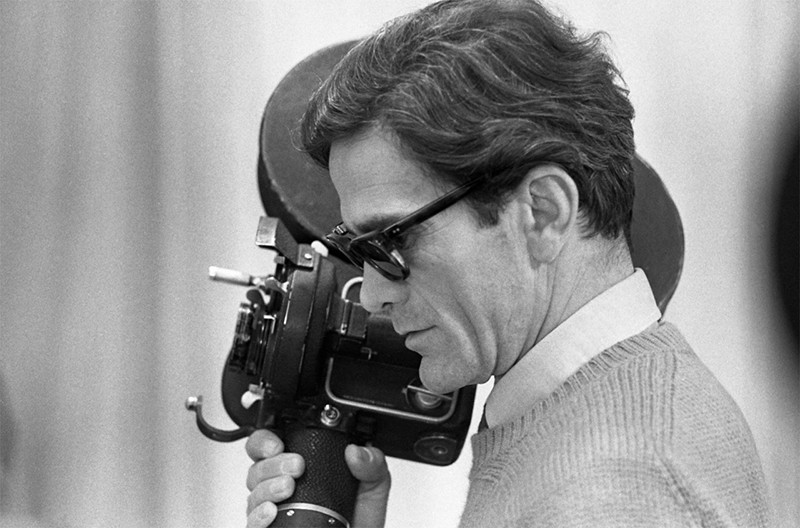
Pier Paolo Pasolini was not simply a film director who also wrote books. He was a poet, novelist, essayist, screenwriter, playwright, critic, actor and political provocateur who moved constantly between different forms of expression. Few figures reveal the conflicts of postwar Italy as vividly as Pasolini: Catholic imagery and Marxist thought, rural tradition and industrial modernity, intellectual privilege and the lives of the poor, sexual freedom and social persecution.
His films made him internationally famous, but Pasolini considered poetry central to his identity. His novels transformed the speech and experiences of Rome’s neglected outskirts into literature. His newspaper essays attacked consumerism, political corruption and cultural conformity with a vehemence that disturbed both conservatives and the institutional left.
His murder at Ostia in 1975 brought his career to a brutal end. Although a young man was convicted, important aspects of the crime remain disputed. The unanswered questions surrounding his death have sometimes overshadowed the complexity of his work. Pasolini’s lasting importance, however, rests not on the mystery of his final hours but on his uncompromising attempt to understand how power reshapes language, bodies, communities and desire.
Childhood Between Bologna and Friuli
Pier Paolo Pasolini was born in Bologna on March 5, 1922. His father, Carlo Alberto Pasolini, was an army officer, while his mother, Susanna Colussi, came from Casarsa della Delizia in Friuli. Because of his father’s military career, the family moved frequently during Pasolini’s childhood, living in several northern Italian towns.
Casarsa became his emotional homeland. Its countryside, farming culture and Friulian language represented a world that he would later idealize as more authentic and less corrupted than modern urban society. His bond with his mother was exceptionally strong, while his relationship with his authoritarian father was far more difficult.
Pasolini studied literature at the University of Bologna, where he encountered art history, philology, contemporary poetry and the city’s lively intellectual culture. He graduated in 1945 with a thesis on Giovanni Pascoli. His visual education—particularly his interest in medieval, Renaissance and Mannerist painting—would later shape the composition of his films.
The Second World War deeply marked the family. Pasolini’s younger brother Guido joined the anti-fascist Resistance but was killed in February 1945 during the Porzûs massacre, in which communist partisans attacked members of the predominantly Catholic Osoppo Brigade. Guido’s death left Pasolini with a permanent sense of grief and complicated his relationship with organized communism.
The Discovery of Friulian Poetry
Pasolini’s first important publication was Poesie a Casarsa, issued at his own expense in 1942. The poems were written in Friulian rather than standard Italian. This was an artistic and political choice: he treated a local language, associated primarily with rural and oral culture, as a vehicle for serious modern poetry.
In Pasolini’s early work, Friuli appears as a place of innocence, physical beauty and sacred attachment to the land. Yet this was never straightforward nostalgia. The poems are shadowed by mortality, sexuality, religious longing and the knowledge that the traditional society they describe is disappearing.
In 1945, Pasolini and other Friulian writers founded the Academiuta di lenga furlana, an association devoted to Friulian language and poetry. His early collections were later reworked in La meglio gioventù in 1954. Shortly before his death, he revisited and radically altered these poems for La nuova gioventù, published in 1975. The later versions are darker, as though the hopeful rural world of his youth had been destroyed by history.
Pasolini continued to write poetry throughout his life. Le ceneri di Gramsci (The Ashes of Gramsci, 1957), one of his most important collections, places personal confession inside the political and historical landscape of postwar Italy. In the title poem, written around the grave of Marxist thinker Antonio Gramsci in Rome, Pasolini confronts the contradiction between his intellectual commitment to Marxism and his emotional attraction to older, pre-bourgeois ways of life.
Later collections—including La religione del mio tempo, Poesia in forma di rosa and Trasumanar e organizzar—became increasingly argumentative and autobiographical. His poetry could be lyrical, polemical, prophetic and deliberately uncomfortable. It offered a space in which he could expose contradictions that neither political ideology nor conventional autobiography could resolve.
Political Commitment, Persecution and Exile from Friuli
After the war, Pasolini worked as a teacher and became active in the Italian Communist Party. He was strongly committed to improving the conditions of agricultural workers, yet he never became a predictable party intellectual.
In 1949, he was accused of offences following a sexual encounter involving local youths. The episode led to his dismissal from teaching and expulsion from the Communist Party for what it called “moral and political unworthiness.” The legal history was complex, and some of the accusations were eventually dismissed or overturned, but the social damage was immediate.
The affair should be understood within the intensely conservative climate of postwar provincial Italy, where homosexuality was heavily stigmatized even when it was not explicitly prohibited by national law. Pasolini did not conceal his attraction to men, and his sexuality remained central to the public hostility directed at him.
In January 1950, Pasolini and his mother left Friuli for Rome. They arrived with little money and initially lived in difficult conditions. The move was both a painful exile and the beginning of the period that would establish him as a major Italian writer.
Rome and the Novels of the Borgate
Pasolini became fascinated by the borgate, the impoverished settlements on Rome’s expanding outskirts. These districts were inhabited by migrants, casual laborers, unemployed families and young people surviving through informal work, theft, prostitution and small-scale crime.
Rather than observing this world from a distance, Pasolini immersed himself in its language and social rhythms. He studied Roman dialect and slang, forming friendships that helped him understand communities largely excluded from official representations of Italy’s postwar recovery.
That experience produced Ragazzi di vita in 1955. Published in English as The Street Kids, the novel follows a shifting group of boys through the neglected edges of Rome. It does not offer a conventional hero or moral transformation. Instead, it presents fragmented episodes of hunger, companionship, cruelty, sexuality and survival.
Its use of Roman dialect was as important as its subject matter. Pasolini allowed his characters’ speech to reshape literary narration, refusing to translate their lives into polished middle-class Italian. The book attracted critical attention and commercial success, but it was also seized and prosecuted for alleged obscenity. Pasolini and his publisher were acquitted in 1956.
His second major Roman novel, Una vita violenta (A Violent Life, 1959), follows Tommaso Puzzilli, a young man whose brutal existence in the suburbs gradually acquires a political dimension. The novel is more conventionally structured than Ragazzi di vita, but it preserves Pasolini’s mixture of documentary observation, linguistic experimentation and tragic compassion.
These novels remain controversial. Some critics see them as giving literary visibility to people ignored by respectable society. Others question whether Pasolini idealized poverty or transformed marginalized young men into objects of aesthetic and erotic fascination. That tension is real, and it forms part of the continuing debate around his work.
Readers interested in the period can place these novels alongside Italia Mia’s history of Italian Neorealism and its broader guide to Italian cinema.
From Screenwriter to Film Director
During the 1950s, Pasolini entered the Italian film industry as a screenwriter and dialogue writer. His knowledge of Roman dialect made him especially valuable to directors portraying working-class life. He contributed to films by Mario Soldati, Mauro Bolognini and Federico Fellini, among others.
His relationship with cinema was initially practical, but he soon recognized that film could establish a more direct relationship with physical reality than literature. Pasolini did not receive conventional technical training. Instead, he developed a visual language influenced by painting, silent cinema, religious art, music and his own experience as a poet.
His directorial debut, Accattone (1961), returned to the Roman underclass. The protagonist is a pimp who survives by exploiting others yet remains trapped within the same poverty and violence. Pasolini filmed streets, wastelands and faces with an austere, almost sacred intensity, while Bach’s music gives Accattone’s degradation the emotional scale of a religious passion.
Mamma Roma (1962) starred Anna Magnani as a former sex worker trying to create a respectable future for her son. The film examines the cruel promise of social advancement: Mamma Roma believes she can escape her past, but the structures surrounding her make that escape nearly impossible.
Pasolini’s first films emerged from the legacy of Neorealism, especially through their locations and nonprofessional actors. Yet their frontal compositions, heightened music and references to religious painting moved beyond Neorealist observation. Poverty was not presented solely as a social problem; it became part of a tragic and symbolic world.
Religion, Marxism and The Gospel According to Matthew
Religion occupied a paradoxical position in Pasolini’s life. He was not an orthodox Catholic, and he repeatedly criticized the Church as an institution of political and social power. Nevertheless, Christian imagery, sacrifice, prophecy and the sacred appeared throughout his poetry and cinema.
His short film La ricotta (1963), starring Orson Welles as a director making a film about the Crucifixion, contrasts the artificial grandeur of a biblical production with the hunger of a poor film extra. The film led to Pasolini’s conviction for insulting the state religion, though the verdict was later overturned.
Pasolini’s religious masterpiece was Il Vangelo secondo Matteo (The Gospel According to Matthew, 1964). Filmed principally in southern Italy, including Matera, it follows the text of Matthew with unusual fidelity. Pasolini’s Christ is both spiritual and revolutionary: stern, urgent and aligned with the poor.
The casting combined nonprofessional performers with Pasolini’s own friends and family. His mother played the older Mary. The soundtrack moved freely between Bach, Mozart, spirituals and non-Western music.
Although made by a Marxist director with a deeply conflicted relationship to Catholicism, the film was praised by many religious viewers and received the Special Jury Prize at the Venice Film Festival. Its power comes from refusing to reduce Christ either to Church tradition or political allegory.
Fables, Myths and the “Cinema of Poetry”
In Uccellacci e uccellini (The Hawks and the Sparrows, 1966), Pasolini paired the beloved comic actor Totò with Ninetto Davoli, who became one of his most recognizable performers and a major figure in his personal life. Accompanied by a talking Marxist crow, the characters wander through a comic fable about faith, class and the uncertain future of communism.
Pasolini described a “cinema of poetry” in which the camera does not disappear behind conventional storytelling. Images, editing, performance and visual references draw attention to the filmmaker’s subjective presence.
His adaptations of classical myth allowed him to explore identity, family and power outside realistic narrative. Edipo re (Oedipus Rex, 1967) combines ancient tragedy with autobiographical and psychoanalytic elements. Medea (1969), starring opera singer Maria Callas in her only dramatic film role, presents a confrontation between an archaic sacred culture and a rational, expansionist civilization.
In Teorema (1968), a mysterious visitor enters the home of a wealthy Milanese family and forms an intimate relationship with each member. After his departure, the family’s identities collapse. The film and accompanying novel attack the emptiness of bourgeois existence, yet their religious symbolism prevents any purely political interpretation.
Porcile (Pigsty, 1969) combines two stories of rebellion, appetite and social repression. Its extremity reflects Pasolini’s growing belief that modern power no longer operated only through police, governments and laws. It also worked through consumption, desire and the apparent freedom offered by modern society.
The Trilogy of Life
In the early 1970s, Pasolini created three films celebrating storytelling, physicality and popular culture: Il Decameron (1971), I racconti di Canterbury (The Canterbury Tales, 1972) and Il fiore delle Mille e una notte (Arabian Nights, 1974).
Known collectively as the Trilogy of Life, these films draw on Boccaccio, Chaucer and the One Thousand and One Nights. They reject prudishness and present sexuality as comic, imperfect and connected to ordinary life. Pasolini traveled widely and cast many nonprofessional actors, creating worlds that feel simultaneously historical, mythical and immediate.
The trilogy was internationally successful, but its commercial reception troubled him. Numerous imitations reduced its celebration of the body to a profitable formula. Pasolini eventually “abjured” the trilogy—not necessarily because he rejected the films themselves, but because he believed consumer culture had absorbed and falsified the sexual freedom they represented.
For a closer examination of the three films, see Italia Mia’s guide to Pasolini’s Trilogy of Life.
Politics, Consumerism and the “Corsair” Essays
Pasolini remained a man of the left, but his politics resisted party discipline. He attacked Christian Democratic power, neo-fascism, television, advertising, institutional education and the failures of the Communist Party. He also provoked other left-wing intellectuals by questioning their assumptions about progress.
After the 1968 clashes between students and police at Valle Giulia in Rome, Pasolini wrote Il PCI ai giovani!! The poem was frequently summarized as support for the police against student protesters. His argument was more complicated, though still intentionally provocative: he portrayed many policemen as working-class young men and many university students as members of the privileged bourgeoisie. The poem challenged the students’ class position rather than simply endorsing police repression.
During the 1970s, Pasolini became a prominent newspaper commentator. Essays later collected in Scritti corsari (Corsair Writings) and Lettere luterane (Lutheran Letters) denounced what he called the homogenizing force of consumerism.
He believed industrial capitalism and mass media were destroying dialects, local cultures, rural knowledge and distinct working-class identities. In his view, consumer society achieved a form of cultural conformity more pervasive than historical Fascism because people participated willingly in it.
Some of Pasolini’s positions remain highly contentious. He opposed the liberalization of abortion, for example, using arguments that alienated much of the feminist and progressive left. His descriptions of social groups could be sweeping, and his longing for pre-industrial cultures sometimes became romantic or paternalistic.
Yet his essays continue to be read because they identify problems that have not disappeared: concentrated media power, the commercialization of private life, ecological destruction and the replacement of cultural differences by standardized consumer behavior.
In his famous 1974 newspaper article commonly known as Io so—“I know”—Pasolini wrote that he knew the names of those responsible for political violence and manipulation in Italy, while acknowledging that he lacked the evidence required to prove his accusations in court. The article was a moral and political indictment, not a documented confession of secret knowledge. Later attempts to connect it directly to his murder remain speculative.
Petrolio and the Unfinished Investigation of Power
At the time of his death, Pasolini was working on Petrolio, an enormous experimental novel that remained unfinished and was published posthumously in 1992.
The book’s central figure, Carlo, is divided into multiple identities. Through fragments, notes, visions, political references and explicit sexual episodes, Pasolini examines industry, energy, state power, neo-fascism and the transformation of Italy.
Because Petrolio refers to subjects connected with political and corporate power, it has frequently been incorporated into theories about Pasolini’s death. It is legitimate to study the novel alongside the political tensions of the period, but there is no conclusive evidence that Pasolini was murdered because of information contained in the manuscript.
Petrolio is best understood as the culmination of his late style: deliberately unfinished, unstable and resistant to the boundaries between fiction, essay, investigation and autobiography.
Salò and the Representation of Absolute Power
Pasolini’s final film, Salò o le 120 giornate di Sodoma (Salò, or the 120 Days of Sodom), transposes the Marquis de Sade’s novel to the Italian Social Republic, the Nazi-backed Fascist state established in northern Italy between 1943 and 1945.
In an isolated villa, four representatives of political and social authority imprison a group of young people and subject them to ritualized humiliation, sexual violence and murder. The film is extraordinarily difficult to watch, but its violence is organized rather than chaotic. Bodies are treated as objects to be classified, consumed and destroyed.
Salò is therefore not merely a film about historical Fascism. It presents Pasolini’s darkest vision of modern power: a system in which domination invades the body and transforms human beings into commodities. The perpetrators observe suffering with bureaucratic detachment, anticipating the mediated distance through which violence is often consumed.
Released after Pasolini’s death, the film was banned or restricted in several countries and remains controversial. Its purpose is not to provide erotic spectacle but to make the spectator confront the relationship between power, voyeurism and complicity.
Controversies, Censorship and Contradictions
Pasolini spent much of his career under attack. Books and films were seized, and he repeatedly faced accusations involving obscenity, religion and public morality. Some cases ended in acquittal; others produced convictions later reversed. These proceedings reflected both the provocative nature of his work and the restrictive cultural climate of postwar Italy.
He was targeted not only for what he created but also for who he was: a gay man whose private life was routinely exposed and politicized. Homophobic stereotypes influenced press coverage during his lifetime and shaped some early accounts of his death.
At the same time, an authoritative assessment should not turn Pasolini into a flawless prophet. His representations of women, Africa, the Arab world and impoverished young men have generated serious criticism. His polemics sometimes relied on generalization, and his rejection of modernity could overlook the hardship and inequality embedded in the traditional cultures he mourned.
These contradictions are not incidental to his legacy. They are part of what makes Pasolini intellectually demanding. He repeatedly placed himself inside the conflicts he analyzed rather than claiming a position of moral purity.
The Murder at Ostia
During the night of November 1–2, 1975, Pasolini was killed at the Idroscalo di Ostia, on the coast outside Rome. He had been severely beaten and run over by his own Alfa Romeo. He was 53 years old.
Seventeen-year-old Giuseppe “Pino” Pelosi was arrested while driving Pasolini’s car. Pelosi confessed and was convicted of murder. The first-instance court found him guilty of committing the crime “in collaboration with unknown persons,” reflecting doubts that one individual could have inflicted all the injuries and produced the physical evidence found at the scene.
The reference to unidentified accomplices was removed on appeal, and Pelosi’s conviction was ultimately confirmed. Decades later, after serving his sentence, Pelosi retracted his confession and claimed that other men had killed Pasolini. His revised account intensified calls for a new investigation but did not establish a definitive alternative version of events.
Forensic reviews, witness claims and inconsistencies in the original investigation have sustained doubts about whether Pelosi acted alone. Proposed explanations have included a homophobic assault, organized crime, political retaliation and a trap involving stolen reels from Salò. None of these theories has been conclusively proven in court.
It is therefore inaccurate either to declare the murder fully solved or to present a political conspiracy as established fact. The judicial record confirms Pelosi’s conviction; it does not resolve every question raised by the evidence and subsequent testimony.
Pasolini’s death occurred during Italy’s Years of Lead, a period marked by terrorism, political violence, secret networks and institutional distrust. That context helps explain why suspicions persist, but historical context is not itself proof of a particular murder plot.
Pasolini’s Legacy
Pasolini’s influence extends far beyond Italian cinema. Filmmakers, writers, artists and political theorists continue to engage with his combination of realism, sacred imagery, sexuality, linguistic experimentation and criticism of consumer society.
His films helped establish a visual language in which the faces of nonprofessional actors could carry the gravity of religious painting. His novels preserved forms of Roman speech excluded from conventional literature. His Friulian poetry demonstrated how a minority language could become a vehicle for modern artistic expression. His essays anticipated debates about globalization, television, cultural homogenization and the commercialization of identity.
Pasolini belongs within the larger history of Italy’s influential postwar film directors, but he cannot be contained within cinema history. He matters because he refused to separate artistic form from political responsibility.
His predictions were not always correct, and his provocations were not always fair. Nevertheless, his work continues to challenge audiences because it does not offer comforting solutions. Pasolini asked what is lost when a society becomes wealthier but more culturally uniform, when freedom becomes indistinguishable from consumption and when images no longer reveal reality but help power reorganize it.
Places Connected with Pasolini
Bologna: Pasolini’s birthplace and university city remains essential to understanding his intellectual formation. The Cineteca di Bologna maintains an important Pasolini archive and has restored and redistributed much of his cinema.
Casarsa della Delizia: Casa Colussi, the maternal family home, now houses the Centro Studi Pier Paolo Pasolini. It preserves books, manuscripts, photographs and materials connected with his Friulian years.
Rome: Pasolini’s adopted city appears throughout his novels, essays and early films. Rebibbia, Monteverde, Pigneto, Testaccio, the Roman outskirts and other locations reveal the changing city that shaped his work. Casa Pasolini in Rebibbia is now open as a cultural space dedicated to his memory.
Matera: The ancient landscape of Matera provided some of the most recognizable settings for The Gospel According to Matthew.
Ostia: The site where Pasolini’s body was found has become the Parco Letterario Pier Paolo Pasolini, a place of remembrance near the Idroscalo.
Recommended Books
The Selected Poetry of Pier Paolo Pasolini: A Bilingual Edition
Edited and translated by Stephen Sartarelli, this substantial bilingual collection introduces English-language readers to Pasolini’s poetry from across his career, including the Friulian poems and later political work.
View the book on Amazon.com
The Street Kids
Ann Goldstein’s English translation of Ragazzi di vita captures Pasolini’s fragmented portrait of young people surviving in the impoverished outskirts of postwar Rome.
View the book on Amazon.com
Pasolini Requiem: Second Edition
Barth David Schwartz’s extensive biography draws on interviews with Pasolini’s friends, collaborators, admirers and opponents. It remains one of the most detailed English-language accounts of his life.
View the book on Amazon.com
External Links
- Pier Paolo Pasolini – Treccani
- Pier Paolo Pasolini – University of Bologna
- Centro Studi Pier Paolo Pasolini in Casarsa
- Centro Studi–Archivio Pasolini at the Cineteca di Bologna
- Pier Paolo Pasolini – National Central Library of Rome
- Casa Pasolini in Rome
- Pasolini’s Rome: Locations and Memorial Sites
- Court Documents from the Pelosi Murder Proceedings