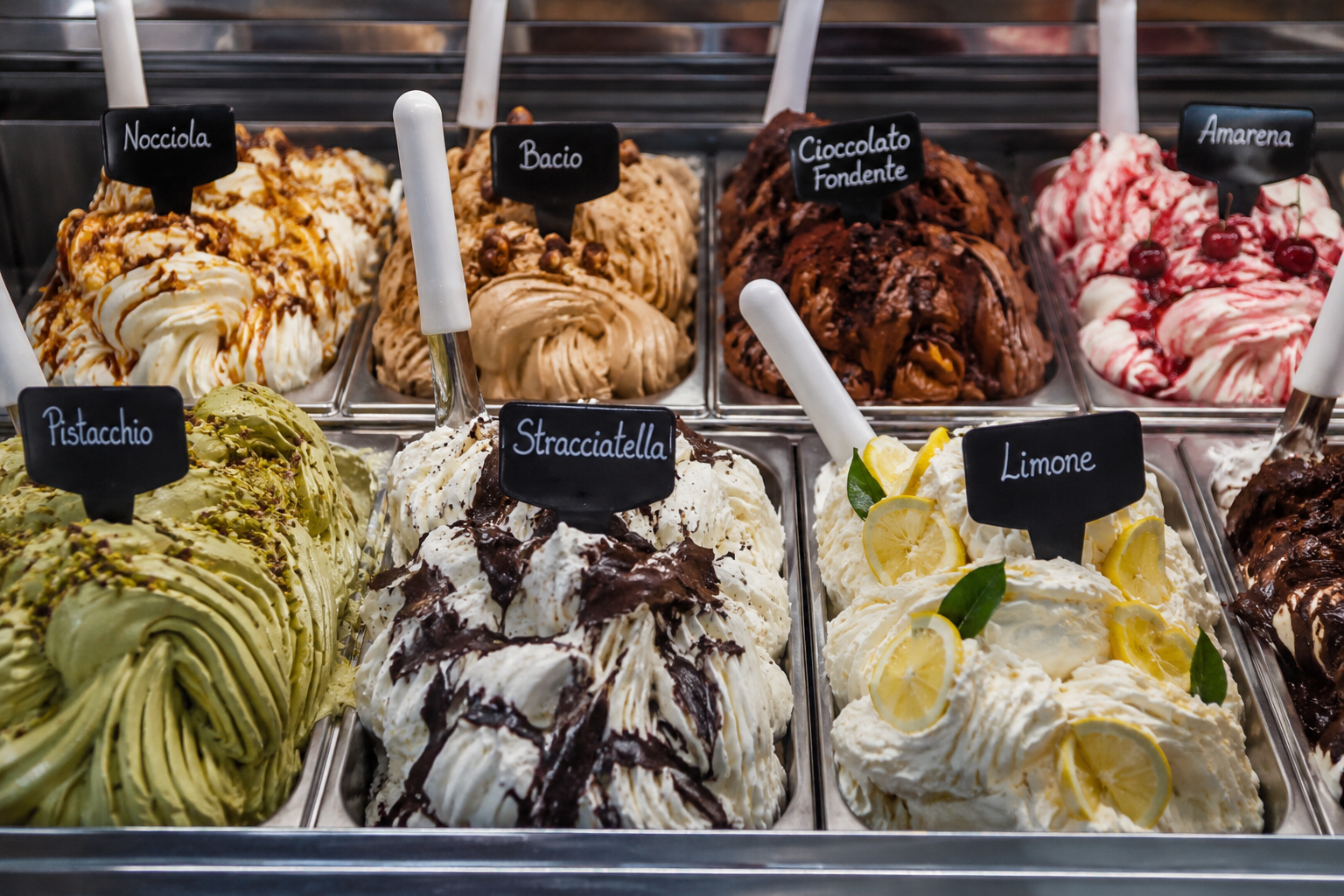
Few foods capture the pleasure of everyday life in Italy as perfectly as gelato. A small cup of pistachio and hazelnut, a cone of creamy stracciatella, or a refreshing lemon sorbet on a hot afternoon can be as memorable as a restaurant meal.
Yet authentic Italian gelato is much more than ordinary ice cream with an Italian name. Its history stretches across centuries, from early frozen desserts and Renaissance experiments to the artisan gelaterie found throughout Italy today.
Every region contributes something different. Piedmont brings hazelnuts and chocolate, Tuscany preserves its famous cream-based flavors, Campania offers fragrant citrus, and Sicily celebrates pistachios, almonds, granita, and brioche.
This guide explores the history of Italian gelato, what distinguishes it from ice cream, regional specialties, classic and unusual flavors, and how to find a genuinely good gelateria in Italy.
What Is Authentic Italian Gelato?
Gelato is the Italian word for ice cream, but in everyday culinary use it also describes a particular approach to preparing and serving frozen desserts.
Traditional Italian gelato is made by combining ingredients such as milk, cream, sugar, fruit, nuts, chocolate, and sometimes eggs. The mixture is carefully balanced, frozen, and churned to achieve a smooth texture.
The process is called mantecazione. During this stage, the mixture freezes while incorporating air. The balance of water, sugars, fats, and air determines its consistency.
A well-made gelato should have a smooth texture and clearly identifiable flavor. Hazelnut should taste of roasted hazelnuts, pistachio should taste of pistachios, and strawberry should retain the natural freshness of the fruit.
Not all gelato contains dairy. Fruit-based sorbets can be made with water, sugar, and fruit, while contemporary gelaterie increasingly offer additional plant-based options.
What matters most is the quality of the ingredients, the recipe, and the skill of the person making it.
The History of Italian Gelato: From Ancient Snow to Renaissance Florence
Frozen desserts before modern gelato
The idea of cooling sweetened drinks and food with snow or ice is far older than Italy’s modern gelato tradition.
Ancient civilizations used stored snow and ice to cool beverages and prepare refreshments. Greek and Roman writers describe practices involving snow, honey, fruit, and flavored drinks.
Stories about the emperor Nero ordering snow from the mountains are frequently repeated in popular histories. However, these accounts should not be confused with evidence that the Romans invented modern gelato.
The ingredients, technology, and textures were very different.
A particularly important stage in the development of frozen desserts took place in Sicily.
During the period of Islamic rule in Sicily, beginning in the ninth century, the island became part of a Mediterranean world in which sugar cultivation, citrus fruits, flavored syrups, and sophisticated food traditions circulated widely.
These influences contributed to the development of Sicilian sorbets and granita.
Before mechanical refrigeration, snow and ice could be stored in insulated underground structures known as neviere. Mountain ice made it possible to prepare cooling refreshments even during warmer weather.
Florence and Bernardo Buontalenti
Florence occupies a special place in gelato history.
During the Renaissance, wealthy courts sponsored elaborate banquets, and cooks experimented with chilled desserts, dairy products, fruit, spices, and sugar.
One of the figures traditionally associated with the development of creamy frozen desserts is Bernardo Buontalenti (1531–1608).
Buontalenti was an architect, engineer, and stage designer who worked for the Medici court. According to Florentine tradition, he helped develop a rich frozen preparation using ingredients such as milk, eggs, honey, and aromatic flavorings.
He is often described as the inventor of gelato. However, that claim is too absolute.
Frozen desserts existed long before Buontalenti, and historians cannot attribute the invention of modern gelato to a single person with certainty.
His importance lies in the Florentine tradition of developing more elaborate, creamy frozen desserts and improving the techniques used to prepare them.
The association survives in the flavor Buontalenti, a rich cream gelato still found in Florence.
From Italy to Paris: Procopio dei Coltelli
Another important name is Francesco Procopio dei Coltelli, a Sicilian entrepreneur associated with the famous Café Procope in Paris.
Founded in 1686, the café helped popularize frozen desserts among the French public.
Italian confectioners and entrepreneurs played a significant role in bringing these preparations to other European cities.
Over the following centuries, the development of refrigeration and mechanical freezing equipment gradually made gelato more accessible.
What had once been a luxury associated with courts and wealthy households became an everyday pleasure.
The modern artisan gelateria
The twentieth century transformed gelato production.
Improved refrigeration, pasteurization, and specialized machinery allowed gelatieri to produce consistent frozen desserts in shops throughout Italy.
Today, training combines traditional recipes with a technical understanding of temperature, ingredients, and food safety.
One fascinating place to explore this history is the Carpigiani Gelato Museum, near Bologna. Its exhibits document the technology, machines, and people responsible for gelato’s evolution.
Italian Gelato vs. Ice Cream: What Is the Difference?
Although the terms overlap, Italian-style gelato and typical American-style ice cream often differ in several important ways.
Fat content
Many traditional milk-based gelato recipes use proportionally more milk and less cream than American-style ice cream.
As a result, they often contain less milk fat.
However, exact percentages depend on the recipe. Chocolate, custard, nut-based, and especially rich cream gelati can contain considerably more fat than simple fruit preparations.
Gelato is not automatically a low-fat dessert.
Air and density
During freezing, air becomes incorporated into the mixture.
Many commercial ice creams are made with relatively high levels of incorporated air, known as overrun. Artisan gelato typically uses less air, creating a denser texture.
That density helps flavors appear concentrated and gives gelato its characteristic mouthfeel.
Serving temperature
Gelato is commonly served at a somewhat warmer temperature than hard-packed ice cream.
At the right serving temperature, the texture becomes softer and the ingredients release more aroma.
This is why well-made gelato can feel especially creamy even when its recipe contains relatively little cream.
Flavor
The finest gelato emphasizes the primary ingredient.
A good pistachio gelato should have the characteristic richness and slight bitterness of the nuts. Chocolate gelato should taste unmistakably of cocoa, while lemon sorbet should balance acidity and sweetness.
Quality comes from the recipe and ingredients, not merely from being made in Italy.
Regional Gelato Traditions Across Italy
Italy’s regional food identities are as important to gelato as they are to pasta, cheeses, and traditional pastries.
Not every region has a completely different type of gelato. Nevertheless, local ingredients and dessert traditions create distinctive combinations.
Piedmont and Turin: Hazelnuts, chocolate, and gianduia
Piedmont is one of Italy’s great chocolate-producing regions, and Turin has a long confectionery tradition.
The region is particularly associated with hazelnuts, including the celebrated Nocciola Piemonte IGP.
Two essential flavors are:
- Nocciola: Smooth, aromatic hazelnut gelato, ideally with a natural roasted-nut flavor.
- Gianduia: A rich combination of chocolate and hazelnut, inspired by Piedmont’s famous confectionery tradition.
Other flavors include dark chocolate, bacio, coffee, and marron glacé, made with candied chestnuts.
For anyone who loves chocolate and nuts, Turin is an especially rewarding place to explore gelato.
Bergamo and Lombardy: The invention of stracciatella
One of Italy’s most internationally recognized gelato flavors originated in Bergamo.
In 1961, Enrico Panattoni created stracciatella at La Marianna, his establishment in Bergamo Alta.
The idea was ingenious: pour warm melted dark chocolate into cold fior di latte gelato during churning.
The chocolate immediately solidifies and breaks into irregular, delicate fragments.
The name comes from the Italian verb stracciare, meaning to tear into pieces, and recalls the appearance of the traditional egg-drop soup known as stracciatella alla romana.
What began as one gelatiere’s experiment became a worldwide favorite.
Veneto and Venice: Coffee, custard, and international influences
Venice’s history as a trading city helped establish its relationship with spices, sugar, and imported ingredients.
Today, Venetian gelaterie offer traditional flavors alongside inventive combinations.
Classics worth trying include coffee, chocolate, amarena cherry, and zabaglione.
Zabaglione is especially interesting because it draws on the traditional Italian dessert made with egg yolks, sugar, and wine, frequently Marsala.
Tiramisù-flavored gelato is another popular modern choice. It combines elements of the celebrated dessert associated with northeastern Italy.
Discover more in our guide to Tiramisù: History, Original Recipe and Italian Variations.
Emilia-Romagna: Gelato craftsmanship and innovation
Emilia-Romagna has become an important center for gelato technology, training, and professional expertise.
Around Bologna, modern gelato education continues to develop techniques that combine culinary craftsmanship with scientific precision.
The region’s gelaterie offer traditional cream, chocolate, and fruit flavors, alongside creations using local ingredients.
Mascarpone, seasonal fruit, and custard-based flavors are particularly attractive choices.
Experimental producers sometimes work with unusual ingredients, including cheeses, herbs, and other savory foods.
Such flavors are modern interpretations, not necessarily ancient regional traditions.
Tuscany and Florence: Crema Fiorentina and Buontalenti
Florence remains closely associated with the history of creamy gelato.
Traditional flavors include crema Fiorentina, fior di latte, and Buontalenti.
Fior di latte is a particularly useful test of a gelateria’s craftsmanship.
Because it has a relatively simple milk-based flavor, there is little room to hide poor ingredients or an unbalanced recipe.
Some Tuscan gelaterie also experiment with local honey, figs, chestnuts, ricotta, and flavors inspired by desserts such as cantucci or panforte.
In Siena and the surrounding countryside, these combinations can be an appealing way to connect gelato with local pastry traditions.
Rome and Lazio: From classics to contemporary flavors
Rome offers an enormous variety of gelato, from traditional neighborhood shops to highly experimental producers.
The classic combinations remain excellent: chocolate and hazelnut, pistachio and fior di latte, or lemon and strawberry.
Modern Roman gelaterie may also offer combinations featuring figs, ricotta, honey, herbs, and seasonal fruit.
Rome is a good place to compare traditional recipes with contemporary interpretations.
Look beyond the most crowded tourist streets and explore residential neighborhoods, where a gelateria often serves regular local customers.
Campania and Naples: Citrus, coffee, and chocolate
Campania’s landscape provides wonderful ingredients for frozen desserts.
The region is famous for fragrant lemons, particularly those associated with the Amalfi Coast and Sorrento.
Lemon sorbet is an obvious choice, especially during warm weather.
Other flavors worth looking for include espresso, dark chocolate, walnut, and fig.
Some gelaterie also experiment with buffalo milk, producing rich and distinctive dairy-based flavors.
Naples has a particularly strong chocolate and pastry tradition. It is therefore an excellent destination for gelato that draws on both.
Readers planning a food-focused visit may also enjoy our guide to Italy’s most iconic dishes.
Puglia: Almonds, figs, and olive oil
Puglia’s excellent agricultural ingredients naturally inspire gelato makers.
Almonds, figs, lemons, and other citrus fruits appear in both traditional sweets and contemporary frozen desserts.
Olive oil gelato is a particularly interesting modern creation. Good extra virgin olive oil contributes a fruity, sometimes gently peppery aroma and a silky texture.
It can be excellent with lemon, vanilla, or dark chocolate.
These flavors reflect the same regional ingredients that define Puglia’s food culture, from Bari to Salento.
Sicily: Pistachios, almonds, and granita
Sicily has one of Italy’s richest frozen-dessert traditions.
Pistachio is perhaps its most famous gelato flavor.
The protected designation Pistacchio Verde di Bronte DOP identifies pistachios produced according to specific rules in a defined area near Mount Etna. Not every gelato labeled Sicilian pistachio uses these certified nuts, so ingredient descriptions matter.
Almond, lemon, blood orange, fig, and mulberry are other important flavors.
Sicilian gelaterie may also offer jasmine or combinations inspired by local pastries and traditional sweets.
Then there is the distinctive custom of eating gelato inside a soft brioche, often called brioche col tuppo.
For a visitor accustomed to gelato in a cone, this can be a revelation.
Sicily is equally famous for granita, often accompanied by brioche at breakfast.
Although granita is not the same as gelato, it belongs to the island’s remarkable frozen-dessert culture.
Sardinia: Honey, myrtle, and local ingredients
Sardinian gelato makers can draw on the island’s distinctive food traditions.
Honey, citrus, local nuts, and herbs lend themselves to interesting combinations.
Some contemporary gelaterie experiment with myrtle or flavors inspired by Sardinian cheeses and pastries.
These are specialties to discover rather than universal flavors available in every shop.
Italy’s Most Popular Gelato Flavors
A good gelateria will normally offer familiar classics alongside seasonal specialties.
Here are some essential flavors to know.
- Pistacchio: Rich pistachio gelato, with a natural nutty flavor and a color that can range from beige to muted green.
- Nocciola: Roasted hazelnut, particularly associated with Piedmont.
- Stracciatella: Milk-based gelato containing thin, irregular flakes of dark chocolate.
- Fior di latte: A simple, creamy milk flavor.
- Crema: Italian custard-style gelato, often prepared with eggs.
- Cioccolato fondente: Intense dark chocolate, sometimes made without milk, depending on the recipe.
- Limone: Refreshing lemon, frequently prepared as a water-based sorbet.
- Caffè: Coffee gelato, inspired by Italy’s espresso tradition.
- Amarena: Creamy gelato with sour-cherry sauce or fruit.
- Gianduia: Chocolate and hazelnut, a Piedmontese classic.
- Zabaglione: A rich dessert-inspired flavor, sometimes containing Marsala wine.
- Tiramisù: Coffee, cocoa, and creamy ingredients inspired by the famous dessert.
- Ricotta e fichi: Ricotta and figs, a combination particularly appealing when fresh figs are in season.
- Mandorla: Almond gelato, especially popular in southern Italy.
- Fragola: Strawberry, a good choice when made with ripe seasonal fruit.
Some of these flavors contain milk, eggs, nuts, or alcohol. Always ask if an ingredient matters for dietary, allergy, or personal reasons.
For another look at Italy’s great sweets, read A Short Guide to Italian Desserts.
Unusual Italian Gelato Flavors Worth Trying
Italian gelato is rooted in tradition, but experimentation is also part of its identity.
Contemporary gelatieri frequently develop flavors that would have surprised earlier generations.
Olive oil: A beautifully balanced extra virgin olive oil gelato can be delicate, fruity, and surprisingly elegant. It is particularly good alongside citrus or chocolate.
Gorgonzola: A sweet-and-savory experiment using the famous blue cheese. The result is rich, slightly salty, and distinctly unconventional.
Lavender: Floral and aromatic, especially when used with restraint. Too much lavender can easily overpower the other ingredients.
Black sesame: A nutty, toasted flavor inspired by Asian culinary traditions. It appears in some contemporary Italian gelaterie, although it is not a traditional Italian specialty.
Basil and lemon: A refreshing combination that brings the perfume of fresh herbs to citrus sorbet.
Ricotta, honey, and fig: A combination inspired by familiar Italian ingredients, balancing creaminess with fruit and floral sweetness.
Chestnut: Especially appealing in autumn, when chestnut-based sweets appear in many Italian regions.
The most successful unusual flavors are not necessarily the strangest ones.
A good gelatiere should make an interesting ingredient enjoyable without allowing novelty to become more important than taste.
How to Recognize Authentic Artisan Gelato
Not every attractive gelateria serves excellent gelato.
Some shops produce their gelato from carefully selected ingredients in small batches. Others rely heavily on ready-made mixtures, industrial preparations, or products made elsewhere.
The distinction is not always obvious from the display.
Nevertheless, there are several useful signs to look for.
1. Pay attention to color
Natural ingredients rarely produce fluorescent colors.
Pistachio gelato is not normally bright emerald green. Its color may be muted green, olive, beige, or brownish, depending on the ingredients.
Banana gelato made from ripe fruit is not necessarily vivid yellow.
Similarly, natural strawberry gelato may vary in color according to the fruit and recipe.
Bright colors are not definitive proof of poor quality, but they can be a reason to look more closely.
2. Be cautious of enormous displays
Towering mountains of gelato look spectacular in photographs.
However, impressive height does not guarantee freshness or craftsmanship.
Air incorporation, recipe stabilizers, temperature, and display practices can all influence the product’s appearance.
A modest display with carefully maintained gelato may be a better sign than a dramatic arrangement designed primarily to attract passing tourists.
3. Look for covered metal containers
Some traditional gelaterie store their gelato in round metal containers called pozzetti.
These containers are often covered, helping maintain a stable temperature and protecting the product from exposure.
Pozzetti are a positive sign, but they are not proof of quality.
Excellent gelato can also be displayed in conventional trays.
What matters is the product, not the container alone.
4. Check the ingredients
A good gelateria should be able to explain what goes into its gelato.
Ask whether the pistachio is made with pistachio paste, whether a fruit flavor contains milk, or whether a particular recipe includes eggs.
Transparent ingredient information is important.
It also helps customers identify allergens and make informed choices.
5. Look for seasonal flavors
A gelateria that changes flavors throughout the year may be paying attention to seasonal produce.
Spring can bring strawberries.
Summer is ideal for peaches, apricots, berries, and fresh figs.
Autumn offers chestnuts, pears, and persimmons.
Not every flavor needs to be seasonal. Chocolate, hazelnut, and fior di latte are wonderful throughout the year.
The important point is that seasonal offerings can reveal how closely the gelateria works with its ingredients.
6. Judge the texture
Good gelato should be smooth and pleasant to eat at the correct temperature.
It should not feel icy, excessively gummy, or strangely foamy.
A dense texture is typical of many Italian artisan gelati, although recipes naturally vary.
The true test comes when you taste it.
Does the chocolate taste of cocoa? Does the pistachio have a natural roasted-nut character? Does the fruit flavor taste fresh rather than artificial?
Your palate is ultimately more useful than the display.
Artisan Gelato vs. Supermarket Gelato
The original Italia Mia article also explored the gelato available in Italian supermarkets, an important distinction for visitors and residents.
Italy has a substantial market for packaged ice cream, including tubs, cones, bars, and individual desserts.
Brands found in this market include Sammontana, Grom, and Valsoia, among others.
These products occupy different categories and should not be treated as identical.
Some are traditional dairy-based desserts. Others emphasize particular ingredients, plant-based formulations, or different approaches to production.
What is different?
Freshly prepared artisan gelato is generally designed to be served relatively soon after production, with an emphasis on texture and freshness.
Supermarket products must withstand transportation, storage, and extended periods in domestic freezers.
Recipes and manufacturing methods are therefore often adapted to those requirements.
This does not automatically make packaged gelato bad.
A good commercial product can be enjoyable, just as a poorly prepared artisan product can be disappointing.
But the experience is different.
How to choose packaged gelato
Look at the ingredient list rather than relying entirely on the packaging.
Consider:
- Whether the ingredients match the flavor advertised.
- How much of the named ingredient is actually present, when a percentage is supplied.
- Whether the product contains milk, cream, vegetable fats, or other ingredients you prefer or avoid.
- The presence of allergens.
- Whether it is a dairy-based gelato, fruit sorbet, or plant-based alternative.
For pistachio products especially, distinguish between pistachio gelato, pistachio-flavored preparations, and products using explicitly identified pistachios.
Also consider storage.
Packaged ice cream should remain properly frozen. Repeated thawing and refreezing can damage texture and may create food-safety concerns.
The supermarket freezer is convenient, but visiting a good neighborhood gelateria remains one of the most enjoyable parts of living in or traveling through Italy.
For more Italian food-shopping advice, explore our guide to What to Buy in an Italian Supermarket.
Gelato, Sorbetto, and Granita: Three Different Experiences
These terms are sometimes used interchangeably by visitors, but they describe different preparations.
Gelato
Gelato generally has a smooth, creamy, or dense texture developed through controlled freezing and churning.
Milk-based flavors often include dairy, while the broader Italian gelato tradition also encompasses fruit-based preparations.
Sorbetto
Sorbetto is generally prepared with water, sugar, and fruit or other flavorings rather than a dairy base.
Lemon and strawberry are familiar examples.
Many sorbets are suitable for people avoiding dairy, but always check the ingredients. Recipes can vary.
Granita
Granita is particularly associated with Sicily.
It has an icy, crystalline texture that differs from the smooth consistency of gelato.
Traditional flavors include almond, lemon, coffee, mulberry, and other fruits.
In Sicily, granita served with a soft brioche is a much-loved breakfast or daytime treat.
If you visit the island, do not limit yourself to gelato. Granita deserves just as much attention.
Famous Gelaterie in Italy: Places Worth Knowing
Italy has thousands of gelaterie, and excellent shops are not limited to famous tourist destinations.
The following is a selection of established names that illustrate different aspects of Italian gelato craftsmanship. It is not a definitive ranking.
Alberto Marchetti — Turin
Alberto Marchetti is known for carefully selected ingredients and a philosophy that emphasizes simplicity and transparency.
Turin is an excellent destination for hazelnut and chocolate flavors, and Marchetti’s approach reflects the city’s strong confectionery tradition.
Try a traditional milk-based flavor or one inspired by Piedmontese ingredients.
La Marianna — Bergamo
La Marianna occupies a special place in Italian gelato history.
This is where Enrico Panattoni created stracciatella in 1961.
Bergamo Alta is beautiful in its own right, but tasting stracciatella in the city where it originated gives an otherwise familiar flavor an added historical dimension.
La Romana — Rimini and other locations
Gelateria La Romana began in Rimini in 1947.
Over time, it developed into a larger gelateria business with locations beyond its original city.
It is associated with creamy flavors and recipes inspired by traditional Italian gelato making.
Because it operates multiple shops, check the official website for current locations.
Suso Gelatoteca — Venice
Suso combines traditional ingredients with inventive flavor combinations.
Located in Venice, it represents the more experimental side of contemporary gelato.
Its menu may change with the season and new creations, so it is worth considering a flavor you would not normally order.
Vivoli — Florence
Vivoli has roots in a dairy business opened in Florence in 1929, with gelato production beginning in the early 1930s.
Located near Santa Croce, it is one of Florence’s established historic gelateria names.
The shop is also known for its coffee-and-gelato creations, including its distinctive presentation of affogato.
Gelateria Dondoli — San Gimignano
Gelateria Dondoli is situated in San Gimignano, the Tuscan hill town famous for its medieval towers.
The gelateria emphasizes artisan production and selected ingredients, with classic flavors and more inventive specialties.
It provides an opportunity to combine a visit to one of Tuscany’s most recognizable historic towns with a taste of contemporary artisan gelato.
Gay-Odin — Naples
Gay-Odin is one of Naples’ historic chocolate-making names, with a history extending back more than a century.
Its chocolate tradition makes it a particularly interesting place for visitors who enjoy cocoa-rich frozen desserts.
Several locations operate in Naples, although customers should check the official website to identify shops offering gelato.
Finding excellent gelato beyond famous names
These establishments are only starting points.
Some of the most satisfying gelato experiences occur in small neighborhood shops without international reputations.
A modest gelateria in a residential district may produce exceptional pistachio, chocolate, or seasonal fruit gelato.
Look for a place where the staff understand their ingredients, the flavors taste balanced, and local customers return regularly.
A famous name can be worth visiting, but it is not a substitute for your own judgment.
How to Order Gelato in Italy
Ordering gelato is straightforward, even if you speak very little Italian.
You will usually choose between a cono (cone) and a coppetta (cup).
Sizes may be described as piccolo, medio, or grande, although shops use their own systems.
A useful phrase is:
“Una coppetta piccola, per favore.”
That means: “A small cup, please.”
If you prefer a cone, ask for:
“Un cono medio, per favore.”
Then choose your flavors.
Some shops allow two flavors even in a relatively small serving.
You can point to the display or say:
“Pistacchio e nocciola, per favore.”
If you want to ask about the ingredients, try:
“Contiene latte?” — Does it contain milk?
“Contiene frutta a guscio?” — Does it contain tree nuts?
“Quali gusti sono senza latte?” — Which flavors contain no milk?
If you have a serious food allergy, explain it clearly and ask about possible cross-contact, not only the listed ingredients.
A serving utensil or preparation area may be shared between flavors.
Cone or cup?
There is no correct answer.
A cone is convenient when strolling, and a crisp wafer adds texture.
A cup is easier to manage on very hot days or when you want to concentrate on the flavors without adding a biscuit.
When do Italians eat gelato?
Gelato is not restricted to dessert after dinner.
It can be an afternoon snack, a stop during a walk, or a small treat after an evening meal.
For many people, buying gelato is part of the same social routine as meeting friends in a piazza or taking a leisurely passeggiata.
And unlike some seasonal businesses, many Italian gelaterie remain open well beyond the summer months, although smaller shops may close for part of the winter.
Can You Make Italian Gelato at Home?
Yes, although achieving the texture of professional artisan gelato takes practice.
The essentials are a carefully balanced recipe, good ingredients, appropriate chilling, and controlled freezing.
An ice cream maker can help create a smoother consistency by churning the mixture as it freezes.
A basic fior di latte recipe generally begins with milk, cream, sugar, and sometimes additional ingredients to improve texture.
Fruit sorbet can be simpler, using fruit, water, sugar, and careful adjustment of sweetness and acidity.
The difficulty lies in achieving the right balance.
Too much water can produce large ice crystals. Too much sugar can make the mixture excessively soft, while an unbalanced fat content can affect texture and flavor.
For home cooks, it is better to follow a well-tested recipe than attempt to copy professional techniques without understanding the proportions.
Even when homemade gelato is imperfect, making it offers an appreciation of the skill involved in producing the smooth, balanced desserts served in a good Italian gelateria.
Why Gelato Remains Part of Italian Everyday Life
Gelato’s appeal is not simply its flavor.
It is also the experience surrounding it.
Buying gelato gives people a reason to stop, stroll, meet friends, or sit in a square for a few minutes.
In Italy, these apparently ordinary experiences are often an important part of daily life.
Gelato also tells a story about regional identity.
A hazelnut gelato in Turin reflects Piedmont’s confectionery heritage.
A rich crema in Florence recalls the city’s Renaissance food traditions.
Stracciatella in Bergamo connects a familiar flavor to an identifiable twentieth-century invention.
And a Sicilian granita with brioche represents a tradition that is very different from the conventional ice cream cone.
For visitors, tasting these specialties offers another way to understand Italy beyond its monuments and museums.
For residents, gelato remains an accessible pleasure that can make an ordinary afternoon feel special.
The next time you enter a gelateria, pay attention to more than the flavors on the menu.
Look at the ingredients, ask about regional specialties, and consider trying something unfamiliar.
You may discover that the best gelato is not necessarily the most colorful, the most expensive, or the most photographed.
It is the one that makes a simple ingredient taste extraordinary.
External Sources and Further Reading
- Treccani — Gelato: Historical background and the development of Italian gelato.
- Carpigiani Gelato Museum — History: Gelato technology and the development of frozen desserts.
- La Marianna — The History of Stracciatella: The documented origin of stracciatella in Bergamo.
- Vivoli — History: The history of a traditional Florentine gelateria.
- Consorzio Pistacchio Verde di Bronte DOP: Information about Bronte’s protected pistachio production.