Updated October 6, 2026.
 Affiliate disclosure: Italia Mia may earn a commission if you purchase through our NordVPN link, at no additional cost to you.
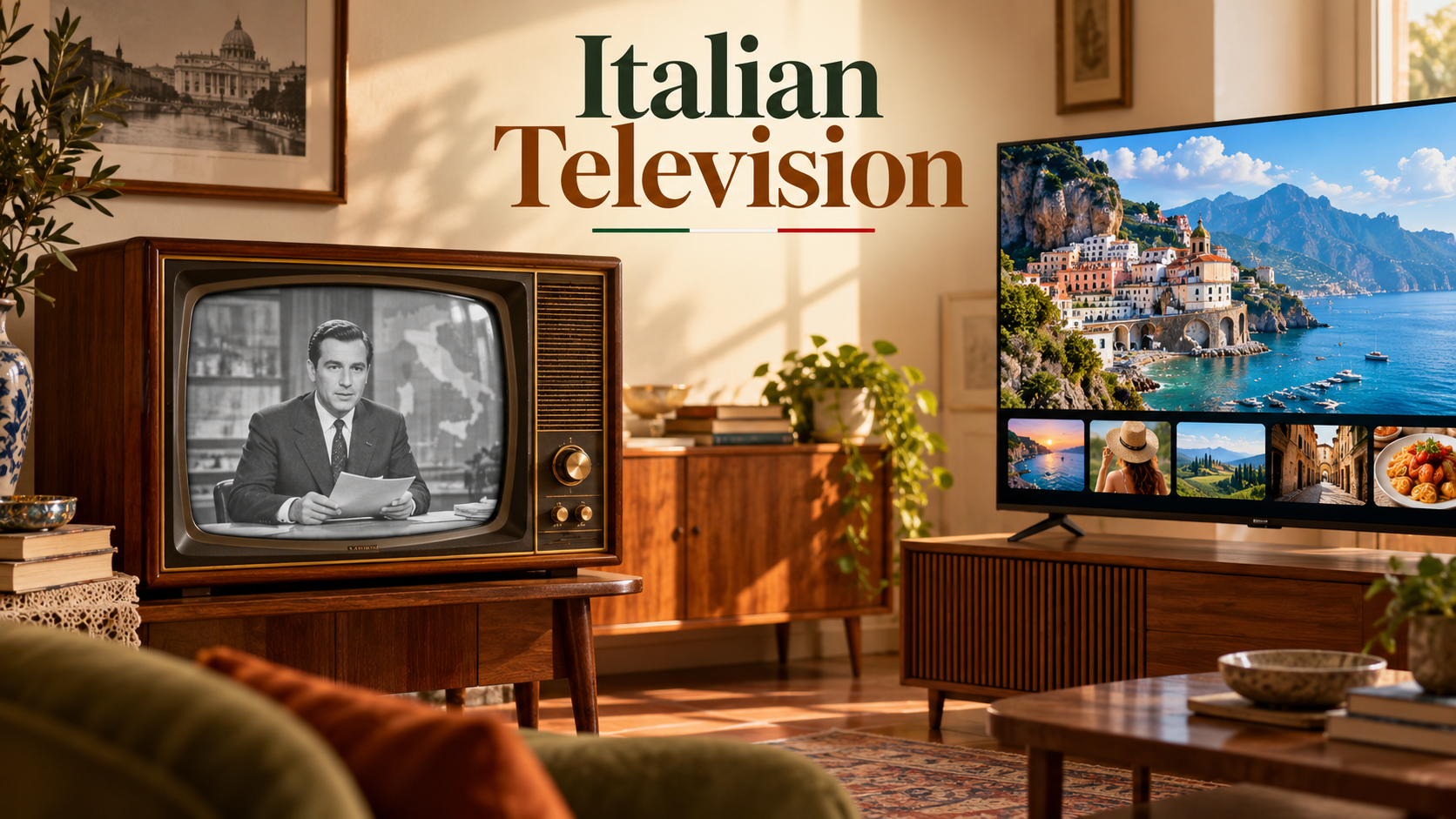
Italian television has helped shape how Italians speak, learn, discuss politics and spend their evenings. From the first regular RAI broadcasts to today’s streaming services, the small screen has followed the country’s changing habits. It has also helped create them.
For decades, a popular programme could bring families together around a single television set. Today, viewers can watch news on a phone, revisit an archive interview or follow a drama whenever they choose. Yet television still offers a useful window into Italian life.
Understanding its history means looking beyond channel names. It means exploring education, entertainment, advertising and the relationship between broadcasting and public debate. You can discover more related guides in Italia Mia’s Italian TV section.
When Did Italian Television Begin?
RAI began regular television broadcasting on January 3, 1954. Experimental broadcasts had taken place earlier, so this date marks the start of the regular public service rather than Italy’s first television experiment.
Announcer Fulvia Colombo introduced the opening broadcasts from Milan. The service initially offered a single channel, the Programma Nazionale, which later became Rai 1. Early schedules included news, cultural programmes, sport and entertainment.
Television ownership was still limited. Many people watched in bars, community spaces or the homes of neighbours who owned a set. Watching television could therefore be a social occasion as much as a private pastime.
RAI’s early broadcasts arrived during Italy’s postwar reconstruction. As household incomes increased and sets became more accessible, television moved steadily into domestic life. It brought distant events into the living room and gave viewers across the country a shared set of programmes and personalities.
How RAI Helped Italians Learn
The early public broadcaster placed considerable emphasis on education. Its mission extended beyond reporting the news or filling an evening with entertainment.
One of the clearest examples was Non è mai troppo tardi, presented by teacher Alberto Manzi. First broadcast on November 15, 1960, the programme continued until 1968. It helped adults learn to read and write through accessible lessons that combined words, drawings and patient explanations.
Organised viewing centres allowed people without television sets to follow the lessons. The programme showed how broadcasting could reach learners beyond a conventional classroom.
Television also increased everyday exposure to standard Italian in a country where regional languages and dialects remained central to daily conversation. Newsreaders, presenters and actors offered a common language heard by audiences in different regions.
This did not erase local identities. Instead, it added a shared national reference point. For readers interested in the language itself, Italia Mia’s Language section explores another part of this cultural story.
Quiz Shows, Variety and Carosello
Education was only one part of early television’s appeal. Quiz shows, musical performances and variety programmes made the screen a source of excitement and familiar company.
Presenters such as Mike Bongiorno became household names. Variety television brought singers, comedians and dancers to audiences who might never attend a major theatre or concert. The studio became a stage shared by viewers across Italy.
Carosello holds a special place in this history. Broadcast from February 3, 1957, to January 1, 1977, it combined advertising with short comic scenes, animation and memorable characters.
Its format gave commercials their own entertainment value. Viewers remembered stories and catchphrases as well as products. For many families, the programme became part of the evening routine and a lasting childhood memory.
Carosello also records the growth of consumer culture. Its advertisements show changing ideas about kitchens, cars, personal care and household comfort. Watching these short films today reveals what companies hoped Italians would buy—and how they imagined modern Italian life.
More Channels and the Arrival of Colour
The Secondo Programma, the predecessor of Rai 2, began broadcasting on November 4, 1961. A second channel gave viewers more choice and allowed RAI to broaden its schedule.
Another major change came on February 1, 1977, when RAI officially began regular colour broadcasting. Earlier experiments had demonstrated the technology, but its regular introduction changed the look of everyday television.
Colour gave new visual impact to costumes, studio sets, sporting events and outdoor reports. It also encouraged households to replace older black-and-white receivers when they could afford to do so.
As broadcasting expanded, television became more varied. Audiences could encounter different styles of reporting and entertainment, while producers developed programmes for increasingly distinct interests.
The screen was becoming a more competitive space. Public service broadcasting remained influential, but it would soon share viewers’ attention with a growing commercial sector.
Commercial Television Changes the Landscape
Local private broadcasters emerged during the 1970s. Their growth opened opportunities for different schedules, advertising models and approaches to entertainment.
Canale 5 developed into a network in 1980, following the earlier local station Telemilanocavo and its successor, Telemilano58. Silvio Berlusconi’s broadcasting businesses subsequently became central to the commercial television landscape associated with Mediaset.
Commercial channels expanded the space available for imported series, films, game shows, variety and advertising. Competition also increased the importance of audience figures and recognisable presenters.
Over time, RAI and the major commercial networks developed a close rivalry for viewers. Performers moved between broadcasters, successful formats inspired alternatives, and schedules competed for the same evening audience.
This history also connects television with politics. Questions about ownership, public broadcaster independence and the influence of news programmes have remained part of Italy’s public debate. Television’s cultural role cannot be separated entirely from the institutions and businesses behind it.
Italian Television Today: Where to Start
Italy’s television landscape includes public channels, commercial networks, subscription services and online platforms. The following guide offers useful starting points rather than a complete channel directory.
| Broadcaster or service | What to explore |
|---|---|
| RAI | Public service news, drama, entertainment, documentaries, culture and sport across its channels |
| Mediaset | Commercial television, including Canale 5, Italia 1 and Rete 4, with entertainment, drama, films and news |
| La7 | News, interviews, political discussion and current affairs, alongside other programming |
| Sky Italia | Subscription television with films, series, entertainment and sport, depending on the package |
| RaiPlay | RAI live channels, catch-up programmes, on-demand titles and selected archive material |
| Mediaset Infinity | Mediaset live and on-demand viewing, with free and paid offerings |
| NOW | Subscription streaming with different passes for entertainment, cinema and sport |
Channel schedules and streaming catalogues change. Check each service directly for the programme, subscription and viewing conditions that interest you.
Drama, News and Shared Cultural Moments
Italian television offers several ways to understand the country. Drama can introduce viewers to regional settings, family relationships and different periods of history. News and interviews show the language and concerns of public debate.
Long-running entertainment formats reveal another side of everyday life. Their presenters, jokes and recurring segments become familiar reference points. Major music and sporting broadcasts can still draw people together even when their usual viewing habits differ.
Television and cinema also share actors, writers and directors. However, a television series has more time to develop characters and revisit a setting. That makes it particularly useful for viewers who want to become familiar with spoken Italian and recurring social situations.
For a wider view of Italian screen culture, explore Italia Mia’s guide to essential Italian movies.
How to Watch Italian Television Online
Start with official broadcaster platforms. RaiPlay is a useful place to explore RAI programming and selected archives. Mediaset Infinity provides access to Mediaset’s online offering, while La7 lists live viewing and catch-up sections.
For subscription viewing, check Sky Italia and NOW. Confirm which package or pass includes the programmes you want before paying.
Availability depends on where you are watching. RAI explains that its overseas on-demand offering is reduced because of the web rights it holds. A title available in Italy may therefore be unavailable in the United States, the United Kingdom or another country.
Registration, subtitles and playback conditions also vary. An account does not automatically provide worldwide access, and English subtitles are not available for every programme. Check the individual title and the service’s current help pages.
Watching While Travelling: NordVPN
If you want to protect your internet connection while travelling, you can explore NordVPN through Italia Mia’s affiliate link.
NordVPN encrypts traffic routed through its VPN connection and offers servers in Italy. Its app lets users select Italy from the country list to obtain an Italian IP address. This can be useful when managing your online connection away from home, including on shared hotel or café Wi-Fi.
A VPN does not include a television subscription or change a programme’s licensing rights. Access to RaiPlay, Mediaset Infinity or a particular title is not guaranteed. Broadcasters may restrict VPN connections, and their regional rules still apply.
Before subscribing specifically for television viewing, check the broadcaster’s terms and travel guidance. If a programme is unavailable, look for an authorised release in your country rather than assuming a different connection will provide access.
Why Italian Television Still Matters
Italian television’s history follows the country from postwar reconstruction to a world of phones, smart televisions and on-demand libraries. Its programmes have taught practical skills, introduced performers, recorded public arguments and created memories shared across generations.
Streaming has changed when and where people watch. It has also made selected older programmes easier to discover. A historical interview, a Carosello advertisement or an educational lesson can now become the starting point for exploring another period of Italian life.
For visitors, language learners and Italians living abroad, television remains a way to hear the country’s voices and follow its changing concerns. Its value lies in that variety: entertainment, information and a record of how Italy has seen itself.
External Sources
- Rai Teche: Fulvia Colombo and the opening broadcasts of 1954
- Rai Teche: Alberto Manzi and Non è mai troppo tardi
- Rai Teche: Carosello, 1957–1977
- Rai Teche: The launch of the second channel
- Rai Teche: The official start of colour broadcasting
- Mediaset: The history of Canale 5
- RAI: RaiPlay frequently asked questions
- NordVPN: Italian servers and connection information