 Best Beaches in Puglia, Italy: 20 Beautiful Beaches & Coastal Towns
With hundreds of kilometers of coastline facing two seas, Puglia is one of Italy’s great beach destinations.
Yet talking about “the beaches of Puglia” can be misleading because the coastline changes dramatically as you travel through the region.
In the north, the Gargano Peninsula offers forest-covered cliffs, sea caves and hidden coves. Around Bari and Monopoli, rocky swimming spots alternate with compact sandy beaches and historic seaside towns. Continue south toward Otranto and the Adriatic becomes increasingly wild, while the Ionian coast around Gallipoli, Porto Cesareo and Pescoluse delivers long stretches of pale sand and remarkably transparent water.
That variety is one reason Puglia works so well as a road-trip destination.
You don’t have to choose between an Italian cultural vacation and a beach holiday. In Puglia, you can visit a medieval cathedral in the morning, swim in turquoise water in the afternoon and spend the evening eating seafood in a centuries-old coastal town.
If you’re planning your first trip, begin with Italia Mia’s guide to the Best Places to Visit in Puglia: 20 Towns, Beaches and Hidden Gems and our broader guide to the Region of Puglia.
Here are 20 of the best beaches and coastal destinations in Puglia, traveling roughly from north to south.
Puglia’s Coast at a Glance
Puglia forms the heel of the Italian peninsula and has coastline on both the Adriatic Sea and Ionian Sea.
That geography gives beach travelers several distinctly different areas.
Gargano
Best for dramatic scenery, cliffs, sea caves and coves.
Bari and the central Adriatic coast
Best for combining swimming with historic towns such as Polignano a Mare and Monopoli.
Otranto and eastern Salento
Best for clear Adriatic water, rocky coves and beaches surrounded by Mediterranean vegetation.
Gallipoli and western Salento
Best for sandy beaches, sunsets and lively summer resorts.
Southern Salento
Best for combining both coasts, small coves and some of Puglia’s clearest water.
1. Baia delle Zagare – Gargano
The Gargano Peninsula looks very different from the Puglia of whitewashed villages and flat olive groves.
Forested hills descend toward the Adriatic, where pale limestone cliffs create secluded beaches and spectacular sea stacks.
Baia delle Zagare, also known as Baia dei Mergoli, is one of Gargano’s iconic coastal landscapes.
Tall limestone formations rise from intensely blue water while steep cliffs enclose the beach.
Access can be more complicated than at an ordinary public beach, and conditions can change, so check current local access information before visiting.
Best for
Scenery, photography, swimming and romantic coastal trips.
Combine with
Vieste, Mattinata and Foresta Umbra.
2. Vignanotica Beach
Between Mattinata and Vieste lies Spiaggia di Vignanotica, another dramatic Gargano beach.
The backdrop is formed by towering white cliffs, while the shoreline consists largely of pebbles rather than fine sand.
The contrast between pale rock, vegetation and blue Adriatic water makes this one of northern Puglia’s most photogenic beaches.
Bring suitable footwear if you prefer not to walk barefoot across pebbles.
Best for
Clear water, dramatic cliffs and a quieter Gargano experience.
3. Vieste
Vieste deserves inclusion even though it is much more than a beach.
Its historic center occupies a dramatic position above the Adriatic and is surrounded by long beaches, caves and rocky formations.
The famous Pizzomunno sea stack rises from the beach near town and has become one of Gargano’s visual symbols.
Vieste also makes an excellent base for boat trips exploring Gargano’s marine caves.
Best for
Families, road trips, boat excursions and travelers wanting beaches plus a lively town.
Stay: 2–4 nights if exploring Gargano.
4. Peschici
Farther along the Gargano coast, Peschici rises above the Adriatic in a cluster of white buildings.
The town has an appealing historic center, while beaches and small bays lie along the surrounding coast.
It is a particularly attractive destination for travelers who prefer combining beach time with evening walks, restaurants and traditional town life.
Peschici also provides access to Gargano’s famous trabucchi, traditional wooden fishing structures extending over the sea.
Best for
Couples, families, seafood and coastal scenery.
5. Lama Monachile – Polignano a Mare
Few beaches in Italy have a more recognizable setting.
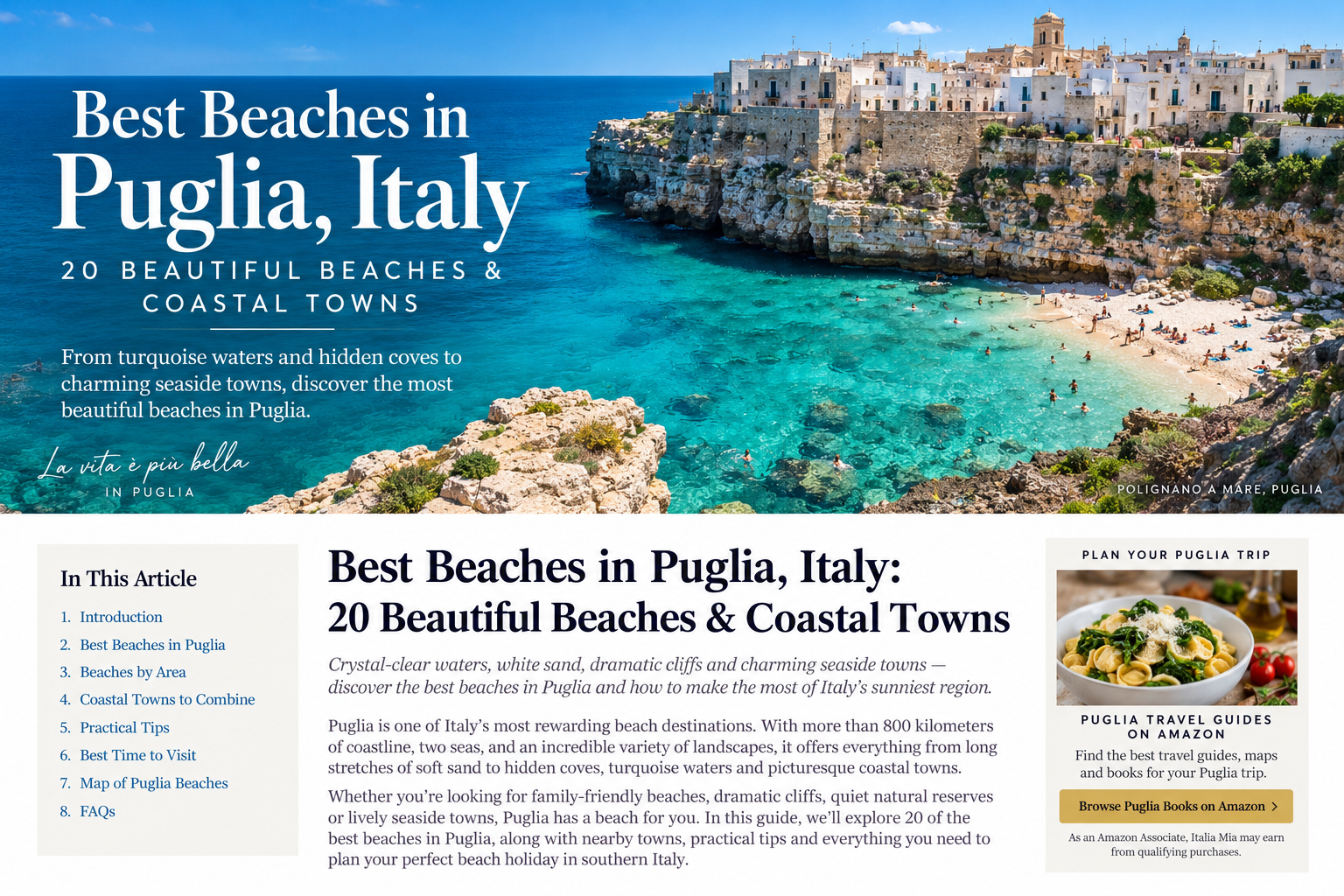
Lama Monachile, sometimes called Cala Porto, occupies a narrow inlet beneath the historic center of Polignano a Mare.
White and honey-colored buildings cling to the cliffs on either side while transparent Adriatic water fills the cove below.
The beach itself is relatively small and pebbly.
You come here as much for the setting as for the sand.
During peak summer, it can become extremely crowded. Visit early in the morning, late in the afternoon or outside July and August for a better experience.
Best for
Photography, iconic scenery and combining sightseeing with swimming.
Don’t miss
Walk through Polignano’s historic center and seek out its panoramic terraces overlooking the Adriatic.
6. Cala Paura – Polignano a Mare
Visitors concentrating entirely on Lama Monachile sometimes overlook Cala Paura.
This small coastal area near Polignano offers another opportunity for swimming in clear water beneath the limestone coast.
It lacks the dramatic postcard composition of Lama Monachile but can be worth considering when spending a full day in Polignano.
Best for
Swimming and a Polignano beach day.
7. Cala Porta Vecchia – Monopoli
A major advantage of Monopoli is that you don’t necessarily need a car to combine sightseeing with swimming.
Cala Porta Vecchia sits immediately beside the historic center and old defensive walls.
You can wander through Monopoli’s streets, visit the harbor and cathedral, have lunch, and then walk directly to the sea.
The beach isn’t isolated or wild. Its appeal comes from being integrated into one of Puglia’s most attractive coastal towns.
Best for
Travelers without a car, families and sightseeing-plus-beach days.
8. Capitolo – Monopoli
South of Monopoli, the coast around Capitolo contains a series of sandy beaches, beach clubs and swimming areas.
This is a better choice than central Monopoli if your priority is spending several hours on the beach rather than simply taking a swim between sightseeing stops.
Some sections are organized as private beach establishments, or lidi, while other stretches provide public access.
Best for
Full beach days, beach clubs and travelers staying near Monopoli.
9. Torre Canne
Continue south and you reach Torre Canne, a seaside resort known for its long coastline and recognizable lighthouse.
The surrounding area is flatter and more open than Polignano’s dramatic cliffs, with sandy stretches particularly suited to traditional beach holidays.
Torre Canne is also conveniently positioned for exploring inland destinations such as Ostuni, Cisternino and the Valle d’Itria.
Best for
Families, longer beach stays and combining the coast with Valle d’Itria.
10. Torre Guaceto
One of Puglia’s most valuable coastal environments is the protected area around Torre Guaceto.
Here the experience becomes less urban and more natural.
Dunes, Mediterranean vegetation, wetlands and marine habitats create a landscape quite different from Puglia’s developed resort beaches.
Access and transportation arrangements are designed to protect the reserve, so check current visitor information before arriving.
Best for
Nature, snorkeling, walking and travelers seeking less-developed coastline.
Combine with
Ostuni, Carovigno and Brindisi.
11. Torre dell’Orso
Once you reach Salento, beach choices multiply rapidly.
Torre dell’Orso, north of Otranto, has a broad crescent of sand backed by pine trees and cliffs.
Offshore stand the famous rock formations known as Le Due Sorelle — the Two Sisters.
The combination of sand, relatively shallow water and nearby services makes Torre dell’Orso one of eastern Salento’s best-known summer destinations.
Best for
Families, swimming and sandy-beach lovers.
12. Grotta della Poesia and Roca Vecchia
Near Torre dell’Orso lies one of Salento’s most unusual coastal landmarks.
Grotta della Poesia is a natural rock formation containing a pool of extraordinarily clear seawater.
The archaeological and natural environment around Roca Vecchia adds historical interest to the coastline.
Because regulations concerning swimming and access are intended to protect the site and may change, verify current rules rather than assuming swimming is permitted.
Best for
Coastal landscapes, archaeology and photography.
13. Baia dei Turchi
Just north of Otranto, Baia dei Turchi is one of the Adriatic coast’s most celebrated beaches.
Its appeal comes from the combination of clear water, pale sand and Mediterranean vegetation.
The beach forms part of a relatively natural coastal landscape compared with heavily developed resorts.
Its name recalls the Ottoman forces who landed in this area during the invasion of Otranto in 1480.
Best for
Swimming, couples, nature and combining beach time with Otranto.
Arrive early during summer.
14. Otranto
Otranto should be considered a beach destination and cultural destination at the same time.
The historic center overlooks brilliant Adriatic water, while several swimming areas are accessible around the town and along the nearby coast.
But don’t spend the entire visit on the beach.
Otranto Cathedral contains an extraordinary medieval mosaic floor, while the castle, walls and old streets make this one of Puglia’s most interesting coastal towns.
Best for
Travelers who want beaches without sacrificing history and culture.
Stay: 1–3 nights.
15. Porto Badisco
South of Otranto, the Adriatic coastline becomes increasingly rugged.
Porto Badisco occupies a small inlet surrounded by rocky landscape.
According to tradition, this area has sometimes been associated with Aeneas’s legendary arrival in Italy, adding another layer to its appeal.
Whether or not you come for the legend, the drive along this stretch of Salento is magnificent.
Best for
Road trips, swimming and travelers exploring the Otranto–Leuca coast.
16. Santa Maria di Leuca
At the southern end of Salento lies Santa Maria di Leuca, traditionally associated with the meeting of the Adriatic and Ionian seas.
Rather than expecting to see a permanent visible line between two bodies of water, come for the coastline itself.
Leuca is surrounded by cliffs, grottoes and coves best appreciated from the sea.
A boat excursion is therefore one of the most rewarding activities here.
Above town stand the lighthouse and Basilica of Santa Maria de Finibus Terrae.
Best for
Boat trips, sea caves, scenic drives and exploring southern Salento.
17. Pescoluse – The “Maldives of Salento”
The Ionian side of southern Salento contains some of Puglia’s most famous sandy beaches.
Marina di Pescoluse is often promoted as the “Maldives of Salento” because of its pale sand and shallow turquoise water.
The nickname is marketing hyperbole, but the beach really is beautiful.
Its gently shelving water also contributes to its popularity with families.
Unsurprisingly, summer crowds can be substantial.
Best for
Fine sand, families and classic turquoise-water beach holidays.
18. Punta della Suina
Approaching Gallipoli, Punta della Suina combines rocky sections, sandy areas, vegetation and clear Ionian water.
Its west-facing position makes this part of Salento particularly attractive in the late afternoon.
Stay for sunset if possible.
Best for
Couples, swimming, sunsets and travelers staying around Gallipoli.
19. Gallipoli and Baia Verde
Gallipoli is one of western Salento’s major coastal destinations.
Its historic center occupies an island connected to the modern town by a bridge, creating an unusual combination of historic architecture and beach culture.
Nearby Baia Verde is known for sandy beaches and a much livelier summer atmosphere.
July and especially August attract large numbers of visitors and a younger nightlife-oriented crowd.
For a quieter experience, visit in June or September.
Best for
Beach clubs, nightlife, seafood, sunsets and historic atmosphere.
20. Punta Prosciutto and Porto Cesareo
If your image of Puglia involves shallow turquoise water and pale sand, finish your journey around Porto Cesareo and Punta Prosciutto.
Punta Prosciutto is widely regarded as one of Salento’s standout beaches, with long sandy stretches and clear, shallow Ionian water.
Nearby Porto Cesareo offers accommodation, restaurants and access to additional beaches.
This is one of the strongest areas in Puglia for travelers whose principal objective is a traditional beach vacation.
Best for
Fine sand, families, swimming and longer beach stays.
Adriatic or Ionian Coast: Which Side of Puglia Is Better?
One of the best things about Salento is that you don’t necessarily have to choose.
The peninsula is narrow enough that travelers staying in the south can explore both sides.
Choose the Adriatic Coast for:
- Dramatic rocky coastline
- Sea caves
- Otranto
- Baia dei Turchi
- Torre dell’Orso
- Scenic coastal drives
- Clear, deeper-looking blue water
Choose the Ionian Coast for:
- Longer sandy beaches
- Shallow turquoise water
- Gallipoli
- Porto Cesareo
- Punta Prosciutto
- Pescoluse
- Spectacular sunsets
Wind can also influence which coast feels more pleasant on a particular day, so travelers staying in Salento often choose their beach according to local conditions.
Best Beach Towns in Puglia
If you’d rather stay somewhere where restaurants, evening walks and sightseeing are available without driving after dinner, consider these bases.
Vieste
Best northern base for Gargano beaches and boat excursions.
Polignano a Mare
Best for iconic scenery and short stays.
Monopoli
One of the best all-around bases, combining beaches, restaurants, railway connections and an attractive old town.
Otranto
Excellent for eastern Salento and travelers interested in history as well as beaches.
Gallipoli
Ideal for the Ionian coast, nightlife and sunsets.
Porto Cesareo
Strong choice for a beach-centered holiday.
For a broader look at these destinations, read Italia Mia’s Best Places to Visit in Puglia: 20 Towns, Beaches and Hidden Gems.
Best Beaches in Puglia for Families
Families generally benefit from beaches with sand, shallow water and easy access.
Good areas to investigate include:
- Torre dell’Orso
- Pescoluse
- Porto Cesareo
- Punta Prosciutto
- Torre Canne
- Baia Verde
Conditions can vary with weather and wind, and parents should always assess sea conditions locally.
Best Puglia Beaches for Couples
For scenery and atmosphere, consider:
- Baia delle Zagare
- Vignanotica
- Lama Monachile
- Baia dei Turchi
- Punta della Suina
- Porto Badisco
Combining a beach with a nearby historic town—such as Polignano, Otranto or Gallipoli—makes it easier to turn the outing into a full day.
Best Puglia Beaches for Nature
Travelers seeking less-developed surroundings should prioritize:
Torre Guaceto for protected dunes, vegetation and marine habitat.
Gargano for cliffs, forests, caves and isolated coves.
Baia dei Turchi for Mediterranean vegetation near Otranto.
Foresta Umbra and the Gargano coast for perhaps Puglia’s strongest combination of woodland and sea.
Free Beaches vs Lidos in Puglia
Like elsewhere in Italy, Puglia has both spiagge libere and organized stabilimenti balneari, commonly called lidos.
A spiaggia libera is a public beach area where you generally bring your own towel, umbrella and other equipment.
A lido usually offers paid umbrellas and sun loungers and may include showers, changing facilities, toilets, restaurants or bars.
During July and August, popular lidos can fill quickly.
If you’re traveling in peak season and want a particular beach club, reserving ahead can be worthwhile.
Public access rules and the balance between concessions and free beach areas can change, so rely on current local information rather than old travel reports.
When Is the Best Time for a Puglia Beach Holiday?
May
Excellent for sightseeing and quiet beaches, although the sea can still feel cool.
June
Arguably one of the best months. Days are long, temperatures are warm and crowds remain below their August peak.
July
Excellent beach weather but increasingly busy and expensive.
August
Peak season.
Beaches, roads, towns and accommodation can become extremely busy, especially around Ferragosto on August 15.
September
Another excellent choice. The sea remains warm while crowds generally begin to decline.
Early October
Potentially beautiful, particularly in good weather, although conditions become less predictable and seasonal facilities may begin closing.
For most international visitors, June and September offer the best compromise.
How Many Days Do You Need for Puglia’s Beaches?
If beaches are only part of your trip, allow at least 7 days for Puglia.
A strong first itinerary could look like:
Days 1–2: Bari, Polignano a Mare and Monopoli
Days 3–4: Valle d’Itria, Alberobello and Ostuni
Days 5–7: Lecce, Otranto and Salento beaches
With 10 days, add Gallipoli, Porto Cesareo and southern Salento.
With two weeks, consider adding Gargano.
Trying to combine Gargano and southern Salento in a short trip creates unnecessary driving.
Do You Need a Car for Puglia’s Beaches?
For serious beach exploration, a car is highly recommended.
Railways work surprisingly well for destinations including Bari, Polignano a Mare, Monopoli and Lecce.
But many of Puglia’s best beaches, rural accommodations and natural areas are considerably easier to reach by car.
A car also allows you to change plans according to weather, wind and crowds.
If you’re driving around Italy, see Italia Mia’s Italian Autostrade Guide before your trip.
What to Bring to the Beach in Puglia
During summer, strong sun and heat deserve consideration.
Useful items include:
- High-SPF sunscreen
- Hat
- Refillable water bottle
- Beach footwear for rocky and pebble beaches
- Snorkeling mask
- Lightweight beach towel
- Waterproof phone pouch
- Umbrella when visiting an unserviced public beach
Water shoes are particularly useful around rocky stretches of the Adriatic coast.
Puglia Travel Books and Maps
A physical guidebook can be surprisingly useful on a Puglia road trip, particularly when exploring small towns and countryside away from the major tourist routes.
Puglia Travel Guides
Dedicated guides can provide additional maps, historical background and restaurant or accommodation ideas.
Browse Puglia travel guides on Amazon.com
Lonely Planet Southern Italy
Useful if you’re combining Puglia with Basilicata, Calabria, Campania or Sicily.
Find Lonely Planet Southern Italy on Amazon.com
Italy Travel Guides
For travelers visiting Puglia as part of a longer Italian itinerary:
Browse Italy travel guides on Amazon.com
Puglia Road Maps
A printed map makes a useful backup when exploring rural areas and smaller coastal roads.
Browse Puglia road maps on Amazon.com
As an Amazon Associate, Italia Mia may earn from qualifying purchases.
Frequently Asked Questions About Puglia Beaches
Does Puglia have good beaches?
Yes. Puglia has one of Italy’s longest and most varied coastlines, encompassing sandy beaches, rocky coves, limestone cliffs, sea caves and protected natural areas.
Which part of Puglia has the best beaches?
For long sandy beaches and shallow turquoise water, Salento’s Ionian coast around Porto Cesareo, Punta Prosciutto and Pescoluse is particularly strong.
For dramatic coastal landscapes, consider Gargano and the Adriatic coast around Otranto.
What is the most famous beach in Puglia?
Lama Monachile at Polignano a Mare is probably Puglia’s most internationally recognizable beach because of its extraordinary cliffside setting.
Where is the clearest water in Puglia?
Clear water can be found throughout the region. Porto Cesareo, Punta Prosciutto, Pescoluse, Otranto, Torre Guaceto and Gargano are among the areas particularly celebrated for water quality and clarity.
Are Puglia beaches sandy?
Some are, some aren’t.
The Ionian coast has many sandy beaches, while parts of the Adriatic coastline contain rock, pebbles, cliffs and small coves.
Are beaches free in Puglia?
Puglia has both free public beach areas and paid beach establishments. At popular destinations, you’ll often find both options within the same general coastal area.
Is Puglia expensive?
Prices vary enormously according to destination and season. August accommodation and beach services in fashionable coastal areas can be expensive, while June and September often provide better value.
Beyond the Beach: What Else Should You See?
One of Puglia’s greatest advantages is how easily beach days can be combined with cultural sightseeing.
Don’t leave without seeing at least some of:
- Bari Vecchia
- Alberobello
- Locorotondo
- Ostuni
- Lecce
- Castel del Monte
- Valle d’Itria
- Gargano
- Otranto
- Gallipoli
Our guide to the Region of Puglia provides the broader regional background.
For a destination-by-destination itinerary, continue with Best Places to Visit in Puglia: 20 Towns, Beaches and Hidden Gems.
Why Puglia Is One of Italy’s Great Coastal Destinations
Puglia isn’t defined by a single famous beach.
That is exactly what makes its coastline so rewarding.
In Gargano, forests descend toward limestone cliffs and hidden coves. Around Polignano a Mare, historic towns rise directly above the Adriatic. Torre Guaceto protects a quieter world of dunes and Mediterranean vegetation.
Then comes Salento.
Around Otranto, the coast becomes rocky, intensely blue and dramatic. Turn toward Gallipoli and Porto Cesareo and the landscape changes to pale sand, shallow turquoise water and sunsets over the Ionian Sea.
Few Italian regions offer that much coastal variety.
And because Puglia’s beaches coexist with trulli, masserie, olive groves, Baroque cities, fishing harbors and extraordinary food, a beach holiday here rarely feels like only a beach holiday.
Allow enough time to explore both the coast and the towns behind it.
That is when Puglia makes the strongest impression.
Related Italia Mia Guides
Continue planning your trip with:
Best Places to Visit in Puglia: 20 Towns, Beaches and Hidden Gems
Region of Puglia: Complete Travel Guide
Top Italian Destinations and Cities
External Sources
For current information on beaches, protected areas, local attractions, access conditions and travel planning, consult these official and regional resources:
- Regione Puglia – Tourism Department — Official regional government tourism information, regulations, projects and visitor resources.
- Pugliapromozione – Regional Tourism Board — Puglia’s regional tourism agency, with destination information, events and links to official visitor resources.
- Visit Puglia – Beaches and Destinations — Information about Puglia’s destinations, beaches, cities, food, experiences and trip planning.
- Visit Puglia – Best Beaches in Puglia — Beach-specific information covering destinations including Pescoluse, Torre dell’Orso, Polignano a Mare, Torre Guaceto and Punta Prosciutto.
- Visit Puglia – Seaside Towns of Puglia — Useful reference for Polignano a Mare, Monopoli, Vieste, Otranto, Gallipoli, Porto Cesareo, Santa Maria di Leuca and other coastal destinations.
- Italia.it – Official Italian Tourism Website — Italy’s national tourism portal, with additional information about Puglia and other Italian destinations.
Because beach access, parking, protected-area regulations and seasonal services can change, check current local information before visiting, particularly for natural reserves and environmentally sensitive coastal areas.