Updated October 6, 2026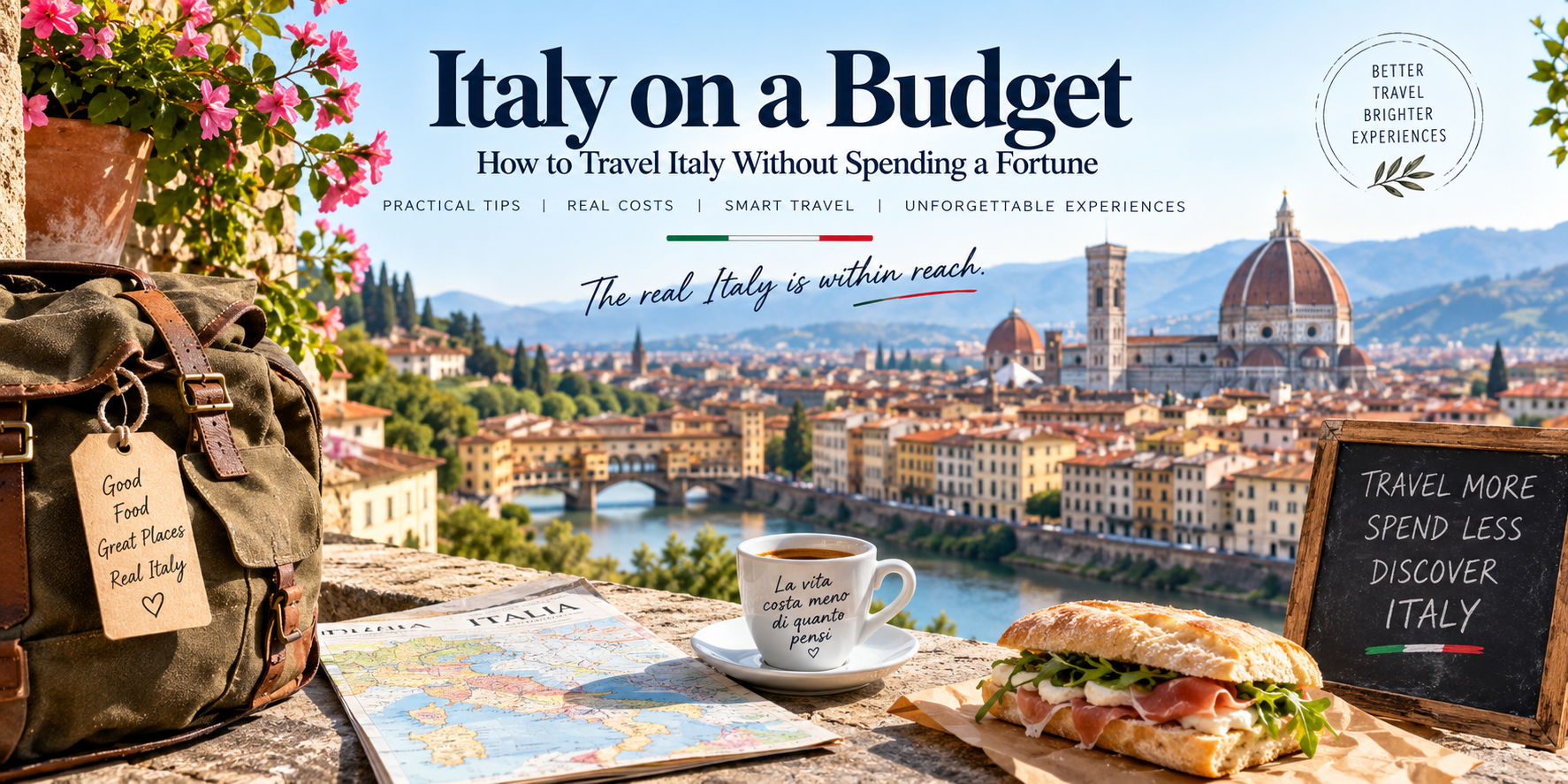
Italy on a Budget: Yes, It Is Still Possible
Italy has a reputation for being an expensive European destination.
Spend a week staying beside Piazza San Marco in Venice, taking taxis everywhere, eating next to major monuments and buying every museum ticket at the last minute, and that reputation will seem completely justified.
But that’s only one way to travel through Italy.
Italy can also be surprisingly affordable.
Take regional trains, stay a few streets away from the most famous attractions, eat where Italians eat, visit smaller cities and travel outside the busiest weeks of summer, and the cost changes dramatically.
Better still, traveling on a budget doesn’t necessarily mean experiencing a lesser version of Italy.
Some of the country’s greatest pleasures cost very little—or nothing at all.
Walking through Rome at night costs nothing. So does watching sunset over Florence from Piazzale Michelangelo, exploring Bologna’s porticoes, wandering through a Tuscan village or sitting in a piazza watching Italian life unfold around you.
The secret isn’t finding a mythical “cheap Italy.”
It is knowing where Italy is expensive, where it offers excellent value, and which expenses are worth paying for.
If this is your first visit, combine the advice below with our Italy for First-Time Visitors guide.
How Much Does a Trip to Italy Cost in 2026?
Budget estimates prepared October 6, 2026. All amounts are in euros.
For two adults sharing a modest private room, the worked budget below comes to €795 per person for 7 days, €1,140 for 10 days, or €1,610 for 14 days, before international flights and a contingency allowance. With approximately 10% set aside for unexpected expenses, practical targets are €880, €1,260 and €1,780 per person.
These are planning examples, not advertised package prices or measured national averages. They assume a private room costing €100 per night for both travelers, €55 per person per day for everyday expenses, and a separate allowance for airport transfers and travel between cities.
A trip through expensive destinations during busy dates can cost much more. Before booking, replace the accommodation and transport allowances with quotes for your exact itinerary.
What These Italy Trip Budgets Include
The calculations use 7 days and 6 nights, 10 days and 9 nights, or 14 days and 13 nights. Arrival and departure days both count as spending days. If you need an extra hotel night, add the room cost separately.
The examples cover accommodation, food, local public transport, paid sightseeing, an allowance for accommodation taxes, airport transfers and some intercity travel. They assume independent travel without a rental car.
International flights, travel insurance, shopping, mobile data, private tours and major optional activities are excluded. Add these using your actual quotes. A cooking class, boat excursion or several guided museum visits can change the total considerably.
Separate Room Prices From Per-Person Costs
A hotel room advertised at €100 per night generally costs €100 for the room, subject to its occupancy and booking conditions. When two adults share it equally, each pays €50 per night.
Meals, museum tickets and train fares usually remain individual expenses. Two people sharing a bedroom still need two lunches and two train tickets.
| Budget item | Planning allowance | How to count it |
|---|---|---|
| Modest private double or twin room | €100 per night | Shared room cost; €50 per person when divided between two adults |
| Food and drinks | €35 per day | Per person |
| Local buses, trams and metro | €5 per day | Per person; averaged across the trip |
| Paid attractions | €10 per day | Per person; averaged across paid visits and free sightseeing days |
| Accommodation tax allowance | €5 per day | Per person; budgeting allowance, not a quoted municipal rate |
| Airport transfers | €40 per trip | Per person, covering arrival and departure |
| Intercity trains or coaches | €70 / €100 / €150 per trip | Per person for the 7-, 10- and 14-day examples respectively |
The daily personal expenses total €55. The accommodation-tax allowance is spread across spending days for simple arithmetic; actual taxes may be charged by night and vary with the destination, property and applicable exemptions. Check whether the quoted room price includes them.
Italy Trip Cost for 7, 10 and 14 Days
| Expense | 7 days / 6 nights | 10 days / 9 nights | 14 days / 13 nights |
|---|---|---|---|
| Room cost for two adults, total | €600 | €900 | €1,300 |
| Room cost per person, sharing equally | €300 | €450 | €650 |
| Food and drinks per person | €245 | €350 | €490 |
| Local transport per person | €35 | €50 | €70 |
| Attractions per person | €70 | €100 | €140 |
| Accommodation-tax allowance per person | €35 | €50 | €70 |
| Airport transfers per person | €40 | €40 | €40 |
| Intercity transport per person | €70 | €100 | €150 |
| Total per person, excluding flights | €795 | €1,140 | €1,610 |
| Total for two adults, excluding flights | €1,590 | €2,280 | €3,220 |
| Suggested per-person target with about 10% contingency, rounded up | €880 | €1,260 | €1,780 |
Do not add the full room total to the per-person accommodation row. The first row shows what the property receives from both guests together. The second row shows each guest’s share and is the amount included in the per-person total.
The formula is straightforward: your share of accommodation + daily personal expenses × spending days + airport transfers + intercity travel.
How Much Does One Week in Italy Cost?
In this example, one week costs €795 per person before flights, or approximately €880 with a contingency allowance. The combined target for two adults is €1,760, plus flights and the other excluded expenses.
Six nights give you time for one main base and a day trip, or two nearby bases. A compact route makes the €70 intercity transport allowance easier to maintain. Crossing the country repeatedly would require a different transport budget.
How Much Does a 10-Day Trip to Italy Cost?
The 10-day example costs €1,140 per person before flights. Set aside approximately €1,260 per person, or €2,520 for two adults, including the contingency allowance.
Two or three bases can work well. Price every move before booking accommodation: a room saving may disappear if it requires additional trains, taxis or airport transfers.
How Much Does Two Weeks in Italy Cost?
For 14 days and 13 nights, the example totals €1,610 per person before flights. A practical target is approximately €1,780 per person, or €3,560 for two adults, including contingency.
An extra week gives you more time to enjoy each destination. It does not require twice as many hotel changes. Several nights in each base can make both the itinerary and the transport budget easier to manage.
What If You Are Traveling Alone?
A solo traveler occupying the same €100 room pays the whole room bill. Keeping the other allowances unchanged produces these totals:
| Solo traveler using a €100 private room | 7 days / 6 nights | 10 days / 9 nights | 14 days / 13 nights |
|---|---|---|---|
| Private room total | €600 | €900 | €1,300 |
| Personal expenses and trip transport | €495 | €690 | €960 |
| Solo total before flights and contingency | €1,095 | €1,590 | €2,260 |
| Suggested target with about 10% contingency, rounded up | €1,210 | €1,750 | €2,490 |
A single room may cost less, but check the actual rate. A hostel bed is normally priced per person, so it should not be divided between two travelers.
How to Adjust the Budget to Your Own Trip
Accommodation has a large effect on the result. If your double room costs €160 instead of €100, each person sharing pays an extra €30 per night. That adds €180 to the 7-day budget, €270 to the 10-day budget or €390 to the 14-day budget.
Likewise, spending an additional €15 per day on meals adds €105, €150 or €210 per person. Small daily choices become substantial over two weeks.
Use the €10 daily attractions allowance as a trip-wide average. You may spend nothing on a day exploring public streets and piazzas, then buy several tickets the next day. Check each attraction’s official website and count reservation charges or guided services separately.
For useful price anchors, the official websites checked on October 6, 2026 listed Rome’s BIT public transport ticket at €1.50, the Leonardo Express airport train at €14 one way, and standard Colosseum–Roman Forum–Palatine admission at €18. These are individual examples; they do not establish hotel prices or a nationwide daily travel cost.
Finally, add your flight quote to the appropriate trip total. If your return flight costs €650, for example, the 10-day shared-room target becomes €1,910 per person, before insurance, shopping and other excluded items. The €650 is an arithmetic example, not an airfare estimate.
Your Destination Matters More Than Almost Anything Else
Italy isn’t uniformly expensive.
Some destinations carry substantial tourism premiums.
Among the places where travelers should expect higher accommodation and restaurant prices are:
- Venice
- Capri
- Positano
- Amalfi Coast
- Central Florence
- Central Rome
- Lake Como
- Costa Smeralda
- Cortina d’Ampezzo during peak periods
You don’t necessarily need to avoid them.
Instead, combine expensive destinations with places offering better value.
For ideas beyond the obvious tourist centers, browse our 25 Best Places to Visit in Italy.
Travel in Shoulder Season
One of the easiest ways to reduce the cost of Italy is simply to change your dates.
July and August can bring high accommodation prices to coastal destinations and major tourist centers.
Easter, Christmas, New Year, major festivals and special events can also push rates sharply upward.
For many travelers, April, May, late September and October provide an excellent balance of weather, availability and price.
Winter can offer even greater savings in art cities.
Rome, Florence, Bologna, Turin and Naples don’t stop being interesting because it’s January.
Museums remain museums. Restaurants remain restaurants. Churches, archaeological sites and historic centers remain.
You may also experience them with fewer visitors.
Don’t Automatically Fly Into Rome
When comparing flights to Italy, check several gateways.
Depending on your origin, useful airports may include:
- Rome Fiumicino
- Milan Malpensa
- Milan Linate
- Venice
- Bologna
- Naples
- Pisa
- Florence
- Turin
- Bari
- Palermo
- Catania
Sometimes flying into one Italian city and home from another—an open-jaw itinerary—can save both time and money.
For example:
Fly into Milan → travel south → fly home from Rome
This avoids spending money and losing a day returning to your original arrival city simply to catch the flight home.
But compare the complete cost, not just the airfare.
A €30 cheaper flight into a distant airport isn’t a bargain if reaching your actual destination requires €50 in additional transportation.
Pack Light and Watch Low-Cost Airline Fees
Europe’s low-cost airlines can provide extremely inexpensive fares.
The headline price, however, may not be the final price.
Additional charges can apply for:
- Cabin baggage
- Checked luggage
- Seat selection
- Priority boarding
- Airport check-in
- Other optional services
A €25 flight can stop being a €25 flight surprisingly quickly.
Always compare the final checkout price.
Traveling with one small bag also makes Italian train travel considerably easier.
Anyone who has dragged a giant suitcase across a Venetian bridge or up the stairs of an old Italian railway station understands why.
Trains Are Usually the Budget Traveler’s Best Friend
Italy has one of Europe’s most useful railway networks.
For journeys between major cities, trains often eliminate the need for:
- Rental cars
- Fuel
- Motorway tolls
- Parking
- Airport transfers
High-speed trains connect major destinations including Rome, Florence, Bologna, Milan, Turin, Venice and Naples.
The two principal high-speed operators are Trenitalia and Italo.
Compare both.
Competition can produce attractive advance fares.
High-Speed Trains: Book Earlier
High-speed rail pricing works differently from ordinary regional trains.
Discounted fares are often tied to specific trains and may have restrictions on changes or refunds.
Buying in advance can therefore produce substantial savings.
If you already know that you’re traveling from Rome to Florence at 10:00 on a particular day, buying early can make sense.
If your plans are uncertain, paying more for flexibility may be worthwhile.
A cheap ticket isn’t cheap if you miss the train and have to buy another one.
Regional Trains: Your Secret Weapon
Regional trains are extremely useful for budget travel.
They connect thousands of smaller cities and towns and generally don’t require the same advance-purchase strategy as high-speed services.
They are particularly useful for shorter trips.
Depending on your itinerary, regional trains can make it inexpensive to explore places such as:
- Pisa
- Lucca
- Siena
- Arezzo
- Orvieto
- Perugia
- Parma
- Ferrara
- Padua
- Ravenna
- Salerno
- Many coastal towns
They are slower than high-speed trains, but speed isn’t always necessary.
Spending €10 instead of €30 to arrive an hour later may be a perfectly reasonable budget decision.
Understand Ticket Validation
Ticket rules vary according to the type and format of ticket.
Some physical regional tickets require validation before travel, while digital regional tickets operate according to their own current conditions.
Don’t rely on advice from an old travel blog or forum post.
Check the instructions attached to the ticket you’ve actually purchased.
Italian railway rules have evolved as digital ticketing has expanded.
Trenitalia or Italo?
Don’t become loyal to one company.
Compare.
Trenitalia operates the Frecciarossa high-speed network as well as Intercity and regional services.
Italo competes on many major high-speed routes.
The best choice may depend on:
- Departure time
- Arrival time
- Price
- Station
- Fare flexibility
- Promotions
For budget travel, the logo on the train matters less than the final combination of price and convenience.
Buses Can Fill the Gaps
Trains don’t reach every Italian destination.
Regional and local buses become particularly important in rural areas and smaller towns.
Long-distance coach companies also connect major cities.
A bus may sometimes be cheaper than rail, although journeys are generally longer and road traffic introduces more uncertainty.
For certain routes, particularly where rail connections are indirect, buses can be excellent value.
Should You Rent a Car on a Budget Trip?
Sometimes.
A rental car makes little financial sense for a classic:
Rome → Florence → Venice
You would be paying for a vehicle that becomes a liability in each city.
But for four people exploring rural Tuscany, the arithmetic changes.
Splitting the cost of a car, fuel and parking among several travelers may be competitive with multiple train and bus tickets—and gives you access to places public transportation doesn’t serve well.
Cars are particularly useful for:
- Rural Tuscany
- Umbria
- Puglia
- Sicily
- Sardinia
- Parts of the Dolomites
- Small villages
- Agriturismi
Before renting, read our Driving in Italy for Tourists guide.
Also account for motorway tolls, fuel and parking. Our Italian Autostrade Guide explains the motorway system.
Don’t Use Taxis as Your Default Transportation
A taxi can be useful.
Using taxis for every journey is a quick way to destroy a budget.
Italian cities are generally walkable, and larger cities have buses, trams and metro systems.
Before taking a taxi, ask:
Can I walk?
Is there a metro?
Is there a bus or tram?
Save taxis for situations where they genuinely provide value—heavy luggage, late arrivals, mobility needs or awkward connections.
Accommodation Will Probably Be Your Biggest Expense
For most travelers, accommodation determines whether an Italian vacation feels affordable or expensive.
The same city can offer a €40 hostel bed and a €1,000 luxury suite.
Fortunately, Italy has an enormous variety of lodging.
Options include:
- Hostels
- Budget hotels
- Guesthouses
- B&Bs
- Apartments
- Agriturismi
- Religious accommodation
- Campsites
- University accommodation in some periods
The key is not simply choosing the cheapest room.
Consider total cost and location.
Staying Outside the Historic Center Can Save Money
A hotel beside the Trevi Fountain is convenient.
You pay for that convenience.
Moving fifteen or twenty minutes away can substantially reduce rates.
Look for neighborhoods with good public transportation rather than insisting on sleeping directly beside the main attraction.
In Rome, for example, a property near a metro station can be more useful than a supposedly “central” hotel requiring expensive transportation.
The same principle applies throughout Italy.
But Don’t Stay Too Far Away Just to Save €10
Budget travel involves optimization, not punishment.
A hotel that saves €10 per night but requires two buses and ninety minutes of commuting each day may be false economy.
Transportation costs money.
Your vacation time also has value.
Always look at the accommodation on a map before booking.
Hostels Aren’t Just for 20-Year-Old Backpackers
Italian hostels have changed considerably.
Many now offer:
- Private rooms
- Ensuite bathrooms
- Family rooms
- Kitchens
- Social areas
- Laundry facilities
Travelers who don’t want a dormitory should still compare private hostel rooms with budget hotels.
However, always compare the total private-room price. Sometimes a simple B&B or hotel is cheaper.
Consider an Agriturismo
An agriturismo is one of the most distinctively Italian accommodation options.
These farm stays range from simple rural rooms to sophisticated country properties.
They are especially common in Tuscany, Umbria and other agricultural regions.
An agriturismo can offer excellent value, particularly when breakfast, parking or other amenities are included.
Some also operate restaurants serving food produced on the property or nearby.
If you’re traveling by car, this can be a wonderful alternative to an expensive city hotel.
Apartments Can Save Families Money
For families or longer stays, an apartment can reduce costs because you gain access to a kitchen and more space.
But compare the complete price, including:
- Cleaning charges
- Service fees
- Local tourist taxes
- Check-in conditions
A low nightly rate can become much less attractive once fees are included.
For a one-night stay, a hotel may be simpler and cheaper.
Don’t Forget the Tourist Tax
Many Italian municipalities charge visitors a local accommodation tax, often called imposta di soggiorno.
The amount varies according to the municipality, accommodation type and other factors.
It may not always be included in the headline accommodation price.
When comparing hotels, check whether the tourist tax is included or payable separately.
A few euros per person per night may not seem significant, but over a long trip it adds up.
Breakfast: Don’t Automatically Pay Hotel Prices
Many Italian hotels include breakfast.
If yours doesn’t, check what the supplement costs before adding it.
Italy makes inexpensive breakfasts remarkably easy.
The traditional option is simple:
cappuccino or coffee + cornetto
At an ordinary neighborhood bar, this can cost far less than a large hotel buffet.
Unless you genuinely want a substantial breakfast, eating like an Italian can save money every morning.
Stand at the Bar for Coffee
This is a small saving, but also an Italian tradition worth understanding.
At many Italian cafés, drinking an espresso or cappuccino standing at the counter can cost less than sitting at a table, particularly in heavily touristed locations.
The difference can be dramatic in famous squares.
If all you want is an espresso, drink it at the bar.
You will also look considerably more Italian doing it.
Avoid Restaurants Directly Beside Famous Monuments
A restaurant with a direct view of the Pantheon or Piazza San Marco may be wonderful.
But part of the bill is paying for the location.
Walk several streets away from the biggest attractions.
Look for restaurants where the menu isn’t designed solely to attract passing tourists.
Budget travelers should become comfortable exploring residential neighborhoods.
That’s often where you’ll find both better prices and more interesting meals.
Learn the Italian Budget-Food Vocabulary
Italy has excellent inexpensive food if you know what to look for.
Pizza al taglio
Pizza sold by the slice or weight.
Ideal for an inexpensive lunch.
Panino
A sandwich can provide a quick, satisfying meal.
Focaccia
Particularly good in Liguria and other parts of northern Italy.
Piadina
The flatbread sandwich associated with Emilia-Romagna.
Arancini or arancine
Sicilian rice balls with various fillings.
Supplì
Roman fried rice croquettes.
Porchetta
Roast pork, often served in sandwiches.
Tavola calda
A casual establishment serving prepared hot dishes.
Gastronomia
A deli-style shop selling prepared foods, meats, cheeses and regional specialties.
Eating cheaply in Italy does not have to mean eating badly.
Quite the opposite.
Lunch Can Be Better Value Than Dinner
Look for restaurants offering a menu del giorno or lunch menu.
These can provide better value than ordering several courses à la carte in the evening.
This is especially useful away from the most tourist-oriented neighborhoods.
Make lunch your main restaurant meal and eat something lighter in the evening.
Use Markets and Supermarkets
A supermarket lunch in Italy does not have to mean sad packaged sandwiches.
Buy:
- Fresh bread
- Prosciutto
- Mortadella
- Local cheese
- Tomatoes
- Fruit
- Olives
Then have a picnic.
Markets are another excellent source of food, although famous tourist markets aren’t always cheap.
A picnic overlooking an Italian landscape can be more memorable than an overpriced tourist restaurant.
Carry a Refillable Water Bottle
Buying bottled water repeatedly is unnecessary in many places.
Rome is particularly famous for its public drinking fountains, known as nasoni.
Carry a reusable bottle and refill where potable public water is available.
In restaurants, however, bottled water is normally ordered and charged.
Understand Coperto
Many Italian restaurants charge a coperto, a per-person cover charge.
It should be indicated on the menu.
This isn’t the same as a tip.
Before sitting down, particularly in tourist areas, look at the menu and understand the charges.
Small costs multiplied across three meals a day can make a noticeable difference over two weeks.
Tipping Is Different From the United States
American visitors sometimes unintentionally inflate their Italian travel budget by applying American tipping practices everywhere.
Italy does not generally operate on the same 15–25 percent restaurant tipping model common in the United States.
Service arrangements vary, and you should always check the bill.
For good service, leaving a modest amount or rounding up may be appreciated, but automatically adding a large American-style percentage isn’t generally required.
Aperitivo Can Be Good Value
An Italian aperitivo usually involves a pre-dinner drink accompanied by snacks.
The amount of food varies enormously by establishment.
In some cities, a well-chosen aperitivo can become a relatively inexpensive light evening meal.
But don’t confuse aperitivo with an unlimited dinner buffet everywhere. The culture and offerings vary by region and establishment.
Gelato: Pay Attention to Location
Gelato doesn’t need to be expensive.
But gelato beside a globally famous landmark can cost substantially more than gelato several streets away.
Look for quality rather than enormous mountains of brightly colored product.
A good gelateria in a residential neighborhood can provide one of Italy’s best affordable pleasures.
Museums Can Become Expensive Quickly
Italy contains so many important museums and archaeological sites that entrance fees can consume a substantial portion of a travel budget.
Don’t attempt to visit everything.
Choose the museums that genuinely matter to you.
If Renaissance art is your passion, paying for the Uffizi makes sense.
If you don’t particularly enjoy museums, spending money on five galleries simply because a guidebook says they’re “must-see” doesn’t.
Travel according to your interests, not someone else’s checklist.
Take Advantage of Free Italy
Some of Italy’s greatest experiences are free.
Depending on the destination, you can enjoy:
- Historic piazzas
- Neighborhood walks
- Public parks
- Many churches
- Markets
- Beaches
- Scenic viewpoints
- Historic streets
- Public architecture
- Evening passeggiate
Rome alone contains extraordinary things that can be appreciated without buying a ticket.
The Trevi Fountain, Piazza Navona, Spanish Steps and countless streets and churches don’t require an admission ticket.
Walking through Venice can occupy an entire day.
The same is true of Florence, Bologna, Naples and dozens of smaller cities.
Check Free-Museum Initiatives
Italy periodically offers free admission initiatives at state museums and archaeological sites, including designated days.
Participating institutions and conditions can change.
If your trip coincides with one, it can save a meaningful amount—particularly for a family.
Check the Italian Ministry of Culture’s official information shortly before your trip rather than relying on an old online list.
Churches Can Contain Masterpieces
Some of Italy’s most extraordinary art isn’t inside conventional museums.
Churches contain works by artists including Caravaggio, Michelangelo, Bernini, Tintoretto and countless others.
Many churches can be entered without a standard museum admission fee, although individual chapels, museums or monuments may charge admission.
Remember that these are places of worship, not simply free galleries.
Dress and behave appropriately.
Walk
This may be the single best money-saving travel strategy in Italy.
Rome, Florence, Venice, Bologna, Turin, Verona, Lucca, Siena and countless smaller towns reward exploration on foot.
Walking costs nothing.
It also allows you to notice:
- Architecture
- Courtyards
- Churches
- Small shops
- Neighborhood restaurants
- Markets
- Street life
A taxi transports you through a city.
Walking lets you experience it.
Choose One Expensive Experience
Budget travel becomes much more enjoyable when it isn’t an exercise in saying “no” to everything.
Choose one or two experiences you really care about.
Maybe it’s:
- A gondola ride in Venice
- A special dinner
- The Vatican Museums
- An opera performance
- A wine tasting in Tuscany
- A boat excursion
- A cooking class
- A football match
Then economize elsewhere.
Saving €3 on every coffee while spending €200 on something you’ll remember for twenty years can be an excellent trade.
Avoid False Economy
The cheapest choice isn’t always the best budget choice.
Consider these examples:
Cheapest hotel: 45 minutes outside Rome.
Better value: €20 more for a room near a metro station.
Cheapest train: arrives at midnight.
Better value: €10 more for an afternoon arrival.
Cheapest flight: distant airport + expensive transfer + baggage fees.
Better value: slightly more expensive flight into the airport you actually need.
Budget travel is about value, not simply selecting the lowest number.
Budget Destinations Worth Considering
If you’re willing to look beyond Italy’s most famous destinations, your money often goes further.
Consider:
Bologna
Outstanding food, beautiful architecture and excellent rail connections.
Turin
Major museums, elegant architecture and generally less international tourism pressure than Rome, Florence or Venice.
Perugia
A good base for exploring Umbria.
Arezzo
An attractive Tuscan city that receives fewer international visitors than Florence or Siena.
Parma
Fantastic for food-focused travelers.
Ferrara
A beautiful Renaissance city well suited to cycling.
Ravenna
Home to some of Europe’s greatest Byzantine mosaics.
Trieste
A distinctive Adriatic city combining Italian and Central European influences.
Lecce
One of southern Italy’s most beautiful Baroque cities and a useful base for Salento.
Palermo
A remarkable combination of architecture, markets, street food and history.
These aren’t necessarily “cheap” at all times, but they can offer better value than Italy’s most heavily touristed destinations.
Expensive Destinations You Can Still Visit on a Budget
You don’t need to skip Venice or the Amalfi Coast merely because you’re watching your spending.
Instead, change the strategy.
Venice
Stay away from the most expensive areas, walk extensively and avoid eating directly beside Piazza San Marco.
Florence
Stay outside the immediate Duomo–Ponte Vecchio tourist core and walk into the center.
Rome
Use metro, buses and walking rather than taxis.
Amalfi Coast
Consider staying in Salerno or another less expensive base and visiting parts of the coast by ferry or public transportation.
Lake Como
Compare towns rather than assuming Bellagio is the only place worth staying.
The most famous address isn’t necessarily necessary to experience the destination.
Venice and Rome on a Backpacker’s Budget
In Venice, spend much of your day on foot: the lanes, bridges, and views from public spaces are the experience you came for. If you want to see the Grand Canal from the water, compare the current ACTV fare with a day pass before boarding a vaporetto. Check the Basilica’s ticket options before assuming admission is free. A bed in Mestre may cost less than one in historic Venice, but compare the full price, travel time, and transport costs. On dates when Venice’s access fee applies, check the official rules for your stay. tickets.basilicasanmarco.it
In Rome, build free walks around piazzas and neighborhoods, then choose the paid interiors you most want to see. The Pantheon now has an admission charge, and access to the inner area of the Trevi Fountain is ticketed for non-residents during its stated hours. If your dates align, check the Vatican Museums’ last-Sunday free entry and opening calendar. For a hostel, compare its location with the stations you will actually use; a lower bed price can be erased by extra journeys across the city.
A Sample €100-a-Day Italy Budget
Can you travel Italy for approximately €100 per person per day?
With careful planning, yes—particularly when sharing accommodation.
For example:
Accommodation: €45
Food and coffee: €30
Local transportation: €5
Attractions: €10
Average intercity transportation: €10
Total: €100
But this is an average.
One day might cost €70 because you spend it walking through Bologna.
Another might cost €140 because you take a high-speed train and visit a major museum.
The important figure is your average cost across the entire trip.
A Sample €150-a-Day Italy Budget
At around €150 per person per day, a couple sharing rooms has substantially more flexibility.
A typical allocation might look like:
Accommodation: €65
Food and drinks: €45
Transportation: €15
Attractions: €15
Miscellaneous: €10
Total: €150
Again, accommodation is the variable most likely to change dramatically.
A €130 double room shared by two people becomes €65 each.
A solo traveler pays the entire €130.
Budgeting for a Couple
Couples often enjoy a significant accommodation advantage.
If two people share a €120 room, that’s €60 per person.
Solo travelers may pay nearly the full room rate themselves.
For couples, an approximate two-week budget excluding international airfare might therefore look like:
Very careful budget: €1,800–€2,500 total
Comfortable budget-conscious trip: €2,800–€4,500 total
Mid-range trip: €4,500–€7,000+ total
These are broad planning ranges rather than promises of what a specific itinerary will cost.
Venice in August and Perugia in November are fundamentally different markets.
Budgeting for Families
Families can save substantially by:
- Renting apartments
- Preparing some meals
- Buying family or group transportation products where available
- Using public transportation
- Limiting hotel changes
- Choosing free outdoor activities
- Spending longer in fewer destinations
Constantly moving a family of four between cities becomes expensive very quickly.
Slow travel can be both cheaper and less exhausting.
Budgeting for Solo Travelers
Solo travelers face one major disadvantage: accommodation.
There is nobody with whom to split the room.
Hostels, private hostel rooms, guesthouses and smaller B&Bs therefore become particularly valuable.
Solo travelers also benefit from Italy’s excellent rail system because there’s no need to absorb the entire cost of a rental car.
A Budget-Friendly 7-Day Italy Itinerary
For a first trip:
Days 1–3: Rome
Walk extensively, choose a few major paid attractions and use public transportation.
Days 4–5: Florence
Travel by train and stay outside the most expensive streets around the Duomo.
Days 6–7: Bologna
Finish somewhere with excellent food, easy walking and convenient transportation.
This can be significantly less expensive than ending the trip with several nights in Venice.
A Budget-Friendly Northern Italy Itinerary
Try:
Turin → Bologna → Ferrara → Padua → Venice
Spend fewer nights in Venice and more time in cities where accommodation may offer better value.
A Budget-Friendly Central Italy Itinerary
Try:
Rome → Orvieto → Perugia → Arezzo → Florence
Regional trains can handle much of this route.
It also introduces you to smaller cities instead of focusing exclusively on Italy’s biggest tourist destinations.
A Budget-Friendly Southern Italy Itinerary
Try:
Naples → Salerno → Matera → Bari → Lecce
Southern Italy can provide excellent experiences for travelers looking beyond the classic Rome–Florence–Venice circuit.
Ten Rules for Saving Money in Italy
If you remember nothing else, remember these:
- Travel outside peak season when possible.
- Compare several arrival airports.
- Book high-speed trains ahead when your itinerary is fixed.
- Use regional trains for shorter journeys.
- Stay slightly outside the most expensive historic centers.
- Walk and use public transportation instead of relying on taxis.
- Eat a few streets away from major attractions.
- Use bakeries, markets, pizzerias and gastronomie for inexpensive meals.
- Choose paid attractions instead of trying to visit everything.
- Spend money on experiences that genuinely matter to you.
Italy Doesn’t Need to Be a Luxury Vacation
Italy’s greatest advantage for budget travelers is that so much of what makes the country special exists outside the luxury travel industry.
You don’t need a five-star hotel to watch the evening passeggiata.
You don’t need a Michelin-starred restaurant to eat excellent pasta.
You don’t need a private driver to travel between Rome and Florence.
And you certainly don’t need an expensive tour to walk through an Italian piazza.
Italy can be luxurious.
It can also be remarkably democratic.
A billionaire and a backpacker can stand beside one another looking at the Pantheon.
They can watch the same sunset.
They can walk the same medieval streets.
And they can both order an espresso at the same neighborhood bar.
The biggest difference in their vacations may be where they sleep afterward.
Plan carefully, spend selectively and don’t confuse price with authenticity.
Italy on a budget is still Italy.
Related Italia Mia Guides
- Italy for First-Time Visitors
- 25 Best Places to Visit in Italy
- 10 Must-See Destinations in Italy
- Driving in Italy for Tourists
- Italian Autostrade Guide
- 8 Tips to Travel Through Italy on a Student Budget
External Links
Use official sources to verify current fares, schedules, museum initiatives and transportation rules before traveling:
- Trenitalia — Official Train Tickets and Timetables
- Italo — High-Speed Train Tickets
- Italia.it — Official Italian Tourism Website
- Italian Ministry of Culture
- Musei Italiani — Official Italian Museum Portal
- ATAC: Rome BIT ticket price and validity
- Trenitalia: Leonardo Express airport connection and fares
- Colosseum Archaeological Park: standard admission and inclusions