
 Cristian and I left Carrara in the morning, taking the train from Carrara-Avenza toward Florence. It was meant to be a straightforward day trip: arrive before lunch, walk through the center, eat somewhere decent and return home in the evening.
Neither of us was going to Florence for the first time. That changes the way you travel. There is no anxiety about completing a list, and no reason to pretend that every famous building is a revelation. You know what is waiting for you—the cathedral, the crowds, the museum lines, the polished shop windows—and you can decide how much of it you actually want.
The train crossed the familiar Tuscan plain while we talked, looked out of the window and made only the loosest kind of plan. We would begin in the center and see what happened after that.
Arriving with Everyone Else
By the time we walked out of Santa Maria Novella station, Florence was fully awake and already occupied.
Groups followed raised umbrellas. People stopped suddenly in the middle of narrow streets to consult their phones. Suitcases rattled over the paving stones. Every few minutes, someone appeared to be photographing the same façade from almost the same position as the person before them.
We passed Santa Maria Novella and entered the streets leading toward the Duomo. Florence is compact enough to make the transition quickly. Within minutes, the dome appeared above the roofs, and then the whole cathedral complex opened in front of us—the marble façade, Giotto’s bell tower and the Baptistery, all surrounded by a slow-moving human ring.
The buildings were as extraordinary as ever. The experience around them was less so.
Cristian looked at the line extending along one side of the cathedral and said, “We’re not doing that.”
I agreed. There was no discussion.
We walked down Via dei Calzaiuoli toward Piazza della Signoria, carried along by the current of visitors. At Orsanmichele, we stopped long enough to look at the statues set into the exterior niches. In Piazza della Signoria, we found a place near the edge rather than pushing toward the center. Palazzo Vecchio rose above the square with its usual authority, while under the Loggia dei Lanzi people moved between sculpture and selfie sticks.
Florence was impressive, busy and slightly exhausting. We had been in the city less than two hours.
A Change of Direction
We continued toward the river, passing the Uffizi courtyard without attempting to enter. Near Ponte Vecchio, the density increased again. The bridge was less a crossing than a bottleneck, filled with people looking into jewelry shops or trying to photograph the Arno through the few open spaces.
Instead of joining them, we followed the river to Ponte Santa Trinita.
It was not a dramatic decision. Cristian simply pointed toward the other bridge, and we changed direction. But that small choice determined the rest of the day.
From Ponte Santa Trinita, we could see Ponte Vecchio properly rather than standing inside it. The view was open, the air moved along the river and, for the first time since leaving the station, we were not negotiating every step.
We crossed into the Oltrarno with no particular destination beyond lunch.
Florence on the Other Side of the Arno
The change was gradual. There were still visitors, especially near Palazzo Pitti, but the streets did not feel organized entirely around them.
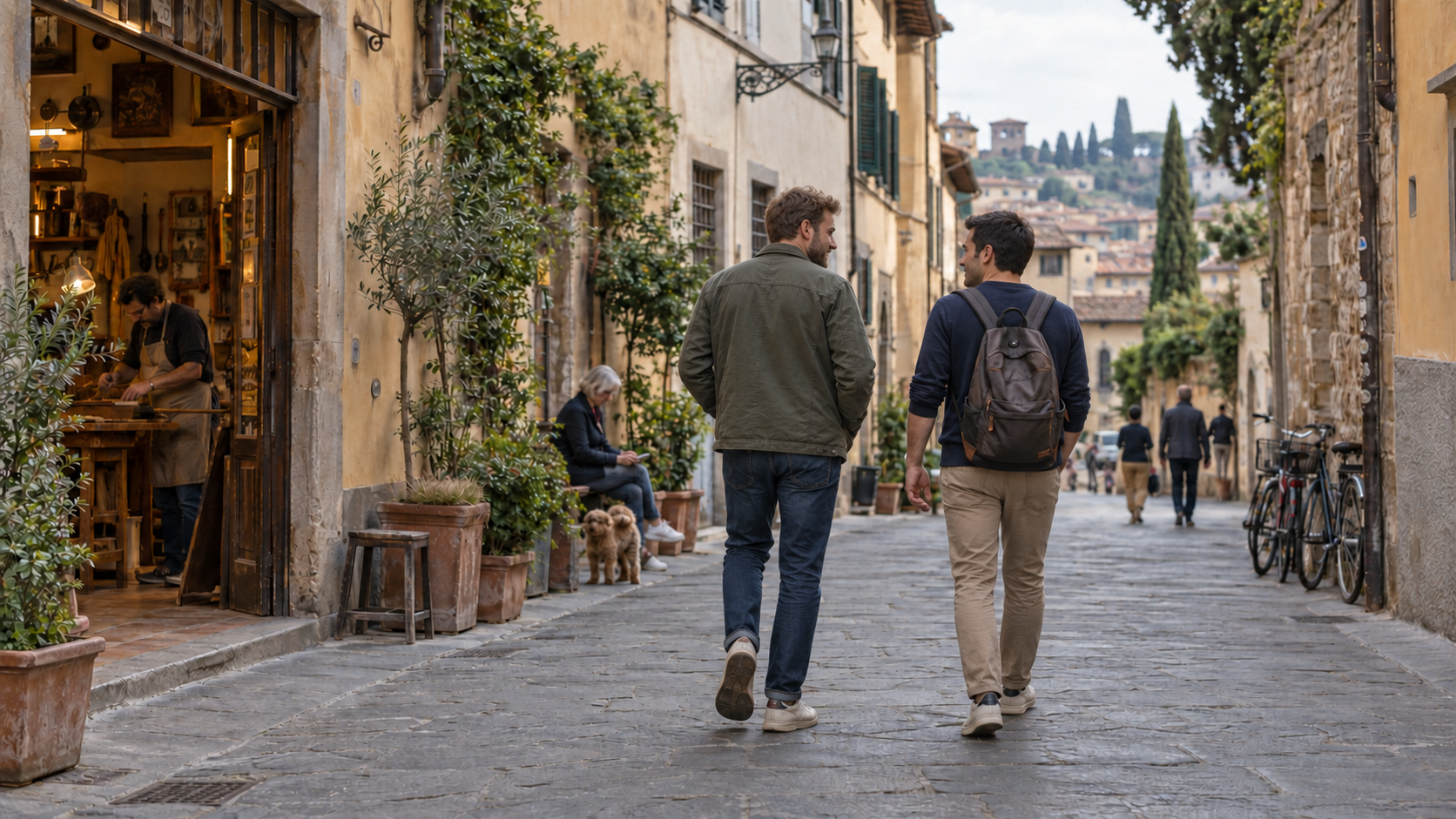
We passed through narrow lanes toward Piazza Santo Spirito. Delivery vans occupied awkward corners. Residents carried shopping bags. Bicycles leaned against walls that showed their age without trying to look picturesque. Workshop windows displayed frames, paper, leather and objects that seemed to belong to the people making them rather than to a souvenir formula.
This was still central Florence, not some undiscovered village. Restaurants had English menus, apartments had been converted for short stays and plenty of tourists knew about the Oltrarno. But the balance was different. Ordinary city life had not disappeared completely behind the performance of Florence.
In Piazza Santo Spirito, we sat outside with coffee and watched the square operate at its own pace. A man crossed it several times while speaking on his phone. Two women stopped their bicycles and continued a conversation that had probably begun somewhere else. A dog refused to move from a patch of shade.
Nothing important happened, which was precisely why we stayed.
Cristian and I talked about the difference between visiting a city and spending time in it. The first is driven by proof: the photographs, the museum tickets, the places one is expected to recognize. The second begins when that obligation weakens.
We had come to Florence for a day, but we did not need to spend the entire day confirming that we had been there.
Lunch Without a Recommendation List
We avoided the restaurants directly facing the busiest part of the square and chose a small place on a side street. It was not hidden, historic or known only to locals. It was simply open, had a few tables and did not require us to wait in a line.
We ordered a simple Tuscan lunch and a glass of wine. After the noise of the center, being able to hear an entire conversation felt like a luxury.
The people at the next table were discussing work. A server greeted someone passing outside by name. Plates came from the kitchen without ceremony. It was the kind of meal that rarely becomes a travel highlight in advance, because it cannot be sold as an attraction. Yet it gave the day its proper rhythm.
We did not rush. There was no reservation waiting and no timed entrance to miss. When we eventually returned to the street, the afternoon light had softened and our original itinerary had effectively disappeared.
From Santo Spirito to San Niccolò
We walked east through the Oltrarno, sometimes close to the river and sometimes several streets away from it. Florence revealed itself in fragments: a dark church interior glimpsed through an open door, tools arranged behind workshop glass, laundry above a courtyard and the smell of coffee escaping from a bar.
Near San Niccolò, the city felt more open. The district sits beneath the slopes leading toward Piazzale Michelangelo, but we were not interested in climbing immediately to the famous viewpoint. We stayed below, around Via di San Niccolò and the streets near Piazza Poggi.
A craftsman stood in the doorway of a small workshop, taking a break. We looked inside, careful not to behave as if every working space existed for public inspection. He noticed our interest and exchanged a few words with us.
The conversation was brief and practical. He spoke about the difficulty of keeping a workshop in an increasingly expensive city and about the difference between selling work and selling the idea of craftsmanship. There was no complaint for effect, just the direct tone of someone describing his working conditions.
That short exchange stayed with me more than many formal explanations of Florence’s artisan tradition. The city’s reputation was built not only by artists whose names now appear in museums, but also by generations of people who made things for a living. That continuity survives, although under pressure and often just beyond the most heavily traveled streets.
We thanked him and continued walking.
The City We Had Not Planned to See
Later, we sat near the river with the Torre di San Niccolò behind us. Across the Arno, Florence looked composed again. From a distance, its towers, roofs and façades returned to the image known around the world.
Up close, the day had been less orderly.
We had arrived among crowds, abandoned the most obvious route, eaten without consulting a ranking and spent an afternoon walking through neighborhoods where people were still working, shopping and arguing about ordinary things. None of this made us experts on Florence. It simply made the city feel less like a collection of masterpieces and more like a place with competing realities.
Cristian said that the best part of the day had begun when we stopped trying to see Florence.
It was exactly right.
Returning to the Station
We crossed back toward the historic center with enough time to reach Santa Maria Novella without hurrying. The central streets were still crowded, although the atmosphere had shifted. Day visitors were beginning to leave, while people arriving for the evening moved in the opposite direction.
We passed through Piazza della Repubblica and skirted the Duomo rather than stopping again. After the Oltrarno, the cathedral area seemed even more theatrical—beautiful, certainly, but staged by the sheer number of people facing it with cameras.
On the train home, the windows reflected the carriage more clearly than the darkening countryside. Cristian was tired. So was I. It had been a full day of walking, though not the day we might have described before leaving Carrara.
We had seen the landmarks, but the landmarks were not the story.
The story was the moment we decided not to enter the crowd on Ponte Vecchio. From there, Florence changed. Or perhaps we changed the way we were looking at it.
What Florence Left With Me
Florence does not need another tribute to its beauty. Its importance is established, its masterpieces are documented and its central streets receive millions of admirers.
What interested me that day was the city’s resistance to being reduced to those things.
Behind the Renaissance image is a contemporary city negotiating tourism, housing, work and the cost of preserving activities that visitors claim to value. In Santo Spirito and San Niccolò, we saw only a small portion of that reality, but enough to complicate the postcard.
I did not return to Carrara believing that we had found the “real Florence.” That phrase is used too easily. The crowded Duomo, the jewelry shops on Ponte Vecchio, the artisan workshop and the quiet table at lunch were all real. They simply belonged to different versions of the same city.
Our day became memorable when we allowed those versions to exist together.
A Practical Note for a Day Trip from Carrara to Florence
The railway station serving Carrara is Carrara-Avenza. Regional journeys to Firenze Santa Maria Novella may require a change, commonly along the coastal or Pisa route, depending on the service. Check the schedule for both the outward and return journeys before leaving, especially if traveling on a Sunday or holiday.
Florence is easy to explore on foot from Santa Maria Novella. For a day shaped like ours, walk through the historic center first, then cross the Arno by Ponte Santa Trinita and continue through Santo Spirito toward San Niccolò. This creates a natural loop and gives you both the monumental center and a less compressed part of the city.
For more ideas about rail travel in the region, see Tuscany Without a Car: Where to Stay and How to Travel by Train and Bus. Italia Mia also has a different view of the city in Walking at Night in Florence.
External Sources
- Feel Florence: San Niccolò district — the official tourism site’s route through San Niccolò, its artisan streets and nearby landmarks.
- Feel Florence: Oltrarno between Pitti, Santo Spirito and Porta Romana — an official introduction to the western Oltrarno.
- Trenitalia — current railway schedules and ticket information for Carrara-Avenza and Firenze Santa Maria Novella.