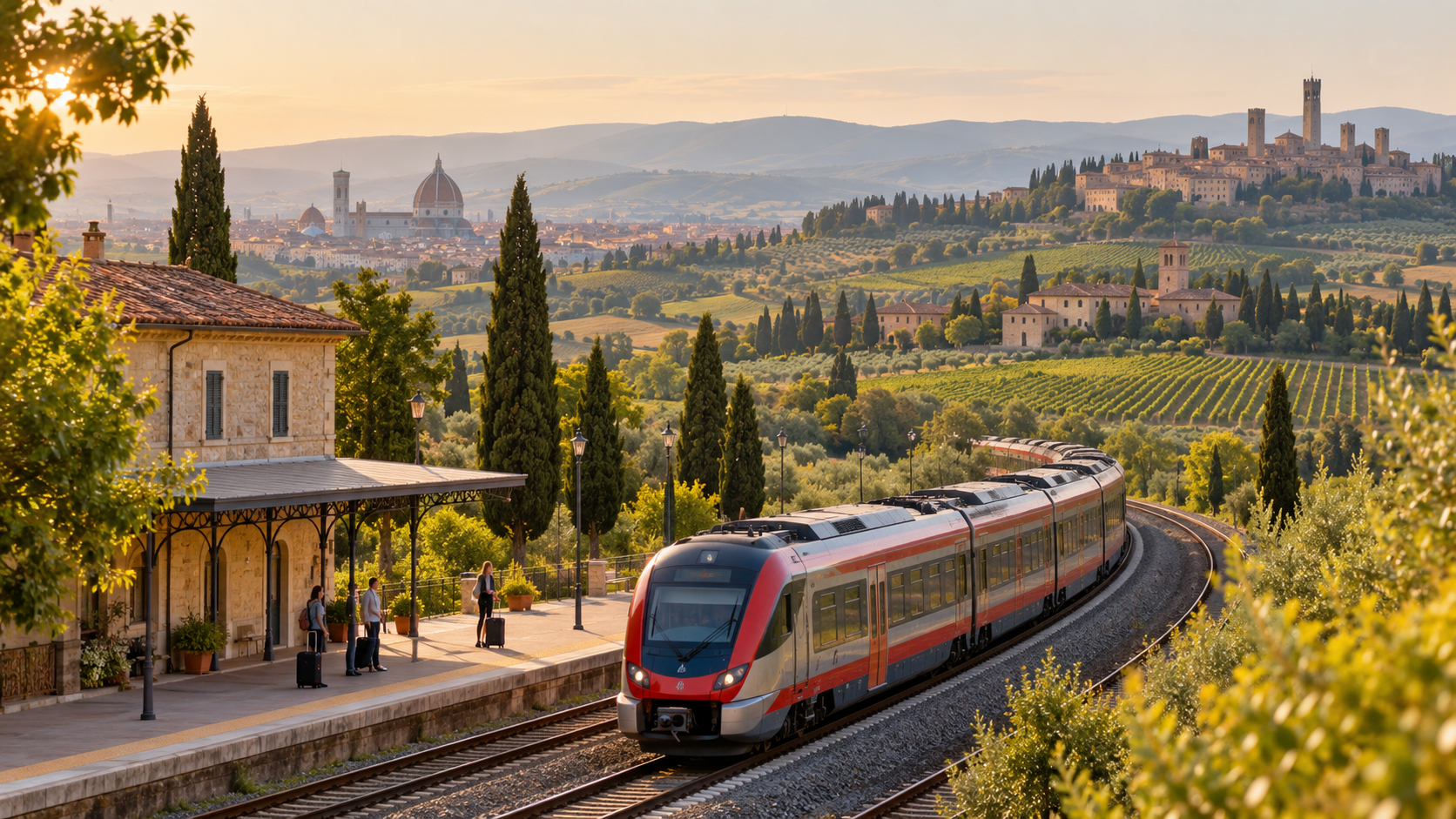
 Tuscany may be famous for winding country roads, hilltop villages and vineyard-covered landscapes, but you do not need to rent a car to enjoy many of the region’s greatest destinations.
Florence, Pisa, Lucca and Arezzo are particularly easy to visit by train. Siena also works well without a car, although buses are often more convenient than trains for reaching its historic center. The real challenge begins when you want to explore Chianti wineries, Val d’Orcia, isolated villages or countryside agriturismi.
For American visitors concerned about driving on unfamiliar roads, understanding Italian signs, finding parking or accidentally entering a restricted traffic zone, a car-free vacation can be both easier and more relaxing. Tuscany’s principal cities are connected by regional trains, while buses and organized excursions can fill many of the remaining gaps.
This guide explains where to stay, which destinations are easiest by train, when a bus is preferable and when booking an organized tour is the most practical choice.
Can You Really Visit Tuscany Without a Car?
Yes—provided you choose the right bases and understand what public transportation does well.
Tuscany’s main railway network connects Florence with Pisa, Lucca, Arezzo and Siena. Florence is the region’s most important transportation hub, with direct or connecting trains serving many of its principal cities.
A car-free Tuscany itinerary works especially well for travelers interested in:
- Renaissance art and architecture
- Historic city centers
- Museums and churches
- Restaurants, cafés and local markets
- Day trips between major Tuscan cities
- Guided excursions into the countryside
- A slower vacation with fewer logistical concerns
It is less convenient if your priority is staying at a remote farmhouse, visiting several wineries independently or exploring small villages on an improvised schedule.
The most successful approach is usually to combine trains for the larger cities with one or two organized tours for rural Tuscany.
Tuscany Without a Car at a Glance
| Destination | Best way to arrive | Ease without a car | Best use |
|---|---|---|---|
| Florence | High-speed or regional train | Excellent | Main base and cultural sightseeing |
| Pisa | Regional train | Excellent | Day trip or one-night stay |
| Lucca | Regional train | Excellent | Relaxed two-night base |
| Arezzo | Regional train | Excellent | Day trip or quieter base |
| Siena | Bus or regional train | Good | Medieval city and tour base |
| San Gimignano | Train plus bus or organized tour | Moderate | Day trip |
| Chianti | Bus or organized tour | Limited | Wine and countryside excursion |
| Val d’Orcia | Organized tour | Difficult independently | Scenic villages and landscapes |
| Montepulciano | Train plus bus or organized tour | Limited | Day trip or overnight stay |
| Pienza | Bus or organized tour | Limited | Val d’Orcia excursion |
Why Avoiding a Rental Car Can Be a Smart Decision
Renting a car provides freedom in the countryside, but that freedom comes with responsibilities that many visitors underestimate.
Historic centers throughout Tuscany commonly have a Zona a Traffico Limitato, usually abbreviated as ZTL. These restricted areas are monitored by cameras that record vehicle license plates. Entering without authorization can result in a fine, sometimes followed by an additional administrative charge from the rental-car company.
Florence’s ZTL entrances, for example, are electronically monitored, and pedestrian areas and reserved lanes are closed to ordinary private traffic.
Other potential complications include:
- Narrow medieval streets
- Limited and expensive parking
- Manual-transmission rental cars
- Different road signs and driving customs
- Toll roads
- Speed cameras
- Difficulty reaching a hotel inside a historic center
- Restrictions on where rental cars may be returned
If your itinerary concentrates on Florence, Siena, Pisa, Lucca and Arezzo, the disadvantages of a car frequently outweigh the benefits.
For more information about Italian rail travel, ticket validation and regional trains, read How to Travel by Train in Italy: The Complete Trenitalia and Italo Guide.
Florence: The Best Overall Base Without a Car
Florence is the easiest and most versatile base for a car-free Tuscany vacation.
The city is connected to Rome, Milan, Bologna, Venice and Naples by high-speed trains. Regional services connect Florence with Pisa, Lucca, Arezzo, Siena, Prato, Pistoia, Empoli and numerous smaller towns.
The most useful station is Firenze Santa Maria Novella, generally abbreviated as Firenze S. M. Novella or Firenze SMN. It is located beside the historic center, within walking distance of the Duomo, Piazza della Repubblica, Ponte Vecchio and many hotels.
Do not confuse it with Firenze Campo di Marte or Firenze Rifredi when booking a hotel or checking a ticket.
Where to Stay in Florence Without a Car
Hotels and accommodation in Tuscany — Compare hotels, apartments, villas and countryside stays across Florence, Siena, Pisa, Lucca and other Tuscan destinations.
Find hotels throughout Tuscany with Expedia
The most convenient areas are:
Santa Maria Novella
Best for travelers taking several day trips. Staying within a ten-minute walk of the station makes early departures and evening returns much easier.
Duomo and Historic Center
Best for first-time visitors who want to walk to Florence’s major attractions. The station remains reachable on foot, although cobblestones can make rolling heavy luggage uncomfortable.
Santa Croce
Atmospheric and central, with excellent restaurants and evening activity. It is slightly farther from the main station.
Oltrarno and Santo Spirito
Ideal for visitors seeking a more residential atmosphere, artisan workshops and traditional restaurants. Allow additional time to reach Santa Maria Novella for morning trains.
Easy Day Trips from Florence by Train
From Florence, you can comfortably reach:
- Pisa
- Lucca
- Arezzo
- Pistoia
- Prato
- Cortona, using Camucia-Cortona or Terontola-Cortona station
- Montecatini Terme
Siena is also connected by train, but the bus can be more convenient because it deposits passengers closer to the historic center.
Arriving from Florence Airport
Florence Airport is connected to the center by the T2 tram. The journey takes approximately 20 minutes and provides a straightforward connection to the area around Santa Maria Novella.
Best Choice For
Florence is the best base for first-time visitors, art lovers and travelers who want to make several independent day trips.
Siena: Beautiful Without a Car, but Choose Your Transportation Carefully
Siena is one of Tuscany’s most memorable cities and one of the places where arriving without a car can actually make the visit easier.
Its medieval center is compact, largely pedestrianized and filled with steep streets, stone stairways and narrow passages. Once you arrive, most major sights can be reached on foot.
The question is whether to arrive by train or bus.
Florence to Siena by Train
Regional trains normally travel between Florence and Siena through Empoli. The journey generally takes around 90 minutes, although the exact duration depends on the service.
Siena railway station is outside and below the historic center, approximately two kilometers from Piazza del Campo. Local buses connect the station with the center, and the station complex also provides access toward the upper city through a series of escalators and walkways.
The train is comfortable and straightforward, but it does not leave you in the heart of Siena.
Florence to Siena by Bus
The regional bus is often the better option for a day trip. It generally brings passengers closer to the historic center, reducing the uphill journey from the railway station.
Because stops, departure points and schedules can change, check the Autolinee Toscane journey planner shortly before traveling.
Siena’s local bus network is also operated by Autolinee Toscane and connects the railway station, outer neighborhoods and historic-center access points.
Where to Stay in Siena Without a Car
Near Piazza del Campo
The most atmospheric option and the best choice for enjoying Siena after day-trippers leave. Expect hills, stairs and cobbled streets.
Near Piazza Gramsci
A strategically convenient area for regional buses and walking into the center.
Near the railway station
Useful for train connections, but less atmospheric. Confirm that your accommodation is close to the escalator route or a practical bus stop.
Day Trips from Siena Without a Car
Siena is an excellent base for organized tours to:
- San Gimignano
- Chianti
- Monteriggioni
- Montalcino
- Pienza
- Montepulciano
- Val d’Orcia
Although public buses serve some of these destinations, services may be infrequent, especially on Sundays and holidays. A guided tour is usually the simplest way to visit several villages or wineries in one day.
Best Choice For
Siena is best for travelers who want medieval atmosphere, slower evenings and guided access to central and southern Tuscany.
Lucca: One of the Easiest Tuscan Cities Without a Car
Lucca is an exceptionally comfortable destination for car-free travelers.
Its railway station is in Piazza Ricasoli, immediately outside the Renaissance walls and only a short walk from the historic center.
After arriving, you can explore almost everything on foot. You can also rent a bicycle and ride along the broad path on top of the city walls.
Reaching Lucca by Train
Lucca has rail connections with:
- Pisa
- Florence
- Viareggio
- Pistoia
- Prato
- Aulla and northern Tuscany
Pisa to Lucca is particularly easy and usually takes approximately 25–30 minutes by regional train.
Florence to Lucca takes longer, generally around 80–100 minutes depending on the service and whether a change is required. It remains perfectly manageable for either a day trip or an overnight stay.
Where to Stay in Lucca Without a Car
Inside the walls
The best choice for atmosphere, restaurants and evening walks. Look for accommodation within reasonable walking distance of Porta San Pietro if arriving with luggage from the station.
Near Porta San Pietro
The most practical compromise between railway convenience and historic character.
Near the station
Suitable for short stays and travelers continuing to Pisa, Florence or Viareggio.
Easy Day Trips from Lucca
Without a car, Lucca works well for trips to:
- Pisa
- Viareggio and the Tuscan coast
- Montecatini Terme
- Pistoia
- Florence
Lucca is not the most efficient base for Siena or Val d’Orcia. Those journeys require more time and may involve changes.
Best Choice For
Lucca is ideal for couples, slower travelers and anyone seeking a peaceful Tuscan city that remains easy to navigate.
Pisa: Convenient, Connected and More Than a Day Trip
Pisa is one of Tuscany’s most accessible cities by public transportation.
Pisa Centrale is the main railway station and has frequent regional connections with Florence, Lucca, Livorno, Viareggio and other destinations along the Tuscan coast.
The Leaning Tower and Piazza dei Miracoli are approximately a 20–25-minute walk from Pisa Centrale. Local buses are available if you prefer not to walk.
Some regional trains also serve Pisa San Rossore, which is closer to the Leaning Tower. However, not every service stops there, and Pisa Centrale provides more connections.
Arriving at Pisa Airport
Pisa International Airport is connected with Pisa Centrale by the PisaMover automated shuttle. This makes Pisa one of the easiest arrival points for travelers beginning a car-free Tuscany itinerary.
Where to Stay in Pisa Without a Car
Between Pisa Centrale and the Arno
Convenient for travelers arriving by train or plane while remaining within walking distance of the historic center.
Around Borgo Stretto and the historic center
Better for restaurants, evening walks and city atmosphere.
Near Piazza dei Miracoli
Convenient for the Leaning Tower but farther from Pisa Centrale and some of the livelier evening areas.
Easy Day Trips from Pisa
Pisa is a practical base for:
- Lucca
- Florence
- Livorno
- Viareggio
- Pietrasanta
- The Versilia coast
Travelers interested in the coast can also consult Italia Mia’s complete guide to the Region of Tuscany for additional destination ideas.
Best Choice For
Pisa is best for travelers arriving through Pisa Airport, visitors combining Tuscany with the coast and anyone planning to pair Pisa with Lucca.
Arezzo: An Underrated and Convenient Rail Base
Arezzo is one of the most overlooked choices for a car-free Tuscan stay.
The city lies on the main railway corridor between Florence and Rome. Regional trains connect it directly with Florence, while some faster regional services make the journey in approximately 40–60 minutes.
Arezzo railway station is close to the lower end of the historic center. From there, the main streets climb gradually toward Piazza Grande, the Cathedral and the upper city.
Why Stay in Arezzo?
Arezzo receives fewer international visitors than Florence or Siena but offers:
- An attractive medieval and Renaissance center
- Piero della Francesca’s celebrated frescoes
- Traditional restaurants
- A major antiques market
- Convenient railway connections
- A more relaxed local atmosphere
Where to Stay in Arezzo Without a Car
Near Corso Italia
This provides a convenient pedestrian route between the station and the historic center.
Near Piazza Grande
More atmospheric, although the uphill streets and cobbles may be challenging with luggage.
Near the railway station
Practical for day trips and early departures while remaining within walking distance of central Arezzo.
Easy Day Trips from Arezzo
By train, Arezzo provides access to:
- Florence
- Cortona
- Castiglion Fiorentino
- Chiusi
- Orvieto
- Rome
Local rail services operated by Trasporto Ferroviario Toscano also connect Arezzo with the Casentino Valley and destinations such as Poppi and Stia. Tuscany’s regional rail information identifies Arezzo as the interchange for these local services.
Travel between Arezzo and Siena is less convenient than the map might suggest. A bus may be preferable, but schedules should be checked carefully. If Siena is an essential part of your trip, visiting it from Florence or staying overnight is usually easier.
Best Choice For
Arezzo suits repeat visitors, independent travelers and anyone who prefers a less crowded Tuscan base with good train service.
Which Tuscany Base Should You Choose?
Choose Florence If You Want the Easiest First Visit
Florence offers the most rail connections, the greatest concentration of museums and the widest selection of tours. It is the safest overall choice for a first trip without a car.
Choose Siena for Medieval Tuscany and Countryside Tours
Siena is more atmospheric at night and places you closer to Chianti, San Gimignano and Val d’Orcia. It works best when you are willing to use buses and organized excursions.
Choose Lucca for a Relaxed, Walkable Stay
Lucca is smaller, calmer and extremely pleasant without a vehicle. It combines particularly well with Pisa and the coast.
Choose Pisa for Airport Convenience
Pisa is practical when using Pisa International Airport or exploring western Tuscany. It also gives you fast access to Lucca.
Choose Arezzo for Fewer Crowds
Arezzo offers an authentic city experience, good rail access and lower visitor pressure than Florence or Siena.
When an Organized Tour Is Better Than a Bus
Public transportation is designed primarily for residents rather than for visitors moving between vineyards and scenic villages.
An organized tour is usually worth considering for:
Chianti Wine Country
Public buses serve some Chianti towns, but wineries are often located outside the villages. A tour avoids the need to coordinate multiple buses and allows everyone in your group to taste wine without driving.
San Gimignano and Monteriggioni
San Gimignano has no railway station. Independent travelers generally take a train to Poggibonsi and continue by bus. This is possible, but a tour is easier if you want to combine San Gimignano with Siena, Chianti or Monteriggioni.
Val d’Orcia
Pienza, Montalcino, Bagno Vignoni and the surrounding countryside are among Tuscany’s most beautiful destinations, but they are not connected by a convenient railway network. Buses can be limited, particularly outside weekday commuting hours.
A tour from Siena or Florence is usually the most efficient car-free solution.
Winery Visits
Never assume that a winery is within walking distance of the village named in its address. Many estates are several miles down rural roads without sidewalks or regular public transportation.
Confirm transportation before reserving a tasting.
A Recommended Seven-Day Tuscany Itinerary Without a Car
Days 1–3: Florence
Spend three nights in Florence. Visit the Duomo, Uffizi Gallery, Accademia, Ponte Vecchio, Oltrarno and Santa Croce.
If this is your first Italian vacation, the practical advice in Italy for First-Time Visitors will help with planning transportation, accommodations and sightseeing.
Day 4: Siena
Travel from Florence to Siena by regional bus or train. Stay overnight so you can enjoy Piazza del Campo after the daytime crowds have departed.
Day 5: Tuscan Countryside Tour
Join a tour from Siena covering either:
- Pienza, Montalcino and Val d’Orcia, or
- San Gimignano, Monteriggioni and Chianti
Return to Siena for a second night.
Day 6: Lucca
Travel from Siena to Lucca, usually with one or more connections. Because this is the least convenient transfer in the itinerary, leave in the morning and avoid scheduling a tightly timed activity immediately after arrival.
Walk or cycle the city walls and stay overnight inside the historic center.
Day 7: Pisa
Take the short regional train from Lucca to Pisa. Visit Piazza dei Miracoli, the Leaning Tower, Cathedral, Baptistery and historic center.
Depart from Pisa Airport or continue by train to Florence, Rome or another Italian destination.
An Even Easier Two-Base Itinerary
Travelers who prefer fewer hotel changes can use just two bases.
Four Nights in Florence
Use Florence for:
- Florence sightseeing
- Arezzo by train
- Siena by bus or train
- A guided Chianti excursion
Three Nights in Lucca or Pisa
Use Lucca or Pisa for:
- Lucca
- Pisa
- Viareggio or another coastal town
This arrangement minimizes luggage handling while still providing a varied experience.
Buying Train and Bus Tickets
Train Tickets
Use the official Trenitalia website or Trenitalia app for regional trains.
Regional train tickets generally do not become significantly cheaper when purchased far in advance. Check the ticket’s conditions carefully because validation procedures differ between paper and digital tickets.
Italia Mia’s complete Italian train guide explains ticket types, validation, reservations and the differences between regional and high-speed trains.
Bus Tickets
Use the official Autolinee Toscane website or its mobile app for routes, current schedules and ticket information.
Contactless payment is available on many Tuscan buses and trams. On extra-urban services, passengers using the contactless system should remember to tap correctly when required, including when leaving the bus.
Do not rely exclusively on schedules shown by third-party travel websites. Roadworks, festivals, school schedules and seasonal service changes can affect routes and departure points.
Practical Advice for American Visitors
Pack Light
Lifts are not guaranteed in small stations, and historic hotels may have stairs. A medium suitcase is considerably easier to manage than multiple large bags.
Learn the Italian Station Names
Useful names include:
- Firenze Santa Maria Novella
- Pisa Centrale
- Lucca
- Siena
- Arezzo
Allow Time for Connections
For regional journeys, avoid building an itinerary around extremely short connections. A 20–30-minute margin reduces stress.
Check Sunday and Holiday Schedules
Bus frequency may be substantially lower on Sundays and Italian public holidays.
Download the Apps Before Leaving Home
Install and configure the Trenitalia and Autolinee Toscane apps while you still have reliable internet access. Saving payment information can make ticket purchases easier during the trip.
Keep a Backup Payment Method
Carry both a physical credit card and some euros. American travelers should make sure their card supports contactless payments and that they know the card’s PIN.
Stay Near Transportation—but Not Necessarily Beside It
A hotel within a ten-minute walk of a station or major bus stop is usually ideal. Staying directly opposite a station may be convenient, but the neighborhood may not offer the atmosphere you want.
Confirm Late-Evening Transportation
Train and bus service becomes less frequent at night. Check the final return options before committing to a long dinner or evening event in another town.
Recommended Tuscany Books
Rick Steves Florence & Tuscany
A practical guide for American visitors, with clear explanations of transportation, sightseeing priorities, museum reservations and realistic itineraries. It is particularly useful for travelers visiting Florence, Siena, Pisa and Lucca without a car.
Lonely Planet Florence & Tuscany
A broad regional guide with destination descriptions, maps, restaurant suggestions and transportation information. This is a good choice for travelers combining famous cities with smaller Tuscan towns.
DK Eyewitness Florence and Tuscany
Known for its photographs, illustrations and visual maps, this guide is helpful for understanding the layout of historic centers, major museums and architectural landmarks before arriving.
Fodor’s Florence & Tuscany
A useful option for travelers looking for hotel, restaurant and itinerary recommendations alongside practical information about Florence and the Tuscan countryside.
Tuscany Marco Polo Pocket Guide
A compact guide suitable for travelers who prefer carrying a lighter book during day trips. It offers concise destination information, maps and practical suggestions without the bulk of a full regional guide.
As an Amazon Associate, Italia Mia may earn from qualifying purchases.
Is Tuscany Better With or Without a Car?
Neither option is universally better.
A car is valuable for:
- Remote agriturismi
- Independent winery visits
- Val d’Orcia
- Small hill towns
- Flexible countryside photography
- Longer stays in rural areas
Public transportation is better for:
- Florence
- Pisa
- Lucca
- Arezzo
- Central Siena
- Travelers uncomfortable with Italian driving
- Visitors concerned about parking and ZTL fines
- Short trips focused on art cities
For many first-time visitors, the ideal solution is a mostly car-free itinerary with one or two organized countryside tours.
You can experience Florence’s Renaissance masterpieces, Siena’s medieval streets, Lucca’s walls, Pisa’s monuments and Arezzo’s quieter historic center without sitting behind the wheel once.
Frequently Asked Questions
What is the best city to stay in Tuscany without a car?
Florence is the best overall choice because it has the most extensive railway connections and the largest selection of organized day tours.
Can I visit Siena from Florence without a car?
Yes. Both regional trains and buses connect Florence with Siena. The bus is often more convenient for a day trip because it arrives closer to Siena’s historic center.
Can I visit Pisa and Lucca on the same day?
Yes. Pisa and Lucca are connected by a short regional train journey. However, spending one night in Lucca creates a more relaxed experience.
Is Arezzo easy to reach by train?
Yes. Arezzo is on the principal Florence–Rome railway corridor and is one of the easiest Tuscan cities to visit without driving.
Can I visit San Gimignano by train?
Not directly. San Gimignano has no railway station. The usual independent route involves taking a train to Poggibonsi and continuing by bus.
Can I reach Chianti wineries by public bus?
Some Chianti villages have bus service, but many wineries are outside the towns. A wine tour is generally more convenient and eliminates concerns about drinking and transportation.
Do Tuscan buses accept credit cards?
Contactless payment is available across much of the Autolinee Toscane network, but carrying a backup card and some cash remains sensible.
Should I buy regional train tickets in advance?
Advance purchase is not normally necessary for price reasons, but buying digitally can save time at the station. Always check the conditions and validation requirements attached to your ticket.
Final Recommendation
American travelers should not feel obligated to rent a car simply because they are visiting Tuscany.
Base yourself in Florence for art, transportation and easy day trips. Add Siena if you want medieval atmosphere and organized excursions into Chianti or Val d’Orcia. Choose Lucca or Pisa for western Tuscany, and consider Arezzo when you want excellent train connections with fewer crowds.
Tuscany without a car requires slightly more planning, but it removes the stress of parking, tolls, unfamiliar roads and restricted traffic zones. More importantly, trains and buses allow you to watch the Tuscan landscape pass outside the window while someone else handles the driving.
External Resources
- Trenitalia: Official Train Schedules and Tickets
- Trenitalia Regional Services in Tuscany
- Autolinee Toscane: Official Bus Schedules and Tickets
- Visit Tuscany: Tuscany by Train
- Feel Florence: Transportation and Mobility
- Visit Siena: Tourist and Transportation Information
- Lucca Tourism: Getting Around