
Part of Unexpected Italy: Stories from My Recent Travels
 The useful thing about living near the Tuscan coast is that Italy can change completely before lunchtime. From Viareggio, the sea establishes the scale of the morning: flat light, umbrella pines, beach establishments and the long line of the promenade. Fiumalbo belongs to another geography. It is a stone mountain village in Emilia-Romagna, reached only after crossing the Apennines at Abetone.
That contrast was the reason for the trip. I was not looking for a complicated itinerary or a checklist of attractions. I wanted to drive inland, stop at Abetone and continue over the regional border to a town I had passed near but never examined properly. Fiumalbo was close enough for a day trip, yet different enough to feel like a real departure.
The distance on a map does not explain the journey. In a little more than two hours, depending on traffic and stops, the road leaves the Versilia coast, follows the Serchio valley and climbs into the forests of the Tuscan-Emilian Apennines. The landscape changes by degrees, but the final effect is abrupt. By the time I reached Fiumalbo, Viareggio felt much farther away than it actually was.
Leaving Viareggio and Turning Inland
I left Viareggio in the morning, before the day had settled into beach traffic. The first part of the drive toward Lucca was familiar: low land, cultivated fields and the Apuan Alps visible at an angle that made them seem like a wall behind the coast.
Near Lucca, the journey turned north and began following the Serchio. This is where the day stopped feeling like an ordinary drive across Tuscany. The broad coastal horizon disappeared. The road entered a narrower landscape of river, railway, wooded slopes and villages built where the valley allowed them to exist.
The route passed through the territory of Borgo a Mozzano and Bagni di Lucca before continuing into the mountains. I did not treat every place as a required stop. That would have defeated the purpose of reaching Fiumalbo with enough time to walk through it slowly. Still, the Ponte della Maddalena near Borgo a Mozzano—better known as the Devil’s Bridge—was difficult to ignore from this route. Its asymmetrical arches belong so perfectly to the Serchio valley that the bridge appears less constructed than balanced there.
Bagni di Lucca introduced another Italy: the old thermal town, quieter than its nineteenth-century reputation, with villas and buildings that recall the period when foreign visitors came to the valley for the waters and summer air. From that point onward, the climb became more insistent.
For travelers planning a longer journey through the region, Italia Mia’s complete Tuscany travel guide provides a broader introduction, while the Tuscany road-trip itinerary is useful for connecting the coast with inland destinations.
The Climb Toward Abetone
Mountain roads impose their own pace. Distances that look minor require attention, and the driver sees less of the scenery than the passenger. The road bends through chestnut and beech woods, passing small settlements and opening occasionally toward slopes that reveal how high the route has already climbed.
The temperature changed before the architecture did. Even on a warm day in Viareggio, the air became noticeably cooler as I approached Abetone. That practical difference is part of the attraction. People on the coast spend summer searching for shade and a breeze; in the mountains, both arrive without negotiation.
Abetone sits at approximately 1,388 meters and has long been associated with skiing. Out of season, the lifts, hotels and ski shops give the town a suspended quality. It does not disappear in summer, but it becomes easier to see the pass beneath the resort—the strategic crossing between Tuscany and the old Modenese territories.
I stopped rather than driving straight through. Abetone is not a village that needs several hours on a day like this, but it deserves more than a glance through the windshield. The two stone pyramids near the pass commemorate the historic boundary between the Grand Duchy of Tuscany and the Duchy of Modena. Today the regional border lies a little farther along the road, but the monuments still make the political history of the landscape visible.
The name Abetone comes from a large fir tree—an abete—that was cut down when the road was built in the eighteenth century. The town later became one of Italy’s best-known ski destinations, but its first importance came from movement: this was a place created because people needed to cross the mountains.
That history suited the day. Abetone was not the destination but the hinge of the journey.
Crossing from Tuscany into Emilia-Romagna
Beyond the pass, the road entered Emilia-Romagna. There was no dramatic transformation at the regional sign. The forest did not change species and the mountains did not reorganize themselves. Yet the direction of the valleys had changed. Water on one side eventually moved toward the Tyrrhenian basin; on the other, the territory opened toward Modena and the Po Valley.
Fiumalbo was only a short drive ahead. This proximity is one reason the town can be missed. Visitors often think of Abetone as the conclusion of the journey from Tuscany, while skiers continue toward their accommodation without considering a stop in the historic village below. Fiumalbo rewards the small decision to leave the main flow of traffic.
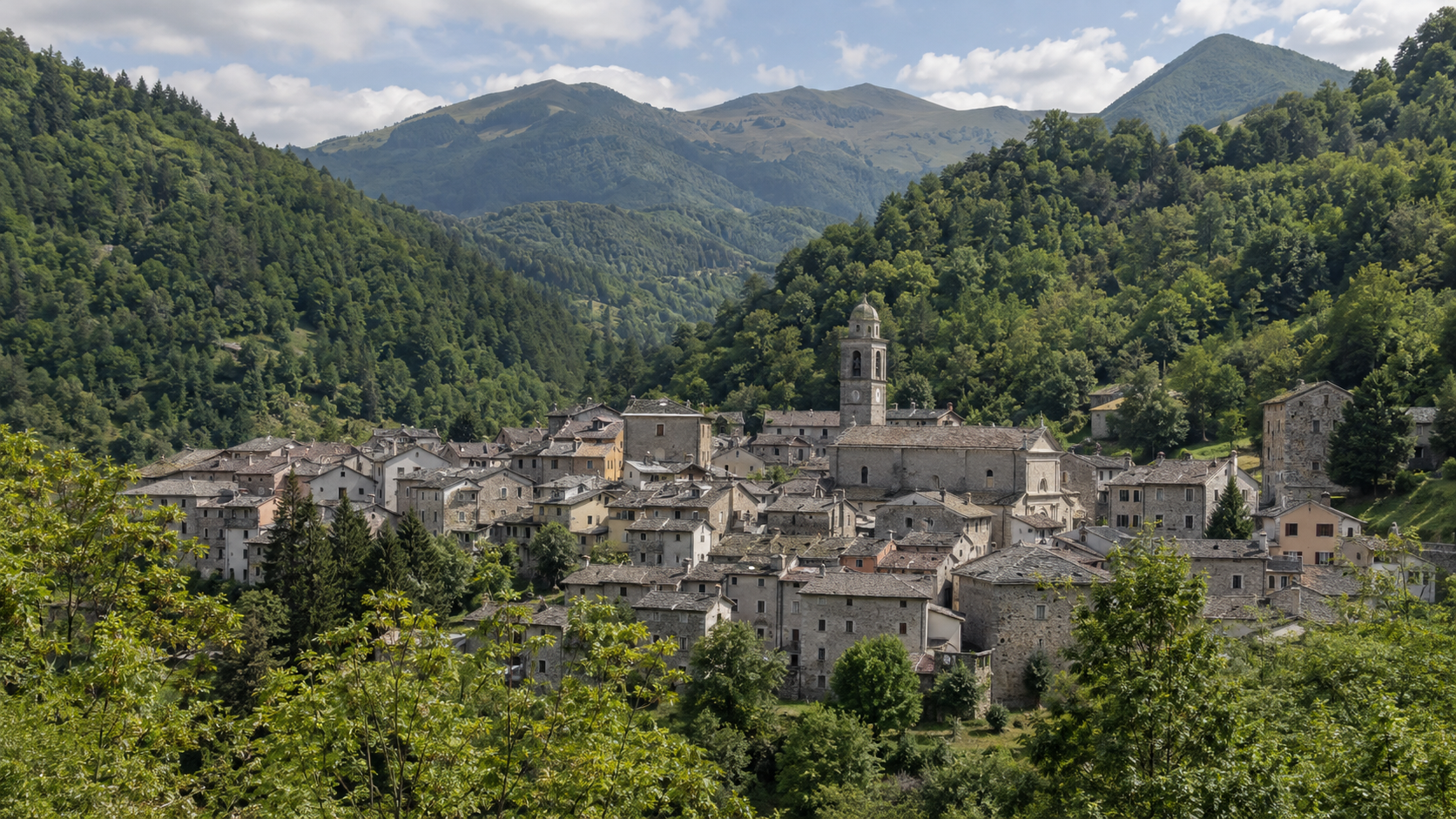
The first view explained the town’s character immediately: gray stone roofs, compact buildings and church towers collected above streams at the bottom of the mountain valley. The name is commonly connected with the Latin Flumen Album, or “white river.” Water is not incidental here. The Acquicciola and Pozze streams meet at Fiumalbo to form the Scoltenna, and their sound follows parts of the walk through the village.
Entering Fiumalbo on Foot
I left the car outside the oldest streets and continued on foot. That is the correct scale for Fiumalbo. The center is small, but not decorative in the artificial sense. Stone houses stand close together because mountain settlements were built for protection, limited space and severe winters, not to provide picturesque compositions for visitors.
The streets rise and narrow without becoming difficult to understand. There are arches, small squares, old doorways and passages that reveal the next roof or bell tower rather than a grand urban panorama. Fiumalbo has been included among Italy’s most beautiful villages and has received the Touring Club Italiano’s Orange Flag, but it has not been polished into anonymity. It still feels like a place whose beauty comes from its structure rather than from tourism management.
The parish church of San Bartolomeo stands at the center of the village’s religious and civic history. Its origins reach back to the medieval period, although the building was substantially altered over the centuries. The carved stone, side chapels and surviving Romanesque elements are more interesting when considered as evidence of continuity. This was not a monument imported into the town. It developed with the community around it.
Nearby, the Church of Santa Caterina—also known as the church of the Rossi confraternity—now houses a small museum of sacred art. At the edge of the historic center, the Renaissance Oratory of San Rocco preserves sixteenth-century frescoes. None of these sites requires the scale or preparation of a major museum visit. Together, however, they establish that Fiumalbo is more than a convenient mountain stop.
Lunch Without Turning It into an Event
By early afternoon, I wanted lunch rather than another attraction. Mountain menus in this part of the Apennines naturally lean toward substantial food: handmade pasta, mushrooms when in season, cured meats, polenta, game and cheeses. The cuisine is geographically Emilia-Romagna but influenced by the Tuscan side of the pass.
I chose a straightforward meal and avoided the temptation to order as if I were staying overnight. That is an important discipline on a mountain day trip. A long lunch followed by a winding descent is not always the intelligent version of leisure.
What mattered was the setting. In Viareggio, lunch often carries the background noise of scooters, the promenade and the sea. In Fiumalbo, the sound was water and the occasional conversation crossing a small room. The difference did not require a dramatic event or a staged encounter. It was already present in the ordinary details.
After eating, I walked again through the center. The village did not offer a new spectacle around every corner, and I appreciated that. Some places become exhausting because they continually insist on their importance. Fiumalbo allowed the visitor to notice proportion: the width of a lane, the weight of a slate roof, a vegetable garden behind stone or the practical position of a house above the stream.
The Unexpected Part of the Day
The surprise was not finding a hidden monument or meeting an eccentric stranger. It was realizing how quickly one version of Italy had replaced another.
That morning had begun on the Tyrrhenian coast in a town associated with beaches, Liberty architecture and Carnival. By afternoon I was in a medieval village above 900 meters, on the other side of the Apennines and in another region. Between them stood a road through the Serchio valley, a historic mountain pass and a series of landscapes that rarely appear together in the same account of Tuscany.
Travel writing often treats regions as self-contained worlds. Tuscany becomes Florence, vineyards and hill towns; Emilia-Romagna becomes Bologna, Parma and the Po Valley. This drive exposes how incomplete those categories are. The mountain border is not an empty line between two famous regions. It has its own settlements, food, dialects and history.
Fiumalbo’s dialect is itself a product of that position, belonging broadly to the northern Italian linguistic area while carrying the effects of centuries near Tuscany. The buildings and churches tell a similar story. The town is Modenese, but it has always lived with the pass.
Returning Toward the Coast
I began the return before late afternoon. The descent required as much concentration as the climb, but the direction of travel changed the views. At Abetone, the pass no longer felt like an objective. It marked the point at which the sea-facing side of the mountains began again.
The road gradually widened into the Serchio valley. Places I had noticed only briefly in the morning appeared from a different angle, and the warmer air returned in stages. By the time I approached Lucca and then Viareggio, the light had recovered the flatter, brighter quality of the coast.
The sea was still where I had left it. That sounds obvious, but it was the final measure of the day. Fiumalbo had not required a flight, a hotel or an elaborate plan. It had required turning away from the coast and continuing beyond the point where many day-trippers stop.
This is what made the journey worth including in Unexpected Italy. The destination was beautiful, but the real subject was the crossing. Viareggio, Bagni di Lucca, Abetone and Fiumalbo belong to the same day’s drive, yet each one occupies a different Italy. The road connected them without making them alike.
Practical Notes for a Fiumalbo Day Trip from Viareggio
Allow roughly two to two and a half hours of driving each way, depending on traffic, road conditions and stops. Navigation may offer variations, but the scenic logic of the journey is to reach the Serchio valley, continue past Bagni di Lucca and climb toward the Abetone Pass before descending the short distance to Fiumalbo.
Mountain weather can differ sharply from conditions in Viareggio. Carry a light jacket even in summer, and check the forecast before leaving. In winter, verify road conditions and any requirements for snow tires or chains.
Leave time for at least one stop at Abetone and two or three hours in Fiumalbo. Comfortable shoes are useful on the village’s sloping stone streets. Church and museum opening times may be limited, particularly outside weekends and the main visitor seasons, so check locally if entering a specific site is important to you.
The drive is most enjoyable when daylight is not rushed. Leaving Viareggio early makes it possible to stop along the Serchio, walk through Fiumalbo, have lunch and begin the return before evening without turning the day into a race.
External Sources
Abetone–Val di Luce Ski Area – Visit Tuscany