The Perfect Tuscany Road Trip: 7-Day and 10-Day Itineraries
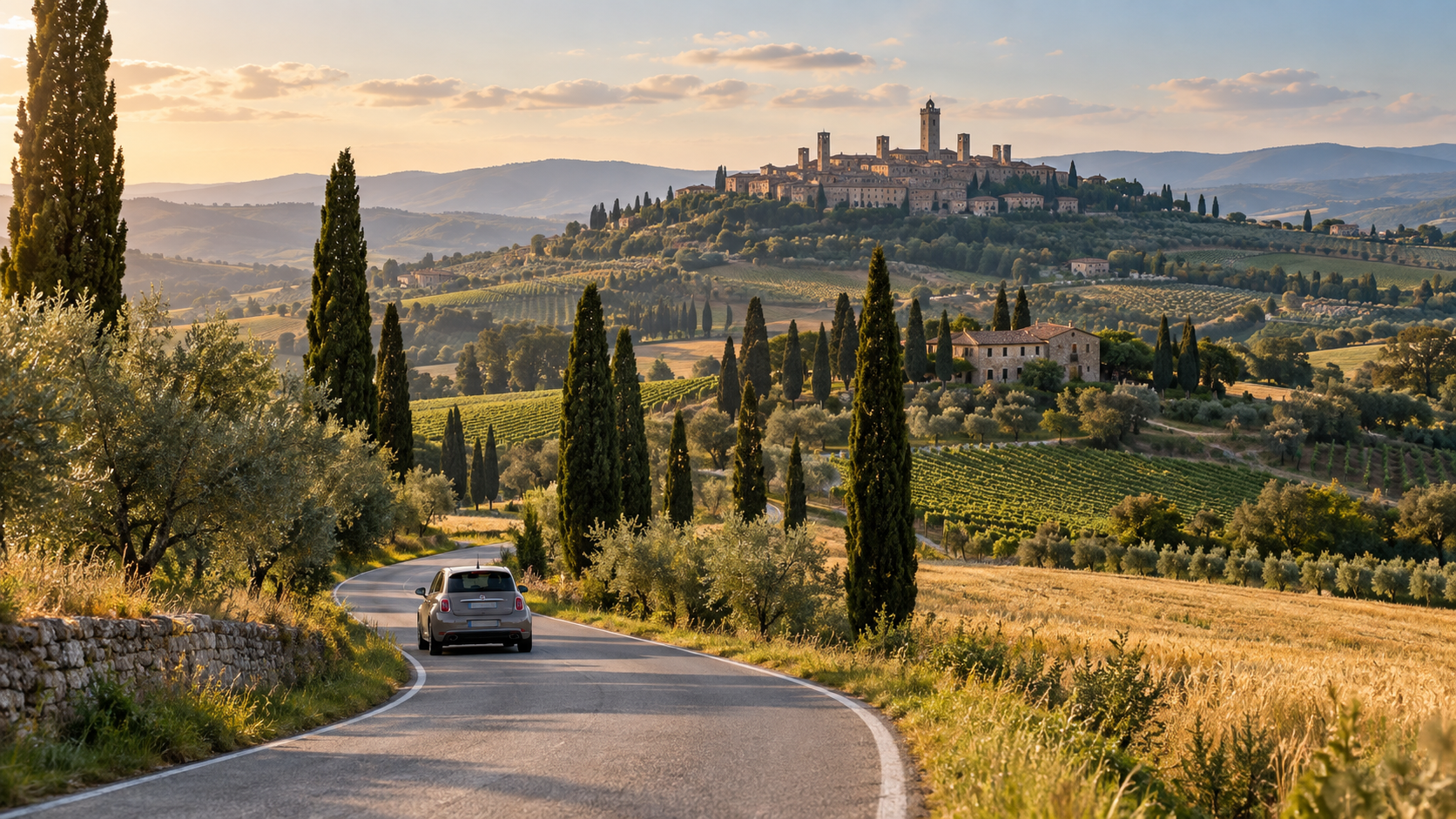
A road trip is one of the most rewarding ways to experience Tuscany.
Trains connect major cities such as Florence, Pisa, Lucca and Arezzo, but much of Tuscany’s beauty lies between its railway stations: medieval villages on isolated hilltops, vineyardsreached by narrow country roads, Romanesque churches surrounded by olive trees and scenic viewpoints where the journey itself becomes part of the experience.
Driving allows you to move beyond Tuscany’s famous cities and explore places such as Pienza, Montepulciano, Montalcino, San Quirico d’Orcia, Volterra and the Chianti countryside at your own pace.
It also requires preparation.
Historic centers frequently have restricted traffic zones, parking is usually outside town walls and journey times can be longer than they appear on a map. The best Tuscany road trip leaves room for slow lunches, unexpected stops and evenings when you decide not to drive anywhere at all.
This guide provides two carefully structured routes:
- A 7-day Tuscany itinerary covering the region’s essential destinations
- A 10-day Tuscany itinerary adding Lucca, Pisa, Volterra and a slower exploration of the countryside
Before choosing your stops, browse our guide to the 25 best places to visit in Tuscany and our complete introduction to the Region of Tuscany.
Tuscany Road Trip at a Glance
| Itinerary | Principal Stops | Best For |
|---|---|---|
| 7 days | Florence, Chianti, San Gimignano, Siena, Val d’Orcia, Montepulciano and Pienza | First-time visitors with one week |
| 10 days | Florence, Lucca, Pisa, Volterra, San Gimignano, Siena, Chianti and Val d’Orcia | Travelers wanting a more complete circuit |
| Recommended airports | Florence or Pisa | Convenient arrivals and car rentals |
| Best seasons | April–June and September–October | Mild weather and attractive countryside |
| Suggested car | Compact vehicle | Narrow streets and easier parking |
| Best city without a car | Florence | Walkable center and extensive public transportation |
| Best countryside base | Pienza, Montepulciano or San Quirico d’Orcia | Val d’Orcia and southern Tuscany |
| Best medieval base | Siena | Central position and evening atmosphere |
Driving distances and times in this guide are approximate. Traffic, road construction, weather, parking and stops can considerably change the duration of a journey.
Should You Rent a Car for Tuscany?
You do not need a car to visit Florence, Pisa, Lucca or Arezzo. These cities have railway stations and can be explored largely on foot.
A car becomes valuable when you want to visit:
- Chianti wineries
- Val d’Orcia
- Pienza
- Montalcino
- San Quirico d’Orcia
- Bagno Vignoni
- Pitigliano and the southern Maremma
- Smaller villages and countryside accommodations
- Agriturismi outside towns
- Scenic roads and rural viewpoints
The most sensible arrangement is often to spend the first part of the journey in Florence without a vehicle. Collect the rental car when leaving the city and return it before reentering Florence or at another convenient city or airport.
This saves rental and parking costs while reducing the risk of accidentally entering Florence’s restricted traffic zone.
The Perfect 7-Day Tuscany Road Trip
This seven-day itinerary provides a strong introduction to Tuscany without changing hotels every night.
The route begins with two days in Florence, followed by a countryside journey through Chianti, San Gimignano, Siena and the Val d’Orcia.
Seven-Day Route Summary
| Day | Route | Overnight |
|---|---|---|
| 1 | Arrive in Florence | Florence |
| 2 | Florence | Florence |
| 3 | Florence → Chianti → San Gimignano | San Gimignano or countryside |
| 4 | San Gimignano → Monteriggioni → Siena | Siena |
| 5 | Siena → Montalcino → Bagno Vignoni | Pienza, San Quirico or Montepulciano |
| 6 | Pienza → Val d’Orcia → Montepulciano | Pienza, San Quirico or Montepulciano |
| 7 | Return to Florence or continue to Rome | Departure |
Day 1: Arrive in Florence
Begin the journey in Florence without collecting your rental car.
Florence’s historic center is compact, highly walkable and protected by a restricted traffic zone. A car offers little advantage while you are visiting the city and can create unnecessary parking costs and complications.
After checking into your hotel, spend the afternoon becoming familiar with the center.
Walk from the Cathedral of Santa Maria del Fiore through Piazza della Signoria to the Ponte Vecchio. Cross the Arno into Oltrarno, where smaller streets, artisan workshops and neighborhood restaurants reveal a more intimate side of Florence.
If energy permits, continue to Piazzale Michelangelo for a panoramic sunset view over the city.
Suggested First-Day Walk
- Florence Cathedral
- Piazza della Repubblica
- Piazza della Signoria
- Uffizi courtyard
- Ponte Vecchio
- Oltrarno
- Piazzale Michelangelo
Avoid scheduling several timed museum reservations on arrival day. Flight delays, jet lag and transportation disruptions can make a rigid schedule stressful.
Overnight: Florence
Day 2: Renaissance Florence
Dedicate the second day to Florence’s artistic heritage.
Reserve either the Uffizi Galleries or Accademia Gallery in advance, particularly during spring, summer and early autumn. Trying to visit both major museums, the cathedral complex and several churches in one day can become exhausting.
A balanced itinerary might include the Accademia in the morning, followed by the Cathedral, Piazza della Signoria and Santa Croce. Alternatively, begin at the Uffizi and spend the afternoon exploring Palazzo Pitti and the Boboli Gardens.
Florence is also one of Italy’s most important shopping destinations. Our guide to buying leather goods, gold jewelry and fashion in Florence explains where to shop and how to recognize better-quality products.
Choose One Morning Priority
- Uffizi Galleries
- Accademia Gallery and Michelangelo’s David
- Florence Cathedral and Brunelleschi’s Dome
Spend the Afternoon Exploring
- Santa Croce
- Palazzo Pitti
- Boboli Gardens
- Santo Spirito
- San Frediano
- Artisan workshops in Oltrarno
Overnight: Florence
Day 3: Florence to Chianti and San Gimignano
Approximate driving: 90–120 kilometers, depending on the route and stops
Driving time without stops: Approximately two and a half hours
Collect your rental car from an airport or location outside the most complicated part of Florence whenever practical. Ask the rental agency to explain the correct route out of the city without entering unauthorized streets.
Travel south into Chianti.
Rather than racing directly to San Gimignano, allow the road through the countryside to become part of the day. Greve in Chianti, Panzano, Castellina in Chianti and smaller villages offer opportunities for lunch, wine tasting and short walks.
A possible route is:
Florence → Greve in Chianti → Panzano → Castellina in Chianti → San Gimignano
The regional road often called the Chiantigiana passes through vineyards, woodland and villages between Florence and Siena. It is scenic, but sections can be narrow and winding.
If visiting a winery, reserve in advance. Many respected estates do not operate as casual walk-in tasting rooms. If everyone in the group plans to taste wine, arrange a driver or guided experience instead of driving.
Continue to San Gimignano in the afternoon. Once the tour buses depart, the medieval town becomes substantially quieter. Walk through Piazza della Cisterna, visit the Collegiate Church and climb Torre Grossa if time permits.
Spending the night in or near San Gimignano allows you to enjoy the town in the evening and early morning.
Overnight: San Gimignano or a nearby agriturismo
Day 4: San Gimignano, Monteriggioni and Siena
Approximate driving: 50 kilometers
Driving time without stops: About one hour
Leave San Gimignano after breakfast and drive toward Monteriggioni.
This compact fortified village is surrounded by medieval walls and can be explored in approximately two hours. Walk through Piazza Roma, visit the small church and access the available sections of the walls for views over the surrounding countryside.
Continue to Siena and park outside the historic center.
Siena is best explored on foot. Begin in Piazza del Campo, then visit Siena Cathedral, one of Italy’s most remarkable Gothic buildings. If available, the cathedral’s combined ticket may include access to additional areas such as the Piccolomini Library, Baptistery, crypt and panoramic viewpoints.
Do not treat Siena as merely an afternoon stop. Staying overnight changes the experience. When day-trippers leave, Piazza del Campo becomes a place for an evening walk, an aperitivo or a relaxed dinner.
The official Visit Siena website provides current information about attractions, transportation and local events.
Overnight: Siena
Day 5: Siena to Montalcino and Bagno Vignoni
Approximate driving: 90 kilometers
Driving time without stops: About two hours
Leave Siena for southern Tuscany and the Val d’Orcia.
The countryside gradually opens into broad cultivated hills, isolated farmhouses and cypress-lined roads. UNESCO recognizes the Val d’Orcia as a cultural landscape shaped during the Renaissance according to ideals of beauty, agricultural productivity and good governance.
Your first principal stop is Montalcino, the hill town associated with Brunello di Montalcino.
Explore the fortress and historic center before visiting a wine estate or enoteca. Winery visits should be arranged in advance, and anyone responsible for driving should limit alcohol consumption.
The Abbey of Sant’Antimo, located in the countryside south of Montalcino, makes a worthwhile additional stop.
Continue toward San Quirico d’Orcia and Bagno Vignoni. The center of Bagno Vignoni contains an extraordinary rectangular pool filled with thermal water. Bathing is prohibited in the historic pool, but spa facilities operate nearby.
Choose a countryside hotel, agriturismo or town accommodation in Pienza, San Quirico d’Orcia or Montepulciano.
Overnight: Pienza, San Quirico d’Orcia or Montepulciano
Day 6: Pienza, Val d’Orcia and Montepulciano
Approximate driving: 50–80 kilometers
Driving time without stops: One and a half to two hours
Day six is devoted to the classic landscapes of the Val d’Orcia.
Begin in Pienza, the Renaissance town associated with Pope Pius II. Visit Piazza Pio II, Palazzo Piccolomini and the streets overlooking the valley. Shops throughout the center sell pecorino di Pienza, the area’s celebrated sheep’s-milk cheese.
Continue to Monticchiello, a tiny walled village overlooking the countryside. Its size makes it easy to visit without consuming the entire day.
Drive toward Montepulciano in the afternoon. The town’s main street climbs toward Piazza Grande through a sequence of Renaissance palaces, churches, wine cellars and viewpoints.
Montepulciano is associated with Vino Nobile di Montepulciano. Several historic cellars can be visited within the town, allowing you to leave the car parked while exploring.
Optional Val d’Orcia Stops
Depending on your pace, add one or two of the following:
- Chapel of the Madonna di Vitaleta
- San Quirico d’Orcia
- Monticchiello
- Bagni San Filippo
- Castiglione d’Orcia
- Radicofani
- Monte Amiata
Do not attempt to include every stop. The Val d’Orcia is most enjoyable when you have time to pause at viewpoints, walk through villages and enjoy a long lunch.
For another mountain and nature excursion, read our guide to Monte Amiata.
Overnight: Pienza, San Quirico d’Orcia or Montepulciano
Day 7: Return to Florence or Continue to Rome
The final route depends on your departure arrangements.
Returning to Florence
Montepulciano to Florence is approximately 115 kilometers and commonly requires around one hour and forty-five minutes without stops.
Allow considerable additional time for fuel, rental-car return, traffic and airport procedures.
Continuing to Rome
Travelers combining Tuscany with Rome may return the car at Rome’s airport or another prearranged location. The journey from Montepulciano to Rome is approximately 175 kilometers and usually takes at least two and a half hours, depending on traffic and the rental return location.
Optional Stop in Arezzo
If returning north and your schedule allows, stop in Arezzo to see Piazza Grande and Piero della Francesca’s frescoes in the Basilica of San Francesco. Reserve the fresco visit in advance.
Avoid planning a substantial sightseeing stop on the same day as an international flight.
The Perfect 10-Day Tuscany Road Trip
The ten-day route adds Pisa, Lucca and Volterra while allowing more time in Florence and the countryside.
It works particularly well as a circular journey beginning and ending at Florence or Pisa airport.
Ten-Day Route Summary
| Day | Route | Overnight |
|---|---|---|
| 1 | Arrive in Florence | Florence |
| 2 | Florence | Florence |
| 3 | Florence | Florence |
| 4 | Florence → Lucca | Lucca |
| 5 | Lucca → Pisa → Volterra | Volterra |
| 6 | Volterra → San Gimignano → Monteriggioni → Siena | Siena |
| 7 | Siena and Chianti | Siena |
| 8 | Siena → Montalcino → Bagno Vignoni | Val d’Orcia |
| 9 | Pienza → Monticchiello → Montepulciano | Val d’Orcia |
| 10 | Return to Florence, Pisa or continue to Rome | Departure |
Days 1–3: Florence
Three nights in Florence provide enough time to see major museums without reducing the city to a checklist.
Use the first evening for an introductory walk. Dedicate the second day to Renaissance highlights and the third to neighborhoods, churches, markets or a second major museum.
A thoughtful three-day schedule might include:
Day 1
- Florence Cathedral exterior
- Piazza della Signoria
- Ponte Vecchio
- Oltrarno
- Piazzale Michelangelo
Day 2
- Accademia Gallery
- San Lorenzo
- Medici Chapels
- Santa Maria Novella
- Evening in Santo Spirito
Day 3
- Uffizi Galleries
- Santa Croce
- Palazzo Pitti or Boboli Gardens
- Artisan workshops
- Final dinner in Florence
Reserve timed museum tickets through official websites and avoid scheduling the Uffizi and Accademia back-to-back unless your time is extremely limited.
Browse our images of Florence for inspiration before planning your walks.
Overnight: Florence for three nights
Day 4: Florence to Lucca
Approximate driving: 80 kilometers
Driving time without stops: About one hour and fifteen minutes
Collect the rental car after completing your stay in Florence and drive toward Lucca.
Lucca’s historic center is enclosed by Renaissance walls that now support a broad pedestrian and cycling path. Rent a bicycle or walk around the walls before exploring Piazza dell’Anfiteatro, Guinigi Tower and San Martino Cathedral.
The city is also closely connected with composer Giacomo Puccini. His birthplace in the historic center is now a museum.
Lucca deserves an overnight stay. Its center becomes peaceful in the evening, and restaurants and cafés feel less oriented toward rapid sightseeing than those in more heavily visited destinations.
Overnight: Lucca
Day 5: Lucca, Pisa and Volterra
Approximate driving: 110 kilometers
Driving time without stops: About two and a half hours
Leave Lucca after breakfast for Pisa, approximately 20 kilometers away.
Park outside the restricted center and walk to Piazza dei Miracoli. The Leaning Tower is only one component of this remarkable architectural complex, which also includes the cathedral, Baptistery and Camposanto.
Tower admission is timed, and advance reservations are strongly recommended during busy periods.
If time permits, continue toward Piazza dei Cavalieri and the Lungarni before returning to the car. Our guide to the city of Pisa explores attractions beyond the Leaning Tower.
Drive south toward Volterra in the afternoon. The final approach crosses an increasingly dramatic landscape of ridges, fields and eroded hills.
Volterra’s relative isolation makes staying overnight worthwhile. Walk through Piazza dei Priori after the day visitors depart and enjoy the atmosphere of one of Tuscany’s oldest continuously inhabited hill towns.
Overnight: Volterra
Day 6: Volterra, San Gimignano, Monteriggioni and Siena
Approximate driving: 85 kilometers
Driving time without stops: About two hours
Begin with Volterra’s Etruscan and Roman heritage.
Visit the Guarnacci Etruscan Museum, Roman Theater and Piazza dei Priori. The town is also known for alabaster craftsmanship, and workshops and stores continue this centuries-old tradition.
Drive to San Gimignano around late morning. Park outside the walls and explore Piazza della Cisterna, Piazza del Duomo and the medieval towers.
Continue to Monteriggioni for a short stop before reaching Siena.
This is a full day, so avoid adding a formal winery visit. The purpose is not to accumulate destinations but to experience three distinct medieval towns without rushing dangerously along unfamiliar roads.
Overnight: Siena
Day 7: Siena and Chianti
Spend the morning exploring Siena rather than immediately returning to the car.
Visit Piazza del Campo, Siena Cathedral and the surrounding medieval streets. Learn about the contrade—the historic districts that remain central to Sienese identity and the Palio.
In the afternoon, choose between two approaches.
Option One: Relaxed Siena Day
Remain in Siena, visit museums, explore quieter neighborhoods and enjoy a long lunch. This is the best choice if you prefer slower travel.
Option Two: Chianti Excursion
Drive north toward Castellina in Chianti, Radda in Chianti or Gaiole in Chianti. Visit one prearranged winery and return to Siena before dark.
Our guide to touring Tuscany’s wine region provides more ideas for a wine-focused day.
If everyone wants to participate fully in a tasting, book a tour with transportation from Siena.
Overnight: Siena
Day 8: Siena, Montalcino and Bagno Vignoni
Approximate driving: 90 kilometers
Driving time without stops: About two hours
Leave Siena after breakfast and follow the route south toward Montalcino.
Explore the fortress and historic center before visiting the countryside around Sant’Antimo. If wine is a major interest, arrange a Brunello tasting at a producer in advance.
Continue through the Val d’Orcia toward San Quirico d’Orcia and Bagno Vignoni.
The route contains numerous photographic viewpoints, but pull over only where there is a safe and legal place to stop. Do not block narrow roads, farm entrances or access points merely to reproduce a photograph seen online.
End the day at a countryside accommodation. An agriturismo with dinner is especially convenient because it eliminates the need to drive after dark or after drinking wine.
Overnight: Val d’Orcia
Day 9: Pienza, Monticchiello and Montepulciano
Approximate driving: 40–60 kilometers
Driving time without stops: Approximately one and a half hours
Begin in Pienza before the busiest part of the day.
Visit its harmonious Renaissance center and walk along the panoramic streets overlooking the valley. Sample local pecorino or purchase supplies for a countryside picnic.
Continue to Monticchiello, one of the Val d’Orcia’s smaller walled villages. Its elevated position offers beautiful views toward Pienza and Montepulciano.
Spend the afternoon in Montepulciano. Walk uphill through the historic center to Piazza Grande and visit one of the town’s underground wine cellars.
If you prefer thermal bathing, substitute Bagni San Filippo or a spa in Bagno Vignoni for Monticchiello. Our guide to Italy’s free thermal springs includes Bagni San Filippo and other Tuscan destinations.
Overnight: Val d’Orcia
Day 10: Departure or Continue Through Italy
Return the rental car at Florence, Pisa or Rome depending on your onward travel.
Do not underestimate the time required to:
- Drive to the return location
- Find the correct rental entrance
- Refuel the vehicle
- Complete the inspection
- Reach the terminal
- Check baggage
- Pass through security
If departing from Florence or Pisa early in the morning, consider spending the final night close to the airport rather than driving from the countryside before dawn.
Travelers continuing through Italy can connect this itinerary with Umbria, Rome, Liguria or Emilia-Romagna.
Optional Extensions for a Longer Tuscany Road Trip
If you have more than ten days, resist the temptation to add another major region immediately. Tuscany contains enough variety for a two-week journey.
Arezzo and Cortona
Add two nights in eastern Tuscany to visit Arezzo’s Renaissance art and Cortona’s Etruscan museum, hilltop streets and panoramic views.
Arezzo is particularly worthwhile when its antiques fair or Giostra del Saracino coincides with your trip. Read our guide to the Fiera Antiquaria in Arezzo.
Maremma and Pitigliano
Continue south from the Val d’Orcia toward Pitigliano, Sovana and Sorano.
This part of Tuscany combines Etruscan archaeology, volcanic-tuff villages, thermal springs and wilder landscapes. Our article about Maremma, a hidden gem of Tuscany introduces this less-traveled part of the region.
Tuscan Coast
Add several days around Castiglione della Pescaia, the Etruscan Coast, Bolgheri, Monte Argentario or Elba.
Our guide to the beaches and coastal towns of Tuscany presents options ranging from fashionable resorts to natural stretches of coast.
Peccioli
Peccioli can be added between Pisa, Volterra and San Gimignano.
The town combines medieval streets with contemporary sculpture, architecture and public art. Read our complete Peccioli travel guide before visiting.
Where to Stay During a Tuscany Road Trip
Hotels and accommodation in Tuscany — Compare hotels, apartments, villas and countryside stays across Florence, Siena, Pisa, Lucca and other Tuscan destinations.
Find hotels throughout Tuscany with Expedia
The location of your accommodation can shape the entire journey.
Florence
Stay near the historic center or a convenient tram connection. Do not select a central hotel based on parking unless the hotel clearly confirms that it can register your license plate for necessary ZTL access.
Siena
Accommodation inside the walls provides atmosphere and convenience for walking. A hotel outside the historic center may be easier if parking is a priority.
San Gimignano and Volterra
Staying overnight lets you experience these towns without the largest daytime crowds.
Val d’Orcia
Pienza, San Quirico d’Orcia and Montepulciano make convenient bases. Countryside agriturismi provide views and quiet evenings but require driving for most meals and activities.
Lucca
Stay inside or immediately outside the walls. The city center is compact, and parking outside the restricted area is usually the simplest arrangement.
Agriturismo or Town Hotel?
Both can work well, but they create different experiences.
Choose an Agriturismo If You Want
- Countryside scenery
- A swimming pool
- Quiet evenings
- Farm-produced food or wine
- Free or convenient parking
- A rural Tuscan atmosphere
Choose a Town Hotel If You Want
- Restaurants within walking distance
- Evening activity
- Less driving after dinner
- Easier access to attractions
- The atmosphere of historic streets after day-trippers leave
A combination often works best: city hotels in Florence, Lucca and Siena, followed by an agriturismo in the Val d’Orcia.
Essential Driving Rules in Tuscany
Driving in Tuscany is generally manageable, but unfamiliar rules can cause expensive problems.
Avoid Restricted Traffic Zones
Many historic centers have a Zona a Traffico Limitato, commonly abbreviated as ZTL.
Cameras may record license plates at entry points. If your vehicle is not authorized, entering can result in a traffic violation. A rental company may also charge an administrative fee for forwarding information connected with the fine.
Do not rely entirely on a navigation application. It may direct you through restricted streets because it does not understand temporary schedules or vehicle permissions.
Park outside the historic center unless your hotel or garage has clearly explained how authorized access works.
Understand Parking Colors
Parking regulations are indicated by signs, but road markings commonly provide an initial clue:
- Blue lines: Paid parking
- White lines: Often free parking, although restrictions may apply
- Yellow lines: Generally reserved for authorized vehicles or specific users
Always read nearby signs. Color alone does not override posted restrictions.
Follow Posted Speed Limits
Italy’s general maximum limits are commonly:
- 130 km/h on motorways
- 110 km/h on principal extra-urban roads
- 90 km/h on secondary extra-urban roads
- 50 km/h in built-up areas
Lower limits frequently apply, and adverse weather can reduce maximum motorway speeds. Speed cameras and electronically monitored zones are common.
The official Italia.it guide to driving in Italy explains principal road rules and signs.
Carry the Correct Documents
Before collecting a rental car, verify the requirements applying to your driver’s license and country of residence.
Travelers may need:
- A valid driver’s license
- Passport or accepted identification
- Rental agreement
- Vehicle documents
- Proof of insurance
- An International Driving Permit when required
An International Driving Permit accompanies rather than replaces your original license.
Do Not Drink and Drive
Tuscany’s wine culture makes advance planning essential.
Designate a driver, limit tasting quantities or book a guided excursion with transportation. Do not assume that short distances between wineries make driving after drinking safe or legal.
Avoid Night Driving in the Countryside
Country roads can be narrow, dark and winding. Wildlife, cyclists, pedestrians and poorly visible junctions add difficulty.
Whenever possible, arrive at rural accommodations before dark and choose places serving dinner or located near restaurants.
Choose a Compact Car
A large vehicle may provide more luggage space, but it can become burdensome in narrow streets, small parking garages and medieval towns.
Choose the smallest vehicle that comfortably accommodates the passengers and luggage. Automatic cars are available but may cost more and should be reserved early.
Tuscany Road Trip Mistakes to Avoid
Changing Hotels Every Night
Constant packing, checking in and locating parking consumes valuable time. Use two- or three-night bases whenever possible.
Visiting Too Many Towns in One Day
Three towns that appear close on a map can become an exhausting day after parking, walking and meal stops. One major town plus one smaller village is often enough.
Driving in Florence
Keep the car outside the Florence portion of the itinerary unless you have a specific reason and confirmed parking arrangements.
Trusting GPS Without Reading Signs
Navigation instructions do not excuse ZTL violations, closed roads or illegal turns. Road signs take priority.
Scheduling Wine Tastings Without Transportation Plans
Decide who will drive before arriving at the winery—not after the tasting.
Leaving Luggage Visible
Do not leave suitcases, electronics or shopping bags visible inside a parked car. Move luggage into the trunk before reaching the parking location.
Planning Only Famous Stops
Florence, Siena, Pisa and San Gimignano are important, but smaller places such as Monticchiello, San Quirico d’Orcia, Peccioli and Anghiari often become the most personal memories of a trip.
Best Time for a Tuscany Road Trip
April and May
Spring brings green landscapes, wildflowers and generally comfortable temperatures. Easter and holiday weekends can be busy.
June
June offers long daylight hours and excellent conditions for evening walks, although temperatures and visitor numbers begin to rise.
July and August
These are the hottest and busiest months. Air conditioning, advance reservations and midday breaks become particularly important.
September
September is one of the best months for a Tuscany road trip. The countryside remains warm, grape harvest activity begins and evenings become more comfortable.
October
Autumn colors, food festivals and wine-related events make October attractive. Days are shorter, and rain becomes more possible.
November Through March
Winter offers quieter cities and lower accommodation prices, but some rural properties, restaurants and attractions may reduce hours or close seasonally.
For a broader comparison, consult our month-by-month guide to the best time to visit Italy.
Tuscany Road Trip Books and Maps
A printed guidebook and paper road map remain useful when mobile reception is inconsistent or a navigation application recommends an unsuitable rural road.
- Rick Steves Florence & Tuscany travel guides
- Lonely Planet Florence & Tuscany travel guides
- DK Eyewitness Florence and Tuscany travel guides
- Fodor’s Florence and Tuscany travel guides
- Michelin Tuscany road maps
- Detailed road maps of Tuscany, Italy
- Tuscan food and regional cookbooks
- Under the Tuscan Sun by Frances Mayes
As an Amazon Associate, Italia Mia may earn from qualifying purchases made through these links, at no additional cost to the reader.
Which Tuscany Itinerary Should You Choose?
Choose the seven-day itinerary if this is your first visit, you have limited time or Tuscany forms one part of a longer Italian vacation.
It delivers the essential combination of Florence, Chianti, Siena, San Gimignano and the Val d’Orcia without excessive driving.
Choose the ten-day itinerary if you want a more complete regional journey.
The additional days make space for Pisa, Lucca and Volterra while preserving sufficient time for Florence and southern Tuscany.
If possible, use the ten-day route and reduce rather than add stops. Tuscany rewards travelers who remain long enough to see a town after sunset, enjoy lunch without watching the clock and follow a country road simply because the landscape looks promising.
Final Thoughts
The perfect Tuscany road trip is not measured by the number of towns visited.
Its most memorable moments may occur between scheduled destinations: morning mist over the Val d’Orcia, a quiet piazza before the shops open, a family-run trattoria discovered outside a village or an unexpected view across vineyards and olive groves.
Use Florence, Siena and the celebrated hill towns as anchors, but give the countryside equal importance. Stay several nights in the same place, avoid unnecessary driving and allow time for experiences that cannot be reserved in advance.
Tuscany is best understood gradually—one road, one village and one landscape at a time.
Related Italia Mia Articles
- 25 Best Places to Visit in Tuscany
- Region of Tuscany: Complete Travel Guide
- Peccioli: Medieval Village, Contemporary Art and Hidden Gems
- Discovering Maremma: A Hidden Gem of Tuscany
- The City of Pisa: History and Culture
- Tuscany Beaches and Coastal Towns
- Monte Amiata: Southern Tuscany’s Highest Mountain
- Touring Tuscany’s Wine Region
- Italy’s Free Thermal Springs
- Italy for First-Time Visitors
External Sources
- Visit Tuscany — Official Tourism Website
- Must-See Tuscany Destinations — Visit Tuscany
- Tuscany — Official Italian Tourism Website
- Driving in Italy: Rules and Practical Information — Italia.it
- Val d’Orcia — UNESCO World Heritage Centre
- Visit Siena — Official Tourist Information
- Val d’Orcia Official Tourism Website
- Autolinee Toscane — Regional Bus Information
- Trenitalia — Train Schedules and Tickets
- Autostrade per l’Italia — Motorway and Traffic Information