
Part of Unexpected Italy: Stories from My Recent Travels
 The Leaning Tower of Pisa has a peculiar effect on a visit. Long before you reach it, you already know what it looks like. You have seen it in photographs, films, advertisements and the familiar pictures of tourists pretending to hold it upright. Then you enter Piazza dei Miracoli and there it is: larger, whiter and more improbable than any reproduction, leaning beside the cathedral with the confidence of something that has survived centuries of concern about its stability.
I was glad to see it again. The tower deserves its reputation, and the rest of the monumental complex deserves even more attention than it usually receives. Pisa Cathedral, the Baptistery and the Camposanto make the square one of the most concentrated architectural experiences in Italy.
But the part of Pisa I remembered most clearly began after I left.
I did not have a carefully planned route. Instead of turning toward the station or following the most direct stream of visitors, I walked away from the square through Via Santa Maria. Within a few minutes, the souvenir shops became less frequent, the crowd loosened and the city began to operate at its normal scale.
That was the moment Pisa changed.
Leaving the Photograph Behind
Piazza dei Miracoli is magnificent, but it is also a controlled environment. People arrive with reservations, entry times and a list of things to photograph. Guides hold flags above groups. Visitors position themselves on the grass. Everybody is looking at the same buildings, often through a telephone screen.
Outside the square, attention becomes less organized.
The streets are narrower and less ceremonial. Bicycles pass close to the walls. Students cross from one university building to another. Residents stop briefly at a bar, collect something from a shop or exchange a few words without blocking the pavement. Nothing announces itself as an attraction, yet the accumulated details begin to show what the famous square cannot: the way Pisa lives when it is not performing for visitors.
I had visited Pisa before, and it is close enough to northern Tuscany to feel familiar. Even so, familiarity can be deceptive. It is easy to think you know a city because you know its best-known image. The tower had become a kind of shorthand for Pisa in my mind, too dominant to leave much space for everything around it.
Walking without a schedule corrected that impression.
Piazza dei Cavalieri Without the Rush
I reached Piazza dei Cavalieri, a square that would be the principal monument in many other cities. In Pisa, it often feels like the place people see after they have finished with the main event.
The space is formal but not theatrical. The decorated façade of Palazzo della Carovana faces the square, now associated with the Scuola Normale Superiore. Nearby, the Palazzo dell’Orologio carries the darker historical memory of Count Ugolino, whose fate entered Dante’s Inferno.
I stopped there longer than expected, partly because the square allowed it. There was no pressure to take the required photograph and move aside for the next person. A few students crossed diagonally. Someone arrived on a bicycle and disappeared through a doorway. The architecture remained imposing, but everyday movement kept it from becoming a museum set.
This mixture is one of Pisa’s strengths. Medieval power, Medici redesign and university life occupy the same streets without being separated into distinct zones. The city’s history is visible, but it has not pushed ordinary life completely out of the center.
Borgo Stretto and the Return of the City
From Piazza dei Cavalieri, I continued toward Borgo Stretto. The arcades narrowed the view and changed the rhythm of the walk. This was no longer the open, monumental Pisa of the cathedral square. It was a city of shop windows, shaded pavements, old façades and people moving with a purpose.
Borgo Stretto runs north from Piazza Garibaldi and Ponte di Mezzo, continuing through the historic commercial center. Its arcades make it one of Pisa’s most recognizable streets, but it does not feel preserved merely for admiration. People still use it as a route, a meeting place and a place to stop for coffee.
I began noticing how many bicycles there were. Some were new, others looked as if they had passed through several generations of students. They were locked to railings, leaned against walls or ridden through gaps that did not appear wide enough to accommodate them. Pisa is flat and compact, and the bicycle seems less like an accessory than part of the city’s circulation system.
The difference from Piazza dei Miracoli was not that Borgo Stretto lacked beauty. It was that nobody seemed obliged to react to it. The residents were not there to admire Pisa. They were using Pisa.
Lunch Near Piazza delle Vettovaglie
I turned into Piazza delle Vettovaglie, historically a market square and now one of the liveliest parts of the center. In the daytime, the porticoes, food shops and market activity give it a practical character. Later, the same area becomes closely associated with Pisa’s student nightlife.
I found a place for a simple lunch and watched the square reorganize itself every few minutes. Deliveries arrived. Chairs moved. A market stall was being reduced after the morning trade. A group of students took possession of one table, talking over one another with the energy of people who had not yet decided how the rest of the day would go.
Nothing remarkable happened, at least not in the usual travel-story sense. Nobody invited me into a private celebration. No old man revealed the secret of the city. There was no perfect cinematic moment waiting for me.
What happened was more useful: I stayed long enough for the place to stop looking picturesque.
Once that happened, the square became more interesting. I noticed the work behind the café tables, the impatience of a delivery driver, the familiarity between customers and shopkeepers, and the quick transformation from market hour to lunch hour. These details were not offered to visitors as entertainment. They would have occurred whether I was there or not.
That independence is often what makes a place feel real.
Crossing the Arno
After lunch, I walked toward Piazza Garibaldi and Ponte di Mezzo. The Arno gives Pisa a different visual identity from the one represented by the tower. Along the Lungarni, the city opens again, but without the ceremonial emptiness of Piazza dei Miracoli. Palaces, churches, university buildings and ordinary façades stand in a continuous line above the river.
From the bridge, Pisa looked balanced and self-contained. The river was not merely scenery. It explained the city’s orientation and recalled its history as a maritime republic, when the Arno connected Pisa commercially and strategically with the Mediterranean.
I continued along the Lungarno rather than immediately turning toward the station. Palazzo Blu and the small Gothic church of Santa Maria della Spina belong to a different register from the tower. Neither tries to dominate the skyline. Santa Maria della Spina, in particular, appears almost too elaborate for its modest scale, set close to the river as though someone had placed a carved reliquary beside the traffic.
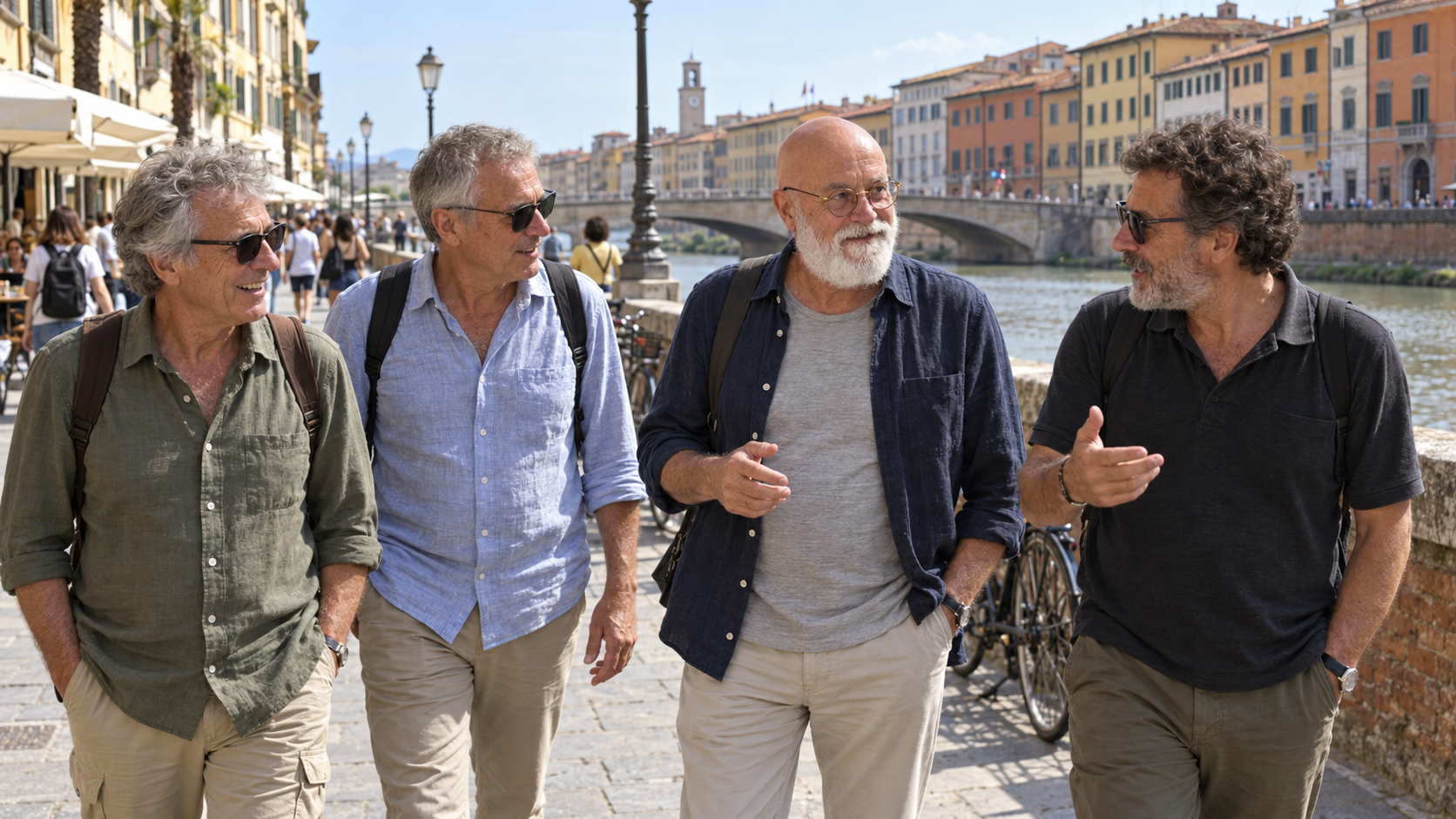
The Lungarni were busy enough to feel urban but calm enough for observation. Students sat along the river wall. Buses moved through the narrow streets. People crossed the bridges without looking at the view because they had seen it hundreds of times.
For a visitor, that indifference can be instructive. A city does not need everyone to admire it at every moment.
The Pisa I Had Not Planned to Visit
By the time I began walking toward Pisa Centrale, the tower was no longer visible. I had not climbed another monument or completed a second list of attractions. I had simply crossed the center on foot, stopped for lunch and followed the river.
Yet the afternoon felt more complete than a tightly organized itinerary.
The famous square had shown me Pisa at its most exceptional. The rest of the walk showed me the conditions that make those monuments belong to a city rather than to an isolated archaeological park: commerce, study, transportation, routine, argument, lunch, bicycles and the repeated crossing of the Arno.
This is not an argument against visiting the Leaning Tower. I would never tell someone to come to Pisa and avoid it. The tower is extraordinary, and the cathedral complex remains essential. The mistake is leaving immediately afterward.
Pisa does not reveal its second identity through a hidden alley known only to locals. It is directly in front of you, beginning a few streets beyond the famous lawn. All that is required is to continue walking after the photograph has been taken.
A Practical Walk Beyond the Leaning Tower
This route is easy to follow without turning the experience into a rigid itinerary. From Piazza dei Miracoli, walk down Via Santa Maria toward Piazza dei Cavalieri. Continue through the historic center to Borgo Stretto and Piazza delle Vettovaglie, then reach the Arno at Piazza Garibaldi and Ponte di Mezzo. Cross the river or follow either bank before continuing toward Pisa Centrale.
Allow at least two or three hours beyond the cathedral complex if you want time to stop rather than simply pass through. The walk is mostly level and works well for travelers arriving by train. For broader planning, Italia Mia’s guides to the history and culture of Pisa, Tuscany without a car and the Region of Tuscany provide practical context. You can also browse images of Pisa before deciding which parts of the city you want to explore.
If your schedule allows only one addition after Piazza dei Miracoli, do not search for another major attraction. Walk to the Arno through the historic center. The route itself is the addition.
External Sources
- Pisa Tourism: Piazza del Duomo
- Pisa Tourism: Piazza dei Cavalieri
- Pisa Tourism: Borgo Stretto and Casa Vanni
- Pisa Tourism: Piazza delle Vettovaglie
- Pisa Tourism: Medieval Pisa itinerary