
Vittorio De Sica was one of the rare artists who achieved lasting international fame on both sides of the camera. To many film lovers, he is the compassionate director of Bicycle Thieves, Shoeshine and Umberto D. To generations of Italian audiences, however, he was also an elegant and immensely popular actor whose career stretched from romantic comedies of the 1930s to some of the most memorable dramatic performances of postwar European cinema.
His directing helped define Italian neorealism, but De Sica was never confined to a single movement. He could move from the poverty-stricken streets of postwar Rome to sophisticated comedy, literary adaptation and international filmmaking without losing the quality that distinguished his finest work: an unusually generous understanding of human weakness.
Childhood and the Beginning of an Acting Career
Vittorio De Sica was born in Sora, in the province of Frosinone, on July 7, 1901. His father, Umberto De Sica, came from a Neapolitan family and worked in banking and insurance, while his mother, Teresa Manfredi, had family roots in Naples. Vittorio spent part of his childhood in Naples before the family settled in Rome.
The De Sicas lived respectably but often struggled financially. These early experiences of insecurity may help explain the director’s later sensitivity toward people trying to preserve their dignity while facing poverty, unemployment or social humiliation.
De Sica appeared in a small film role while still a teenager, but his professional education took place primarily in the theater. During the 1920s he worked with important companies, developing the precise diction, expressive gestures and natural charm that would later make him a screen star. He was equally comfortable in prose theater, light comedy, revue and song.
By the beginning of the 1930s, De Sica had become a leading man of Italian cinema. Director Mario Camerini recognized that his appeal came not simply from his looks but from his ability to combine elegance with vulnerability. In Gli uomini, che mascalzoni! (What Scoundrels Men Are!, 1932), De Sica played a young chauffeur and introduced audiences to the song “Parlami d’amore Mariù,” which became closely associated with him.
Further successes—including Darò un milione (1935), Il signor Max (1937) and Grandi magazzini (1939)—established him as one of the most popular stars of the so-called white-telephone era. These polished comedies presented fashionable apartments, well-dressed characters and romantic misunderstandings far removed from the hardships experienced by much of Italy.
Yet De Sica’s performances were warmer and less artificial than the settings surrounding him. His screen persona was often that of an ordinary man attempting to appear more confident or sophisticated than he really was. Beneath the charm, audiences could sense embarrassment, longing and uncertainty.
From Popular Actor to Film Director
De Sica made his directing debut with Rose scarlatte in 1940, followed by light comedies such as Maddalena… zero in condotta and Teresa Venerdì. These early films remained connected to the commercial cinema in which he had become famous, but his interests were beginning to change.
A decisive step came with I bambini ci guardano (The Children Are Watching Us). The film examines the collapse of a marriage from the perspective of a young child. Rather than treating adultery as a conventional melodramatic plot, De Sica concentrates on its emotional consequences for someone who cannot understand the adults around him.
The film also marked an important stage in De Sica’s partnership with writer and screenwriter Cesare Zavattini. Their collaboration became one of the most important creative relationships in film history. Zavattini advocated stories drawn from apparently ordinary situations: a worker searching for a stolen bicycle, an elderly pensioner facing eviction or two children dreaming of buying a horse.
De Sica transformed those ideas into emotionally direct cinema. Zavattini provided the social observation and narrative foundation; De Sica contributed his instinct for performers, faces, gestures and moments of unexpected tenderness.
De Sica and Italian Neorealism
Italian neorealism emerged from the physical and moral devastation surrounding the Second World War. Filmmakers turned away from studio-bound escapism and focused on unemployment, homelessness, social inequality and the struggle for survival.
De Sica’s neorealist films frequently used working-class locations and performers with little or no professional experience. However, their apparent simplicity was carefully constructed. His direction was not an attempt to record reality without interpretation. He selected faces, controlled performances and shaped everyday incidents into stories capable of revealing larger social truths.
Shoeshine
Sciuscià (Shoeshine, 1946) follows two boys who earn money shining the shoes of American soldiers in Rome. Their dream of buying a horse leads them into a criminal scheme and eventually into a brutal juvenile detention system.
The tragedy does not result from one purely evil individual. Instead, the boys are gradually crushed by poverty, bureaucracy, suspicion and institutions unable to protect them. De Sica portrays their friendship with tenderness while refusing to soften the consequences of their environment.
At the 1948 Academy Awards, Shoeshine received an Honorary Award, several years before a regular competitive category for foreign-language films was established.
Bicycle Thieves
Ladri di biciclette (Bicycle Thieves, 1948) became De Sica’s most famous film. Antonio Ricci, an unemployed father, finally finds work putting up posters around Rome, but the job requires a bicycle. When it is stolen, Antonio and his young son Bruno spend the day searching through streets, markets, churches and working-class neighborhoods.
The missing bicycle is a simple object with enormous consequences: without it, Antonio cannot work; without work, he cannot support his family. The search gradually becomes a test of his dignity and of his relationship with Bruno.
Lamberto Maggiorani, who played Antonio, was a factory worker rather than an established actor. Enzo Staiola, who played Bruno, was discovered after De Sica noticed him watching the production. Their performances demonstrate the director’s exceptional ability to draw emotional truth from inexperienced performers.
The film received a Special Foreign Language Film Award at the 1950 Academy Awards, while Zavattini was nominated for the screenplay. Today it remains one of the essential works in any serious exploration of the greatest Italian movies.
Miracle in Milan and Umberto D.
With Miracolo a Milano (Miracle in Milan, 1951), De Sica and Zavattini introduced fantasy into a story about homeless people living on the outskirts of an industrial city. The film moves between social satire, fairy tale and political allegory. Its miraculous conclusion does not erase the reality of displacement; instead, it expresses the desperate need to imagine a world beyond exploitation.
Umberto D. (1952) is quieter and, for many viewers, even more devastating. Its central character is a retired civil servant whose pension is insufficient to pay his rent. His closest companion is his dog, Flike. Through small daily incidents—a visit to a hospital, an attempt to sell a watch and the search for the missing dog—De Sica explores old age, loneliness and the fear of becoming invisible.
The film was not a commercial success when released, and some Italian politicians accused it of presenting the country negatively. Its reputation has grown steadily, and it is now widely regarded as one of De Sica’s most humane achievements.
A Major Acting Career That Never Disappeared
De Sica continued acting even while making his most important films as a director. Acting provided financial stability, but it was not merely a secondary occupation. He appeared in well over 150 films and demonstrated a range far greater than the charming romantic persona that first made him famous.
In Max Ophüls’s The Earrings of Madame de… (1953), De Sica gave one of his most refined performances as Baron Fabrizio Donati. His elegance and emotional restraint were perfectly suited to Ophüls’s world of desire, deception and social ritual.
The same year, De Sica achieved enormous popular success in Luigi Comencini’s Pane, amore e fantasia (Bread, Love and Dreams). As the Carabinieri marshal Antonio Carotenuto, he combined vanity, authority and romantic comedy opposite Gina Lollobrigida. The role produced several sequels and helped develop the warmer, more accessible style sometimes called “pink neorealism.”
He also proved himself an effective international actor. His performance as Major Alessandro Rinaldi in the 1957 adaptation of Ernest Hemingway’s A Farewell to Arms earned him an Academy Award nomination for Best Supporting Actor.
One of his greatest dramatic roles came in Roberto Rossellini’s Il generale Della Rovere (General Della Rovere, 1959). De Sica plays Vittorio Bardone, a charming swindler arrested by the Gestapo and forced to impersonate a resistance leader inside a prison. What begins as another fraud gradually becomes an unexpected journey toward courage and moral responsibility.
He later appeared in productions as varied as It Started in Naples, The Millionairess, The Shoes of the Fisherman and Alberto Sordi’s Un italiano in America. Even when the films themselves were uneven, De Sica’s mixture of theatricality, irony and melancholy remained unmistakable.
Sophia Loren and De Sica’s Later Films
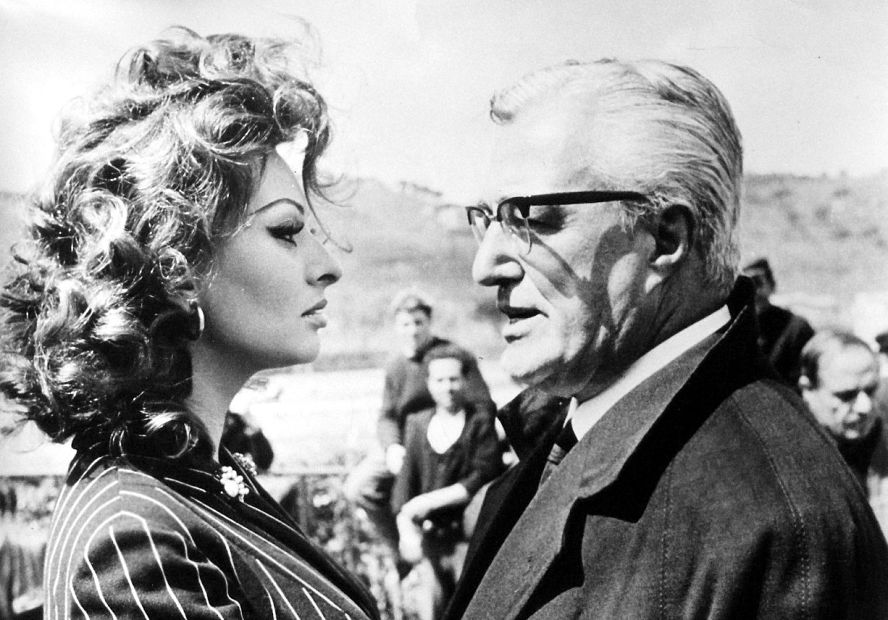
De Sica played a decisive role in the development of Sophia Loren as a dramatic actress. He understood that her beauty and comic energy could coexist with a profound ability to portray hardship, anger and survival.
Their most important early collaboration was La ciociara (Two Women, 1960), adapted from Alberto Moravia’s novel. Loren plays Cesira, a mother attempting to protect her daughter during the final stages of the Second World War. Under De Sica’s direction, Loren delivered a performance of extraordinary emotional force and became the first performer to win the Academy Award for Best Actress for a predominantly non-English-language role.
De Sica reunited Loren with Marcello Mastroianni in Ieri, oggi e domani (Yesterday, Today and Tomorrow, 1963). The film’s three episodes allowed both stars to move between farce, romance and social observation. It won the Academy Award for Best Foreign Language Film at the 1965 ceremony.
The trio worked together again on Matrimonio all’italiana (Marriage Italian Style, 1964), adapted from Eduardo De Filippo’s play Filumena Marturano. Loren’s performance earned another Best Actress nomination, while the film was nominated for Best Foreign Language Film.
De Sica also directed Loren and Mastroianni in I girasoli (Sunflower, 1970), a moving story about a woman searching for the husband who disappeared on the Russian front. The film examines the long emotional aftermath of war rather than the battlefield itself.
The Garden of the Finzi-Continis
De Sica’s late-career triumph was Il giardino dei Finzi-Contini (The Garden of the Finzi-Continis, 1970), adapted from Giorgio Bassani’s novel.
Set in Ferrara during the rise of Fascism and the introduction of Italy’s racial laws, the film follows an aristocratic Jewish family that initially believes its wealth and social position will protect it. Their enclosed garden becomes a temporary refuge, but history gradually intrudes upon their privileged world.
The film won the Academy Award for Best Foreign Language Film at the 1972 ceremony. Its success demonstrated that De Sica had lost none of his ability to connect an intimate personal story with a wider historical tragedy.
His final directing projects included Una breve vacanza (A Brief Vacation, 1973), about an exhausted working-class woman who discovers a measure of independence while recovering in a sanatorium, and Il viaggio (The Voyage, 1974), adapted from Luigi Pirandello.
Personal Life and Death
De Sica married actress Giuditta Rissone in 1937, and they had a daughter, Emi. He later formed a long relationship with Spanish actress María Mercader, with whom he had two sons, Manuel and Christian De Sica. Christian followed his father into cinema and became a well-known Italian actor and director.
The complicated legal status of divorce in Italy meant that De Sica’s private life remained difficult for many years. After obtaining French citizenship and completing the necessary legal arrangements, he and Mercader married in Paris in 1968.
Vittorio De Sica died in Neuilly-sur-Seine, near Paris, on November 13, 1974. He was 73 years old.
Four Oscar-Recognized Films Directed by Vittorio De Sica
Four films directed by De Sica received recognition from the Academy as outstanding foreign-language productions:
- Sciuscià (Shoeshine) — Honorary Award presented in 1948
- Ladri di biciclette (Bicycle Thieves) — Special Foreign Language Film Award presented in 1950
- Ieri, oggi e domani (Yesterday, Today and Tomorrow) — Best Foreign Language Film at the 1965 ceremony
- Il giardino dei Finzi-Contini (The Garden of the Finzi-Continis) — Best Foreign Language Film at the 1972 ceremony
The first two awards preceded the establishment of the permanent competitive foreign-language film category. It is therefore more accurate to describe all four as Oscar-recognized films rather than four personal directing Oscars awarded directly to De Sica.
Essential Vittorio De Sica Films
As Director
- The Children Are Watching Us — The bridge between De Sica’s early comedies and his mature social cinema.
- Shoeshine — A heartbreaking portrait of childhood damaged by poverty and institutions.
- Bicycle Thieves — His defining neorealist masterpiece.
- Miracle in Milan — Social realism transformed into a modern fairy tale.
- Umberto D. — An intimate study of old age, isolation and dignity.
- Two Women — A powerful wartime drama featuring Sophia Loren’s Oscar-winning performance.
- Yesterday, Today and Tomorrow — Three lively portraits of Italian relationships and society.
- Marriage Italian Style — Comedy, melodrama and social criticism united by Loren and Mastroianni.
- Sunflower — A moving examination of love and loss after the war.
- The Garden of the Finzi-Continis — A late masterpiece about memory, privilege and persecution.
As Actor
- Gli uomini, che mascalzoni! — The romantic comedy that established De Sica as a screen star.
- The Earrings of Madame de… — One of his most elegant and emotionally controlled performances.
- Bread, Love and Dreams — De Sica at his most charming and comic.
- A Farewell to Arms — The performance that earned him an Oscar nomination.
- General Della Rovere — His finest dramatic role and an essential film of postwar Italian cinema.
Vittorio De Sica’s Legacy
De Sica’s influence reaches far beyond Italian cinema. The emotional directness and location-based realism of Bicycle Thieves inspired filmmakers including Satyajit Ray and helped shape later forms of socially engaged cinema across Europe, Asia, Latin America and the United States.
Yet his legacy is not based on technique alone. What remains most powerful is the compassion with which he observed people under pressure. His characters make mistakes, tell lies, lose hope and sometimes betray their own values. De Sica never treats them as social statistics or simple moral examples.
For me, that is the quality that continues to make his films feel alive. He looked at poverty without romanticizing it, at comedy without dismissing its characters and at human failure without withdrawing sympathy. Few filmmakers have combined social criticism and emotional generosity so naturally.
His acting and directing careers should therefore be understood together. The actor’s knowledge of gesture, timing and vulnerability shaped the director’s work with performers. The director’s understanding of ordinary lives, in turn, gave depth to the actor’s most memorable roles.
Explore Vittorio De Sica’s Work
Browse available Vittorio De Sica films, collections and books on Amazon.com. (Affiliate link: Italia Mia may receive a commission from qualifying purchases.)
External Links
- Vittorio De Sica — Treccani Biographical Dictionary
- Vittorio De Sica — Treccani Encyclopedia of Cinema
- The 1948 Academy Awards
- The 1950 Academy Awards
- The 1965 Academy Awards
- The 1972 Academy Awards