

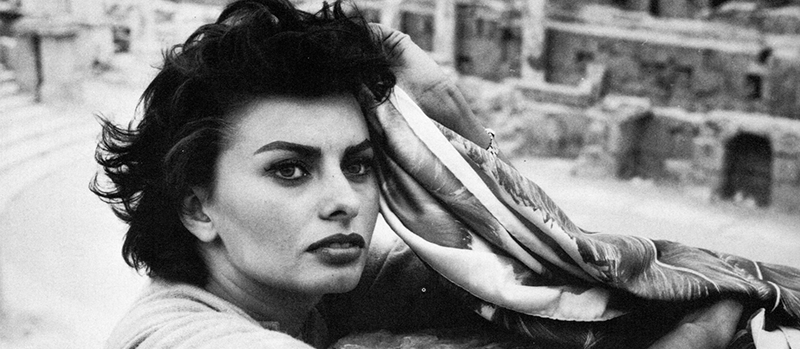
Sophia Loren is more than one of Italy’s most famous actresses. Her journey from a childhood marked by poverty and war to international stardom is one of the most extraordinary stories in cinema.
During a career spanning more than seven decades, Loren moved confidently between Italian films, Hollywood productions, intimate dramas, romantic comedies and historical epics. Her beauty made her instantly recognizable, but her finest performances revealed emotional depth, comic intelligence and a powerful connection to the experiences of ordinary Italian women.
Her Academy Award-winning portrayal of Cesira in Two Women changed the way international audiences viewed her. Later films such as Marriage Italian Style, Sunflower and A Special Day confirmed that Loren was not simply a glamorous celebrity but one of the great screen actresses of her generation.
Early life in Rome and Pozzuoli
Sophia Loren was born Sofia Costanza Brigida Villani Scicolone in Rome on September 20, 1934. Her mother, Romilda Villani, was a piano teacher and aspiring actress. Her father, Riccardo Scicolone, acknowledged Sofia and allowed her to use his surname but did not marry Romilda or provide the family with a stable home.
Loren spent most of her childhood in Pozzuoli, near Naples, where she lived with her mother, younger sister Maria and maternal grandparents. The family had very little money, and the hardships became even more severe during the Second World War.
Pozzuoli’s port and industrial installations made the area a target for Allied bombing. Loren later remembered air raids, nights spent in railway tunnels and the constant search for food. She was injured by shrapnel during one raid. These experiences were not distant history when she later appeared in wartime films: they were connected to her own memories of fear, displacement and survival.
As a child, she was extremely thin and shy, earning the nickname “toothpick.” Her appearance changed dramatically during adolescence, and her mother began entering her in local beauty contests. In 1950, the 15-year-old Sofia participated in the Miss Italia competition, where she received the title Miss Eleganza.
Beauty contests offered young Italian women a possible path into cinema, which was expanding rapidly after the war. Loren and her mother moved to Rome, where Sofia attended acting classes and worked as a model for illustrated photo-romance magazines known as fotoromanzi.
Her first appearances in Italian cinema
Loren began appearing in films in small, often uncredited roles. One of her earliest productions was the Hollywood epic Quo Vadis, filmed at Rome’s Cinecittà studios. For a time, she was credited as Sofia Lazzaro before adopting the professional name Sophia Loren.
In 1950, she met producer Carlo Ponti at a beauty contest. Ponti recognized her potential and encouraged her to study acting, improve her diction and develop a screen identity that would be more substantial than that of a conventional beauty queen.
Her first major opportunities arrived in the early 1950s. She played the Ethiopian slave Aida in the 1953 film adaptation of Verdi’s opera, with her singing voice dubbed by soprano Renata Tebaldi. In The Gold of Naples (1954), directed by Vittorio De Sica, she gave a lively and memorable performance as a Neapolitan pizza seller.
The role allowed Loren to draw upon the gestures, humor, resilience and sensuality of the Naples she knew. It also began one of the most important creative partnerships in Italian cinema.
Her first film with Marcello Mastroianni was Alessandro Blasetti’s Too Bad She’s Bad in 1954. Loren and Mastroianni would eventually make 12 films together, becoming one of cinema’s most beloved screen couples.
Unlike traditional romantic pairings, they could be passionate, ridiculous, tender, selfish and deeply human. Their chemistry was particularly effective in the bittersweet comedies associated with commedia all’italiana.
From Italian star to Hollywood actress
By the middle of the 1950s, Loren was already a major Italian celebrity. Her international breakthrough came when she began working in English-language films with some of Hollywood’s biggest stars.
In The Pride and the Passion (1957), she appeared with Cary Grant and Frank Sinatra. That same year, she starred in Boy on a Dolphin, her first major English-language leading role. The film, shot partly on the Greek island of Hydra, presented her to international audiences as a new Mediterranean screen presence.
Loren subsequently appeared with John Wayne in Legend of the Lost, with William Holden in The Key and with Cary Grant in Houseboat. Although some of these productions emphasized her appearance and exoticized her Italian identity, Loren was learning how to work in a second language and adapt her acting to different cinematic traditions.
She won the Volpi Cup for Best Actress at the Venice Film Festival for The Black Orchid (1958), in which she played a widowed mother opposite Anthony Quinn. The award was an important early acknowledgment of her dramatic ability.
Her marriage to Carlo Ponti
Carlo Ponti became central to both Loren’s professional and personal life. Their relationship was complicated by Italian marriage law. Ponti was separated from his first wife, Giuliana Fiastri, but divorce was not yet legally available in Italy.
Loren and Ponti attempted to marry by proxy in Mexico in 1957. Italian authorities did not recognize the marriage, exposing Ponti to accusations of bigamy. The couple subsequently had the marriage annulled.
After obtaining French citizenship and resolving Ponti’s previous marriage under French law, Loren and Ponti married legally in 1966. They remained together until his death in 2007 and had two sons: Carlo Ponti Jr., who became an orchestra conductor, and Edoardo Ponti, a film director.
Their relationship should not be reduced to the familiar story of a producer creating a star. Ponti undoubtedly guided Loren’s early career, but her success ultimately depended upon her discipline, instinct, intelligence and ability to grow as a performer.
Two Women and a historic Academy Award
The turning point in Loren’s career was Vittorio De Sica’s Two Women (La ciociara), released in Italy in 1960. Adapted from Alberto Moravia’s novel, the film follows Cesira, a widowed shopkeeper who flees wartime Rome with her young daughter, Rosetta.
Loren was only 25 when she played Cesira, a character originally conceived as considerably older. She initially hoped to play the daughter, while Anna Magnani was considered for the role of the mother. Magnani reportedly believed Loren was better suited to Cesira, and the younger actress accepted the challenge.
The film drew upon Loren’s childhood memories of bombing, hunger and wartime insecurity. She removed the glamorous mannerisms associated with her international image and created a raw portrait of a mother struggling to protect her child.
After Rome is bombed, Cesira and Rosetta seek safety in the countryside. On their journey home following the Allied advance, both are assaulted inside an abandoned church. De Sica concentrates on the psychological devastation of the attack and on Cesira’s anguish as she realizes that she has been unable to protect her daughter.
Loren won Best Actress at the 1961 Cannes Film Festival. At the 1962 Academy Awards, she became the first performer to win an acting Oscar for a role in a non-English-language film. She did not attend the ceremony and learned that she had won through an early-morning telephone call from Cary Grant.
The victory was important not only for Loren but also for Italian cinema. It demonstrated that an Italian-language performance could receive Hollywood’s highest acting honor during a period when international films were often treated as separate from mainstream American cinema.
Readers interested in the movement that helped transform postwar filmmaking can also read ItaliaMia’s guide to Italian Neorealism.
Comedy and the partnership with Marcello Mastroianni
After the emotional intensity of Two Women, Loren demonstrated her remarkable comic range in Yesterday, Today and Tomorrow (1963). Directed by De Sica, the film consists of three stories set in Naples, Milan and Rome. Loren and Mastroianni play different couples in each episode.
Loren moves from a resourceful Neapolitan street seller to a wealthy industrialist’s wife and then to a Roman sex worker. Her famous striptease scene with Mastroianni became one of the most recognizable moments in Italian cinema, but the film’s enduring appeal comes from the pair’s timing, physical comedy and ability to shift between satire and tenderness.
The film won the Academy Award for Best Foreign Language Film.
Their next great collaboration was Marriage Italian Style (1964), adapted from Eduardo De Filippo’s play Filumena Marturano. Loren plays Filumena, a former sex worker who has spent years in an unequal relationship with the wealthy Domenico Soriano, played by Mastroianni.
When Domenico prepares to marry a younger woman, Filumena devises a plan to force him to recognize her sacrifices and acknowledge that one of her three sons is his. Loren makes the character proud, vulnerable, furious and calculating without losing the audience’s sympathy.
The performance earned her a second Academy Award nomination for Best Actress. It remains one of the clearest examples of her ability to unite melodrama and comedy within the same character.
Hollywood spectacles and international productions
Loren continued to work in large international productions throughout the 1960s. She starred opposite Charlton Heston in El Cid (1961), one of the decade’s most ambitious historical epics. She also appeared in The Fall of the Roman Empire, Arabesque with Gregory Peck and Charlie Chaplin’s final film, A Countess from Hong Kong, with Marlon Brando.
These films strengthened her position as a global star, although they did not always give her characters the complexity found in her Italian work. Loren was most convincing when allowed to combine elegance with humor, anger, vulnerability and a recognizable connection to everyday life.
In Lady L (1965), she appeared alongside Paul Newman and David Niven. In Man of La Mancha (1972), she played Aldonza opposite Peter O’Toole. She later joined an international cast in the disaster thriller The Cassandra Crossing (1976).
Sunflower: love divided by war
One of Loren and Mastroianni’s most moving films is De Sica’s Sunflower (1970). Loren plays Giovanna, whose husband Antonio is sent to the Eastern Front during the Second World War and never returns.
Refusing to accept that he is dead, Giovanna travels to the Soviet Union to find him. She eventually discovers that Antonio survived but has built another life with the Russian woman who rescued him.
Loren’s performance is restrained and emotionally devastating. The railway-station sequences use silence, facial expression and physical distance to convey the consequences of war long after the fighting has ended. The film also features an evocative score by Henry Mancini.
A Special Day and Loren’s mature dramatic work
In Ettore Scola’s A Special Day (1977), Loren delivered another of her defining performances. The story takes place in Rome on May 6, 1938, when Adolf Hitler visited Benito Mussolini.
While most of their neighbors attend the public celebrations, Antonietta, an exhausted housewife and mother of six, remains in her apartment building. She meets Gabriele, played by Mastroianni, a former radio announcer dismissed because he is gay and considered politically suspect by the Fascist regime.
Both stars deliberately suppress their familiar glamour. Loren portrays a woman trapped by domestic labor, patriarchal expectations and Fascist ideas about motherhood. Mastroianni’s Gabriele is isolated for a different reason, but the two characters briefly recognize one another’s loneliness.
Their encounter does not offer an easy escape. Instead, it reveals how authoritarian ideology enters private homes and shapes personal relationships. The film is now widely regarded as one of the finest works of both Loren and Mastroianni.
Family, motherhood and a slower career
Loren experienced miscarriages before the births of her sons Carlo Jr. in 1968 and Edoardo in 1973. Motherhood became an important priority, and she gradually reduced the number of films she made.
During the 1980s, she appeared in television productions, including a biographical adaptation of her own life in which she played both herself and her mother. Her screen appearances became less frequent, allowing her to protect her family life after decades of intense public attention.
In 1982, Loren served a brief prison sentence in Italy connected to a long-running tax dispute. She maintained that the case resulted from an error in a tax return prepared by an adviser. The episode did little to diminish her popularity, and she was greeted by supporters and journalists upon her release.
Honors and later films
In 1991, the Academy presented Loren with an Honorary Oscar, describing her as one of world cinema’s genuine treasures. The award recognized an international career that had bridged European and American filmmaking.
She reunited with Mastroianni in Robert Altman’s fashion-industry satire Prêt-à-Porter (1994). The film playfully recreated their famous striptease sequence from Yesterday, Today and Tomorrow. Loren also appeared with Walter Matthau and Jack Lemmon in the comedy Grumpier Old Men (1995).
In 2009, she joined Daniel Day-Lewis, Marion Cotillard, Penélope Cruz, Judi Dench and Nicole Kidman in Rob Marshall’s musical Nine, inspired by Federico Fellini’s 8½. Loren played the mother of a troubled Italian film director, adding another connection between her career and the history of Italian cinema.
Working with her son Edoardo Ponti
Some of Loren’s most meaningful later work has been directed by her son Edoardo Ponti. She appeared in his film Between Strangers in 2002 and starred in his adaptation of Jean Cocteau’s one-woman play The Human Voice in 2014.
Their most important collaboration is The Life Ahead (La vita davanti a sé), released in 2020. Set in Bari and adapted from Romain Gary’s novel, the film follows Madame Rosa, a Holocaust survivor and former sex worker who cares for children in her apartment.
Madame Rosa develops a difficult but increasingly affectionate relationship with Momo, a Senegalese orphan played by Ibrahima Gueye. Loren avoids sentimentality, portraying Rosa as proud, irritable, frightened and compassionate.
The film marked Loren’s first major leading role in approximately a decade. Her performance earned her a seventh competitive David di Donatello Award for Best Actress in 2021, making the role another important milestone in her long career.
Sophia Loren’s essential films
For readers discovering her work, these films provide a strong introduction:
The Gold of Naples (1954) – An early showcase for Loren’s Neapolitan humor and vitality.
Too Bad She’s Bad (1954) – Her first screen partnership with Marcello Mastroianni.
The Black Orchid (1958) – The dramatic performance that won her the Venice Film Festival’s Volpi Cup.
Two Women (1960) – Her most historically important performance and the role that earned her the Academy Award.
El Cid (1961) – Loren at the center of a major Hollywood historical epic.
Yesterday, Today and Tomorrow (1963) – A demonstration of her versatility across three comic roles.
Marriage Italian Style (1964) – One of her richest combinations of comedy, anger and emotional drama.
Sunflower (1970) – A moving study of love and separation after the Second World War.
A Special Day (1977) – A quiet, politically charged drama containing one of her finest performances.
The Life Ahead (2020) – A powerful late-career role directed by her son Edoardo Ponti.
Several of these titles also appear in ItaliaMia’s guide to the greatest Italian movies.
Why Sophia Loren remains important
Loren’s international image was built partly around beauty, fashion and glamour, but concentrating only on those qualities obscures her achievement as an actress.
Her best characters are rarely passive. They negotiate poverty, war, abandonment, motherhood, sexual double standards and unequal relationships. Loren gives these women a strong physical presence, but she also reveals their intelligence and survival instincts.
She could move from broad comedy to tragedy without losing credibility. Her humor often came from timing, gesture and an understanding of social behavior rather than from dialogue alone. In dramatic roles, she was capable of remarkable restraint, communicating grief or humiliation through a glance or a change in posture.
Her collaborations with De Sica and Mastroianni also helped bring Italian stories to international audiences. Together, their films captured regional identities, changing attitudes toward marriage and sexuality, memories of war and the contradictions of postwar prosperity.
Celebrating a living legend
Loren turned 90 in September 2024. Her birthday was marked by retrospectives and tributes, including the Academy Museum and Cinecittà program Sophia Loren: La Diva di Napoli. Film at Lincoln Center also presented a retrospective devoted to her work.
These celebrations placed renewed attention on her artistic range rather than simply her celebrity. They introduced restored versions of her films to audiences who may have known her name and image without having experienced her strongest performances.
Her legacy connects several different histories: postwar Naples, the rebirth of Italian cinema, the international expansion of Cinecittà, Hollywood’s fascination with European stars and the gradual recognition of performances made outside the English language.
Sophia Loren became a symbol of Italy, but her finest work goes beyond national identity. Cesira in Two Women, Filumena in Marriage Italian Style, Antonietta in A Special Day and Madame Rosa in The Life Ahead are distinct, complicated women rather than variations on a glamorous persona.
That is why Loren’s career continues to matter. She did not merely become one of the most photographed women of the twentieth century. She transformed her childhood experiences, cultural identity and formidable screen presence into performances that remain alive long after the fashions surrounding them have changed.
External Sources
Academy of Motion Picture Arts and Sciences: Sophia Loren
Academy Awards: Sophia Loren’s 1991 Honorary Award
Festival de Cannes: Sophia Loren
David di Donatello: Sophia Loren’s Career and Awards
British Film Institute: Sophia Loren’s Essential Films
Cinecittà: Celebrating Sophia Loren