

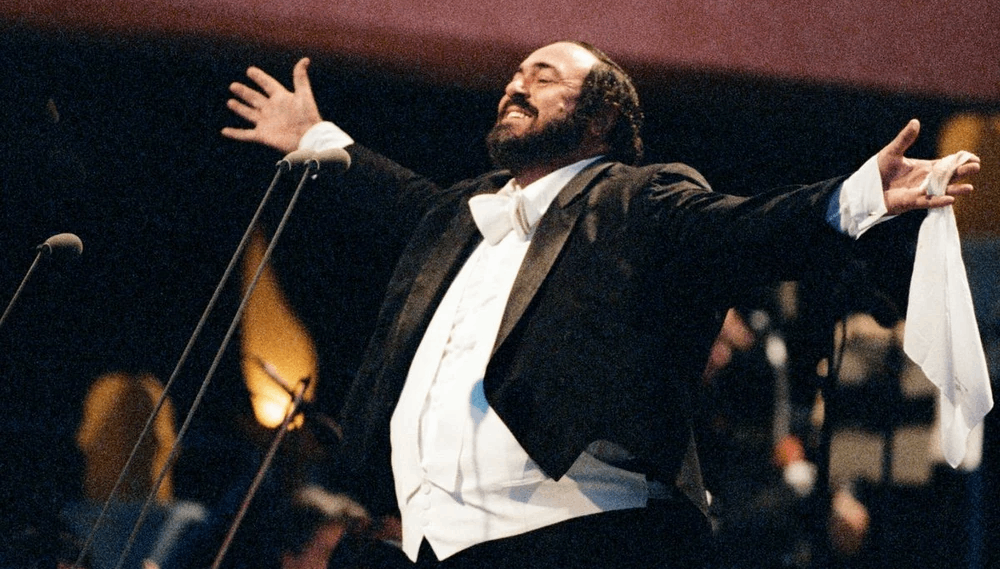
 Few opera singers have been as instantly recognizable as Luciano Pavarotti. The radiant high notes, expansive smile, white handkerchief and unmistakable beard turned the tenor from Modena into an international symbol of Italian music.
Yet the familiar public image can obscure the seriousness of his achievement. Before stadium concerts, celebrity collaborations and televised appearances made him famous far beyond the opera house, Pavarotti had built his reputation through disciplined study and performances of some of the most demanding roles in the tenor repertoire.
His voice combined brilliance, warmth, clarity and unusual freedom in its upper register. He was especially admired in the operas of Gaetano Donizetti, Vincenzo Bellini, Giuseppe Verdi and Giacomo Puccini. At his best, he made technically difficult singing sound spontaneous and direct.
Over a professional career lasting approximately 45 years, Pavarotti helped bring opera to audiences who might never have entered a traditional theater. His performances, recordings, television broadcasts, Three Tenors concerts and charitable events made him one of the most influential classical performers of the twentieth century.
Childhood and Family Life in Modena
Luciano Pavarotti was born in Modena, Emilia-Romagna, on October 12, 1935. His father, Fernando Pavarotti, worked as a baker and possessed a fine amateur tenor voice. His mother, Adele Venturi, worked in a cigar factory.
The family lived modestly, and Luciano grew up during the difficult years surrounding the Second World War. In 1943, after Modena became increasingly dangerous, the family temporarily left the city and lived in the countryside.
Music was part of everyday family life. Fernando sang in the Corale Gioachino Rossini, a male choir in Modena, and filled the family home with recordings by celebrated tenors such as Enrico Caruso, Beniamino Gigli, Tito Schipa and Giuseppe Di Stefano. Luciano listened carefully, imitated what he heard and gradually absorbed the traditions of Italian singing.
As a boy, however, he also dreamed of becoming a professional footballer. He played as a goalkeeper and remained an enthusiastic football supporter throughout his life.
His mother encouraged him to choose a secure profession. Pavarotti studied at Modena’s teacher-training institute and worked briefly as an elementary-school teacher. He later joked that his pupils did not always benefit from the experience, but teaching helped him develop the confidence, humor and ability to communicate that would become central to his public personality.
The Choir Competition That Changed His Direction
A decisive moment arrived in 1955, when Pavarotti traveled to Wales with his father and the Corale Gioachino Rossini. The choir won first prize at the Llangollen International Musical Eisteddfod.
The victory strengthened his belief that music could become more than a private passion. He abandoned the idea of a conventional career and began the long, uncertain process of training as an opera singer.
His first important teacher was Arrigo Pola, a professional tenor in Modena. When Pola moved to Japan, Pavarotti continued his studies with Ettore Campogalliani, a respected teacher whose pupils also included Mirella Freni, Renata Tebaldi and Renata Scotto.
Pavarotti and Freni had known each other since childhood. They were born in Modena in the same year, and their mothers worked in the same cigar factory. Both eventually became internationally celebrated interpreters of Puccini, and their shared background contributed to an unusually natural partnership onstage and in the recording studio.
Pavarotti studied for several years without receiving the assurance of a successful career. His father agreed to support him but reportedly imposed a practical limit: if Luciano had not established himself by around the age of 30, he would need to find another profession.
Operatic Debut in La Bohème
Pavarotti’s breakthrough came after he won the Achille Peri International Singing Competition in 1961. The victory led to his professional debut as Rodolfo in Puccini’s La Bohème at the Teatro Municipale in Reggio Emilia on April 29, 1961.
Rodolfo proved ideally suited to the young tenor. The role requires lyrical warmth, conversational ease, emotional sincerity and the ability to rise confidently to climactic high notes. It became one of Pavarotti’s signature parts and remained closely associated with him throughout his career.
Engagements in regional Italian theaters and elsewhere in Europe soon followed. He sang in cities including Amsterdam, Vienna and Zürich, gradually developing the technique and theatrical experience needed for the world’s major opera houses.
An important opportunity arose at London’s Royal Opera House, Covent Garden, in 1963. Pavarotti had been engaged as Giuseppe Di Stefano’s understudy in La Bohème. When Di Stefano withdrew, Pavarotti replaced him as Rodolfo and made a highly successful London debut.
His reputation grew rapidly. In 1965 he made his La Scala debut in Milan, again singing Rodolfo. Appearing at Italy’s most prestigious opera house represented a major step in the career of any Italian singer.
Joan Sutherland and the Bel Canto Repertoire
One of the most important artistic relationships of Pavarotti’s early career was his partnership with Australian soprano Joan Sutherland.
In 1965, he joined Sutherland on an extended tour of Australia. Performing repeatedly beside a singer admired for her exceptional breath control and command of bel canto technique gave him an invaluable practical education. Pavarotti later acknowledged that observing Sutherland helped him understand how to support long phrases and manage the breath more efficiently.
Their voices also complemented each other. Sutherland’s agility, range and opulent tone were matched by Pavarotti’s bright upper register and clear Italian diction. Together they became leading interpreters of operas by Donizetti and Bellini.
Pavarotti excelled in a repertoire that demands elegance as well as power. His important roles included Elvino in La sonnambula, Arturo in I puritani, Edgardo in Lucia di Lammermoor, Nemorino in L’elisir d’amore and Tonio in La fille du régiment.
These works exposed every aspect of a singer’s technique. Long melodic lines, rapid ornamentation, delicate soft singing and repeated high notes could not be concealed beneath a large orchestra. Pavarotti’s ability to meet those demands established him as much more than a naturally gifted celebrity.
The Metropolitan Opera and the “King of the High Cs”
Pavarotti made his Metropolitan Opera debut in New York on November 23, 1968, as Rodolfo in La Bohème. The Met would become one of the principal theaters of his career.
His legendary American breakthrough came there in 1972, when he sang Tonio in Donizetti’s La fille du régiment. The aria “Ah! mes amis” contains nine demanding high Cs, delivered in quick succession. Pavarotti produced them with brilliance and apparent ease, provoking an extraordinary audience response and 17 curtain calls.
The performance helped earn him the popular nickname “King of the High Cs.” Although the label captured his technical excitement, it described only part of his artistry. Pavarotti’s best performances also displayed careful phrasing, vivid characterization, precise words and a tender mezza voce.
His Met repertoire expanded to include the Duke of Mantua in Giuseppe Verdi’s Rigoletto, Riccardo in Un ballo in maschera, Rodolfo in Luisa Miller, Nemorino in L’elisir d’amore, Cavaradossi in Tosca and other central Italian tenor roles.
In 1977, a televised Met performance of La Bohème conducted by James Levine attracted a record audience for the company’s television broadcasts. The following year, Pavarotti gave a nationally televised solo recital from the Metropolitan Opera House, demonstrating how effectively his personality and voice could communicate through the camera.
What Made Pavarotti’s Voice Distinctive?
Pavarotti’s voice was immediately identifiable. Its appeal did not depend solely on volume. The tone possessed a bright, ringing center that carried easily through an opera house, while its underlying warmth prevented the sound from becoming metallic or impersonal.
His vowels were open and clearly formed, and his diction allowed listeners to understand the words without consulting a libretto. This clarity reflected both his technical training and his instinctive connection to the Italian language.
The upper register was especially remarkable. At his peak, Pavarotti approached high notes without the visible strain that often accompanies heroic tenor singing. The notes seemed to grow naturally out of the musical phrase rather than appearing as isolated athletic feats.
He was not equally suited to every type of role. His strengths lay primarily in lyrical and lyric-spinto repertoire rather than the darkest, heaviest dramatic parts. As his voice matured, he took on roles such as Calaf in Turandot and Radamès in Aida, but he remained most persuasive when vocal beauty, warmth and direct emotional expression were central to the character.
Pavarotti was also a relatively straightforward stage actor. He did not attempt the psychologically elaborate characterizations associated with some modern productions. Instead, he relied on vocal expression, physical presence and personal charisma. For millions of listeners, that directness was precisely the source of his power.
Rigoletto, La Bohème and His Greatest Operatic Roles
Among Pavarotti’s most admired interpretations was the Duke of Mantua in Rigoletto. The role allowed him to combine elegance, confidence and vocal brilliance. His performances of “Questa o quella,” “Ella mi fu rapita” and “La donna è mobile” became reference points for later tenors.
Rodolfo in La Bohème remained central to his identity. Pavarotti’s youthful-sounding timbre and conversational delivery made the poet’s first encounter with Mimì unusually believable. His recordings with Mirella Freni preserved one of the most celebrated operatic partnerships of the recording era.
He was also acclaimed as Nemorino in L’elisir d’amore. The apparently simple country character suited Pavarotti’s warmth and humor, while “Una furtiva lagrima” gave him an opportunity to demonstrate restraint and lyrical sensitivity.
Other important roles included Edgardo in Lucia di Lammermoor, Fernando in La favorita, Riccardo in Un ballo in maschera, Manrico in Il trovatore, Cavaradossi in Tosca and Calaf in Turandot.
Pavarotti’s recording career was unusually extensive. His long association with Decca produced complete operas, recital albums, sacred music, Neapolitan songs and popular collections. These recordings introduced his voice to listeners far beyond the cities in which he performed.
Readers interested in hearing his principal recordings can browse Luciano Pavarotti albums and collections on Amazon.com. Purchases made through this affiliate link may earn ItaliaMia a commission at no additional cost to the buyer.
“Nessun Dorma” and the 1990 World Cup
Pavarotti was already an international opera star when “Nessun dorma,” Calaf’s aria from Puccini’s Turandot, transformed him into a figure of global popular culture.
The BBC used Pavarotti’s recording during its coverage of the 1990 FIFA World Cup in Italy. The aria’s gradual rise toward the final cry of “Vincerò”—“I will win”—made it an ideal musical symbol for sporting drama.
Listeners who had never attended an opera became familiar with the aria. Its popularity also demonstrated Pavarotti’s unusual ability to communicate operatic emotion outside its original theatrical setting.
“Nessun dorma” was never intended to be a self-contained popular song. Within Turandot, it expresses Calaf’s certainty that he will overcome the princess’s challenge. Pavarotti’s performance retained the aria’s operatic scale while making its emotional message immediately accessible.
The recording became one of the best-known examples of Italian music worldwide and helped turn an aria written in the 1920s into a modern cultural phenomenon.
The Three Tenors
On July 7, 1990, the evening before the World Cup final, Pavarotti appeared with Plácido Domingo and José Carreras at the Baths of Caracalla in Rome. Zubin Mehta conducted the orchestra.
The concert had originally been conceived partly as a celebration of Carreras’s return to the stage after treatment for leukemia. Its mixture of opera arias, Neapolitan songs, Broadway melodies and popular favorites reached an enormous international television audience.
The Three Tenors became a global phenomenon. Later concerts were held at Dodger Stadium in Los Angeles in 1994, beneath the Eiffel Tower in Paris in 1998 and in Yokohama in 2002.
Some classical critics objected to the amplification, stadium settings and show-business atmosphere. They feared that opera was being reduced to a collection of spectacular high notes and familiar melodies.
The concerts nevertheless introduced classical voices to millions of new listeners. Pavarotti understood that accessibility did not necessarily require abandoning serious music. His approach was to welcome audiences through recognizable arias and songs, hoping that curiosity would eventually lead some of them toward complete operas.
Pavarotti & Friends
Pavarotti’s willingness to cross musical boundaries was also evident in the Pavarotti & Friends benefit concerts held in Modena between 1992 and 2003.
These events brought him together with artists from rock, pop, blues and world music, including Bono, Sting, Zucchero, Elton John, Eric Clapton, Queen, Céline Dion, Mariah Carey, Stevie Wonder, Andrea Bocelli and the Spice Girls.
The collaborations were sometimes musically unconventional, but they were not designed as conventional opera performances. Their purpose was to attract a broad audience and raise money for humanitarian causes.
Funds supported children and refugees affected by conflicts and crises in Bosnia, Kosovo, Guatemala, Liberia, Afghanistan and Iraq. Pavarotti worked with organizations including War Child and the United Nations.
The concerts revealed an important aspect of his public philosophy: fame created responsibilities as well as privileges. He used the recognition earned in opera to draw attention and financial support toward people who otherwise had little connection to the classical-music world.
Awards and International Recognition
Pavarotti received numerous honors during his lifetime. His recordings earned gold and platinum awards, while his classical performances brought him multiple Grammy Awards.
In 1998, he received the Grammy Legend Award and was named MusiCares Person of the Year. He was also honored by governments, cultural institutions and humanitarian organizations.
The scale of his popular recognition was exceptional for an opera singer. His televised performances reached enormous audiences, and his recordings regularly appeared outside the traditional classical charts.
Statistics concerning record sales and audience sizes vary between sources and are sometimes exaggerated in promotional accounts. What is beyond dispute is that Pavarotti became one of the most commercially successful and widely recognized classical singers in recording history.
ItaliaMia includes him among its top Italian music artists and among the performers who helped Italian songs reach international audiences.
Marriage, Family and Public Scrutiny
Pavarotti married Adua Veroni in 1961. They had three daughters: Lorenza, Cristina and Giuliana. Adua played an important role in organizing his early career, and their marriage lasted for several decades.
During the 1990s, Pavarotti’s relationship with Nicoletta Mantovani, who had worked with him professionally, became public. The intense press coverage surrounding the relationship and the end of his first marriage sometimes overshadowed discussion of his music.
Pavarotti and Mantovani married in Modena in 2003. Their daughter Alice was born earlier that year. Alice’s twin brother, Riccardo, died before birth.
His private life was complicated, and biographies have approached it from sharply different perspectives. A balanced account should neither ignore the pain caused by his choices nor reduce a long artistic life to tabloid controversies.
Friends and colleagues frequently described a man of enormous appetites, strong emotions, generosity, superstition and humor. He could be demanding and conscious of his celebrity, but he also maintained deep ties to Modena and often supported young singers.
Final Performances and Illness
As Pavarotti grew older, health problems and the physical demands of singing limited his operatic appearances.
His final performance in a fully staged opera at the Metropolitan Opera took place on March 13, 2004, when he sang Cavaradossi in Puccini’s Tosca. The audience gave him a prolonged ovation, recognizing the end of an extraordinary association with the company.
He subsequently embarked on a farewell concert tour, although several appearances were postponed or canceled because of illness.
In February 2006, Pavarotti appeared during the opening ceremony of the Winter Olympic Games in Turin in what was presented as a performance of “Nessun dorma.” Because of the cold conditions and concerns about his health, the music had been recorded in advance. Nevertheless, the ceremony provided an emotionally powerful final public image: Pavarotti raising his arms after the triumphant conclusion of the aria most closely associated with him.
Later that year, doctors diagnosed pancreatic cancer. He underwent surgery in New York and returned to Modena, but his condition deteriorated.
Luciano Pavarotti died at his home in Modena on September 6, 2007, at the age of 71. His funeral was held in Modena Cathedral and broadcast internationally. Italy’s Frecce Tricolori flew overhead, trailing the colors of the Italian flag.
The Luciano Pavarotti House Museum
Pavarotti’s home on the outskirts of Modena is now the Casa Museo Luciano Pavarotti. He had designed the house as a personal retreat and lived there during the final years of his life.
The museum preserves stage costumes, photographs, paintings, awards, personal objects and rooms associated with his daily life. Visitors can see the contrast between the international celebrity and the man who remained deeply connected to his native city.
Modena is also an important destination for travelers interested in Emilia-Romagna’s food, music and cultural traditions. The house museum provides the most personal introduction to Pavarotti’s life, while the Teatro Comunale di Modena—renamed Teatro Comunale Pavarotti-Freni—honors both Pavarotti and Mirella Freni.
The Luciano Pavarotti Foundation continues his legacy by organizing commemorative events and supporting young opera singers.
Essential Pavarotti Recordings
Listeners approaching Pavarotti for the first time should begin with his complete operatic performances rather than relying only on crossover collections.
His recording of La Bohème with Mirella Freni and conductor Herbert von Karajan captures the warmth and freshness of his Rodolfo. The Rigoletto conducted by Richard Bonynge, with Joan Sutherland and Sherrill Milnes, demonstrates his brilliance as the Duke of Mantua.
Donizetti’s La fille du régiment and L’elisir d’amore display his command of bel canto singing, while his recordings of Un ballo in maschera, Lucia di Lammermoor, Tosca and Turandot reveal different stages of his vocal development.
Collections of Italian and Neapolitan songs show another side of his appeal. In pieces such as “’O sole mio,” “Mamma” and “Torna a Surriento,” Pavarotti combined classical technique with the direct warmth of popular Italian singing.
The album and concert recording of The Three Tenors in Concert offers the best introduction to the event that transformed classical crossover. Ron Howard’s documentary Pavarotti provides an accessible overview of his life, performances and private relationships.
Recordings, biographies and the documentary can be found through this Luciano Pavarotti collection on Amazon.com.
Pavarotti’s Enduring Legacy
Pavarotti changed the public position of the opera singer. Before him, several tenors—including Caruso, Gigli and Mario Lanza—had achieved mass popularity, but modern television and global broadcasting allowed Pavarotti to reach audiences on an unprecedented scale.
His legacy remains debated. Traditionalists sometimes criticize the stadium concerts, amplified performances and celebrity duets. Others argue that without those events, an entire generation might never have encountered “Nessun dorma,” La Bohème or the sound of an operatic tenor.
Both perspectives contain some truth. Crossover appearances could simplify opera, but Pavarotti’s fame was built on genuine operatic accomplishment. He did not become important merely because he appeared with pop stars. Pop stars wanted to appear with him because he had first conquered the world’s greatest opera houses.
His finest recordings preserve a voice of exceptional beauty and individuality. More broadly, his career demonstrated that opera could retain its language, history and vocal discipline while speaking to a global audience.
Luciano Pavarotti was not simply the singer of one famous aria or the smiling tenor with a white handkerchief. He was a major interpreter of Italian opera, a master of vocal communication and one of the most effective cultural ambassadors Italy has ever produced.
Related ItaliaMia Guides
Learn more about the traditions that shaped Pavarotti in Italian Music: Classical, Opera, Folk, Pop and Jazz.
Explore the composer of La Bohème, Tosca and Turandot in Giacomo Puccini: Life, Operas, Musical Style and Legacy.
Read about another central figure in the operatic repertoire in Giuseppe Verdi: The Master of Italian Opera.
See where Pavarotti ranks among the top Italian music artists and explore ItaliaMia’s selection of the 100 most famous Italian songs.
External Sources
Official Luciano Pavarotti website and biography
Metropolitan Opera Archives: Pavarotti at the Met
Recording Academy: Luciano Pavarotti
Affiliate disclosure: ItaliaMia may earn a commission from qualifying Amazon purchases made through links in this article, at no additional cost to the reader.