

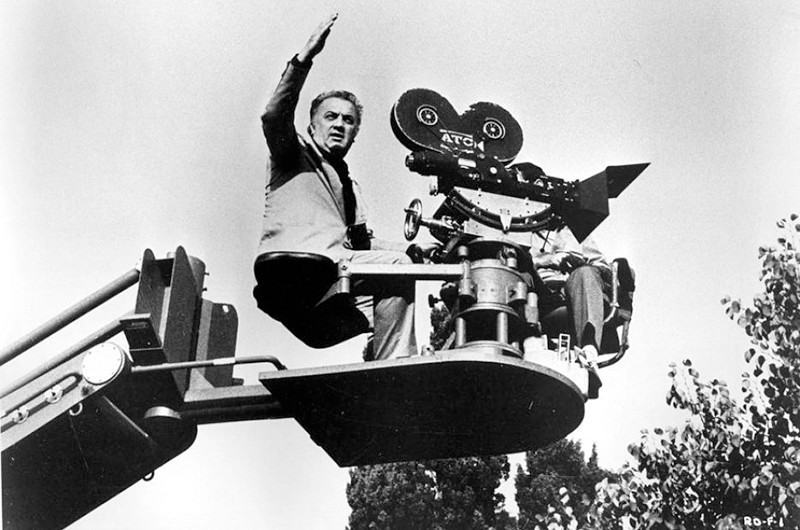
Few filmmakers have created a world so distinctive that their name became an adjective. “Felliniesque” describes something extravagant, dreamlike, theatrical and slightly grotesque—a spectacle in which reality, memory and fantasy seem to exist at the same time. That imaginative universe originated with Federico Fellini, one of the most influential directors in the history of Italian and international cinema.
Born in Rimini in 1920, Fellini began as a cartoonist, humorist and screenwriter before becoming a director. His career moved from the streets and moral uncertainties of postwar Italy to increasingly personal films populated by clowns, performers, aristocrats, priests, journalists, dreamers and outsiders.
His films received four Academy Awards for Best Foreign Language Film, while Fellini himself was presented with an Honorary Academy Award in 1993. Yet awards alone cannot explain his importance. Fellini changed the language of cinema by demonstrating that a film could behave like a dream, moving freely between observation, autobiography, invention and spectacle.
Childhood in Rimini
Federico Fellini was born in Rimini on January 20, 1920, the eldest of three children of Urbano Fellini, a traveling salesman, and Ida Barbiani. Rimini was already a popular Adriatic resort, combining provincial routines with beaches, seasonal visitors, cinemas, circuses and variety entertainment.
These surroundings later became central to Fellini’s imagination. The Rimini of his films, however, was rarely a literal reconstruction. It was a place remembered, embellished and reinvented. Its foggy streets, schoolrooms, seaside promenades, eccentric residents and adolescent fantasies reappeared most famously in I vitelloni and Amarcord.
Fellini showed an early talent for drawing and caricature. As a teenager, he produced portraits of film stars for Rimini’s Cinema Fulgor and contributed cartoons to publications. Drawing remained essential throughout his life. Before filming a character, costume or scene, he often sketched it, turning his notebooks into a visual laboratory for the people and images that would eventually fill his movies.
Rome, Journalism and Radio
Fellini moved to Rome in 1939, officially intending to study law. Instead, he entered the capital’s lively world of newspapers, popular entertainment and radio. He wrote for the satirical magazine Marc’Aurelio, where his humor, caricatures and observations of human behavior attracted attention.
His work introduced him to comedians and performers, including Aldo Fabrizi, for whom he wrote sketches and monologues. Fellini also contributed to radio programs. During this period, he met the actress Giulietta Masina, who performed the character Pallina in a radio serial he had written. They married on October 30, 1943.
Masina would become much more than Fellini’s wife. She was one of his greatest creative partners, bringing emotional depth, humor and vulnerability to films including La strada, Il bidone, Le notti di Cabiria and Giulietta degli spiriti. Their marriage lasted almost 50 years.
From Screenwriter to Film Director
After the Second World War, Fellini became closely involved with the development of Italian Neorealism. He contributed to Roberto Rossellini’s Rome, Open City and received an Academy Award nomination as one of the screenwriters of Paisan.
Working with Rossellini gave Fellini direct experience of filmmaking during one of Italian cinema’s most innovative periods. Nevertheless, his personality was too imaginative to remain entirely within Neorealism. Even in his early work, he was drawn to performers, spiritual questions, loneliness, fantasy and the blurred boundary between ordinary life and spectacle.
Fellini co-directed Variety Lights with Alberto Lattuada in 1950. The story of an unsuccessful traveling theatrical company introduced several enduring Fellini themes: the backstage world, disappointed ambition, makeshift families and the mixture of comedy and sadness found among entertainers.
His first solo feature, The White Sheik, followed in 1952. Starring Alberto Sordi, it tells the story of a newly married woman who escapes into the artificial world of photo-romance celebrities. Although it was not an immediate success, the film marked the beginning of Fellini’s long collaboration with composer Nino Rota.
I Vitelloni and the Memory of Provincial Italy
Fellini’s breakthrough came with I vitelloni in 1953. The film follows five young men who spend their days avoiding responsibility in an Adriatic provincial town. Its title refers to immature men who continue living like carefree adolescents despite having reached adulthood.
The film draws upon Fellini’s memories of Rimini without presenting itself as strict autobiography. Its combination of sharp observation, melancholy and affection established Fellini as a major director. Alberto Sordi’s performance also helped propel the actor toward national fame.
I vitelloni received the Silver Lion at the Venice Film Festival. It remains one of Fellini’s most accessible works and an important bridge between the social observation of Neorealism and the director’s increasingly personal cinema.
La Strada and International Recognition
La strada, released in 1954, brought Fellini international recognition. Giulietta Masina plays Gelsomina, an innocent young woman sold by her impoverished mother to the brutal traveling strongman Zampanò, played by Anthony Quinn. Richard Basehart appears as the Fool, a tightrope walker whose playfulness offers Gelsomina an alternative way of understanding her life.
The film combines poor roads, small towns and traveling performers with a poetic story about cruelty, love, responsibility and spiritual redemption. Some Italian critics initially objected to Fellini’s movement away from the political and social priorities of Neorealism. International audiences, however, responded strongly to the film’s humanity and visual simplicity.
La strada won the Academy Award for Best Foreign Language Film. Its success established Fellini and Masina as internationally recognized figures.
Cabiria, Compassion and Giulietta Masina
After the darker Il bidone, Fellini directed Le notti di Cabiria in 1957. Masina plays Cabiria, a Roman sex worker who repeatedly suffers humiliation and betrayal but refuses to surrender her capacity for hope.
Cabiria had first appeared briefly in The White Sheik, but the later film transformed her into one of Fellini’s most memorable protagonists. Masina’s performance avoids sentimentality by combining comic energy with emotional openness. The final scene, in which Cabiria gradually responds to the music and faces surrounding her, is among the most celebrated conclusions in Italian cinema.
Le notti di Cabiria earned Fellini’s second Academy Award for Best Foreign Language Film.
La Dolce Vita and a Changing Rome
With La dolce vita in 1960, Fellini entered a new phase of his career. Instead of following a conventional plot, the film presents a series of episodes experienced by Marcello Rubini, a journalist moving through Rome’s nightlife, aristocratic parties, religious spectacles and celebrity culture.
Marcello Mastroianni gave one of his defining performances as Marcello, while Anita Ekberg created an enduring cinematic image by entering the Trevi Fountain in an evening dress. The photographer Paparazzo, played by Walter Santesso, also gave the world a new term: “paparazzi.”
The film captured an Italy transformed by postwar prosperity, mass media and consumer culture. Its Rome is seductive but spiritually exhausted. Public reaction was intense, and the film was attacked by conservative and religious commentators. Despite—or partly because of—the controversy, La dolce vita became an international phenomenon and won the Palme d’Or at the Cannes Film Festival.
8½ and the Crisis of Creativity
After the enormous success of La dolce vita, Fellini found himself uncertain about his next project. He transformed that creative block into 8½, released in 1963. The title referred playfully to the number of films and episodes he believed he had previously directed.
Mastroianni plays Guido Anselmi, a famous director preparing a science-fiction film that he no longer understands or wishes to make. Producers, actors, journalists, relatives and lovers surround him while memories and fantasies interrupt the present.
The film’s apparent disorder is carefully structured. Reality passes into dreams without warning; childhood recollections coexist with adult anxieties; women appear as individuals, memories and projections of Guido’s imagination. Fellini turned the problem of not knowing what film to make into one of cinema’s greatest films about artistic creation.
8½ won the Academy Award for Best Foreign Language Film and became a lasting influence on filmmakers exploring memory, identity and creative crisis.
Fellini’s Cinema Becomes More Surreal
Juliet of the Spirits, released in 1965, was Fellini’s first full-length color feature. Giulietta Masina plays a woman confronting her husband’s infidelity while visions, memories and flamboyant visitors invade her life. Fellini used color not simply for realism but as an expressive language, creating emotional environments through costumes, décor and light.
His subsequent films became increasingly detached from conventional storytelling. Toby Dammit, his contribution to the anthology Spirits of the Dead, transformed an Edgar Allan Poe story into a sinister journey through celebrity culture and modern Rome.
Fellini Satyricon presented ancient Rome as an alien, fragmented civilization rather than a polished historical reconstruction. The Clowns combined documentary, memory and performance, while Fellini’s Roma treated the Italian capital as a living spectacle filled with traffic, ruins, ecclesiastical fashion and disappearing traditions.
Amarcord: Memory, Fascism and Rimini
Fellini returned imaginatively to provincial Italy in Amarcord, released in 1973. The title derives from a Romagnol expression meaning “I remember,” but the film is not a literal memoir. Instead, it recreates the emotional truth of adolescence through exaggeration, fantasy and communal memory.
Set during the Fascist period, Amarcord observes a town filled with comic rituals, sexual fantasies, family arguments and public ceremonies. Fascism appears not only as a political system but also as childish conformity, theatrical display and the desire to belong to a crowd.
The film moves through the seasons, from drifting springtime seeds to heavy winter snow. Its famous images include the arrival of the ocean liner Rex, a family expedition to the countryside and the peacock that spreads its tail in the snow. Amarcord won Fellini’s fourth Academy Award for Best Foreign Language Film.
Casanova and the Darker Side of Spectacle
Fellini’s Casanova, starring Donald Sutherland, offered a deliberately cold and artificial portrait of the famous Venetian adventurer. Rather than celebrating Casanova as a romantic hero, Fellini depicted him as a mechanical performer trapped by his reputation and appetites.
The production’s elaborate studio reconstructions emphasized artificiality. Even the sea was created from moving plastic sheets. Fellini’s version of the 18th century resembles an unsettling dream filled with ceremonies, machines and emotionally empty encounters.
The film initially divided audiences but has increasingly been recognized as one of Fellini’s most visually ambitious works.
Later Films
Orchestra Rehearsal used a quarrelling orchestra as a compact allegory of society, authority and political disorder. City of Women returned to male fantasy and confusion, with Mastroianni wandering through a shifting landscape shaped by desire and fear.
And the Ship Sails On transformed a luxury ocean voyage into an operatic meditation on European culture approaching the First World War. In Ginger and Fred, Giulietta Masina and Mastroianni played former dance partners reunited for a chaotic television variety program. The film criticized commercial television’s tendency to turn memory, emotion and individual talent into disposable entertainment.
Intervista revisited Cinecittà and Fellini’s own filmmaking history. One of its most moving sequences reunites Mastroianni and Anita Ekberg as they watch their younger selves in La dolce vita.
Fellini’s final feature, La voce della luna, was released in 1990. Starring Roberto Benigni and Paolo Villaggio, it follows two outsiders searching for meaning in a noisy and distracted modern world. Read more about its leading actor in ItaliaMia’s biography of Roberto Benigni.
Fellini’s Creative Collaborators
Although Fellini’s films bear his unmistakable personality, they were created through major artistic collaborations. Screenwriters Tullio Pinelli, Ennio Flaiano, Bernardino Zapponi and poet Tonino Guerra helped shape different periods of his career.
Composer Nino Rota created the music for most of Fellini’s films from The White Sheik through Orchestra Rehearsal. Rota’s melodies could sound playful, nostalgic, ceremonial or melancholy, often holding together scenes that moved rapidly between comedy and sadness.
Cinematographers including Otello Martelli and Gianni Di Venanzo helped define Fellini’s visual development, while production designers, costume designers, choreographers and large groups of carefully selected performers turned Cinecittà’s sound stages into self-contained worlds.
Giulietta Masina and Marcello Mastroianni became his two most important screen interpreters. Masina often embodied vulnerability, resilience and grace. Mastroianni functioned more frequently as Fellini’s sophisticated but uncertain alter ego.
What Makes a Film Felliniesque?
Fellini’s cinema is recognizable through recurring images: circuses, processions, beaches, nightclubs, enormous women, lonely roads, artificial seas and crowds assembled as if for a theatrical performance. Priests, aristocrats, journalists and entertainers often appear as members of the same strange social pageant.
His films resist a simple division between autobiography and fiction. Fellini repeatedly transformed memories until they became myths. He was less interested in recording exactly what happened than in showing how the past survives within imagination.
He also possessed a rare ability to combine opposites. His work can be comic and mournful, vulgar and spiritual, affectionate and satirical. Spectacle may conceal loneliness, while an apparently ridiculous character can suddenly reveal great dignity.
Essential Federico Fellini Films
- I vitelloni (1953): A compassionate and critical portrait of provincial young men unwilling to grow up.
- La strada (1954): A poetic drama about cruelty, love and redemption, starring Giulietta Masina and Anthony Quinn.
- Le notti di Cabiria (1957): Masina’s unforgettable performance as a woman whose hope survives repeated betrayal.
- La dolce vita (1960): Fellini’s panoramic examination of celebrity, pleasure and spiritual emptiness in modern Rome.
- 8½ (1963): A director’s creative crisis becomes an innovative journey through memory, fantasy and filmmaking.
- Giulietta degli spiriti (1965): A richly colored exploration of marriage, independence and the unconscious.
- Fellini Satyricon (1969): Ancient Rome imagined as a fragmented and disturbing alien world.
- Roma (1972): A personal, episodic and highly theatrical portrait of the Italian capital.
- Amarcord (1973): A comic and melancholy reconstruction of youth under Fascism.
- Fellini’s Casanova (1976): A visually extraordinary rejection of the traditional romantic legend.
Readers interested in collecting his films can browse Federico Fellini films and collections on Amazon.com. Books about his drawings, dreams and filmmaking are available through this selection of Federico Fellini books.
Where to Experience Fellini in Italy
The most important Fellini destination is his birthplace, Rimini. The city’s Fellini Museum is distributed across Castel Sismondo, Palazzo del Fulgor and Piazza Malatesta. Its multimedia installations explore Fellini’s films, drawings, dreams and creative process rather than presenting only a conventional chronological biography.
Palazzo del Fulgor includes the historic Cinema Fulgor, where the young Fellini encountered the magic of film. The museum’s other spaces evoke images from movies such as Amarcord and And the Ship Sails On.
Fellini and Masina are buried in Rimini’s Monumental Cemetery. Their memorial, designed by sculptor Arnaldo Pomodoro, resembles the sail or prow of a ship.
Rome is equally important to Fellini’s story. Visitors can see locations connected with La dolce vita, particularly the Trevi Fountain and Via Veneto, although much of Fellini’s Rome was created or transformed inside Cinecittà. The studio allowed him to control streets, skies, seas and crowds as if arranging the elements of a dream.
Honorary Oscar, Death and Legacy
In March 1993, Fellini received an Honorary Academy Award recognizing his place among cinema’s master storytellers. Giulietta Masina watched from the audience as Sophia Loren and Marcello Mastroianni presented the award.
Fellini died in Rome on October 31, 1993, after suffering a stroke and subsequent health complications. He was 73. Masina died less than five months later, on March 23, 1994.
His influence extends far beyond filmmakers who imitate his imagery. Directors including Martin Scorsese, Terry Gilliam, Pedro Almodóvar, Woody Allen and Paolo Sorrentino have drawn inspiration from his blending of personal experience, fantasy and spectacle. The influence of 8½ can be recognized in countless films about directors, writers and artists struggling with their work.
Fellini demonstrated that cinema did not have to choose between reality and imagination. A film could be an autobiography that invented its memories, a social portrait shaped like a circus or a dream constructed inside a studio. His greatest works remain unmistakably Italian while speaking to universal fears and desires: the longing to escape, the need to be loved, the anxiety of growing older and the endless human ability to transform life into stories.
External Sources
- Fellini Museum Rimini – Biography and Filmography
- Fellini Museum Rimini – Museum and Visitor Information
- Academy of Motion Picture Arts and Sciences – 1993 Honorary Award
- Festival de Cannes – La Dolce Vita
- La Biennale di Venezia – Postwar Film Festival History
- Rai Cultura – Federico Fellini