
He was equally convincing as an insecure husband, a melancholy intellectual, a ridiculous would-be seducer, a persecuted outsider and an aging man confronting regret. His performances could be charming without vanity, comic without exaggeration and moving without sentimentality. That combination made him indispensable not only to Fellini, but also to Sophia Loren and to many of the most important Italian and European directors of the 20th century.
Early Life and Wartime Experiences
Marcello Vincenzo Domenico Mastroianni was born on September 26, 1924, in Fontana Liri, a small town in the Lazio region between Rome and Naples. His family later lived in Turin before settling in Rome, where his father worked as a carpenter.
Mastroianni studied building construction and technical drawing. During the Second World War, he was employed by a company producing maps for the German military. After Italy’s 1943 armistice, he was detained by German forces and sent to a labor camp. He escaped and remained in hiding until the end of the war.
Back in Rome, he found employment as an accountant with a film production company while studying acting in his spare time. His earliest screen appearances included small or uncredited parts, but the theater provided his real professional education.
Mastroianni joined the theatrical company of Luchino Visconti, working alongside established performers such as Rina Morelli and Paolo Stoppa. Under Visconti’s demanding direction, he appeared in productions including Tennessee Williams’s A Streetcar Named Desire and Arthur Miller’s Death of a Salesman. The experience taught him discipline and restraint—qualities that would remain central to his screen acting.
Visconti later gave him one of his first major dramatic film roles in White Nights (Le notti bianche, 1957), adapted from Dostoevsky. As a lonely dreamer wandering through a stylized nocturnal city, Mastroianni revealed the emotional vulnerability hidden beneath his handsome appearance.
From Supporting Actor to Italian Film Star
During the 1950s, Mastroianni appeared in numerous dramas, romances and comedies. His breakthrough came with Mario Monicelli’s Big Deal on Madonna Street (I soliti ignoti, 1958), one of the foundational works of commedia all’italiana.
The film follows a group of incompetent small-time criminals attempting an elaborate robbery. Mastroianni plays Tiberio, an unemployed photographer who must care for his baby while his wife is in prison. His performance is understated and wonderfully funny, demonstrating his ability to make an ordinary, imperfect character sympathetic.
That ability became one of his greatest strengths. Unlike many conventional leading men, Mastroianni was never afraid to look foolish, weak, confused or defeated. He understood that comedy frequently grows from wounded pride and that apparent sophistication can conceal uncertainty.
Marcello Mastroianni and Federico Fellini
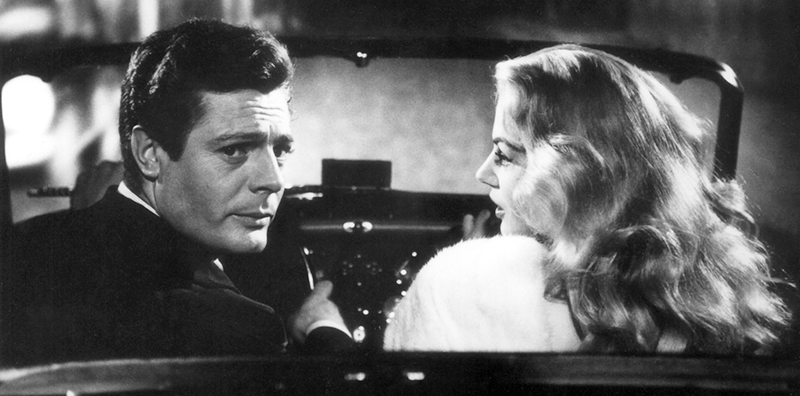
Mastroianni’s international breakthrough arrived with La Dolce Vita in 1960. Directed by Federico Fellini, the film follows gossip journalist Marcello Rubini through seven days and nights among Rome’s celebrities, aristocrats, intellectuals and pleasure seekers.
Mastroianni’s dark suit and sunglasses created an instantly recognizable image of urban elegance. Yet Marcello Rubini is not a triumphant seducer. He is a frustrated writer drifting through a world of spectacle, unable to commit either to meaningful work or to the people who care about him. Mastroianni communicates the character’s spiritual exhaustion through small gestures, pauses and fleeting expressions rather than dramatic speeches.
The actor became even more closely identified with Fellini in 8½ (1963). He plays Guido Anselmi, a celebrated film director suffering from creative paralysis while trying to organize a new production. Guido retreats into memories, dreams and fantasies as the pressures of his work and relationships close in around him.
Although Guido functions partly as Fellini’s alter ego, Mastroianni never reduces him to an imitation of the director. He creates a complete character: charming, evasive, selfish, imaginative and increasingly overwhelmed. The performance helped make 8½ one of the most influential films ever made about artistic creation.
Mastroianni later returned to Fellini’s universe in City of Women (1980), playing a middle-aged man lost in a bewildering landscape of desire, fear and changing gender relations. In Ginger and Fred (1986), he and Giulietta Masina portrayed an aging dance partnership reunited for a chaotic television special. The film uses their dignity and weariness to criticize the vulgarity of commercial television.
He also appeared in Intervista (1987), in which Fellini mixed autobiography, documentary and fantasy. One of its most touching scenes reunites Mastroianni with Anita Ekberg as they watch images of their younger selves in the Trevi Fountain sequence from La Dolce Vita. The moment transforms an iconic piece of cinema into a meditation on time, memory and mortality.
A Legendary Partnership with Sophia Loren
Mastroianni’s partnership with Sophia Loren was one of the most enduring and beloved screen relationships in Italian cinema. Beginning with Alessandro Blasetti’s Too Bad She’s Bad (Peccato che sia una canaglia, 1954), they appeared together repeatedly over four decades.
Their chemistry depended on contrast. Loren brought energy, emotional directness and a formidable physical presence; Mastroianni responded with irony, hesitation and a talent for deflating masculine self-importance. They could play lovers, adversaries, spouses or strangers without repeating exactly the same relationship.
Vittorio De Sica made particularly effective use of the partnership. In Yesterday, Today and Tomorrow (1963), Loren and Mastroianni play different characters in three stories examining love, sex and marriage across Italian society. The film moves between popular comedy and social observation while allowing both actors to display their versatility.
In Marriage Italian Style (Matrimonio all’italiana, 1964), Loren plays Filumena Marturano, who has devoted years of her life to the wealthy and unreliable Domenico Soriano. Mastroianni makes Domenico selfish and exasperating without turning him into a simple villain. Their confrontations give the film its humor, but also expose profound inequalities involving class, gender and respectability.
The pair adopted a very different tone in De Sica’s Sunflower (1970), a drama about a woman searching for her husband after he disappears on the Eastern Front during the Second World War.
Their most emotionally restrained collaboration was Ettore Scola’s A Special Day (Una giornata particolare, 1977). Set in Rome during Adolf Hitler’s 1938 visit to Benito Mussolini, the film follows an exhausted housewife and a gay radio broadcaster who meet while their neighbors attend a Fascist parade. Stripped of their customary glamour, Loren and Mastroianni create a tender encounter between two people marginalized by the society around them.
They appeared together for the last time in Robert Altman’s fashion-world satire Prêt-à-Porter in 1994, returning playfully to memories of their earlier screen partnership.
Beyond Fellini: Italy’s Great Directors
Mastroianni’s career offers a remarkable journey through postwar Italian cinema. Michelangelo Antonioni cast him opposite Jeanne Moreau and Monica Vitti in La Notte (1961). As a successful novelist whose marriage is quietly disintegrating, Mastroianni gives one of his most subdued performances. His emotional distance is not emptiness; it is the central subject of the film.
In Pietro Germi’s Divorce Italian Style (1961), he deliberately dismantled his glamorous image. He plays a Sicilian aristocrat who dreams of escaping his marriage by manipulating his wife into an affair and then murdering her under Italy’s former “crime of honor” laws. The performance combines vanity, cowardice and elaborate comic calculation, earning Mastroianni his first Academy Award nomination for Best Actor.
He also worked repeatedly with Mario Monicelli, Marco Ferreri, Elio Petri and Ettore Scola. Ferreri pushed him toward provocative and grotesque material in films such as The Ape Woman, La Grande Bouffe and Bye Bye Monkey. Petri used his elegant screen presence to satirize consumer culture in the futuristic The 10th Victim and later cast him as a sinister priest in the political allegory Todo modo.
Scola became one of Mastroianni’s most important later collaborators. In addition to A Special Day, they worked together on The Pizza Triangle, That Night in Varennes, The Family and What Time Is It? In Scola’s films, Mastroianni often embodies men forced to confront political disillusionment, lost love or the passage of time.
A Truly European Actor
Although Mastroianni received offers from Hollywood, his career remained firmly connected to European cinema. He worked in Italian, French, English and other international productions without abandoning the ambiguity and understatement that distinguished his acting.
His directors included Louis Malle, Jacques Demy, Agnès Varda, Theo Angelopoulos, Manoel de Oliveira, Raúl Ruiz and Nikita Mikhalkov. For Angelopoulos, he starred in The Beekeeper (1986), playing a withdrawn man traveling through Greece after the collapse of his family life. The film contains one of Mastroianni’s bleakest and most physically exposed performances.
In Mikhalkov’s Dark Eyes (Oci ciornie, 1987), inspired by stories by Anton Chekhov, he plays an aging Italian who recounts his lost opportunity for love. The role earned him the Best Actor award at Cannes and his third Academy Award nomination.
Even late in his career, he remained adventurous. He appeared in Giuseppe Tornatore’s Everybody’s Fine, de Oliveira’s Journey to the Beginning of the World, Ruiz’s Three Lives and Only One and Varda’s playful celebration of cinema, One Hundred and One Nights.
Essential Marcello Mastroianni Films
Big Deal on Madonna Street (I soliti ignoti, 1958)
Mario Monicelli’s classic heist comedy revealed Mastroianni’s gift for ensemble acting and helped establish commedia all’italiana.
White Nights (Le notti bianche, 1957)
This visually beautiful Visconti adaptation shows his romantic and dramatic sensitivity before he became an international star.
La Dolce Vita (1960)
Mastroianni’s disillusioned journalist became an emblem of modern Rome and one of the most recognizable characters in world cinema.
La Notte (1961)
Antonioni’s study of alienation demonstrates how much Mastroianni could communicate through silence, discomfort and emotional withdrawal.
Divorce Italian Style (Divorzio all’italiana, 1961)
A brilliant satire of masculine privilege in which Mastroianni gleefully makes himself vain, ridiculous and morally compromised.
8½ (1963)
His performance as Guido Anselmi remains the definitive portrait of a filmmaker trapped between ambition, memory, desire and creative fear.
Marriage Italian Style (Matrimonio all’italiana, 1964)
One of his finest films with Sophia Loren, balancing broad comedy with a serious examination of dignity and social inequality.
The 10th Victim (La decima vittima, 1965)
A stylish science-fiction satire that displays Mastroianni’s ease with pop art, absurdity and deadpan comedy.
A Special Day (Una giornata particolare, 1977)
Perhaps his most compassionate performance, portraying a gay man persecuted by Fascist society. The film earned him his second Oscar nomination.
The Beekeeper (O melissokomos, 1986)
Theo Angelopoulos draws a haunting late-career performance from Mastroianni as a man traveling through a landscape of memory and isolation.
Ginger and Fred (1986)
Mastroianni and Giulietta Masina bring humor and melancholy to Fellini’s criticism of celebrity culture and commercial television.
Dark Eyes (Oci ciornie, 1987)
A poignant portrait of charm, missed opportunity and regret that brought Mastroianni his second Cannes acting prize and third Oscar nomination.
Private Life and Final Years
Mastroianni married actress Flora Carabella in 1950. Although they later lived largely separate lives, they remained married until his death and had a daughter, Barbara. He also had a long relationship with French actress Catherine Deneuve, with whom he had a second daughter, actress Chiara Mastroianni.
He continued working despite illness, appearing on stage and completing films during the final year of his life. Marcello Mastroianni died of pancreatic cancer in Paris on December 19, 1996, at the age of 72. He was buried in Rome’s Campo Verano cemetery.
His international honors included three Academy Award nominations and two Best Actor awards at the Cannes Film Festival: for The Pizza Triangle in 1970 and Dark Eyes in 1987. The Venice Film Festival subsequently named its award for an outstanding emerging actor or actress in his honor.
Marcello Mastroianni’s Legacy
Mastroianni’s importance lies partly in his refusal to protect his own image. He became famous as a symbol of Italian masculine elegance, then devoted much of his career to playing men who were uncertain, compromised, lonely or absurd. He made weakness dramatically interesting and allowed comedy and sadness to coexist within the same character.
His work with Fellini helped define the imaginative possibilities of modern cinema. His films with Sophia Loren created one of its greatest acting partnerships. His collaborations with Visconti, Antonioni, De Sica, Germi, Monicelli, Scola, Ferreri and filmmakers across Europe placed him at the center of several major cinematic movements.
For anyone exploring the greatest Italian films, Mastroianni is an essential guide. Through him, viewers encounter the glamour of postwar Rome, the contradictions of the economic boom, the sharp social criticism of Italian comedy and the introspection of European art cinema.
He was an international star who never stopped being a character actor—and a celebrated leading man who was at his best when revealing the doubts behind the charm.