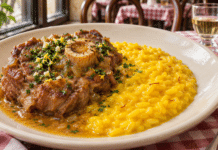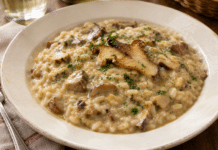

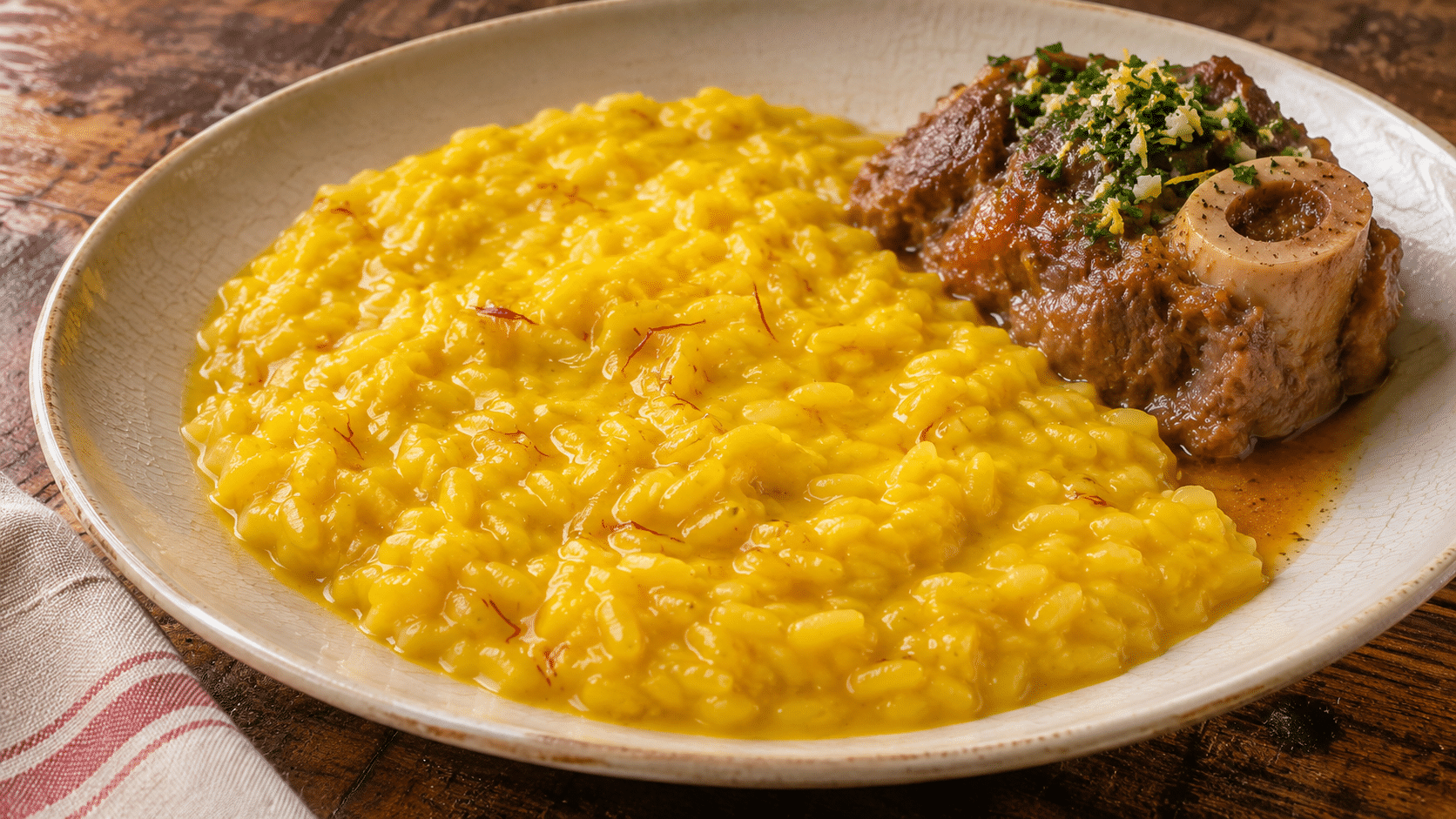
Give the pan a short shake just before you serve risotto alla Milanese. The golden rice should rise in a low wave, fold over and settle level again. Milanese cooks call that movement all’onda. It tells you something a timer can’t. The grains have released enough starch to hold the butter and broth together, yet there’s still enough liquid to carry a spoonful of rice across the plate.
In Milan, the risotto can arrive on its own as a primo, or beside a whole braised veal shank. For the second option, start with Italia Mia’s ossobuco alla Milanese with lemon gremolata. The veal takes the better part of an afternoon. The rice needs your attention for the last half hour, and it’s worth arranging lunch around those few minutes.
Ingredients for four servings
Allow about 10 minutes for preparation and 22–25 minutes at the stove. This makes four first-course portions or four generous accompaniments to ossobuco.
- 300 g (10½ oz) Carnaroli rice
- 1.2 liters (about 5 cups) lightly salted beef or veal broth, plus a little extra hot water if needed
- 0.15 g saffron threads, or one 0.125 g sachet of ground saffron
- 1 small yellow onion, about 60 g (2 oz), very finely diced
- 50 g (3½ tablespoons) unsalted butter, divided
- 20 g (¾ oz) finely chopped beef marrow, optional
- 50 g (1¾ oz) finely grated Grana Padano
- Fine salt, to taste
Carnaroli gives you a little leeway as you finish the dish. Arborio will also work. Taste it early and stir gently as its outer layer softens. Choose a broth you would enjoy drinking on its own. If yours tastes salty straight from the carton, dilute it before heating. By the time a ladleful has reduced around the rice, it will taste stronger, and the Grana Padano will add salt of its own.
Marrow gives the onion a rich cooking fat and is part of Milan’s municipal recipe. If you’re serving the rice with ossobuco, you might prefer to leave the marrow in each shank for your guests. The quantity of butter here is enough to cook the rice either way. This version also follows the municipal recipe in leaving out wine. The white wine in Italia Mia’s accompanying braise comes through in the spoonful of sauce you serve with the veal.
How to make risotto alla Milanese
- Prepare the saffron and broth. Bring the broth to a gentle simmer in a saucepan beside the burner you’ll use for the rice. Lightly crumble the saffron threads into a small cup, pour over a few tablespoons of hot broth and leave them to steep while you chop the onion and start the risotto. If using ground saffron, dissolve it in a little warm broth shortly before adding it near the end of cooking.
- Soften the onion. Melt 20 g of the butter in a wide, heavy pan over medium-low heat. Add the optional marrow and the diced onion. Cook gently for about 5 minutes, stirring occasionally, until the onion looks translucent and a piece gives easily under the spoon. Finely diced onion almost disappears among the grains.
- Warm the rice. Tip the dry, unwashed rice into the pan. Turn the heat up to medium and stir for about 2 minutes, sweeping into the corners so every grain gets coated in fat. When the grains are hot and glossy, pour in enough simmering broth to just cover them. The first addition will hiss. Adjust the heat until small bubbles break across the surface.
- Add the broth in stages. Stir regularly, reaching across the base of the pan. When the spoon begins to leave a trail and you can see the pan beneath it, add another ladleful. Keep the rice moving freely. About halfway through cooking, pour in the saffron-thread infusion, threads and all, and rinse the cup into the pan with a spoonful of broth. If using dissolved ground saffron, add it in the final few minutes instead.
- Taste for doneness. Start tasting about 14 minutes after the first broth went in. Bite through two or three grains. A hard, chalky center needs more broth and another minute. Once the grains are tender through the middle with a little resistance, take the pan off the burner. Depending on the rice, this can take around 16–20 minutes. You may have broth left over. Keep it handy.
- Finish off the heat. Cut the remaining 30 g of cold butter into small pieces. Add it with the grated cheese and stir briskly while rocking the pan by its handle. This finish, called mantecatura, brings the butter, cheese and starchy broth together. Taste for salt. Give the rice a minute to settle, then check the wave once more before carrying it to the table.
How to judge the consistency
Check the grain and the liquid separately. A spoonful can look creamy while the centers are still hard. If that happens, give the rice another small ladle of hot broth and keep it simmering. Conversely, perfectly cooked grains can sit in a stiff mass if the last of the broth has evaporated. In that case, take the pan off the heat and fold in hot broth a tablespoon at a time. The grains are finished cooking and only need room to move.
For a final check, spoon a little risotto onto a warm flat plate and tap underneath the rim. The rice should ease outward into a shallow circle, with the golden liquid clinging to the grains. If your spoon leaves a standing peak, loosen the panful before plating the rest. If thin broth runs ahead of the rice, stir the pan off the heat and check again after a few seconds. Use small additions of broth near the end so you can make these adjustments while the rice still has some bite.
How to serve the risotto with ossobuco
Let the veal set the timetable. Italia Mia’s four-shank recipe allows about 2 to 2½ hours for cooking. Before starting the onion for the rice, slip a fork into the thickest part of a shank. When it enters easily and the meat still holds around the bone, you can turn your attention to the risotto. Keep the shanks covered in their juices over gentle heat. Have the parsley, garlic and lemon zest ready for the gremolata, and finish the veal as directed in the companion recipe.
Set out warm dinner plates and a wide spatula for lifting the shanks. Spoon the saffron rice slightly to one side of each plate and tap it level. Set a shank alongside, bone facing up, then spoon a little braising sauce over the meat and along the edge where it meets the rice. Leave some golden rice clear so guests can taste the saffron on its own and draw as much sauce into each forkful as they like. A small spoon beside each place makes it easy to reach the marrow.
Cookbooks and external links
As an Amazon Associate, Italia Mia earns from qualifying purchases.
- Marcella Hazan, Essentials of Classic Italian Cooking. Read the risotto chapter with this recipe in mind, particularly the point at which you begin tasting individual grains. Amazon.com · Amazon.it
- Pellegrino Artusi, Science in the Kitchen and the Art of Eating Well. Look up the Milanese risottos to compare how one nineteenth-century author approached the same dish in several ways. English edition on Amazon.com · Italian edition on Amazon.it
- Risotto alla milanese, Milan’s De.Co. recipe — The municipal version includes marrow and roast drippings and describes the traditional finish.
- ERSAF Lombardia, Nuovo codice della cucina lombarda (PDF) — The regional collection gives a version with white wine and explains the term all’onda.